


Yemeni Government Forces Regroup to Shift the Momentum

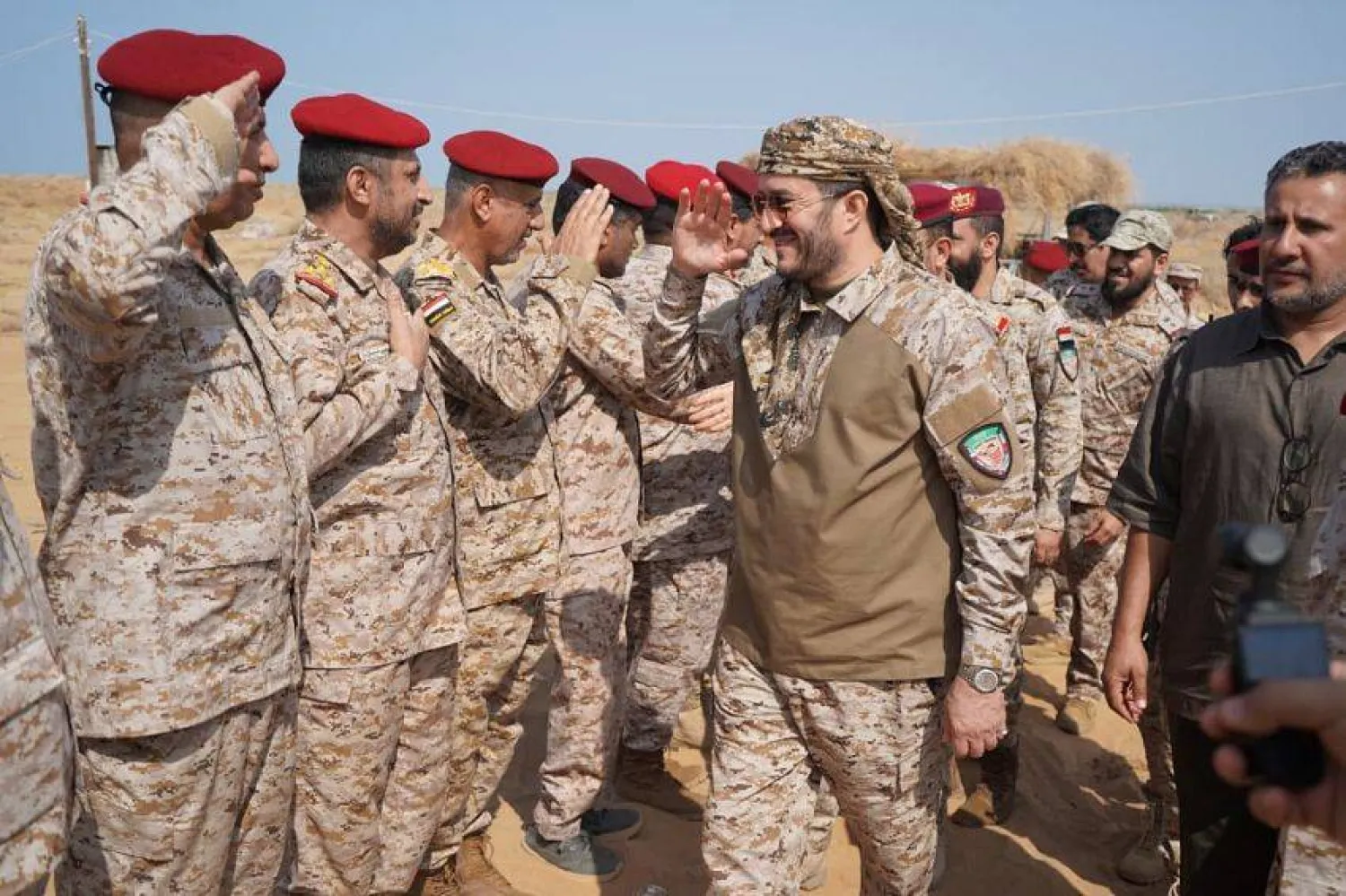
Othman Mujalli, a member of Yemen’s Presidential Leadership Council, inspects forces in Hajjah. (government media)
TT

Yemeni Government Forces Regroup to Shift the Momentum

Othman Mujalli, a member of Yemen’s Presidential Leadership Council, inspects forces in Hajjah. (government media)

Yemen’s army and allied forces have raised their state of alert on the Taiz and Hajjah fronts as they move to reorganize their military positions to shift the momentum, while the Houthis increase pressure on Taiz after seizing the western coast as far as Bab al-Mandab.

In northwestern Hajjah province, Presidential Leadership Council member Othman Mujalli inspected Fifth Military Region forces and affiliated fronts, reviewing their readiness, training and morale.

Mujalli said the armed forces would continue confronting the Houthis and working to restore state institutions, stressing the need to maintain morale and prepare for the battle to liberate the country.

He also praised the Fifth Military Region’s ability to develop equipment for ammunition production and the maintenance of weapons and vehicles, as well as bolster its drone unit and advanced surveillance system.

The visit included naval forces, the coast guard and several islands off Midi district. Mujalli reviewed efforts to evacuate civilians and personnel from Zubair Island after they were stranded because of recent developments along the western coast. He also inspected naval readiness to secure the islands and territorial waters and strengthen the military and security presence along the coast.

The visit comes as government forces seek to hold their positions in the northwest while reassessing their military deployment following rapid developments on the western coast.

Pressure on Taiz

In southwestern Taiz, the Yemeni army announced Tuesday that it had struck a Houthi ballistic missile launch platform at Taiz airport, east of the city. The Taiz Military Axis said warplanes targeted the platform as military vigilance increases around the city amid growing pressure from the west.

The Yemeni Armed Forces had earlier announced strikes on Houthi equipment, personnel and positions seized by the group in Dhubab in Taiz province and Al-Khawkhah in Hodeidah province, according to military spokesman Col. Majid al-Nazili.

The strikes coincided with an inspection tour by Taiz Military Axis Chief of Staff Maj. Gen. Abdulaziz al-Majidi of several fronts surrounding the city.

In southern Taiz, Tur al-Bahah Axis commander and 4th Mountain Infantry Brigade commander Maj. Gen. Abu Bakr al-Gbouli inspected front lines stretching from Bani Omar to Jardad and the outskirts of Al-Wazi’iyah district.

Al-Gbouli said his forces were at a high level of combat readiness and capable of responding to developments on the ground, stressing vigilance, operational discipline and constant preparedness for Houthi movements.

Regrouping

The moves follow a major shift after the Houthis seized large parts of the western coast, including Mokha, Al-Khawkhah and Hays, before reaching Bab al-Mandab and several Red Sea islands. The developments have increased pressure on Taiz, which could become a target for Houthi attempts to expand their control and tighten their grip on the city and surrounding countryside.

Observers say government military activity in Taiz and Hajjah reflects an effort to contain the repercussions of losing the coast and prevent the Houthis from turning their recent gains into a permanent reality on the ground, while reorganizing forces and raising readiness in the most sensitive sectors.

Mujalli also urged tribes to protect their sons from Houthi recruitment and being drawn into fighting. He praised Saudi support for Yemeni forces and humanitarian and development projects and inspected efforts by the Masam mine-clearance project to remove mines planted by the Houthis in government-held areas.

The developments indicate that government forces are seeking to move beyond responding to the recent setback and build a more cohesive military posture, particularly in Taiz, where inland fronts intersect with the coast and Red Sea routes, making the province central to any attempt to shift the momentum.



Houthi Military Escalation Threatens Yemen with New Wave of Hunger

Wheat imports through ports controlled by the Yemeni government fell 42.5% (UN)
TT

Houthi Military Escalation Threatens Yemen with New Wave of Hunger

Wheat imports through ports controlled by the Yemeni government fell 42.5% (UN)

Yemen's food security crisis is worsening amid a Houthi military escalation, with declining food and fuel imports, rising prices of essential goods and eroding household purchasing power. Some 18.7 million people are facing acute food insecurity as displacement increases and humanitarian funding falls short.

Recent indicators from the United Nations Food and Agriculture Organization (FAO) warn that continued conflict, supply chain disruptions, declining humanitarian assistance and climate pressures could push millions of Yemenis into more severe food deprivation during the final months of the year, with some areas at growing risk of reaching Emergency or Catastrophe levels.

The data reveal a widening gap between people's food needs and their ability to obtain adequate supplies in a country heavily dependent on imports for basic necessities. Markets are facing simultaneous pressures from higher transportation and fuel costs and declining household incomes.

According to the latest indicators, approximately 18.7 million people in Yemen, more than half the population, are experiencing acute food insecurity at Phase 3 or above under the Integrated Food Security Phase Classification (IPC).

Conditions have deteriorated further amid escalating armed clashes and displacement, particularly in Taiz governorate, along the western coast and in conflict-affected areas of southern Yemen.

These developments have placed additional pressure on essential services already struggling with limited resources, while host communities face growing demands from increasing numbers of displaced people.

Field reports indicate that large-scale displacement, including more than 350,000 people forced from their homes within two months according to local data, is placing additional burdens on families and host communities while intensifying competition for scarce resources, jobs and services.

Houthi restrictions on the movement of people and goods, along with disruptions to roads and maritime routes, have also slowed commercial shipments and increased freight and transportation costs. These pressures have driven up food prices and complicated the delivery of humanitarian assistance to the most vulnerable populations.

Prices Outpace Household Incomes

In a further indication of mounting pressure on living standards, prices of several essential food items increased in September.

Flour prices rose 7.4% month on month, while rice prices increased 6.3%. Sunflower oil became 3.3% more expensive, and bean prices climbed 3.6%.

The cost of the minimum food basket also increased by 2% compared with August, placing it 7% above its level a year earlier and 2% higher than the three-year average.

These increases come as wages remain weak and workers struggle to keep pace with rising living costs.

Wages for unskilled daily laborers declined 0.4% month on month and remained 9.7% below their levels a year earlier, while agricultural labor wages increased by just 0.4%.

The impact was particularly evident in food purchasing power. The amount of flour that unskilled daily laborers could afford fell by 7.2% month on month and 23.1% year on year, highlighting the widening gap between household incomes and the cost of basic necessities.

Wheat Imports Decline

The pressures extend beyond rising prices and weak incomes to declining commercial supplies on which local markets depend.

Recorded wheat and wheat flour imports fell 1.5% nationwide, while imports through ports controlled by the Yemeni government dropped 42.5%.

The sharp decline at government-controlled ports provides further evidence of mounting pressure on essential supply flows, particularly given Yemen's heavy reliance on imports to meet its food needs.

Gasoline and diesel imports also declined by 9.9%. However, the lack of data from Houthi-controlled areas limits the ability to assess overall fuel import trends across the country.

Although official diesel prices fell 4.5% month on month, they remain significantly higher than levels recorded a year earlier and the three-year average.

This continues to keep transportation and production costs elevated, adding further pressure to the prices of essential goods.

These developments are particularly significant as trade, road networks and maritime routes continue to be affected by disruptions and restrictions.

Higher shipping and transportation costs are being passed directly on to consumers at a time when households have increasingly limited capacity to absorb further price increases.

Mounting Pressures

Meanwhile, the Yemeni rial has shown relative stability in government-controlled areas, although its value remains 4% below the level recorded a year earlier and 8% below the three-year average.

However, this relative improvement has not been sufficient to offset rising food prices and living costs or halt the decline in household purchasing power.

Families continue to face overlapping pressures from weak wages and higher prices for goods and services.

In the livestock sector, prices of local goats and sheep rose 1.6% and 2.4%, respectively, on a monthly basis.

Nevertheless, prices remained below their year-earlier levels, limiting the ability of livestock-dependent households to rebuild their sources of income.

These households are becoming increasingly vulnerable as climate shocks and erratic rainfall persist, alongside severe funding shortfalls in the humanitarian response.

Together, these factors are compounding the risks facing communities that depend on agriculture and natural resources to meet their basic needs.


Lebanon Slams Israeli Military Official’s Visit to School in South

Israeli military's Arabic-language spokesperson Ella Waweya in a screengrab from her visit to Debel. (Ella Waweya on X)
TT

Lebanon Slams Israeli Military Official’s Visit to School in South

Israeli military's Arabic-language spokesperson Ella Waweya in a screengrab from her visit to Debel. (Ella Waweya on X)

Lebanese officials have denounced a visit by an Israeli military spokesperson to a school in a Christian village in an Israeli-occupied area of southern Lebanon.

On Sunday, as Lebanon marked its Independence Day, the Israeli military's Arabic-language spokesperson Ella Waweya shared a video showing her outside a school in Debel and then standing in front of a classroom of children.

The village is located inside the occupied "security zone" that Israel declared after the latest war erupted with Hezbollah in March and which covers a strip of southern Lebanon along the border around 10 kilometers (six miles) deep.

It is among a number of Christian-majority villages near the frontier where many residents have refused to leave despite Israeli military orders to evacuate.

Cut off from the rest of Lebanon, they are largely dependent on humanitarian aid.

"During my last visit to south Lebanon, I was amazed by the beauty of the land and the villages which have paid a heavy price due to their exploitation... by a terrorist organization," Waweya said, referring to the Iran-backed Hezbollah group.

Lebanese Prime Minister Nawaf Salam later denounced Israel for "dragging students into a military and propaganda display".

"An occupying power has no right to exploit our children to embellish the image of its occupation or impose its dominance over our people in the south," he added.

Lebanese Education Minister Rima Karami condemned what she called an "attack on the Debel school and its students".

The Debel municipality said the visit took place around a month earlier "without any prior coordination with the school's administration".

Since the video's publication, the village and local officials have been targeted on social media with accusations of collaborating with Israel.

Such attacks are particularly incendiary in the area because Israel relied on local collaborators during its around two-decade-long occupation of southern Lebanon, which ended in 2000.

The municipality said that the choice by residents to remain was not "acceptance of the occupation" but rather "an expression of our attachment to our Lebanese land".

Residents "for long months have lived in exceptional and difficult conditions under the Israeli military presence," it said.

Hezbollah drew Lebanon into the Middle East war in March with rocket fire at Israel, which responded with massive airstrikes and a ground invasion.

Lebanon says Israeli attacks since then have killed more than 4,300 people.


War in Gaza Wreaks Environmental Catastrophe, Analysis Says

 Palestinians search for reusable items at a landfill in Deir al-Balah, central Gaza Strip, Friday, Nov. 20, 2026. (AP)
Palestinians search for reusable items at a landfill in Deir al-Balah, central Gaza Strip, Friday, Nov. 20, 2026. (AP)
TT

War in Gaza Wreaks Environmental Catastrophe, Analysis Says

 Palestinians search for reusable items at a landfill in Deir al-Balah, central Gaza Strip, Friday, Nov. 20, 2026. (AP)
Palestinians search for reusable items at a landfill in Deir al-Balah, central Gaza Strip, Friday, Nov. 20, 2026. (AP)

Israel’s military offensive in Gaza has unleashed an environmental catastrophe likely to impact Palestinians for decades, according to an analysis released Monday.

The military assault, launched in response to Hamas’ Oct. 7, 2023, attack, has strewn heavy metals, explosive residues, asbestos and biological contaminants across the entire territory, according to the analysis by Oxfam and the Conflict and Environment Observatory, a British nonprofit that studies the environmental impact of war.

Oxfam International Executive Director Amitabh Behar said Gaza's destruction “will have fundamentally degraded the environmental conditions necessary for human safety and survival.”

With Gaza’s infrastructure in ruins, mountains of trash tower over the tents. Some trash is burned, contributing to respiratory issues. Residents say they also suffer from skin diseases and pest infestations.

Nisreen Hassan, from Khan Younis, said no one is handling sanitation, leaving trash to accumulate for months.

She said children are especially susceptible to stomach ailments and other health problems stemming from pests contaminating food in people's tents.