


Al-Malki Warns Houthis to Read Coalition Statement Carefully

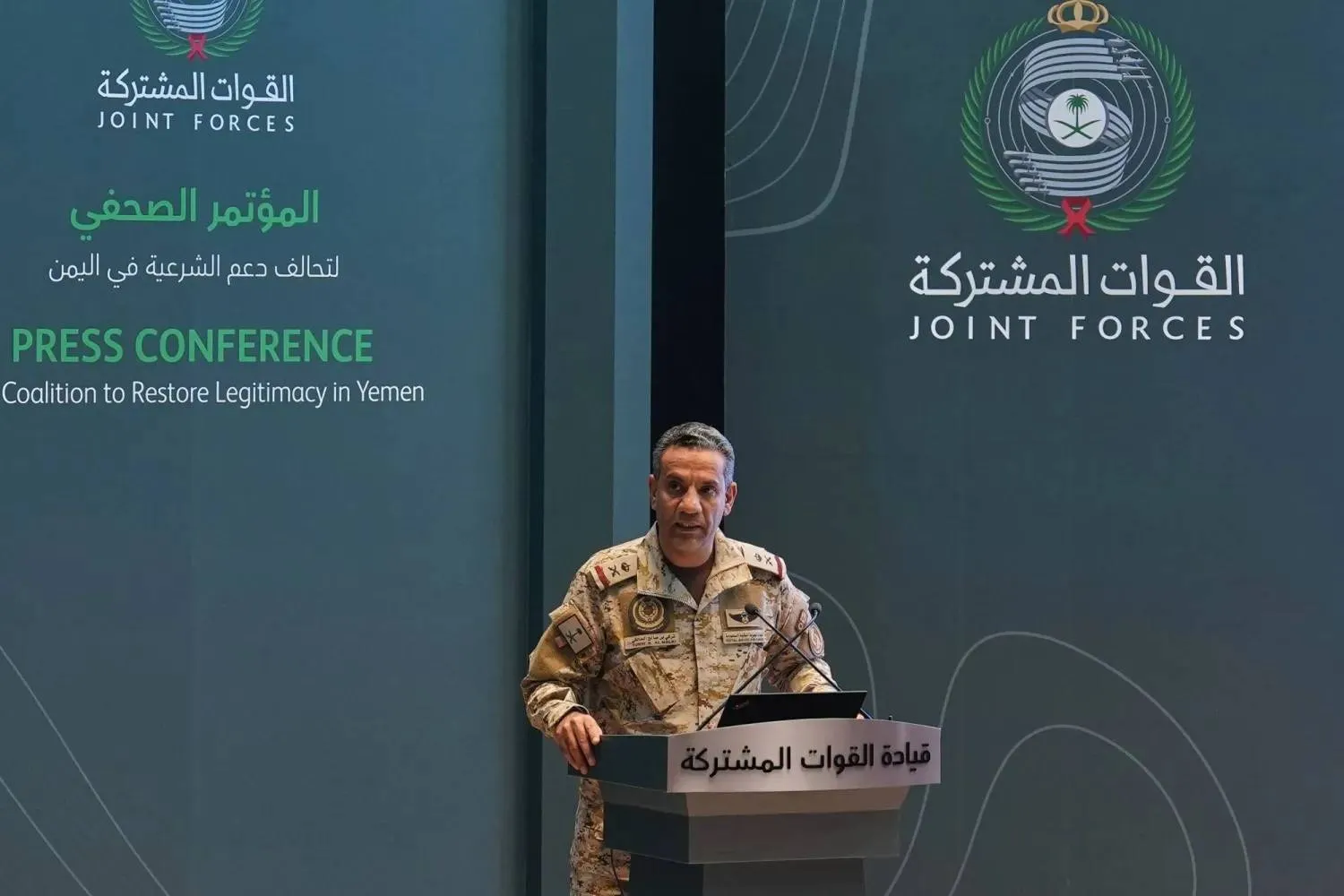
Maj. Gen. Turki al-Malki speaks during a news conference in Riyadh on Thursday (AP)
TT

Al-Malki Warns Houthis to Read Coalition Statement Carefully

Maj. Gen. Turki al-Malki speaks during a news conference in Riyadh on Thursday (AP)

Maj. Gen. Turki al-Malki, spokesman for the Arab Coalition to Support Legitimacy in Yemen, warned the Houthis against targeting civilians and civilian facilities in Saudi Arabia, saying coalition forces were fully capable of confronting missiles, drones and cruise missiles.


Speaking at a news conference in Riyadh on Thursday evening, al-Malki urged the Houthis to halt attacks on civilians and civilian infrastructure in the kingdom.


“The terrorist Houthi millitias must stop their attacks on civilians in Saudi Arabia, and they should carefully read the coalition’s statement — and between the lines,” he said.


Al-Malki said the Houthis had obtained advanced technology with the help of regional parties, enabling them to acquire ballistic missiles, attack and suicide drones and explosive-laden fast boats.


He said the development placed responsibility on the international community to prevent terrorist groups from gaining access to advanced weapons and technology.


“The leadership of the coalition’s joint forces affirms that its operations will continue to deter the terrorist Houthi millitias from attempting to target civilians and civilian facilities in Saudi Arabia and from threatening freedom of navigation in the southern Red Sea and the Bab al-Mandab Strait,” he said.


Al-Malki also reaffirmed support for Yemen’s internationally recognized government and armed forces “on all fronts,” along with round-the-clock air support for units on the ground.


19 killed, 364 injured


Al-Malki said Houthi attacks on airports in the kingdom had killed 19 people and injured 364, adding that 1,104 missiles and 1,135 drones had been launched since operations began.


He said Houthi attempts to target Islam’s two holiest mosques reflected a systematic hostile approach and amounted to a “heinous act” aimed at pilgrims and visitors.


According to al-Malki, Houthi violations since the 2022 truce included about 175 ballistic missiles, 330 drones, 2,229 projectiles launched from drones and 28,121 unidentified projectiles.


He stressed that Saudi Arabia had the intelligence capabilities to identify targets and confront threats.


“We have the capability to deal with these missiles, drones and cruise missiles,” he said.


During the news conference, al-Malki showed footage of coalition aircraft striking ballistic missile launchers, weapons depots and facilities he said the Houthis used to support military operations.


He said coalition forces had also neutralized an imminent ballistic missile attack on the kingdom.


Attacks threaten passenger safety


Al-Malki condemned Houthi attacks on civilians and civilian facilities in Saudi Arabia, including King Khalid International Airport in Riyadh, noting that thousands of passengers and civilians use such facilities every day.


He also pointed to attempted attacks on airports, ports and oil facilities in the kingdom.


Al-Malki said Houthi attacks on civilians were a flagrant violation of international norms, adding that attacks on airports “undermine the kingdom’s security, threaten international air traffic and endanger the lives of passengers of various nationalities.”


He said the coalition had destroyed 127 storage facilities in mountainous areas and a launch platform in Yemen.


Al-Malki said the Houthis had built mountain storage facilities concentrated in Sanaa, Saada and Amran, from which attacks were launched against Yemen and neighboring countries.


“The leadership of the coalition’s joint forces is working to dismantle this network and eliminate the experts and operators behind these capabilities by destroying mountain storage facilities and fixed and mobile launch platforms, based on an intelligence system operating around the clock,” he said.


Saudi defense systems on high alert


Al-Malki said the Saudi armed forces had advanced, highly combat-ready systems, including air defenses capable of intercepting threats and thwarting attempted attacks.


He said the systems were designed to protect the kingdom’s sovereignty, security, strategic assets and holy sites, as well as citizens and residents.


“We have the capability to identify the locations used by the Houthi militias, and we are working to dismantle the terrorist network and eliminate the experts involved,” he said.


Al-Malki again stressed the coalition’s strict commitment to international humanitarian law, saying it had taken all feasible precautions to avoid civilian casualties or damage while planning operations to neutralize Houthi capabilities used in attacks.

Houthis Launch Attack on Presidential Palace in Yemen’s Aden

A boat motors under Al-Maashiq Presidential Palace, at top, in Aden, Yemen, Aug. 20, 2024. (AP)
TT

Houthis Launch Attack on Presidential Palace in Yemen’s Aden

A boat motors under Al-Maashiq Presidential Palace, at top, in Aden, Yemen, Aug. 20, 2024. (AP)

At least six explosions struck Thursday near the palace used by Yemen's legitimate government in the port city of Aden, witnesses said. An official said at least two people were killed, and Iran-backed Houthi militants based in northern Yemen quickly claimed responsibility.

It was a rare attack on the palace area, as fighting has escalated between the militia and a Saudi-led coalition in the latest front in the Iran war. The explosions caused panic among residents, who fled the area.

Yemen's Ministry of Information confirmed the safety of Prime Minister Shaya Al-Zindani and ministers, saying they no longer hold permanent meetings inside the palace in anticipation of such attacks.

At least two people were killed and six wounded, said the official, who spoke on condition of anonymity because he was not authorized to speak to the press. The government said the Houthis attacked with missiles and drones, the Aden-based SABA news agency reported.

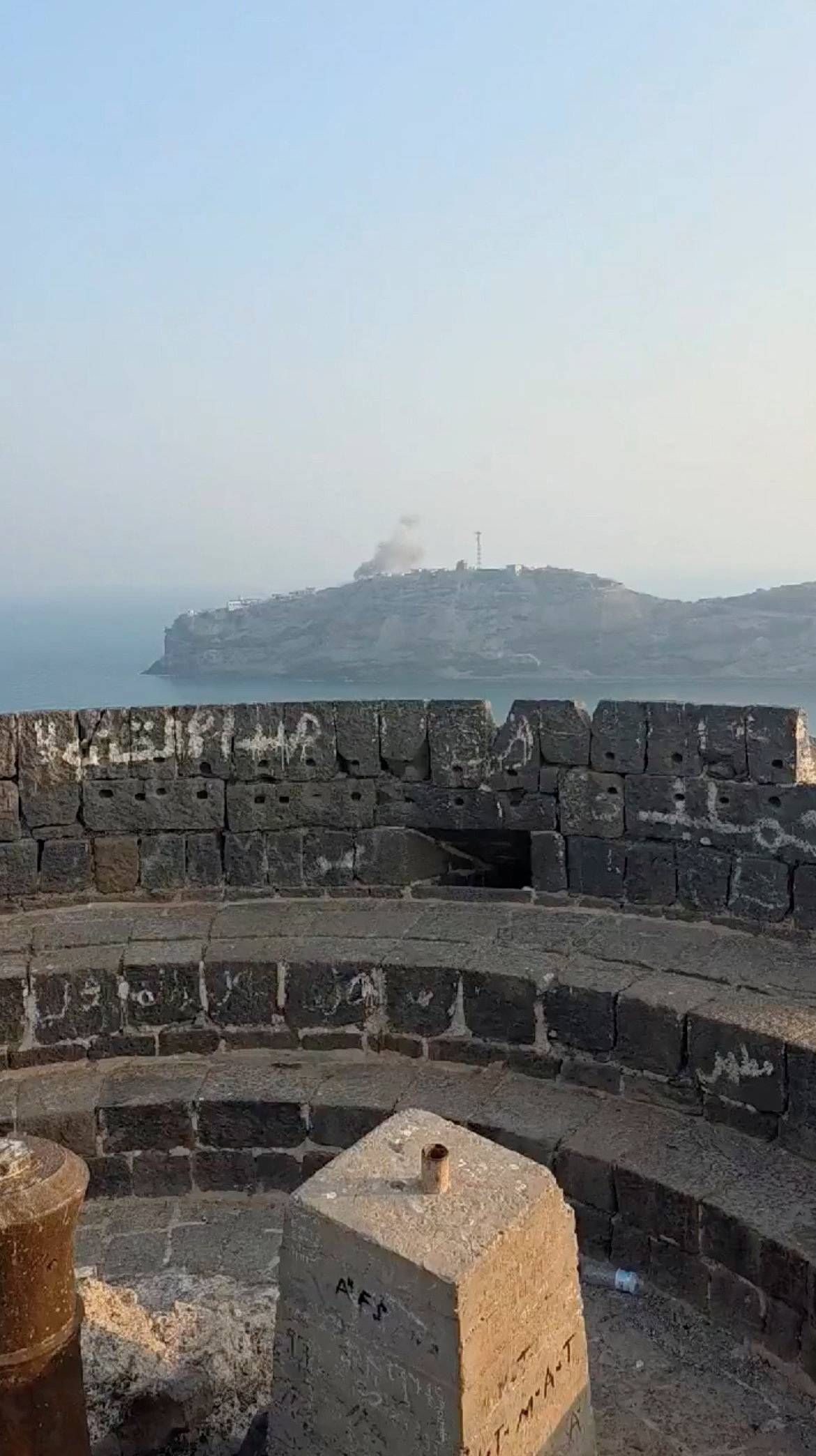
A security official said at least two explosions were on top of the hill near the Al-Maashiq Presidential Palace, and two others were near the security gate.

Many of Yemen's government leaders are living in exile, and those in Aden were safe, a government official said. Both officials spoke on condition of anonymity because they were not authorized to speak to the media. A video circulating on social media and analyzed by The Associated Press shows smoke rising from the area where the palace is located.

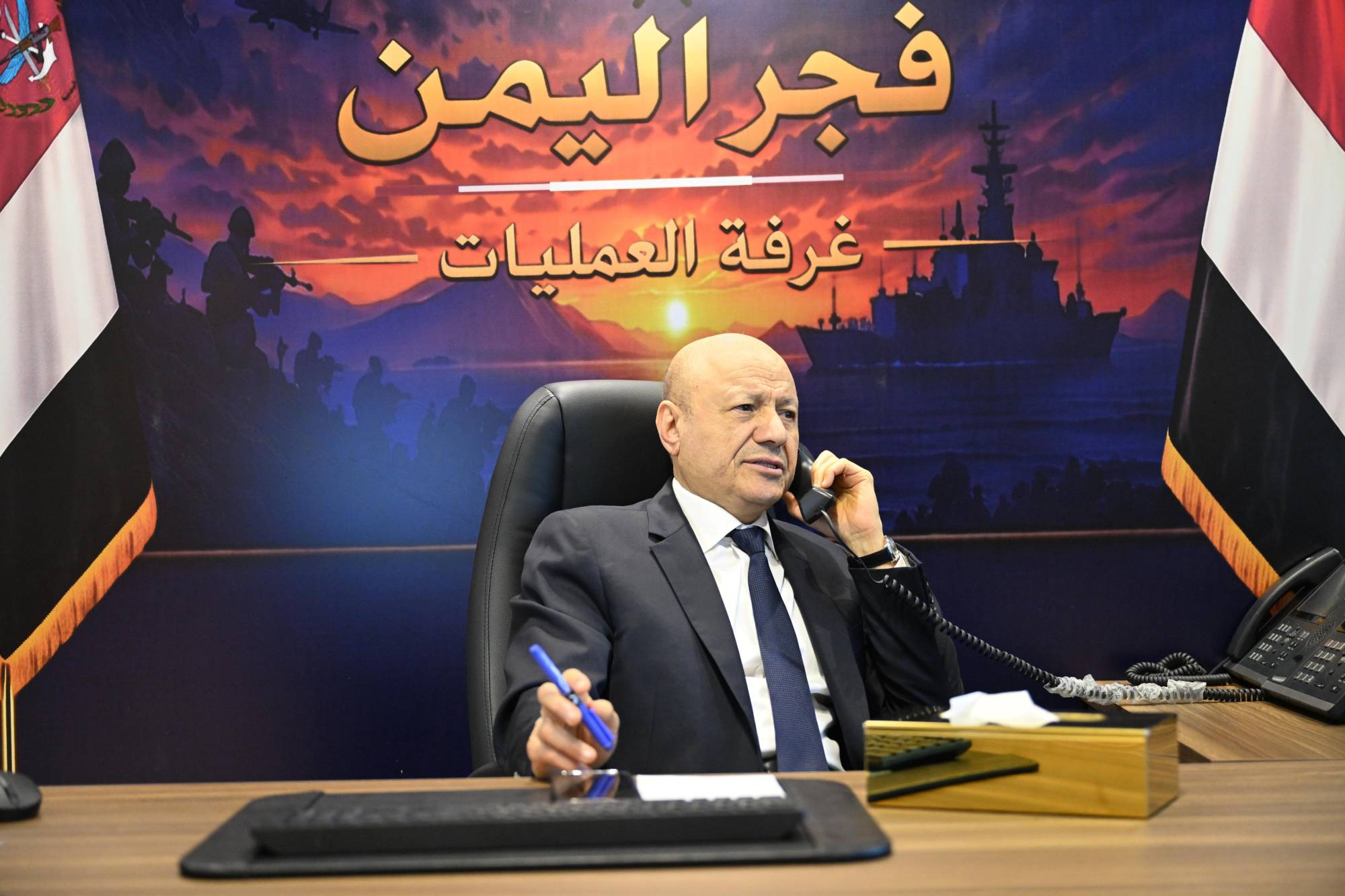
Chairman of the Presidential Leadership Council Dr. Rashad al-Alimi contacted ministers in wake of the attack.

Chairman of the Presidential Leadership Council Dr. Rashad al-Alimi contacted ministers in wake of the attack. (SABA)

He asserted that the Houthi attack on the palace is an extension of the militias' approach of targeting airports, oil facilities, and civilian objects in Yemen and Saudi Arabia, threatening regional security and waterways.

He stressed that the state will continue to carry out its constitutional responsibilities with utmost firmness, and that protecting its sovereign facilities and citizens is a non-negotiable responsibility.

He ordered the relevant military and security authorities to take the necessary measures to protect state institutions, counter terrorist threats, and respond appropriately to sources of threat in a manner that ensures the protection of civilians and civilian objects.

In turn, the cabinet affirmed that the attack on the Al-Maashiq Palace reveals the terrorist approach of the Houthis and their persistence in targeting civilians.

It stressed that it will not deter the government from performing its responsibilities and duties toward citizens, and continuing the battle to restore the state and its institutions and end the coup being pursued by the Dawn of Yemen Operation.

The attack on the palace is part of an escalating pattern of Houthi terrorism that has not been limited to targeting state institutions, but has extended to attacks on civilian objects and vital facilities in Saudi Arabia, and the shelling of residential neighborhoods in the governorates of Taiz and Lahj.

"The future of Yemen will not be held hostage by a militia that bears arms against its people, targets the security of its neighbors, and relies on violence to compensate for the Yemeni rejection of its coup project,” it added.

The cabinet called on the international community and the United Nations to take a clear and firm stance regarding these attacks, to stop treating them as isolated incidents separate from their context, to exert the necessary pressure to halt the targeting of civilians and civilian facilities, and to hold those responsible for the violations accountable.

Smoke billows from the presidential palace complex following an attack by Yemen's Houthis, according to government officials, in Aden, Yemen, October 15, 2026, in this screen grab obtained from a social media video. (Social media/via Reuters)

Elsewhere in Yemen, the fighting has revived a devastating civil war after four years of relative calm. One focus of alarm is the Houthi-besieged city of Taiz.

Residents of Yemen’s third-largest city are running short of basic necessities. Where goods can be found, prices have soared. Gas stations sit empty or out of service. The World Food Program said it can no longer reach more than 600,000 people in Taiz who depend on aid.

At a news conference late Thursday in Taiz, the Health Ministry said 120 people were killed and 307 wounded in the fighting through Oct. 5, with most of the deaths reported in Taiz, Saada and Jawf areas.

Fathiyya Mohamed al-Mugahed said she had gone looking for flour, cooking gas and fuel but found none.

“The Houthis have surrounded us from all sides,” she said. “Projectiles are all we have received from them.”

The International Committee of the Red Cross said Taiz has seen some of the “highest casualty burdens” in the country.


Netanyahu Rival Vows to End Hamas Rule within 18 Months if Elected

People walk past a banner featuring Israel's Prime Minister Benjamin Netanyahu (R) of the Likud party and country's former chief of the general staff and leader of the Yashar centrist political party Gadi Eisenkot in Ramat Gan on October 15, 2026. (AFP)
TT

Netanyahu Rival Vows to End Hamas Rule within 18 Months if Elected

People walk past a banner featuring Israel's Prime Minister Benjamin Netanyahu (R) of the Likud party and country's former chief of the general staff and leader of the Yashar centrist political party Gadi Eisenkot in Ramat Gan on October 15, 2026. (AFP)

Israeli opposition politician Gadi Eisenkot, Prime Minister Benjamin Netanyahu's main rival in upcoming elections, vowed Thursday to end Hamas rule in Gaza if he wins office following the October 27 vote.

"Today I give a public commitment: from the moment I enter the Prime Minister's Office, within 18 months Hamas will no longer rule the Gaza Strip," the leader of the center-right Yashar party said at a press conference near the war-ravaged Palestinian territory.

He said he would achieve this either by implementing US President Donald Trump's ceasefire plan, which provides for the gradual disarmament of Hamas and a transfer of power, or through "creative operations" by Israel's military aimed at destroying the Palestinian movement's military wing.

Hamas announced in July that it was disbanding its governing body to facilitate the transfer of Gaza's administration to a nascent technocratic Palestinian committee called the National Committee for the Administration of Gaza (NCAG).

The NCAG, currently based in Cairo, was created following the declaration of a ceasefire last October and is overseen by Trump's Board of Peace.

Later in July, Hamas announced it had agreed to a deal involving the handing over of its weapons to the NCAG.

But Israel has been skeptical, with Netanyahu demanding verifiable decommissioning of all weapons before any withdrawal of the military takes place.

Hamas has not gone ahead with disarmament, Israel has refused to reciprocate by starting to withdraw forces, and the NCAG is not operating inside the territory.

Israeli forces were allowed to stay in 53 percent of Gaza under the terms of the ceasefire, but a year later they control about 70 percent, according to official accounts.

- 'Strategic failure' -

Eisenkot's campaign pledge on Thursday is one of the strongest yet from the 66-year-old former military chief.

The close-fought election will be the first since Hamas's October 7, 2023, attack on Israel, which resulted in the deaths of more than 1,200 people.

In response to the attack, Israel launched a massive offensive in Gaza that has killed more than 74,300 people, according to the territory's health ministry, which operates under Hamas and whose figures are generally considered reliable by the United Nations.

Eisenkot on Thursday accused Netanyahu of a "strategic failure" in Gaza, where he said "Hamas is still the sovereign... armed, arming itself, and militarily active" after three years of war.

He also reiterated a pledge to establish a state commission of inquiry to identify those responsible for any security lapses leading up to October 7, a push the government has so far resisted.

"There is a way to prevent the next disaster," he said.

Eisenkot, like other opposition politicians, regularly accuses Netanyahu of bearing personal responsibility for the October 7 attack, notably by ignoring warnings from his security services, according to media reports.

Netanyahu has categorically rejected the accusations and maintains that security officials did not wake him on the morning of the attack.

Current polls show that neither Netanyahu's bloc nor that led by Eisenkot is in a position to win the 61 seats needed to control the 120-seat parliament and form a governing coalition.


Israel Says Commercial Goods Not Entering Gaza Over Hamas Tax Dispute

 Palestinians inspect a building destroyed in an Israeli airstrike late Saturday in Zawaida, central Gaza Strip, Sunday, Oct. 11, 2026. (AP)
Palestinians inspect a building destroyed in an Israeli airstrike late Saturday in Zawaida, central Gaza Strip, Sunday, Oct. 11, 2026. (AP)
TT

Israel Says Commercial Goods Not Entering Gaza Over Hamas Tax Dispute

 Palestinians inspect a building destroyed in an Israeli airstrike late Saturday in Zawaida, central Gaza Strip, Sunday, Oct. 11, 2026. (AP)
Palestinians inspect a building destroyed in an Israeli airstrike late Saturday in Zawaida, central Gaza Strip, Sunday, Oct. 11, 2026. (AP)

Israel on Thursday said commercial goods usually delivered into Gaza by private merchants had not entered the beleaguered territory for days because of Hamas threats and a taxation scheme, an accusation the group rejected.

Despite a fragile ceasefire observed since October 2025, the Gaza Strip remains engulfed in a severe humanitarian crisis and the alleged dispute between Hamas and merchants threatens to further cut off supplies to the territory.

Gaza, a tiny territory surrounded by Israel, Egypt and the Mediterranean Sea, has been under blockade even before Hamas's October 7, 2023 attack sparked the most recent war.

But COGAT, the Israeli defense ministry agency responsible for civilian affairs in the Palestinian territories, said it told senior international officials that merchants had suspended coordination for the entry of goods into Gaza "until further notice" because of what it described as Hamas coercion.

In a letter to international representatives involved in implementing the ceasefire, COGAT said merchants reported that Hamas demanded about 10,000 shekels ($3,200) for every truck into Gaza and that traders sell around 30 percent of goods in cash instead of bank transfers.

The agency also cited reports that Hamas security personnel had arrested the son of a merchant who refused to comply with the demands, prompting traders to suspend operations out of fear for their safety.

Hamas rejected the allegations in a letter addressed to mediators including Egypt, Qatar and Türkiye, saying it "categorically" denied imposing taxes or government fees on commercial trucks.

It said it had not collected taxes or fees on commercial activity in the past three years of war because of the humanitarian and economic conditions in Gaza.

Hamas said the 10,000-shekel figure referred to a "voluntary community initiative" by Gaza's businesspeople to put money into a "national fund" for relief projects, while the transaction requirement was to inject "cash liquidity" into the territory.

COGAT said the private sector accounted for roughly half of all trucks entering Gaza each week and warned the suspension could undermine the ceasefire agreement.

COGAT said Israel had not initiated the suspension of coordination, but the merchants.

Nickolay Mladenov, the Gaza representative of the US-backed Board of Peace tasked with implementing the ceasefire, said he had received COGAT's letter and condemned reported "threats and coercion" against merchants.

"Such practices are unacceptable and must end immediately," Mladenov wrote on X, adding that interference in supply chains increased the suffering of Gaza's civilians.

The International Organization for Migration (IOM) last week called for Israel to ease the "constraints" on the entry of critical supplies into Gaza.
