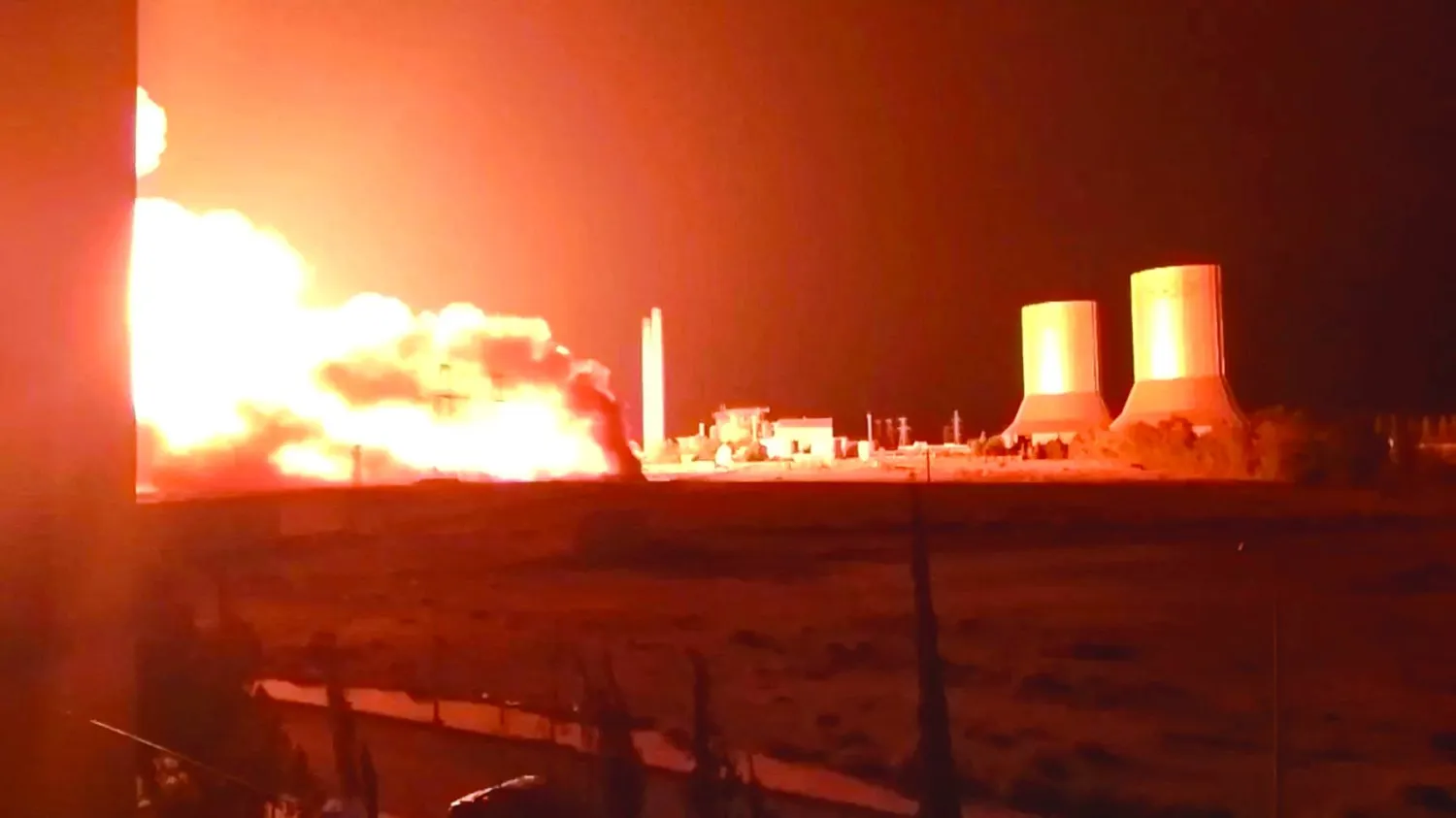
Jbessa Gas Export Pipeline Targeted in Northeastern Syria, Fire Erupts, SANA Reports

File: Flames rise at Tishreen thermal power plant following an explosion, near Otaybah, Syria, September 30, 2026, in this screengrab from video obtained from social media. Social Media/via REUTERS
TT

Jbessa Gas Export Pipeline Targeted in Northeastern Syria, Fire Erupts, SANA Reports

File: Flames rise at Tishreen thermal power plant following an explosion, near Otaybah, Syria, September 30, 2026, in this screengrab from video obtained from social media. Social Media/via REUTERS

The Jbessa gas export pipeline in northeastern Syria was targeted in the al-Arabidi area, causing a fire, state news agency SANA reported on Thursday citing the director of the Syrian Petroleum Company's media office.

The company said in a statement that the 16-inch ‌pipeline exploded at ‌5.15 p.m. in an ‌area ⁠about 60 km ⁠from the city of Shaddadi. It did not specify the cause of the explosion, according to Reuters.

Technical teams isolated the damaged section by closing valves at the Jbessa gas plant and the ⁠Deir Ezzor gas station ‌in the al-Bughailiya area, ‌while firefighting and safety crews headed to ‌the site to secure the area, ‌the company said.

The extent of the damage and whether gas supplies had been disrupted were not immediately clear.

The explosion ‌followed a separate incident on Thursday morning in which the Baniyas-Homs ⁠oil ⁠products pipeline was damaged near the village of Hudeida in the western Homs countryside in what the company described as sabotage aimed at stealing fuel.

That incident caused a gasoline leak, the company said, adding that work was continuing to repair the damage and restore the line to service.


China Says Israel Should Stop Its 'Forced Establishment' of West Bank Settlements

Cattle gather in an enclosure at a farm run by Israeli settlers near the Palestinian town of Duma in the Israeli-occupied West Bank, on October 13, 2026. (Photo by Ilia YEFIMOVICH / AFP)
TT

China Says Israel Should Stop Its 'Forced Establishment' of West Bank Settlements

Cattle gather in an enclosure at a farm run by Israeli settlers near the Palestinian town of Duma in the Israeli-occupied West Bank, on October 13, 2026. (Photo by Ilia YEFIMOVICH / AFP)

Chinese Foreign Minister Wang Yi told Israeli President Isaac Herzog that Israel should stop and reverse its "forced establishment" of West Bank settlements, China's foreign ministry said in a statement on Friday.

China has consistently held that the Palestinian question is the greatest historical injustice of this ‌century, Wang ‌told Herzog during a meeting ‌in ⁠Azerbaijan, the ministry ⁠added.

Wang had earlier said that promoting peace and reconciliation in the region is the "cornerstone" of China's Middle East policy

China believes that the "two-state solution" is the right path ⁠to a resolution and the ‌immediate priority ‌is to fully open access to the ‌Gaza Strip so a humanitarian "catastrophe" ‌is not allowed to spread, Wang added

At the same time, Israel should stop and reverse its forced establishment of ‌settlements in the West Bank, he said

China is ⁠willing ⁠to work with the international community to push all parties to return to dialogue and consultation as soon as possible and seek a political settlement of the conflict, Wang added

China has long been a supporter of the Palestinian cause and Beijing also has close ties with Israel's main regional foe, Iran.


Netanyahu Says Spoke with Syria’s Sharaa on Sweida Unrest

People walk under a giant election billboard bearing a portrait of Israeli Prime Minister Benjamin Netanyahu's Likud party in Ramat Gan, on October 15, 2026. (AFP)
TT

Netanyahu Says Spoke with Syria’s Sharaa on Sweida Unrest

People walk under a giant election billboard bearing a portrait of Israeli Prime Minister Benjamin Netanyahu's Likud party in Ramat Gan, on October 15, 2026. (AFP)

Israeli Prime Minister Benjamin Netanyahu said on Thursday that he had previously spoken with Syrian President Ahmed al-Sharaa about violence towards the Druze community, in his first acknowledgement of direct contact.

Netanyahu did not say when exactly the call took place, but implied it had been during bloody clashes in southern Syria in July of 2025 involving Druze factions, Bedouin fighters and government security forces.

"I called al-Sharaa. It was a very short, very sharp conversation, and the slaughter stopped," Netanyahu said at an election rally with Israel's Druze community, according to footage aired by Israel's public broadcaster KAN.

The 2025 clashes erupted in Syria's Sweida province between armed Druze factions and Bedouin fighters, with government security forces and some tribal groups then intervening.

A committee set up by the Syrian government said it had documented 1,760 deaths.

Israel, which also has a Druze population, intervened militarily during the clashes, with strikes in Sweida and against government targets in Damascus, saying it was defending the minority community.

Government-aligned forces later withdrew from Sweida city, leaving a fragile ceasefire in place, and in July of this year Damascus said it had begun trying suspects over the violence.

A Syrian government source told the country's state news agency SANA on Thursday that Damascus "categorically rejects any attempt to politicize (Syria's Druze minority) or to involve it in Israeli propaganda and elections," without confirming nor denying whether the call between Netanyahu and Sharaa had taken place.

Since the December 2024 ousting of longtime Syrian ruler Bashar al-Assad, Israel has carried out hundreds of strikes in Syria and sent troops into a UN-patrolled buffer zone that had separated Israeli and Syrian forces in the Golan since 1974.

It has also carried out repeated incursions deeper into Syrian territory and has vowed to keep troops in a so-called "security zone" in southern Syria, where it seeks a broader demilitarized area.

Syria's new leaders have condemned Israeli military action in the country's south but have refrained from responding with force.

Despite the tensions, Syria and Israel have held several rounds of direct talks as they edge towards a security agreement.


Iraq Parliament Fills Cabinet Posts, Naming a US-Sanctioned Deputy Prime Minister

 Iraqi Prime Minister Ali al-Zaidi attends a parliamentary session to approve the remaining members of his cabinet, in Baghdad, Iraq, October 15, 2026. (Iraqi Prime Minister's Media Office/Handout via Reuters)
Iraqi Prime Minister Ali al-Zaidi attends a parliamentary session to approve the remaining members of his cabinet, in Baghdad, Iraq, October 15, 2026. (Iraqi Prime Minister's Media Office/Handout via Reuters)
TT

Iraq Parliament Fills Cabinet Posts, Naming a US-Sanctioned Deputy Prime Minister

 Iraqi Prime Minister Ali al-Zaidi attends a parliamentary session to approve the remaining members of his cabinet, in Baghdad, Iraq, October 15, 2026. (Iraqi Prime Minister's Media Office/Handout via Reuters)
Iraqi Prime Minister Ali al-Zaidi attends a parliamentary session to approve the remaining members of his cabinet, in Baghdad, Iraq, October 15, 2026. (Iraqi Prime Minister's Media Office/Handout via Reuters)

Iraq's parliament voted Thursday to appoint ministers to previously vacant Cabinet posts and complete the country's government, including a deputy prime minister who is under US sanctions.

Laith al-Khazali, appointed to that post, is the brother of Qais al-Khazali, leader of the Iran-backed Asaib Ahl al-Haq armed faction. Laith al-Khazali was arrested by US forces in 2007 over allegations related to an attack targeting American forces in Karbala in January of that year, which resulted in the deaths of five US soldiers.

He was released from US custody in June 2009. In 2019, the US Treasury Department imposed sanctions on him, citing his leadership role in Asaib Ahl al-Haq and allegations involving human rights abuses as well as the 2007 attack.

His appointment to a senior government position raises questions about its potential implications for relations between Baghdad and Washington. Iraqi Prime Minister Ali al-Zaidi was backed by US President Donald Trump when he took the post and has strong relations with Washington, but he has also sought to maintain relations with Iran.

Past Iraqi governments have also sought to balance relations with Washington and Tehran, but the balancing act has become more difficult since the US and Iran went to war on Feb. 28.

There was no immediate official statement from the US on the appointment.

Republican US Rep. Joe Wilson wrote on X that al Khazali “is a designated terrorist and Iranian puppet whose militia AAH killed Americans and Iraqis.”

“He is no better than ISIS, maybe even worse,” Wilson said. "It is outrageous but sadly not shocking that he has been appointed deputy PM of Iraq.”

The parliament also appointed two other deputy prime ministers, as well as a new interior minister, defense minister, planning minister, minister of higher education and scientific research, and culture minister.

The other Cabinet posts had been appointed five months earlier.

Al-Zaidi said in a statement that with the vacant posts filled, “we are embarking on a phase of accelerated, diligent work” and pledged to "move forward in implementing our government’s priorities and program, and in fulfilling the aspirations of all Iraqis.”

He said the government had worked over the past several months amid complicated domestic and international circumstances, noting that the war in the region had imposed exceptional economic challenges on Iraq, in addition to security challenges.

Al-Zaidi has vowed to fight corruption and strengthen Iraq's sovereignty, both by completing the withdrawal of US forces from the country and by disarming non-state armed groups.

Some of the most powerful factions have said they have no intention of giving up their weapons, although Asaib Ahl al-Haq is one of a handful that have agreed to hand over their arms.