The transformation taking place in Saudi Arabia's labor market is no longer measured solely by the decline in unemployment to a historic low of 2.8 percent, or by the fact that half of employed Saudi citizens now work in the private sector. It is increasingly measured by the Kingdom's ability to turn investments in human capital and technology into development models that attract the attention of international institutions.
One prominent example is the Seha Virtual Hospital, the world's largest provider of virtual healthcare services. It has successfully leveraged digital technologies and artificial intelligence to expand access to healthcare and improve service efficiency, in what the World Bank considers a model of the knowledge- and innovation-driven economy of the future.
This assessment is reinforced by the joint report issued by the World Bank and Saudi Arabia's Ministry of Human Resources and Social Development, titled “A Decade of Progress: Inside Saudi Arabia’s Labor Market Transformation.”
The report finds that the Saudi economy has entered a new phase characterized by greater reliance on human capital, the private sector, and the digital economy. Labor force participation has risen to 67.1 percent, half of employed Saudi nationals now work in the private sector, and the digital economy contributes approximately 15 percent of the country's gross domestic product (GDP).
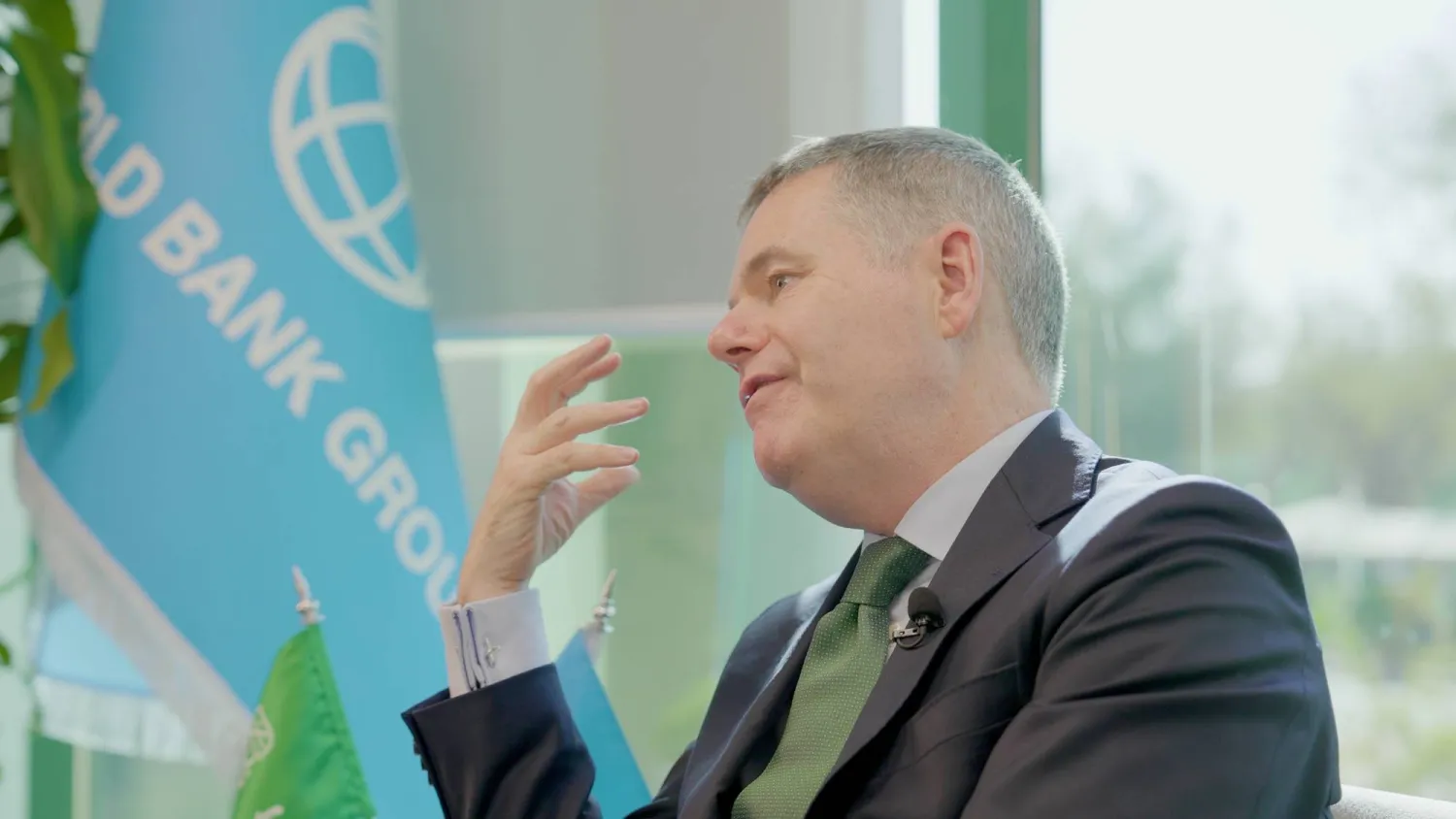
In remarks to Asharq Al-Awsat, Paschal Donohoe, Managing Director and Chief Knowledge Officer of the World Bank Group, said that Saudi Arabia's achievements go beyond improving economic indicators. Rather, they reflect the development of a new growth model that links employment, skills, innovation, and the application of knowledge to enhance public services—making economic growth more sustainable and inclusive.
A Healthcare Model Attracting Global Attention
Donohoe's praise came after his visit on Sunday to Seha Virtual Hospital in Riyadh, where he reviewed the hospital's digital services and operating model.
In an interview with Asharq Al-Awsat, he described it as one of the “most impressive” models he has seen for harnessing technology to serve people, saying it provides a practical example of integrating artificial intelligence into healthcare within a comprehensive development vision.
According to Donohoe, the Saudi healthcare experience stands out for three key features that position it as a global leader. First is its exceptional success in using artificial intelligence to enable immediate and effective contact between patients and highly specialized medical experts. Second is the flexibility of the system, which extends this digital connectivity across both in-hospital and remote care. Third is the sophistication of its real-time monitoring and oversight systems, which allow authorities to measure outcomes with a high degree of scientific accuracy.
From Financing to Knowledge Exchange
Donohoe noted that the relationship between Saudi Arabia and the World Bank has entered a new phase. Rather than being centered on financing or technical assistance, it is now increasingly focused on knowledge creation and the exchange of expertise.
He described the establishment of the Knowledge Hub in Riyadh - the first of its kind in the region - as a turning point in the partnership. The center will document Saudi Arabia's successful experiences, refine them, and transform them into models that can be adapted and applied in other countries.
He stressed that Saudi Arabia is no longer simply a recipient of international expertise but has become a partner in generating and sharing development knowledge. In this context, the World Bank looks forward to working with Saudi institutions, particularly in the healthcare sector, to build on the experience of Seha Virtual Hospital and adapt its model to meet the needs of developing countries and regions facing shortages of qualified medical professionals, thereby strengthening knowledge exchange and supporting development in the region and the world.
A New Structural Reality
The World Bank's interest in exporting the Saudi experience is rooted in its belief that the Kingdom's achievements reflect a broad structural transformation of the economy rather than the success of a single project or sector.
The reforms driven by Vision 2030 have gone beyond creating new jobs. They have reshaped the relationship between education and the labor market, strengthened the role of the private sector, and increased the contribution of knowledge- and innovation-based activities, making economic growth more sustainable and better equipped to adapt to technological change.
Donohoe believes this transformation is particularly significant because it links investment in people with productivity and innovation. This has given rise to leading models across multiple sectors, including digital healthcare, which he sees as the product of integrated reforms in education, skills development, and digital transformation - not merely a collection of standalone technology projects.
The Artificial Intelligence Challenge
At a time when the rapid advancement of artificial intelligence is fueling global concerns about the future of work - with the World Bank estimating that approximately 1.2 billion young people will enter labor markets while only around 400 million jobs are expected to be created - Donohoe believes Saudi Arabia offers a different approach. Rather than viewing AI as a substitute for human labor, the Kingdom is using it as a tool to enhance productivity and generate new employment opportunities.
He noted that early investment in digital skills development, combined with the integration of advanced technologies into education and training programs, has helped build a broad pool of qualified talent, alongside the growing contribution of the digital economy to GDP.
According to Donohoe, Saudi Arabia's AI applications, particularly in digital healthcare, demonstrate how technology can improve the quality and efficiency of public services while simultaneously creating new opportunities for specialized careers and future-oriented skills.
Good Jobs—Not Just More Jobs
Donohoe argued that the success of a labor market should not be measured solely by the number of jobs created, but also by the quality of those jobs and their ability to provide sustainable incomes, opportunities for career advancement, and higher productivity.
He noted that recent years, marked by slower economic growth and rising living costs, have made the creation of "good jobs" one of the foremost challenges facing policymakers around the world.
He added that the World Bank works with governments to strengthen sectors with the greatest potential to create high-value employment, including healthcare, tourism, and agriculture, while also improving regulatory frameworks that encourage private-sector investment and support business growth.
In his view, Saudi Arabia represents an advanced model in this regard, and the Knowledge Hub in Riyadh will serve as a platform for exchanging expertise and developing policies aimed at improving job quality and productivity, rather than merely increasing the number of jobs.
The Private Sector: The Engine of the Next Phase
Donohoe stressed that achieving the goal of creating better jobs - not simply more jobs - is closely tied to the private sector's ability to lead investment and job creation in the years ahead.
He believes that future employment growth will depend increasingly on the private sector's capacity to drive investment and economic expansion, rather than on government spending.
World Bank analysis indicates that Saudi Arabia's private sector is already playing a pivotal role in several strategic industries. However, the next stage will require additional incentives to enable businesses to expand investment and create new employment opportunities.
"No country, regardless of its wealth, can rely entirely on public capital to do everything," he said. Against this backdrop, the World Bank is focused on helping governments develop regulatory frameworks that strengthen investor confidence and encourage long-term private investment.
He considers this one of the defining strengths of Vision 2030, which has succeeded in creating an investment environment and infrastructure that enable the private sector to play a greater role in driving economic growth.
Resilient Growth Amid Macroeconomic Uncertainty
These domestic structural reforms are unfolding against an increasingly complex global and regional economic backdrop.
According to World Bank projections, the region's growth outlook has been affected by the economic consequences of geopolitical conflicts and trade tensions, leading to a downward revision in expected regional growth from around 4 percent to a range of approximately 1.5 to 2.5 percent.
Despite supply chain disruptions, inflationary pressures, and elevated global food prices, Donohoe said the Saudi economy continues to demonstrate remarkable resilience and a strong capacity to withstand external shocks.
He argued that strengthening resilience in healthcare, education, and employment is essential to enabling economies to absorb shocks over time.
Donohoe added that Saudi Arabia's experience is no longer defined simply by stronger labor market or economic indicators. Instead, it has evolved into a model for leveraging knowledge, innovation, and public-private collaboration to build a more resilient economy capable of adapting to global transformations, making it a valuable reference point for many other economies around the world.