


Minister: UAE's Industrial Exports Have Grown by $19 Billion in 3 Years

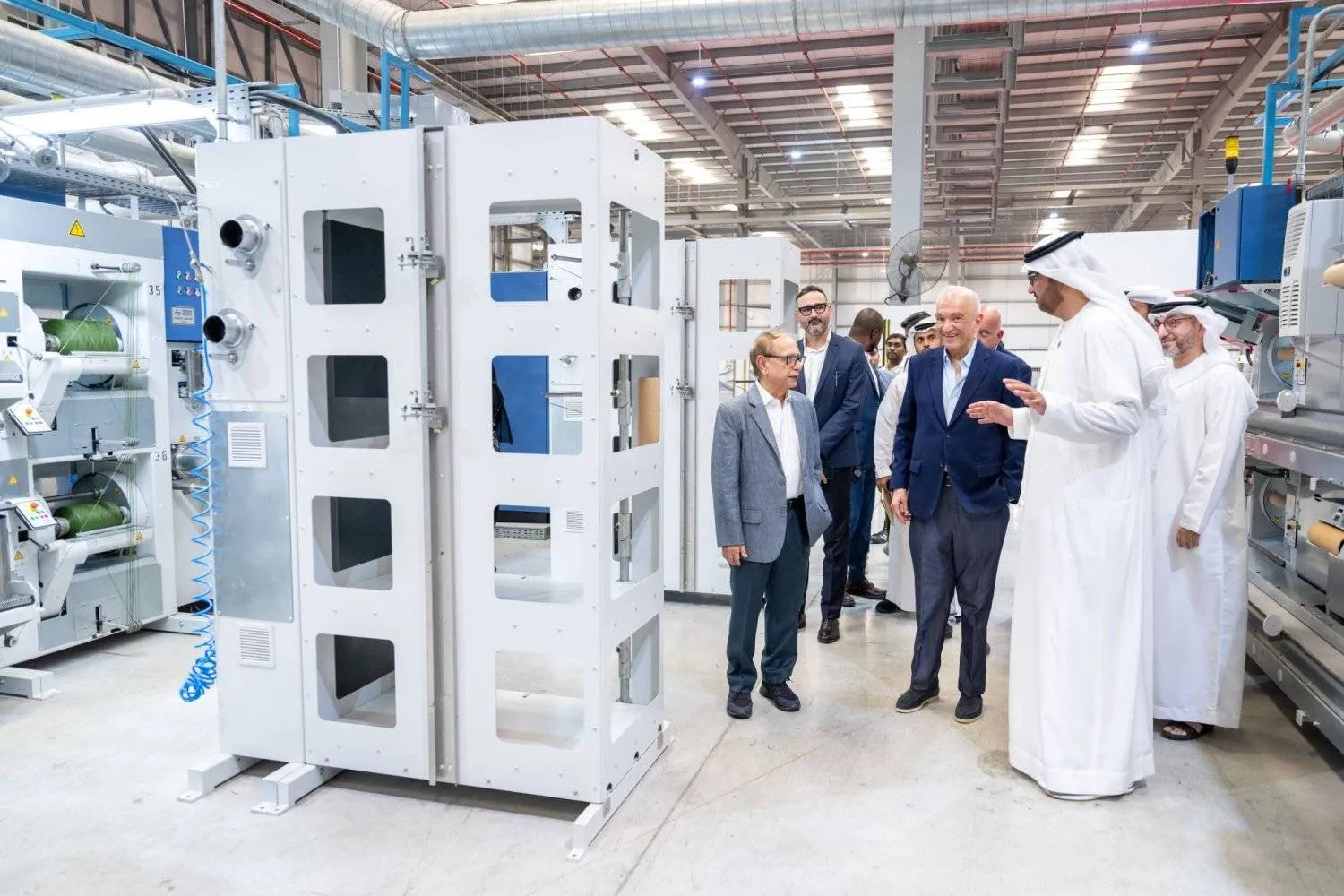
Dr. Sultan bin Ahmed Al Jaber, Minister of Industry and Advanced Technology, visiting an Emirati factory (WAM)
TT

Minister: UAE's Industrial Exports Have Grown by $19 Billion in 3 Years

Dr. Sultan bin Ahmed Al Jaber, Minister of Industry and Advanced Technology, visiting an Emirati factory (WAM)

UAE Minister of Industry and Advanced Technology Dr Sultan bin Ahmed Al Jaber has said the UAE industrial exports have grown by more than 70 billion dirhams ($19 billion) in the last three years.

“Industrial exports have grown by 60 percent with significant progress being made last year, amounting to a projected 187 billion dirhams ($50.9 billion) compared to 117 billion dirhams ($31.8 billion) in 2020,” the Minister said Wednesday.

He added that since its establishment, the Ministry of Industry and Advanced Technology (MoIAT) has launched numerous strategic initiatives and programs to empower the national industrial sector as well as enhance the business environment and industrial competitiveness.

“This has contributed to greater national industrial security and self-sufficiency, resulting in 9.3 billion dirhams ($2.5 billion) worth of import substitution projects,” the UAE Minister explained.

He said the Ministry-launched enablers and incentives were among the most important tools for supporting sustainable business growth, and reducing financial barriers and risks for industrial companies, nothing that “financing not only supports innovation and technological transformation but can also enhance business growth and help create more high-tech job opportunities in the private sector.”

Al Jaber said if we look at the sector’s key performance indicators, the industry’s contribution to the UAE’s economy has increased by 49 percent. He added that in 2020, before the ministry was created, the sector's contribution to GDP was 132 billion dirhams ($35.9 billion), while currently, it has reached a projected 197 billion dirhams ($53.6 billion).

Therefore, industrial productivity has increased by 18 percent compared to 2020.

In a statement published by the Emirati news agency, WAM, Al Jaber said MoIAT has launched strategic initiatives and programs to empower the national industrial sector as well as enhance the business environment and industrial competitiveness.

Accordingly, he said his ministry focused on two main pillars.

“The first is boosting in-country value in the national industrial sector while also enhancing the value add of manufacturing. This is to meet our basic necessities and boost supply chain security as well as economic competitiveness in a way that supports national products,” the minister said, while “the second is providing more valuable opportunities to the industrial sector, whether it is through investment opportunities or facilitating access to global markets, as well as attracting foreign investments in advanced industries.”

Al Jaber underscored one of MoIAT’s flagship initiatives is the National In-Country Value (ICV) Program, through which more than 237 billion dirhams ($64.5 billion) being spent outside the UAE has been redirected into the national economy.

“This recapturing of national procurement has contributed to the growth and competitiveness of the industrial sector and has directly enhanced self-sufficiency. So far, 16,000 Emiratis have been employed across ICV-certified companies,” he said.

In terms of promoting advanced technologies and Industry 4.0 solutions, the Emirati Minister said that MoIAT has paved the way for the adoption of robotics, artificial intelligence, blockchain, nanotechnology, biotechnology, the Internet of Things and 3D printing, among others.

These technologies, he noted, have boosted industrial exports, supporting the UAE's position as a leading regional and international hub for future industries.

The Ministry also stimulated high-tech industries with financing solutions worth 1.5 billion dirhams ($408 million) in 2023 alone.

This has resulted in the growth of high-tech exports from 2.9 billion dirhams ($789 million) in 2020 to 3.5 billion dirhams ($952 million) in 2023, according to the minister.



Gold Eases as Strong US Data, Easing Geopolitical Tensions Sap Momentum

FILE PHOTO: A saleswoman displays a gold necklace inside a jewellery showroom on the occasion of Akshaya Tritiya, a major gold buying festival, in Kolkata, India, May 7, 2019. REUTERS/Rupak De Chowdhuri/File Photo
TT

Gold Eases as Strong US Data, Easing Geopolitical Tensions Sap Momentum

FILE PHOTO: A saleswoman displays a gold necklace inside a jewellery showroom on the occasion of Akshaya Tritiya, a major gold buying festival, in Kolkata, India, May 7, 2019. REUTERS/Rupak De Chowdhuri/File Photo

Gold prices ticked lower on Friday, extending losses from the previous session, as stronger-than-expected US economic data and easing geopolitical tensions in Iran hampered bullion's bullish momentum.

Spot gold eased 0.3% to $4,603.02 per ounce by 0918 GMT. However, the metal is poised for a weekly gain of about 2% after scaling a record peak of $4,642.72 on Wednesday. US gold futures for February delivery edged 0.4% lower to $4,606.70.

"There was ‌a lot of ‌momentum in the (gold) market, which seems to ‌have ⁠faded slightly ‌at the moment....the economic news flow out of the US has been causing some headwinds rather than tailwinds as of late, which is reflected in a somewhat stronger US dollar," said Julius Baer analyst Carsten Menke.

The US dollar hovered near a six-week high on the back of positive economic data on Thursday showing initial jobless claims dropped 9,000 ⁠to a seasonally adjusted 198,000 last week, below economists' forecast of 215,000.

A firmer ‌dollar makes greenback-priced bullion more expensive for overseas ‍buyers. On the geopolitical front, people ‍inside Iran, reached by Reuters on Wednesday and Thursday, said ‍protests appeared to have abated since Monday.

Safe-haven gold tends to do well during times of geopolitical and economic uncertainty. Meanwhile, gold demand in India stayed muted this week as prices hit record highs again, taking the shine off retail buying, while bullion traded at a premium in China as demand remained steady ahead of the Lunar ⁠New Year.

Spot silver shed 1.1% to $91.33 per ounce, although it was headed for a weekly gain of over 14% after hitting an all-time high of $93.57 in the previous session. "The silver market seemed very determined to reach the $100 per ounce threshold before moving lower again....speculative traders are keeping an eye on that level even though it would not be sustainable in the medium to longer-term," Menke added.

Spot platinum dropped 2.7% to $2,345.78 per ounce, and was set to gain more than 3.1% for the week so far. Palladium lost 2.6% to $1,755.04 per ‌ounce, after hitting a more than one-week low earlier, and was headed for a weekly loss of 3.3%.


IMF's Growth Forecasts to Show Resilience to Global Trade Shocks, Georgieva Says

International Monetary Fund (IMF) Managing Director Kristalina Georgieva speaks during an interview with Reuters, amid Russia's attack on Ukraine, in Kyiv, Ukraine January 15, 2026. REUTERS/Valentyn Ogirenko
TT

IMF's Growth Forecasts to Show Resilience to Global Trade Shocks, Georgieva Says

International Monetary Fund (IMF) Managing Director Kristalina Georgieva speaks during an interview with Reuters, amid Russia's attack on Ukraine, in Kyiv, Ukraine January 15, 2026. REUTERS/Valentyn Ogirenko

The International Monetary Fund's latest economic forecasts due next week will show the global economy's continued resilience to trade shocks and "fairly strong" growth, IMF Managing Director Kristalina Georgieva told Reuters on Thursday.

In an interview during a visit to Kyiv to discuss the IMF's loan to Ukraine, Georgieva suggested the IMF could again revise its forecasts slightly upward as the World Bank did this week.

In October, the IMF edged its 2025 global GDP growth forecast higher to 3.2% from 3.0% in July as the drag from US tariffs was less than initially ‌feared. It kept ‌its 2026 global growth outlook unchanged at 3.1%.

Asked what ‌the ⁠January forecasts ‌would show after the upgrade in October, Georgieva said: "More of the same - that the world economy is remarkably resilient, that trade shock has not derailed global growth, that risks are more tilted to the downside, even if performance now is fairly strong."

The IMF is expected to release its World Economic Outlook update on January 19.

Georgieva said risks were focused on geopolitical tensions and rapid technological shifts. Things could turn out well, ⁠she said, but the global economy could also face significant financial distress if the huge resources flowing into ‌artificial intelligence did not result in promised productivity gains.

"We ‍are in a more unpredictable ‍world, and yet, quite a number of businesses and policymakers operate as if ‍the world hasn't changed."

Georgieva said she worried that many countries had failed to build up sufficient reserves to deal with any new shock that could occur. The IMF currently has 50 lending programs, a high number by historic standards, but was bracing for more countries to seek funds, she said.

The IMF chief said US economic performance had been "quite impressive" despite a raft of tariffs imposed by President Donald ⁠Trump last year on nearly every country in the world.

She said overall tariff levels were lower than initially threatened, and the US accounted for only about 13% to 14% of global trade. Most other countries had also refrained - at least so far - from imposing retaliatory measures, which had helped limit the impact of the wave of US tariffs.

She said inflation and macroeconomic conditions could still worsen, though, if the trade picture darkened.

Geopolitical factors were also clouding the outlook and now played a more significant role than in years past, said Georgieva, who took office in October 2019, just months before the COVID-19 pandemic hit in early 2020.

"Regrettably, since I took ‌this job (in 2019), there has been one shock after another after another," she said.


Mauritania to Saudi Investors: We Are Your Atlantic Gateway to Securing Minerals of the Future

Mauritania’s Minister of Mines and Industry, Thiam Tijani (Asharq Al-Awsat) 
TT

Mauritania to Saudi Investors: We Are Your Atlantic Gateway to Securing Minerals of the Future

Mauritania’s Minister of Mines and Industry, Thiam Tijani (Asharq Al-Awsat) 

Mauritania is positioning its mining weight and strategic Atlantic Ocean location as an “African mining gateway” for Saudi investments, extending a clear invitation to move immediately into partnerships that go beyond traditional extraction and open new horizons in downstream and value-added industries.

This message was conveyed by Mauritania’s Minister of Mines and Industry, Thiam Tijani, in an interview with Asharq Al-Awsat on the sidelines of the International Mining Conference held in Riyadh.

He stressed that the message was not merely an economic call, but a reaffirmation that Saudi investment in Mauritania is an “investment in the future” and a “unique development partnership in which the Saudi investor is not viewed as a stranger, but as a genuine partner welcomed through the open doors of Nouakchott to translate historical ties into major projects that benefit both brotherly countries.”

Today, Mauritania’s mining sector represents the backbone of the national economy, contributing more than 24 percent of GDP. The sector is undergoing a profound transformation aimed at moving it from a purely extractive activity into a comprehensive development sector.

While Mauritania has historically relied on iron ore and gold, recent discoveries and the country’s push toward green hydrogen are placing it on the threshold of an unprecedented industrial transformation on the African continent.

The minister said Mauritania is redrawing its mining map to make it broader and richer, setting ambitious targets for the next five years. Nouakchott aims to raise iron ore production to more than 20 million tons annually and increase gold output to over 1.5 million ounces per year.

He emphasized that the next phase will prioritize not only production volumes, but also the sector’s ability to generate local added value that supports sustainable economic growth.

Saudi Arabia... The Strategic Partner and the Awaited Expertise

Addressing bilateral relations, Tijani described Saudi Arabia as a “strategic partner,” noting that these ties are grounded in the forward-looking vision of the two countries’ leaderships. He praised the historic role of the Saudi Fund for Development, as well as investments by Saudi companies such as SABIC.

He expressed Mauritania’s aspiration for broader participation by major industrial players, including Maaden, stressing that the country is aligning its laws and regulations to be attractive to Saudi investors, whom he described as “partners in development, not strangers to the home,” particularly in downstream industries where the Kingdom has long-standing expertise.

Leadership in Hydrogen and the Production of “Green Steel”

On the energy front, Tijani revealed Mauritania’s ambition to become Africa’s “capital of green hydrogen,” capitalizing on its abundant wind and solar resources. The strategic plan, he said, is to use clean energy to process iron ore locally into “green steel,” a project he believes has the potential to “change the rules of the game globally.”

He extended an open invitation to leading Saudi companies in renewable energy and heavy industries to take part in this transformation, ensuring that Mauritanian mining products become among the most in demand in global markets in the future.

Fuel of Technology... Lithium and Rare Minerals

Turning to the minerals of the future, Tijani said recent geological surveys have revealed promising potential for lithium, cobalt, nickel, and chromium. Describing these minerals as the “fuel of the technological revolution” and electric vehicles, he noted that Mauritania has designated new concession areas and prepared technical files to present to Saudi partners.

He stressed that Saudi Arabia has a valuable opportunity to secure its supply chains for these strategic materials through direct investment in Mauritanian mines.

To ensure smooth investment flows, Tijani announced a major leap in facilitating procedures through the digitization of the mining land registry and making it available online, ensuring full transparency and allowing investors in Riyadh to access maps and data remotely. He added that a dedicated one-stop shop has been established to reduce bureaucracy and accelerate the processing of applications.

He concluded with a message of reassurance to leaders in Saudi Arabia’s mining sector, emphasizing that “Mauritania is the safest and most viable destination, thanks to its political and security stability and a legal framework that protects rights,” inviting them to invest in “the future” through Mauritania’s Atlantic gateway.