

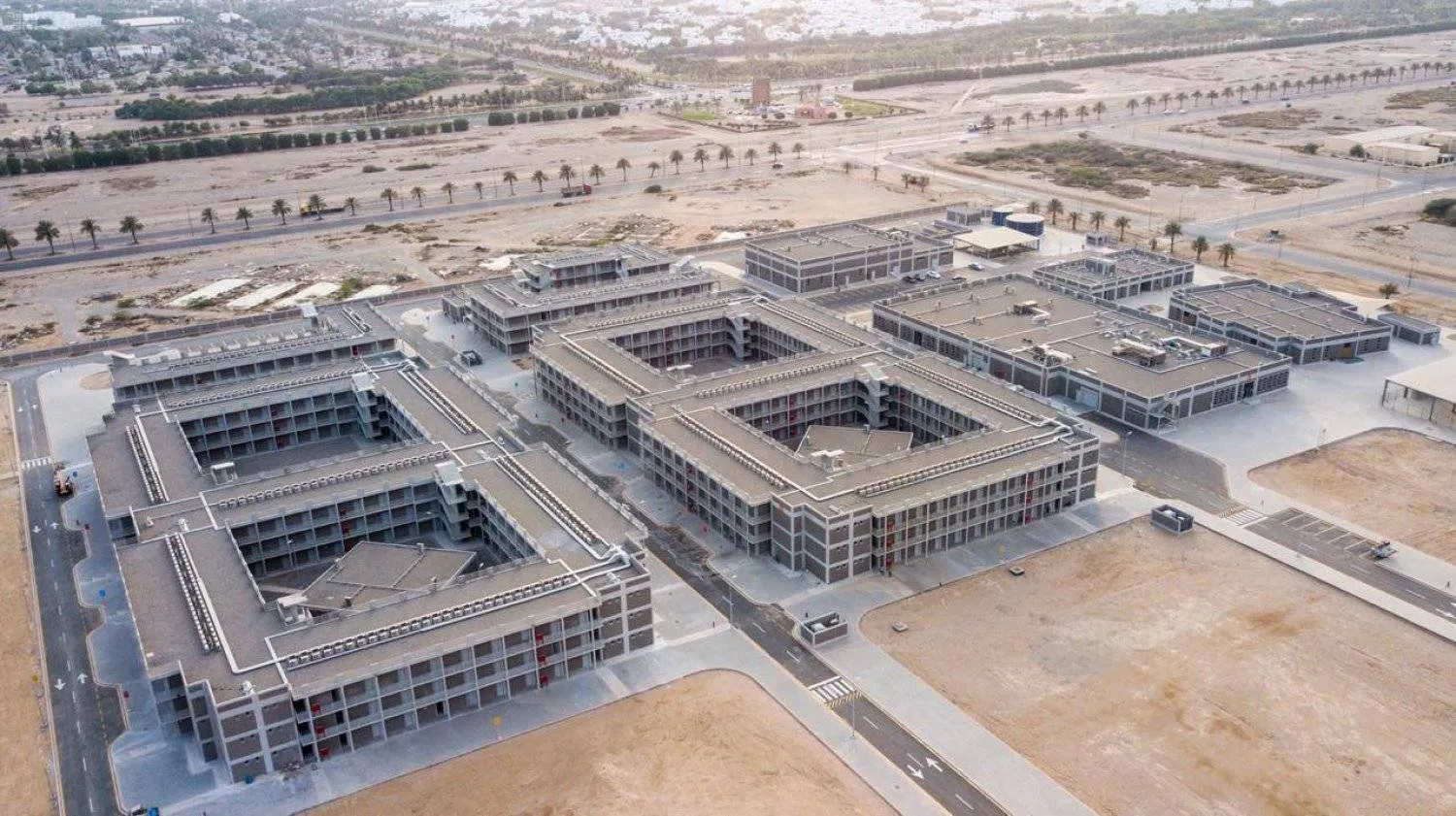

Saudi PIF Invests in Workers' Housing to Meet Demands of Megaprojects

Housing complexes for workers affiliated with the Royal Commission in Yanbu (SPA)
TT

Saudi PIF Invests in Workers' Housing to Meet Demands of Megaprojects

Housing complexes for workers affiliated with the Royal Commission in Yanbu (SPA)

The Public Investment Fund (PIF) has announced plans to invest in workers’ housing and develop more residential complexes for laborers involved in Saudi Arabia’s major construction and development projects. Experts say this move will increase the supply of housing solutions, especially in light of upcoming global events such as Expo 2030 and the 2034 FIFA World Cup, as well as the ongoing megaprojects in the Kingdom.
The PIF has launched the Smart Accommodation for Residential Complexes Co. (SARCC), a company focused on the development and operation of residential complexes for workers across key construction and development projects in the country. SARCC aims to meet the growing demand for worker housing solutions and provide services for both public and private projects nationwide.
Real estate experts believe this new company will help ease pressure on family housing by creating additional housing options for workers. This is expected to boost the overall supply of housing and, in turn, help reduce prices and contribute to the goal of increasing the homeownership rate for Saudi families to 70% by 2030.
Khaled Al-Mobid, CEO of Menassat Real Estate, highlighted that one of the biggest challenges for the Kingdom’s development is the rising demand for labor due to the ongoing megaprojects. He pointed out that these workers need suitable housing, but the market currently suffers from a shortage of available options, many of which are not suitable for workers.
Al-Mobid noted that the PIF’s decision to launch a real estate development company focused on worker housing is a timely and beneficial step that will address the issue of workers living in inadequate areas.
Ahmed Omar Basodan, another expert in real estate, said that establishing SARCC aligns with the scale of the ongoing megaprojects and upcoming global events like Expo 2030 and the 2034 FIFA World Cup, which will require a massive workforce. Basodan emphasized that the new company will help move workers out of family housing and into specialized residential complexes, increasing the supply of housing and supporting the goal of 70% homeownership by 2030.
He further noted that the PIF has already launched companies in the real estate sector, such as Roshn Group, Saudi Downtown Company, and New Murabba Development Company, recognizing the significant opportunities within Saudi Arabia’s real estate market.
According to the PIF’s statement, SARCC will play a key role in developing the housing sector by investing in and managing worker housing complexes. It will also enhance housing standards for workers by developing and operating projects that meet international standards set by the European Bank for Reconstruction and Development and the International Finance Corporation, which is part of the World Bank.


New Aramco Digital Network to Enable Secure Industrial Connectivity across Saudi Arabia

New Aramco Digital Network to Enable Secure Industrial Connectivity across Saudi Arabia
TT

New Aramco Digital Network to Enable Secure Industrial Connectivity across Saudi Arabia

New Aramco Digital Network to Enable Secure Industrial Connectivity across Saudi Arabia

Aramco Digital, the technology subsidiary of Saudi Aramco, is set to launch the Kingdom’s national industrial communications network operating in the 450 MHz band. Designed to deliver secure, highly reliable industrial connectivity across Saudi Arabia, the network will support sectors that require continuous operations and dependable communications for critical assets and facilities.

As part of the launch, Aramco Digital will introduce a comprehensive portfolio of 450 MHz-based industrial digital solutions, including tailored connectivity packages for various sectors and a new generation of smart radios developed specifically for demanding industrial environments, SPA reported.

These smart radios combine rugged, industrial-grade design with advanced capabilities such as AI, enhanced sensing technologies, extended battery life through improved energy efficiency, and real-time data processing at the device level. Together, these features will support operational accuracy, reliability, and continuity in complex operating conditions.

The network will enable a broad range of Industrial Internet of Things (IIoT) applications, including asset condition and performance monitoring, fleet and equipment tracking, air quality and environmental sensing, smart video surveillance, smart metering, lighting and infrastructure control, and industrial mobility and fleet management solutions. These capabilities will enhance operational transparency, support automation, and improve efficiency across both industrial and service sectors.

The network is intended to underpin the Kingdom’s next phase of industrial development and support the objectives of Saudi Vision 2030. By providing a highly reliable national communications infrastructure, the network will enable advanced automation, intelligent systems, and digital services in vital sectors.


Oil Rises as Market Focuses on Venezuela and US Sanctions Plans

A view shows disused oil pump jacks at the Airankol oil field operated by Caspiy Neft in the Atyrau Region, Kazakhstan April 2, 2025. REUTERS/Pavel Mikheyev
TT

Oil Rises as Market Focuses on Venezuela and US Sanctions Plans

A view shows disused oil pump jacks at the Airankol oil field operated by Caspiy Neft in the Atyrau Region, Kazakhstan April 2, 2025. REUTERS/Pavel Mikheyev

Oil prices rose on Thursday after two days of declines as investors assessed Venezuela developments and reports on progress of proposed US sanctions legislation against countries doing business with Russia.

Brent crude futures were up 59 cents, or 0.98%, at $60.55 a barrel by 1038 GMT. US ‌West Texas Intermediate ‌crude gained 58 cents, or 1%, ‌to $56.57.

Higher ⁠prices ​are ‌led by the US President allowing the Russia sanctions bill to advance, as it raises fears of further disruption to Russian oil exports, said PVM analyst Tamas Varga. Republican Senator Lindsey Graham said on Wednesday that Trump had given the green light on the legislation, adding that the bill could be put ⁠to a vote as early as next week.

Both benchmarks fell more than ‌1% for a second day on Wednesday, ‍with market participants expecting ‍abundant global supply this year. Analysts at Morgan Stanley forecast ‍a surplus of as much as 3 million barrels per day in the first half of 2026. US gasoline and distillate stocks increased by more than analyst expectations in the week ended January ​2, while crude stocks fell, the Energy Information Administration said on Wednesday. On Tuesday, Washington announced a deal with ⁠Caracas to gain access to up to $2 billion of Venezuelan crude. The deal initially could require the rerouting of cargoes that were bound for China, sources told Reuters. Chinese independent refiners that consume much of the country's Venezuelan imports could switch to Iranian oil to make up the shortfall. The US seized two Venezuela-linked oil tankers in the Atlantic Ocean on Wednesday, one sailing under Russia's flag, as part of President Donald Trump's aggressive push to dictate oil flows in the Americas and force ‌Venezuela's socialist government to become an ally.


Gold Falls as Commodity Index Rebalancing Sparks Selling Pressure

UK gold bars and gold Sovereign coins are displayed at Baird & Co in Hatton Garden in London, Britain, October 8, 2025. REUTERS/Hiba Kola//File Photo
TT

Gold Falls as Commodity Index Rebalancing Sparks Selling Pressure

UK gold bars and gold Sovereign coins are displayed at Baird & Co in Hatton Garden in London, Britain, October 8, 2025. REUTERS/Hiba Kola//File Photo

Gold prices fell on Thursday as investors braced for futures selling tied to a commodity index reshuffle, with a stronger US dollar adding pressure by making the metal costlier for overseas buyers.

Spot gold fell 0.6% to $4,428.06 per ounce, as of 1115 GMT. US gold futures for February delivery fell 0.6% to $4,436.30.

"Gold and silver remain under pressure as the annual commodity-index ‌rebalancing gets ‌underway. Over the next five days, COMEX ‌futures ⁠could ​see ‌selling in the region of $6 to $7 billion in each metal," said Ole Hansen, head of commodity strategy at Saxo Bank.

The annual Bloomberg Commodity Index rebalancing, designed to keep the index aligned with the current state of the global commodity market, begins this week, Reuters reported.

"(The US-Venezuela conflict) added a small georisk premium at the beginning of ⁠the week which is now deflating as the attention turns to the rebalancing," ‌Hansen added.

Meanwhile, the US dollar hovered ‍near a one-month high ‍as investors assessed mixed economic data ahead of Friday’s nonfarm payrolls ‍report.

Data on Wednesday showed US job openings dropped to a 14-month low in November while hiring resumed its sluggish tone, pointing to ebbing labor demand.

Investors are now awaiting the US non-farm payrolls data for ​more clues on monetary policy, with markets pricing in two interest rate cuts by the Federal Reserve ⁠this year.

On the geopolitical front, the US seized two Venezuela-linked oil tankers in the Atlantic Ocean on Wednesday.

Spot silver lost 3.2% to $75.64 per ounce, after hitting an all-time high of $83.62 on December 29.

HSBC sees gold hitting $5,000 per ounce in the first half of 2026 on geopolitical risks and rising fiscal debts, and expects silver to trade between $58 and $88 in 2026, driven by supply deficits, robust investment demand, and high gold prices, but warned of a market correction later in the year.

Spot platinum was ‌down 4.2% at $2,211.94 per ounce, while palladium shed 2.4% to $1,721.61 per ounce.
