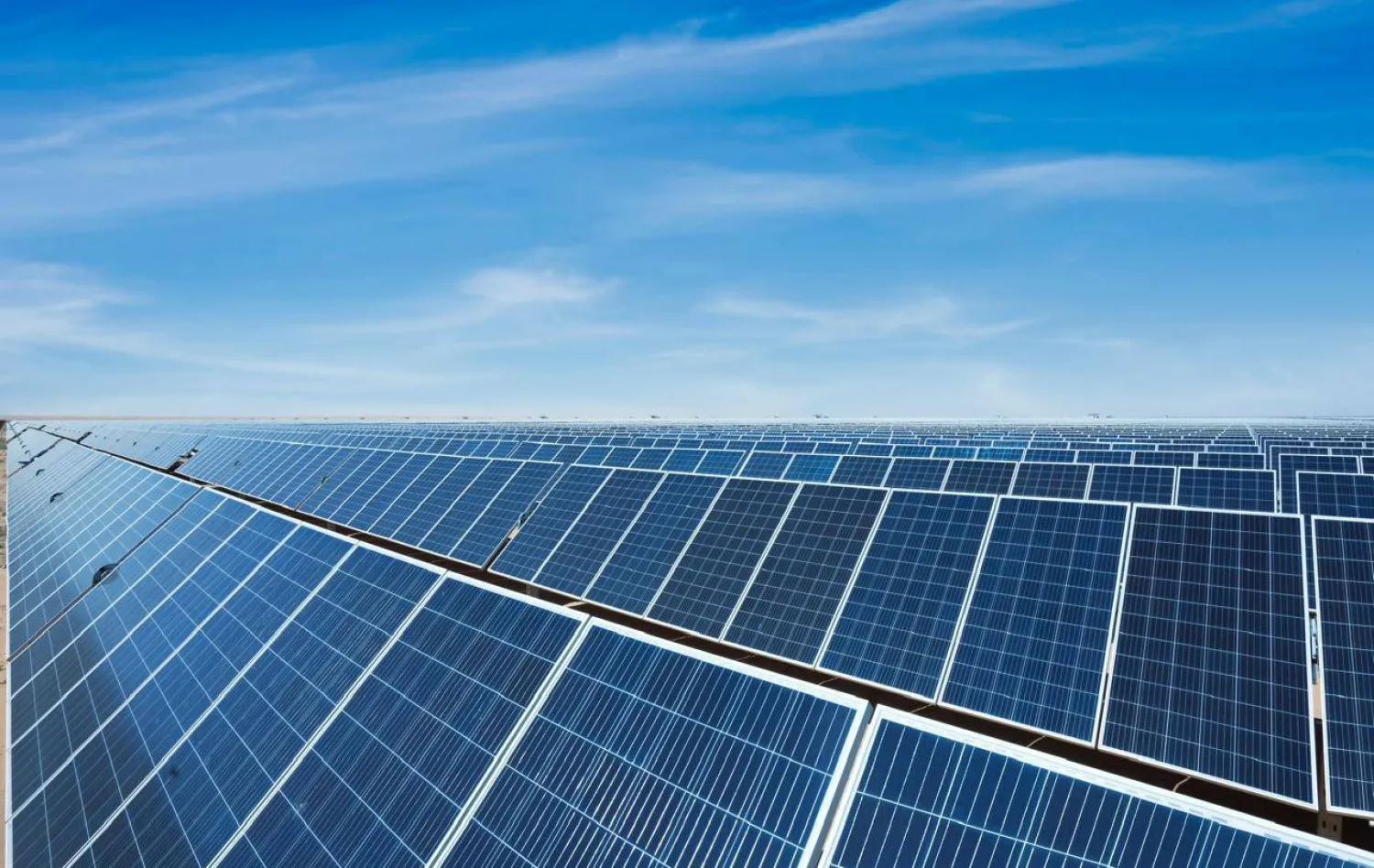
Abu Dhabi's Masdar Buys 234 MW Photovoltaic Solar Project in Spain

The project is expected to be operational by the first half of 2027. Photo: WAM
TT

Abu Dhabi's Masdar Buys 234 MW Photovoltaic Solar Project in Spain

The project is expected to be operational by the first half of 2027. Photo: WAM

Abu Dhabi's state-owned renewable power company Masdar said on Thursday it has bought Valle Solar, one of the largest photovoltaic solar projects in Spain's Valencia region.
The project, expected to be operational by the first half of 2027, will feature a 234 megawatt solar plant with a potential 259 MW battery energy storage system, Masdar said in a statement.
The acquisition was conducted through Masdar's wholly owned subsidiary, Saeta, which it acquired from Canada's Brookfield in a $1.4 billion deal in September.


OPEC+ Hikes Oil Production Quotas, Reaffirms Commitment to Market Stability

FILE PHOTO: A view shows the logo of the Organization of the Petroleum Exporting Countries (OPEC) outside its headquarters in Vienna, Austria, May 28, 2024. REUTERS/Leonhard Foeger/File Photo
TT

OPEC+ Hikes Oil Production Quotas, Reaffirms Commitment to Market Stability

FILE PHOTO: A view shows the logo of the Organization of the Petroleum Exporting Countries (OPEC) outside its headquarters in Vienna, Austria, May 28, 2024. REUTERS/Leonhard Foeger/File Photo

The seven OPEC+ countries, which had previously announced additional voluntary adjustments in April and November 2023, namely Saudi Arabia, Russia, Iraq, Kuwait, Kazakhstan, Algeria, and Oman, met virtually on Sunday, deciding a production adjustment of 188,000 barrels per day.

“In their collective commitment to support oil market stability, the seven participating countries decided to implement a production adjustment of 188,000 barrels per day from the additional voluntary adjustments announced in April 2023,” a statement issued after the meeting said.

“The additional voluntary adjustments announced in April 2023 may be returned in part or in full subject to evolving market conditions and in a gradual manner,” it said.

The countries added that they “will continue to closely monitor and assess market conditions.”

While stressing market stability, they reaffirmed the importance of adopting a cautious approach and retaining full flexibility to increase, pause or reverse the phase out of the voluntary production adjustments, including reversing the previously implemented voluntary adjustments announced in November 2023.

The seven OPEC+ countries also noted that this measure will provide an opportunity for the participating countries to accelerate their compensation.

They reiterated their collective commitment to achieve full conformity with the Declaration of Cooperation, including the additional voluntary production adjustments that will be monitored by the Joint Ministerial Monitoring Committee (JMMC). They also confirmed their intention to fully compensate for any overproduced volume since January 2024.

The seven OPEC+ countries said they will meet again on June 7.


Nissan Says Gulf Strategy Unchanged Despite Geopolitical Challenges

Cartier during a presentation at a company event (Asharq Al-Awsat)
TT

Nissan Says Gulf Strategy Unchanged Despite Geopolitical Challenges

Cartier during a presentation at a company event (Asharq Al-Awsat)

Nissan Motor Co.’s Chief Performance Officer Guillaume Cartier said the Gulf and Middle East remain central to the company’s growth and profitability despite recent geopolitical challenges, adding that investment plans in the region remain unchanged.

Cartier told Asharq Al-Awsat that the automaker is securing supply chains through alternative logistics routes to ensure the continued flow of vehicles and spare parts, as it seeks to sustain operations in one of its key global markets.

He said Nissan has rerouted shipments in recent weeks to alternative ports, including Jeddah in Saudi Arabia and Fujairah in the United Arab Emirates, while using transit hubs in Sri Lanka and Singapore.

The steps have secured supplies for the next four months, he said, amid continued uncertainty over regional demand.

Cartier described current geopolitical pressures as temporary and said Nissan’s strategic direction in Saudi Arabia and the Gulf remains steady.

He added that the company remains confident in the region’s long-term outlook and will continue executing its plans.

New strategy

Cartier said Nissan’s new strategy hinges on tight alignment across product, market and technology execution.

He said cutting models from 56 to 45 is aimed at boosting efficiency, not reducing market presence.

The strategy focuses on placing the right product in the right market and channeling investment into higher-return models to drive sales volumes.

Customer acceptance of new technologies will be decisive, he said.

Performance and outlook

Cartier said the “Re:Nissan” plan will run through 2026, with a final review in 2027, adding that performance is very positive and ahead of plan following the restructuring that improved efficiency and profitability.

He described Gulf markets, led by Saudi Arabia, as a “golden jewel” among high-value markets, citing Nissan’s strong presence and broad customer base.

The expansion strategy centers on a broad lineup across segments, including SUVs such as Patrol, Pathfinder and X-Trail, alongside models sourced from Japan, China and India.

Saudi Arabia is the region’s largest market, where Nissan already posts strong performance, and the diversified lineup is expected to support further growth, he said.

Regional push

Cartier said Nissan is expanding beyond the Gulf, strengthening its presence in Syria and broadening operations in Iraq as part of a push to widen its regional footprint and tap emerging opportunities.

The move reflects a focus on markets with future growth potential despite challenges, he added.

US, China targets

Nissan aims to sell more than one million vehicles annually in both the United States and China by 2030 by delivering the right product with the right technology, Cartier said.

He said the US strategy will focus on SUVs and hybrid V6 vehicles, while China will see a faster rollout of electric and hybrid models and broader market coverage.

2030 vision

Cartier said Nissan is working toward a distinct global identity by 2030 built on innovation and boldness, integrating technology and design into a new brand promise.

The company is developing vehicles designed to stand out from competitors by combining performance with advanced technologies, he added.

Hybrids and AI

Cartier said Nissan is stepping up investment in its third-generation e-Power hybrid technology, improving fuel consumption, emissions and noise levels.

He said slower-than-expected electric vehicle adoption in some regions makes hybrids a practical option for now, especially in markets such as Saudi Arabia, where infrastructure is still developing.

Artificial intelligence is a core pillar of Nissan’s strategy, with plans to expand advanced driver assistance systems such as ProPILOT to around 90% of production in the future, he said.

The aim is to deliver technology at scale in a practical way that improves customer experience and safety.


Trump Auto Tariff Hike Could Cost Germany Nearly $18 Billion in Output

A worker wears a protective mask at the Volkswagen assembly line in Wolfsburg, Germany, April 27, 2020. (Swen Pfoertner/Reuters)
TT

Trump Auto Tariff Hike Could Cost Germany Nearly $18 Billion in Output

A worker wears a protective mask at the Volkswagen assembly line in Wolfsburg, Germany, April 27, 2020. (Swen Pfoertner/Reuters)

The tariff hike on cars and trucks from the European Union announced by US President Donald Trump could cost Germany nearly 15 billion euros ($17.58 billion) in output, an economic institute told Reuters on Saturday.

The estimate from the Kiel Institute for the World Economy (IfW) highlights the exposure of the EU's largest economy to US import tariffs, which have already cost the German automotive industry billions.

"The effects would be substantial," IfW President Moritz Schularick said, ⁠with output losses ⁠rising to around 30 billion euros over the longer term, according to the institute's analysis.

Trump said on Friday he would increase the auto tariffs to 25% next week from a previously agreed 15%, saying the bloc had not complied ⁠with its trade deal with Washington.

"Germany's already sluggish growth rate would be hit hard," IfW economist Julian Hinz said.

The institute currently expects the German economy to grow by 0.8% this year.

Other European economies with significant automotive sectors - including Italy, Slovakia, and Sweden - are also likely to suffer significant losses, it added.

The German economy minister's chief adviser advised caution towards Trump.

"The EU should ⁠simply ⁠wait and see for now," Jens Suedekum told Reuters.

"It is well known that Trump is quick to suspend or withdraw his grandiose tariff threats."

The president must explain why he thinks the EU is not complying with the existing trade agreement, Suedekum said, adding that it was also not clear whether there was a legal basis for the latest tariff threat.

"It all seems quite impulsive," the adviser said.