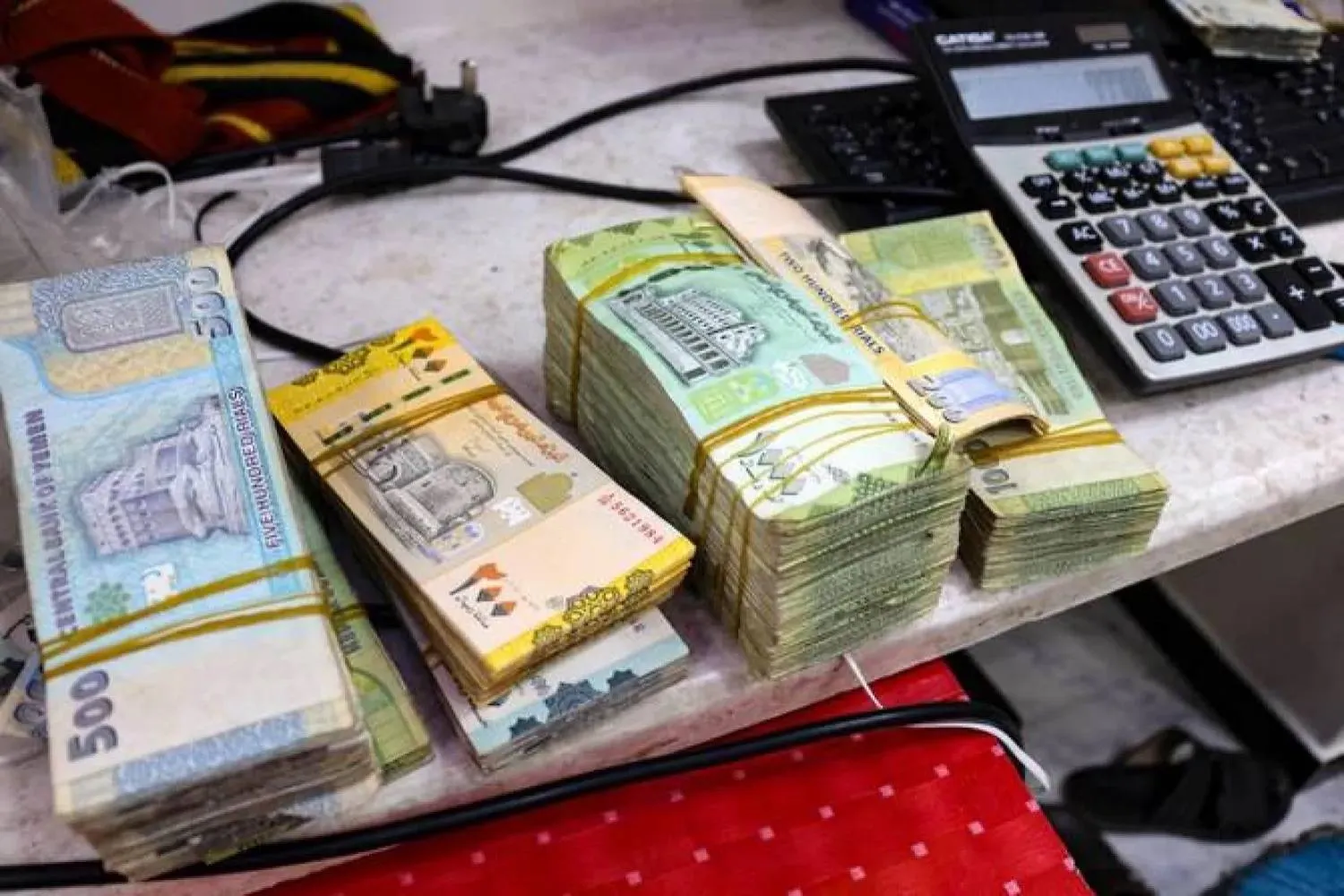
Yemen’s Fragile Economy Feels the Heat of Iran-Israel Conflict

Fears mount over the impact of military escalation on the Yemeni currency, which has recently seen a rapid decline (AFP). 
TT

Yemen’s Fragile Economy Feels the Heat of Iran-Israel Conflict

Fears mount over the impact of military escalation on the Yemeni currency, which has recently seen a rapid decline (AFP). 

The ripple effects of the escalating conflict between Iran and Israel are being felt in Yemen’s fragile economy. The already-depreciated Yemeni rial has fallen further, fuel prices have surged following a government decision, and fears of wider inflation loom over one of the region’s most vulnerable economies.

Last week, the exchange rate for the US dollar crossed 2,750 Yemeni rials before slightly retreating. Economists warn the rial will likely continue to weaken amid broader regional instability. In response, Prime Minister Salem bin Braik announced an emergency 100-day plan to stabilize the economy and ensure basic state obligations, including public sector salaries.

The government also introduced new fuel pricing, raising costs by up to $1 per 20-liter container of gasoline and diesel. This marks the fourth fuel price hike this year, compounding pressure on Yemen’s already burdened consumers.

With Yemen importing over 95% of its goods, any increase in global shipping costs or insurance premiums immediately impacts domestic prices.

Economist Rashid Al-Ansi explained to Asharq Al-Awsat that the cost of food, fuel, and other essential goods is rising due to the weakened currency and regional tensions. Unlike neighboring countries, he added, Yemen lacks the fiscal space and policy flexibility to absorb such shocks.

Adding to the strain, foreign currency reserves are being depleted as locals rush to convert their savings into dollars or gold amid fears of an open war between Israel and Iran. This has raised concerns of further rial depreciation and capital flight, according to economist Fares Al-Najjar.

Al-Najjar also warned that remittance flows - Yemen’s main source of foreign currency - may decline due to global uncertainty, reducing the central bank’s ability to stabilize the market. The government is already struggling to fund basic services, including electricity in Aden and water supply in Taiz.

Experts are particularly concerned about potential disruption to maritime trade. If military tensions spill over into the Red Sea or Gulf of Aden, Yemen’s surrounding waters could be labeled “high-risk zones,” driving shipping and insurance costs up by as much as 300%. This would cripple import flows and make oil exports - Yemen’s last lifeline for foreign currency - nearly impossible.


US Renews Russian Oil Waiver for a Month to Curb Global Energy Prices

US Treasury Secretary Scott Bessent speaks with reporters in the James Brady Press Briefing Room at the White House, Wednesday, April 15, 2026, in Washington. (AP)
TT

US Renews Russian Oil Waiver for a Month to Curb Global Energy Prices

US Treasury Secretary Scott Bessent speaks with reporters in the James Brady Press Briefing Room at the White House, Wednesday, April 15, 2026, in Washington. (AP)

Washington renewed on Friday a waiver allowing countries to buy sanctioned Russian oil at sea for about a month, even as lawmakers accused the government ‌of going easy on Moscow as its war on Ukraine grinds on.

The Treasury Department's waiver lets countries purchase Russian oil and petroleum products loaded on vessels as of Friday through May 16.

It replaces a 30-day waiver that expired on April 11 and excludes transactions involving Iran, Cuba and North Korea.

Reversal

The move is part of the administration's effort to control global energy prices that have shot higher during the US-Israeli war with Iran.

It came after countries in Asia, suffering from the global energy shock, pressed Washington to allow alternative supplies to reach markets.

“As negotiations (with Iran) accelerate, Treasury wants to ensure oil is available to those ⁠who need it,” a Treasury Department spokesperson said.

Last Wednesday, Treasury Secretary Scott Bessent said Washington would not be renewing the waiver for Russian oil and another for Iranian oil, which is set to expire on Sunday.

Global oil prices tumbled 9% on Friday to about $90 a barrel after Iran temporarily reopened the Strait of Hormuz, an oil choke point in the Gulf. But the war has already created the worst global energy supply disruption in history, the International Energy Agency has said.

The war, which enters its eighth week on Saturday, has damaged more than 80 oil and gas facilities in the Middle East, and Tehran has warned it could close the strait again if the recent US Navy blockade of Iranian ports continued.

High oil prices are a threat to President Donald Trump's fellow Republicans ahead of November's midterm elections.

Trump has also faced pressure from partner countries on the oil price.

A US source told Reuters partner countries on the sidelines of Group of 20, World Bank and International Monetary Fund meetings ‌in Washington ⁠this week had requested the US extend the waiver. Trump also spoke about oil this week in a call with Prime Minister Narendra Modi of India, a big purchaser of Russian oil.

The waiver on Iranian oil, which the Treasury Department issued on March 20, allowed about 140 million barrels of oil to reach global markets and helped relieve pressure on energy supply, Bessent said last month.

Lasting damage

US lawmakers from both political parties had slammed the administration over the sanctions waivers, saying they stood to help the economy of Iran while it was at war ⁠with the US and of Russia as it was at war with Ukraine.

The waivers could impede the West's efforts to deprive Russia of revenue for its war in Ukraine and put Washington at odds with its allies. European Commission President Ursula von der Leyen has said now is not the time to relax sanctions against Russia.

Russian President Vladimir Putin's special envoy Kirill Dmitriev ⁠said an extension of the US waiver will affect another 100 million barrels of Russian oil, bringing the total volume affected by both waivers to 200 million barrels.

Dmitriev, who travelled to the US on April 9 for meetings with members of the Trump administration ahead of the previous waiver expiry, said on his Telegram channel that the ⁠extension faced “active political opposition.”

Brett Erickson, a sanctions expert at the consulting firm Obsidian Risk Advisors, said Friday's renewal is likely not the last waiver Washington will issue.

“The conflict has done lasting damage to global energy markets, and the tools available to stabilize them are nearly exhausted,” Erickson said.


Turkmenistan, China Launch Expansion of World’s Second-largest Gas Field

Former Turkmen president Gurbanguly Berdymukhamedov and Chinese Vice Premier Ding Xuexiang applaud during a ceremony launching the fourth of seven planned development phases at Galkynysh gas field, the world's second-largest gas field in the Karakum desert about 400 kilometres (250 miles) east of the capital Ashgabat, on April 17, 2026. (Photo by AFP)
TT

Turkmenistan, China Launch Expansion of World’s Second-largest Gas Field

Former Turkmen president Gurbanguly Berdymukhamedov and Chinese Vice Premier Ding Xuexiang applaud during a ceremony launching the fourth of seven planned development phases at Galkynysh gas field, the world's second-largest gas field in the Karakum desert about 400 kilometres (250 miles) east of the capital Ashgabat, on April 17, 2026. (Photo by AFP)

Turkmenistan and China broke ground Friday on works to expand production at the giant Galkynysh gas field, strengthening Beijing's already dominant position in the secretive Central Asian nation's energy sector.

The former Soviet republic, which holds the world's fourth-largest gas reserves, has exported nearly all its production to China since 2009, when the Central Asia-China pipeline opened.

In the middle of the desert, former president Gurbanguly Berdymukhamedov -- who effectively runs the country alongside his son, President Serdar Berdymukhamedov -- formally inaugurated the launch of the fourth of seven planned development phases at Galkynysh.

The ceremony was attended by Chinese Vice Premier Ding Xuexiang, an AFP correspondent saw.

"Turkmen gas is a symbol of happiness -- it is present in every Chinese household," Ding said.

The event featured songs and dances celebrating Turkmen-Chinese friendship, staged with the lavish pomp typical of Turkmenistan's state-sponsored events.

Gurbanguly Berdymukhamedov, officially titled "Hero-Protector" and vested with sweeping powers, presided over the gathering.

Galkynysh, in the Karakum desert about 400 kilometers (250 miles) east of the capital Ashgabat, has been producing gas since 2013 and is the world's second-largest gas field, according to the British consulting firm GaffneyCline.

Expansion works are being carried out by the state-owned China National Petroleum Corporation (CNPC).

On a visit to Ashgabat the day before the ceremony, CNPC chairman Dai Houliang said "the friendship between China and Turkmenistan is as deep as the roots of a tree."


$27 Billion City to be Built East of Cairo

The project covers approximately 2.4 million square meters of land. Asharq Al-Awsat
TT

$27 Billion City to be Built East of Cairo

The project covers approximately 2.4 million square meters of land. Asharq Al-Awsat

Egypt's Talaat Moustafa Group (TMG) will build a new 1.4 trillion Egyptian pound ($27 billion) mixed-use city east of Cairo, CEO and Managing Director Hisham Talaat Moustafa said at a press conference on Saturday.

The project, called The Spine, is to be developed in partnership with ⁠the National Bank ⁠of Egypt, with a paid-up capital of 69 billion Egyptian pounds ($1.3 billion).

The project, to be built as a Special Investment ⁠Zone with TMG's Madinaty, covers approximately 2.4 million square meters of land, combining residential, commercial, hospitality, retail, entertainment, and public green space within a single continuous urban environment.

The investment is equivalent to roughly 1% of Egypt's GDP, according to Moustafa, and is ⁠projected ⁠to generate approximately 818 billion Egyptian pounds in tax revenues for the state budget over time.

The project is expected to create more than 55,000 direct jobs and hundreds of thousands of indirect positions.