Iraq Resumes Kurdish Oil Exports to Türkiye after 2-1/2-year Halthttps://english.aawsat.com/business/5190978-iraq-resumes-kurdish-oil-exports-t%C3%BCrkiye-after-2-12-year-halt
Iraq Resumes Kurdish Oil Exports to Türkiye after 2-1/2-year Halt
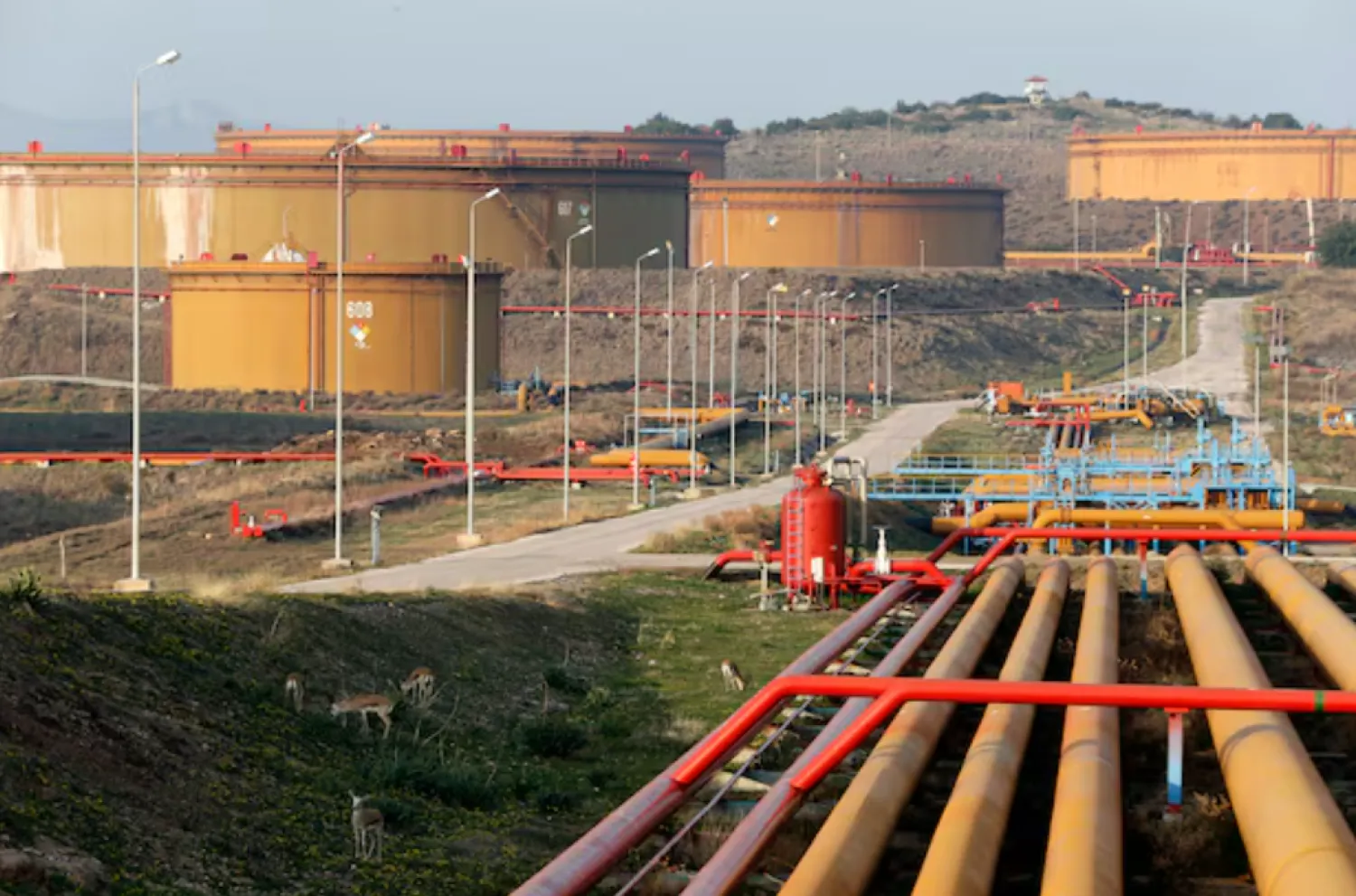
A general view of oil tanks at Türkiye's Mediterranean port of Ceyhan, February 19, 2014. REUTERS/Umit Bektas/File Photo Purchase Licensing Rights
Crude oil flowed on Saturday through a pipeline from the semi-autonomous Kurdistan region in northern Iraq to Türkiye for the first time in 2-1/2 years, after an interim deal broke a deadlock, Iraq's oil ministry said.
The resumption started at 6 a.m. local time (0300 GMT), according to a statement from the ministry.
"Operations started at a rapid pace and with complete smoothness without recording any significant technical problems," the ministry said, Reuters reported.
The agreement between Iraq's federal government, the Kurdistan regional government (KRG) and foreign oil producers operating in the region will allow 180,000 to 190,000 barrels per day of crude to flow to Türkiye's Ceyhan port, Iraq's oil minister told Kurdish broadcaster Rudaw on Friday.
The US had pushed for a restart, which is expected to eventually bring up to 230,000 bpd of crude back to international markets at a time when OPEC+ is boosting output to gain market share.
Iraq's delegate to the Organization of the Petroleum Exporting Countries, Mohammed al-Najjar, said his country can export more than it is now after the resumption of flows via the Kirkuk-Ceyhan pipeline, in addition to other planned projects at Basra port, state news agency INA reported on Saturday.
"OPEC member states have the right to demand an increase in their (production) shares especially if they have projects that led to an increase in production capacity," he said.
Iraq's oil ministry undersecretary Bassem Mohamed told Reuters that the resumption of Kurdish oil flows will help raise the country's exports to nearly 3.6 million bpd in the coming days.
Iraq's production and export levels will remain within its OPEC quota of 4.2 million bpd, he said.
Iraq, the group's largest overproducer, was among states that submitted updated plans to OPEC in April to make further oil output cuts to compensate for pumping above agreed quotas.
Flows through the Kirkuk-Ceyhan pipeline were halted in March 2023 when the International Chamber of Commerce ordered Türkiye to pay Iraq $1.5 billion in damages for unauthorised exports by the Kurdish regional authorities.
Turkish Energy Minister Alparslan Bayraktar also confirmed the resumption of oil exports to Türkiye from Iraq in a post on X.
Gold Eases on Firmer Dollar as Investors Await Clarity on US-Iran Talkshttps://english.aawsat.com/business/5264764-gold-eases-firmer-dollar-investors-await-clarity-us-iran-talks
An image taken with a slow shutter speed showing an Indian woman walking in front of gold ornaments at a jewelry shop on the occasion of the Akshaya Tritiya festivities in Bangalore, India, 20 April 2026. (EPA)
TT
TT
Gold Eases on Firmer Dollar as Investors Await Clarity on US-Iran Talks
An image taken with a slow shutter speed showing an Indian woman walking in front of gold ornaments at a jewelry shop on the occasion of the Akshaya Tritiya festivities in Bangalore, India, 20 April 2026. (EPA)
Gold prices eased on Tuesday as the dollar firmed, while investors waited to see if the US and Iran are meeting this week for peace talks after renewed tensions over the weekend.
Spot gold was down 0.2% at $4,807.91 per ounce, as of 0217 GMT, extending its fall from Monday when it hit the lowest level since April 13. US gold futures for June delivery were steady at $4,827.30.
The US dollar firmed, making greenback-denominated commodities more expensive for holders of other currencies.
Investors are now awaiting "the next headline regarding whether the talks are going to go ahead in Islamabad and then if they do, whether a ceasefire is extended or even better, a peace deal is done," said Kyle Rodda, a senior financial market analyst at Capital.com.
"If those things happen, gold will probably be well supported because oil prices will drop. If those things don't come about, you might start to see some of that volatility come back into the market," Rodda said.
Oil prices fell as investors reassessed supply risks on expectations peace talks between the US and Iran will take place this week and allow more supply to flow from the key Middle East producing region.
Higher crude prices feed into inflation by raising transportation and production costs. Gold is considered an inflation hedge, but high interest rates make yield-bearing assets more attractive, weighing on its appeal.
Iran is considering attending peace talks with the United States in Pakistan, a senior Iranian official told Reuters on Monday, following moves by Islamabad to end a US blockade of Iran's ports, a significant obstacle to Tehran rejoining peace efforts as the end of a two-week ceasefire approaches.
The two-week ceasefire to the conflict that has killed thousands and roiled the global economy, particularly energy markets, is set to expire this week.
Gold prices have fallen about 8% since the US and Israel launched strikes on Iran in late February.
Among other metals, spot silver fell 0.6% to $79.40 per ounce, platinum lost 0.7% to $2,074, while palladium was up 0.3% at $1,556.16.
Iraq Reopens Rabia Border Crossing to Boost Fuel Oil Exports via Syriahttps://english.aawsat.com/business/5264636-iraq-reopens-rabia-border-crossing-boost-fuel-oil-exports-syria
This aerial picture shows cars and trucks loaded with goods waiting to cross over into Syria at the al-Rabia border crossing on April 20, 2026. (AFP)
TT
TT
Iraq Reopens Rabia Border Crossing to Boost Fuel Oil Exports via Syria
This aerial picture shows cars and trucks loaded with goods waiting to cross over into Syria at the al-Rabia border crossing on April 20, 2026. (AFP)
Iraq has reopened the Rabia border crossing with Syria after more than a decade to accelerate overland fuel oil exports and revive cross-border trade amid disruption to Gulf shipping following the Iran war, Iraqi border officials said on Monday.
The crossing, located in Iraq’s northern Nineveh province, will allow fuel oil shipments to be trucked through Syria while also reopening the route to commercial trade traffic that has been halted since the conflict that followed Syria’s civil war, officials said.
The head of Iraq’s Border Ports Commission, Omar al-Waeli, said reopening Rabia would ease pressure on fuel shipments to Syria by allowing more fuel oil trucks to cross, with most convoys currently backed up at the al-Waleed crossing in western Iraq, the only operating border point.
Iraq’s state oil marketer SOMO has recently turned to overland routes through Syria, despite higher costs, as one of the few viable alternatives to keep exports flowing. SOMO awarded contracts to supply about 650,000 metric tons of fuel oil per month from April to June to be trucked overland via Syria.
Convoys of tanker trucks loaded with Iraqi fuel oil are expected to begin crossing in the coming days, adding capacity to an operation that energy officials say has already stretched Iraq’s trucking and border infrastructure.
Iraq had previously exported the bulk of its fuel oil through the Khor al-Zubair terminal on the Gulf.
IFAD to Asharq Al-Awsat: Repercussions of Hormuz Closure Trigger Global Food Security Shockhttps://english.aawsat.com/business/5264575-ifad-asharq-al-awsat-repercussions-hormuz-closure-trigger-global-food-security
IFAD to Asharq Al-Awsat: Repercussions of Hormuz Closure Trigger Global Food Security Shock
A container ship is seen in the Strait of Hormuz off the coast of Qeshm Island, Iran, Saturday, April 18, 2026. (AP Photo/Asghar Besharati)
The International Fund for Agricultural Development (IFAD) said the repercussions of the closure of the Strait of Hormuz have triggered a global food security shock, warning that disruptions to fertilizer and fuel supplies, rising input costs, and declining purchasing power are threatening production at a critical point in the agricultural season. This is driving food prices higher and will severely affect the world’s most vulnerable populations.
Gerardine Mukeshimana, Vice President of IFAD, told Asharq Al-Awsat that the repercussions of the US-Israeli-Iranian conflict have led to a global food security shock that has already begun to manifest in local food crises, particularly for small-scale producers and rural populations.
On this Mukeshimana said “The ripple effects of the conflict have triggered a global food security shock that is already translating into local food crises, particularly for small-scale producers and rural populations. While it is too early to quantify a precise global ‘food gap,’ nor foresee all possible consequences, we do know that many of the women and men who produce our food are already under pressure.”
Critical timing and heightened risks
Mukeshimana stressed the seriousness of the timing, as farmers across nearly half the world are entering critical agricultural seasons between March and June. Any shortage of inputs at this stage will inevitably lead to lower yields and reduced food availability in the coming months.
“Between March and June, farmers across nearly half the world enter critical planting seasons, meaning that input shortfalls and price spikes today risk lower harvests and tighter food availability in the months ahead. As past crises have shown, these shocks do not originate at the farm level, but they ultimately land there, among those with the least capacity to absorb them.”
Impact of shipping disruptions on agricultural production
On the repercussions of the closure of the Strait of Hormuz on the passage of ships carrying agricultural inputs and fertilizers, and estimates of losses over the past 40 days, Mukeshimana said: “The abrupt halt and severe disruption of shipping through the Strait of Hormuz and Bab el-Mandeb has had immediate repercussions for fertilizers, fuel and other agricultural inputs. While exact volume losses over the past 40 days vary by commodity and route, evidence from IFAD investments points to significant shipment delays, curtailed exports and cascading market effects, from reduced planting to distorted farm-gate prices and declining rural incomes, as gathered in detail by the position paper, ‘Global shock, local crisis,’ published by Alvaro Lario, President of IFAD this week.”
She noted that these impacts are clearly reflected in shrinking cultivated areas, distortions in agricultural price structures, and a deterioration in farmers’ net incomes, as documented in the position paper issued this week by IFAD President Alvaro Lario titled “Global shock, local crisis,” which warned that international logistical disruptions are translating into severe local livelihood crises.
Vice-President of IFAD Gerardine Mukeshimana (Asharq Al-Awsat)
Import-dependent countries in a double bind
“The supply chain disruptions are cutting off farmers’ access to markets to both purchase inputs – such as seeds, veterinary medicines, and equipment – and sell their products both domestically and as exports. The result: farmers’ expenses rise as their income drops.”
Mukeshimana said this represents a global risk, as small-scale farmers produce about one-third of the world’s food, and up to 70 percent in Africa. When their production declines due to input shortages, it leads to reduced output, higher prices, deeper vulnerability, and rising hunger.
She warned that these repercussions directly translate into lower production levels, rising prices, and worsening economic vulnerability, ultimately expanding the scope of hunger.
Mukeshimana added that countries that rely on imports face a double bind, as fertilizer shortages and rising costs compound existing pressures from climate shocks, armed conflict, and accumulated debt, making it extremely difficult for these countries to withstand the current crisis.
“In import-dependent countries, fertilizer shortages and price spikes amplify existing pressures from climate shocks, conflict, and debt. Left unaddressed, these shocks can drive wider development setbacks, hunger, increasing humanitarian needs, forced migration, conflict and political instability.”
لم تشترك بعد
انشئ حساباً خاصاً بك لتحصل على أخبار مخصصة لك ولتتمتع بخاصية حفظ المقالات وتتلقى نشراتنا البريدية المتنوعة