


Labubu-Maker Pop Mart Learns from Disney to Capitalize on Toy’s Viral Success 

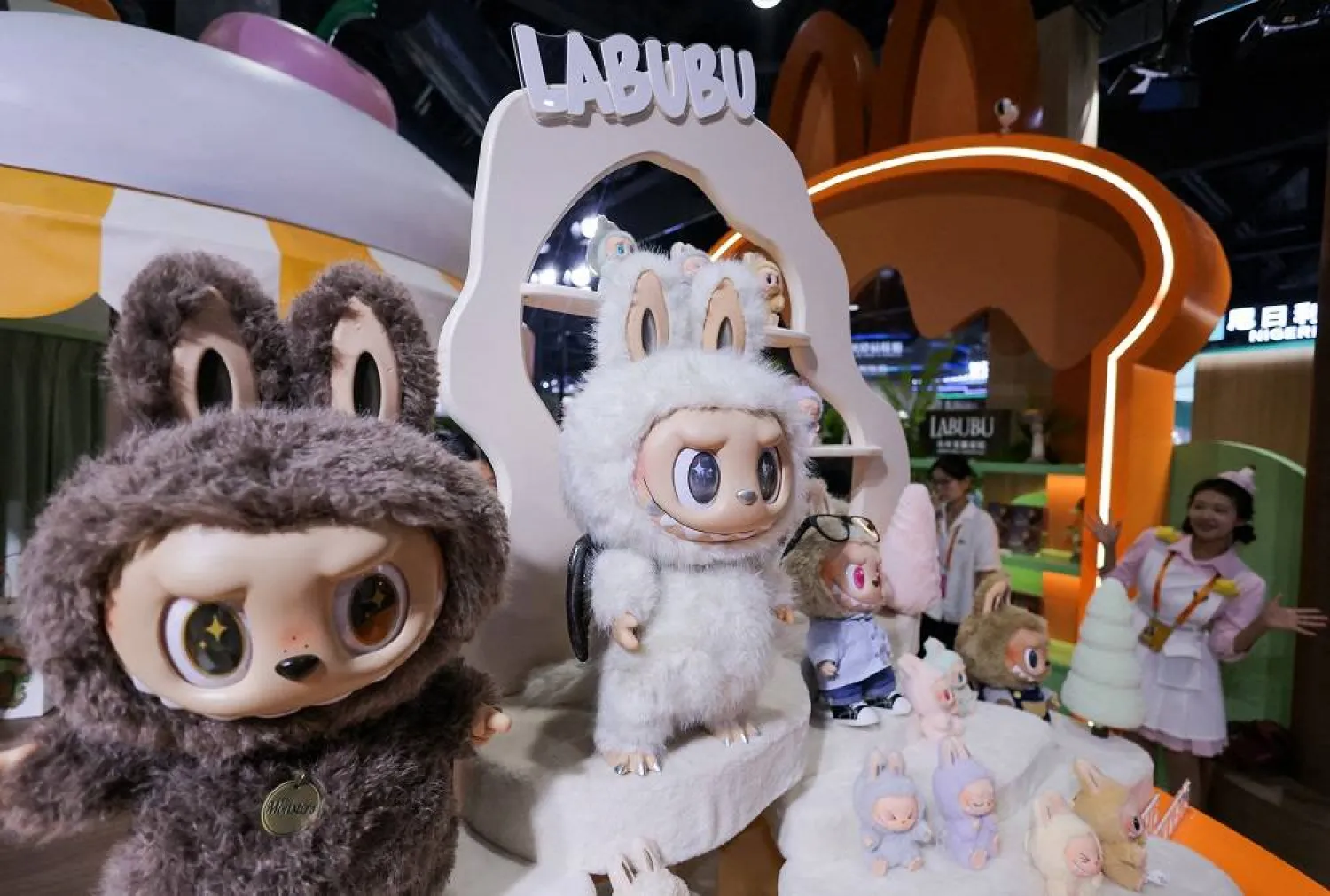
An employee gestures next to Labubu toys on display at Pop Mart's booth at China International Fair for Trade in Services (CIFTIS) in Beijing, China, September 10, 2025. (Reuters)
TT

Labubu-Maker Pop Mart Learns from Disney to Capitalize on Toy’s Viral Success 

An employee gestures next to Labubu toys on display at Pop Mart's booth at China International Fair for Trade in Services (CIFTIS) in Beijing, China, September 10, 2025. (Reuters)

China's Pop Mart is borrowing from Disney's playbook to turn toothy monster Labubu's blockbuster sales into long-term success, Executive Director and co-COO Si De told Reuters in a rare interview.

Pop Mart has already done what many thought impossible - making Labubu the first Chinese product to win a global audience for its emotional and creative appeal rather than because it represents value-for-money.

Now it aims to capitalize on the art toy's success.

"We have learned from Disney for a long time. In fact, Disney's great value lies in its ability to operate IP (intellectual property) over the long-term, even up to 100 years," Si said, pointing to the example of Mickey Mouse, created as a cartoon nearly a century ago.

Even as analysts question Pop Mart's reliance on Labubu and the company's fate as the toy's popularity inevitably cools, the firm itself still sees plenty of potential to develop content, entertainment, theme parks and more merchandise around the character - as Disney does with its most popular IP.

Si did not give a timeline or estimate on investment during the first interview a top executive from the firm has done with foreign media since 2022.

He said Pop Mart's focus in the near-term was not to find the "next big hit" but to invest in "better products, finding better collaborations, developing content, theme parks, store displays" for Labubu, and the eventual goal was to have five to 10 IPs with similar long-term potential to Labubu.

THE LABUBU PARADOX

Labubu's global success has sent the Hong Kong-listed company's shares up almost 200% so far this year, and Pop Mart is now worth more than Hasbro, Mattel and Sanrio combined.

"Pop Mart is selling a lifestyle that consumers are buying because they want to be part of it," said Louis Houdart, China managing partner at Mad, a consulting firm, adding that its margins rivalled some luxury brands.

It has also fueled investment in China's red-hot art toy industry, intensifying the competitive pressure on Pop Mart, the market leader.

Estimates in July from Industry World, a Chinese market intelligence platform, said the Chinese art toy market was expected to reach more than 120 billion yuan ($16.85 billion) in revenue this year, accounting for more than 35% of the global market and maintaining double-digit growth in China.

Though Pop Mart does not break out Labubu sales, the series it belongs to, The Monsters, accounted for almost 35% of total first-half revenue this year, raising questions about the company's dependence on the character.

Labubu's popularity has boosted sales of stablemates such as Molly, Skullpanda and Crybaby (which each had more than 1 billion yuan in sales in the first half), but also fueled curiosity beyond Pop Mart's offerings.

"Because of the success of Pop Mart, there are more people with money wanting to invest in this industry. You see right now there's a lot of new companies and there's definitely more and more artists trying to do IP as a way of making money," said Runyu, the 24-year-old winner of China's first art toy design competition reality TV show.

Other major art toy retailers in China include 52 Toys and Miniso, which traditionally relied on licensing IP from the likes of Disney and Sanrio but is now investing more in original IP development and signing partnerships with art toy designers.

"Pop Mart has blazed a trail" for the rest of China's art toy industry, said Zhou Junyu, head of IP at Siguworks, one of the art toy companies working with Miniso.

As Pop Mart has studied Disney, other firms in China have studied Pop Mart. Whether the Disney model will help it see off the growing competition remains unclear.

"We all know Disney's playbook, which overall is relatively easy to replicate, but its success is not," said Morningstar analyst Jeff Zhang. "I mean, compared to the legacy IP operators like Disney and Sanrio, Pop Mart still has a long way to go and during the process, there is also execution risk."

FOUNDATION FOR SUCCESS

Pop Mart's success with Labubu did not happen overnight and was largely due to strategic decisions taken by founder and CEO Wang Ning over the past decade, three current and former Pop Mart employees said. They declined to be named because they were not authorized to speak to the media.

In 2010, Wang, only 23 but with a string of entrepreneurial ventures behind him, opened a hip lifestyle store in Beijing.

Within a few years he saw collectible figurines accounting for a significant portion of revenue and decided to focus on art toys.

Wang also realized Pop Mart needed to own the IP it sold, according to two former employees, leading him to Kenny Wong - the designer of Molly, with her distinctive pouty face.

Hong Kong-based Wong was dismissive when Wang first approached him in 2016, but he eventually agreed to a trial collaboration.

"During my most difficult years, inventory was my biggest concern, then Wang Ning showed up. He first solved my inventory problem, selling out all of it in a short period of time," Wong told Reuters. Wong handed regional licensing for Molly over to Pop Mart and the success continued. Labubu made its Pop Mart debut in 2019.

"Each time, they achieved remarkable results and progress, so much so that I finally gave them everything I had," Wong said.

Pop Mart's "blind box" retail strategy - where consumers buy packages for around $10 to $20 without knowing exactly which toy is inside - and its focus on characters with appeal to young women, a high-spending consumer group that had previously been largely overlooked by the art toy industry, were the twin foundations of its success, the Pop Mart insiders told Reuters.

"I wouldn't say they have the model 100% right, that every IP is going to be a hit, but I think with the experience they have, they will get it right more than most," one said.



Trump Set to Lead Largest-Ever US Delegation to World Economic Forum in Davos Next Week

This photograph shows a sign of the World Economic Forum (WEF) at the Congress center, during the WEF annual meeting in Davos on January 20, 2025. (AFP)
TT

Trump Set to Lead Largest-Ever US Delegation to World Economic Forum in Davos Next Week

This photograph shows a sign of the World Economic Forum (WEF) at the Congress center, during the WEF annual meeting in Davos on January 20, 2025. (AFP)

US President Donald Trump will return to the World Economic Forum's annual meeting of business, political and cultural elites in Davos, Switzerland next week, leading a record-large US delegation, organizers said Tuesday.

The Geneva-based think tank says Trump, whose assertive foreign policy on issues as diverse as Venezuela and Greenland in recent months has stirred concerns among US friends and foes alike, will be accompanied by five Cabinet secretaries and other top officials for the event running from Monday through Jan. 23.

A total of 850 CEOs and chairs of the world's top companies will be among the 3,000 participants from 130 countries expected in the Alpine resort this year, the forum says.

Forum President Borge Brende says six of seven G7 leaders — including Trump — will attend, as well as presidents Volodymyr Zelenskky of Ukraine, Ahmed al-Sharaa of Syria and others. A total of 64 heads of state or government are expected so far — also a record — though that number could increase before the start of the event, he said.

China's delegation will be headed by Vice Premier He Lifeng, Beijing's top trade official, Brende said.

The forum, which held its first annual meeting in 1971, has long been a hub of dialogue, debate and deal-making. Trump has already attended twice while president and was beamed in by video last year just days after being inaugurated for his second term.

Critics call it a venue for the world’s elites to hobnob and do business that sometimes comes at the expense of workers, the impoverished or people on the margins of society. The forum counters that its stated goal is “improving the state of the world” and insists many advocacy groups, academics and cultural leaders have an important role too.


World Bank: Global Economy Shows Resilience Amid Historic Trade, Policy Uncertainty

A woman places coins inside a red wallet in Germany. (dpa)
TT

World Bank: Global Economy Shows Resilience Amid Historic Trade, Policy Uncertainty

A woman places coins inside a red wallet in Germany. (dpa)

The global economy is proving more resilient than anticipated despite persistent trade tensions and policy uncertainty, according to the World Bank’s latest Global Economic Prospects report. Global growth is projected to remain broadly steady over the next two years, easing to 2.6% in 2026 before rising to 2.7% in 2027, an upward revision from the June forecast.

The resilience reflects better-than-expected growth, especially in the United States, which accounts for about two-thirds of the upward revision to the forecast in 2026. Even so, if these forecasts hold, the 2020s are on track to be the weakest decade for global growth since the 1960s. The sluggish pace is widening the gap in living standards across the world, the report finds: at the end of 2025, nearly all advanced economies enjoyed per capita incomes exceeding their 2019 levels, but about one in four developing economies had lower per capita incomes.

In 2025, growth was supported by a surge in trade ahead of policy changes and swift readjustments in global supply chains. These boosts are expected to fade in 2026 as trade and domestic demand soften. However, the easing global financial conditions and fiscal expansion in several large economies should help cushion the slowdown, according to the report. Global inflation is projected to edge down to 2.6% in 2026, reflecting softer labor markets and lower energy prices. Growth is expected to pick up in 2027 as trade flows adjust and policy uncertainty diminishes.

“With each passing year, the global economy has become less capable of generating growth and seemingly more resilient to policy uncertainty,” said Indermit Gill, the World Bank Group’s Chief Economist and Senior Vice President for Development Economics. “But economic dynamism and resilience cannot diverge for long without fracturing public finance and credit markets.”

“Over the coming years, the world economy is set to grow slower than it did in the troubled 1990s, while carrying record levels of public and private debt. To avert stagnation and joblessness, governments in emerging and advanced economies must aggressively liberalize private investment and trade, rein in public consumption, and invest in new technologies and education.”

In 2026, growth in developing economies is expected to slow to 4% from 4.2% in 2025 before edging up to 4.1% in 2027 as trade tensions ease, commodity prices stabilize, financial conditions improve, and investment flows strengthen. Growth is projected to be higher in low-income countries, reaching an average of 5.6% over 2026-27, buoyed by firming domestic demand, recovering exports, and moderating inflation. However, this will not be sufficient to narrow the income gap between developing and advanced economies.

Per capita income growth in developing economies is projected to be 3% in 2026 - about a percentage point below its 2000-2019 average. At this pace, per capita income in developing economies is expected to be only 12% of the level in advanced economies.

These trends could intensify the job-creation challenge confronting developing economies, where 1.2 billion young people will reach working age over the next decade. Overcoming the jobs challenge will require a comprehensive policy effort centered on three pillars.

The first is strengthening physical, digital, and human capital to raise productivity and employability. The second is improving the business environment by enhancing policy credibility and regulatory certainty so firms can expand. The third is mobilizing private capital at scale to support investment. Together, these measures can help shift job creation toward more productive and formal employment, supporting income growth and poverty alleviation.

In addition, developing economies need to bolster their fiscal sustainability, which has been eroded in recent years by overlapping shocks, growing development needs, and rising debt-servicing costs. A special-focus chapter of the report provides a comprehensive analysis of the use of fiscal rules by developing economies, which set clear limits on government borrowing and spending to help manage public finances. These rules are generally linked to stronger growth, higher private investment, more stable financial sectors, and a greater capacity to cope with external shocks.

“With public debt in emerging and developing economies at its highest level in more than half a century, restoring fiscal credibility has become an urgent priority,” said M. Ayhan Kose, the World Bank Group’s Deputy Chief Economist and Director of the Prospects Group.

“Well-designed fiscal rules can help governments stabilize debt, rebuild policy buffers, and respond more effectively to shocks. But rules alone are not enough: credibility, enforcement, and political commitment ultimately determine whether fiscal rules deliver stability and growth.”

More than half of developing economies now have at least one fiscal rule in place. These can include limits on fiscal deficits, public debt, government expenditures, or revenue collection. Developing economies that adopt fiscal rules typically see their budget balance improve by 1.4 percentage points of GDP after five years, once interest payments and the ups and downs of the business cycle are accounted for.

Use of fiscal rules also increases by 9 percentage points the likelihood of a multi-year improvement in budget balances. However, the medium- and long-term benefits of fiscal rules depend heavily on the strength of institutions, the economic context in which the rules are introduced, and how the rules are designed, the report finds.


Saudi Industry Minister Discusses Automotive Manufacturing Cooperation with China's BYD

The Saudi and Chinese delegations meet in Riyadh on Tuesday. (SPA)
TT

Saudi Industry Minister Discusses Automotive Manufacturing Cooperation with China's BYD

The Saudi and Chinese delegations meet in Riyadh on Tuesday. (SPA)

Saudi Minister of Industry and Mineral Resources Bandar Alkhorayef held talks in Riyadh on Tuesday with Chinese company BYD Founder and Chairman Wang Chuanfu to discuss cooperation in automotive manufacturing and the transfer of advanced vehicle technologies to the Kingdom.

They explored ways to strengthen industrial cooperation and expand promising investment opportunities to localize the automotive industry in the Kingdom, with particular focus on electric vehicle manufacturing to meet growing domestic demand and reinforce Saudi Arabia’s position as a leading regional and global hub for automotive production.

Discussions tackled the incentives and enablers offered to investors in high-value industries, including the automotive sector, as well as the Kingdom’s significant investments in electric vehicle charging infrastructure.

The meeting highlighted the objectives of the comprehensive strategy for the mining and mineral industries, which emphasizes support for the electric vehicle ecosystem and the development of local supply chains for battery manufacturing and advanced materials.

These efforts help in localizing the automotive industry and advancing the goals of Saudi Vision 2030 to diversify the national economy.