


Washington's Struggling Economy Takes Another Economic Hit from the Government Shutdown

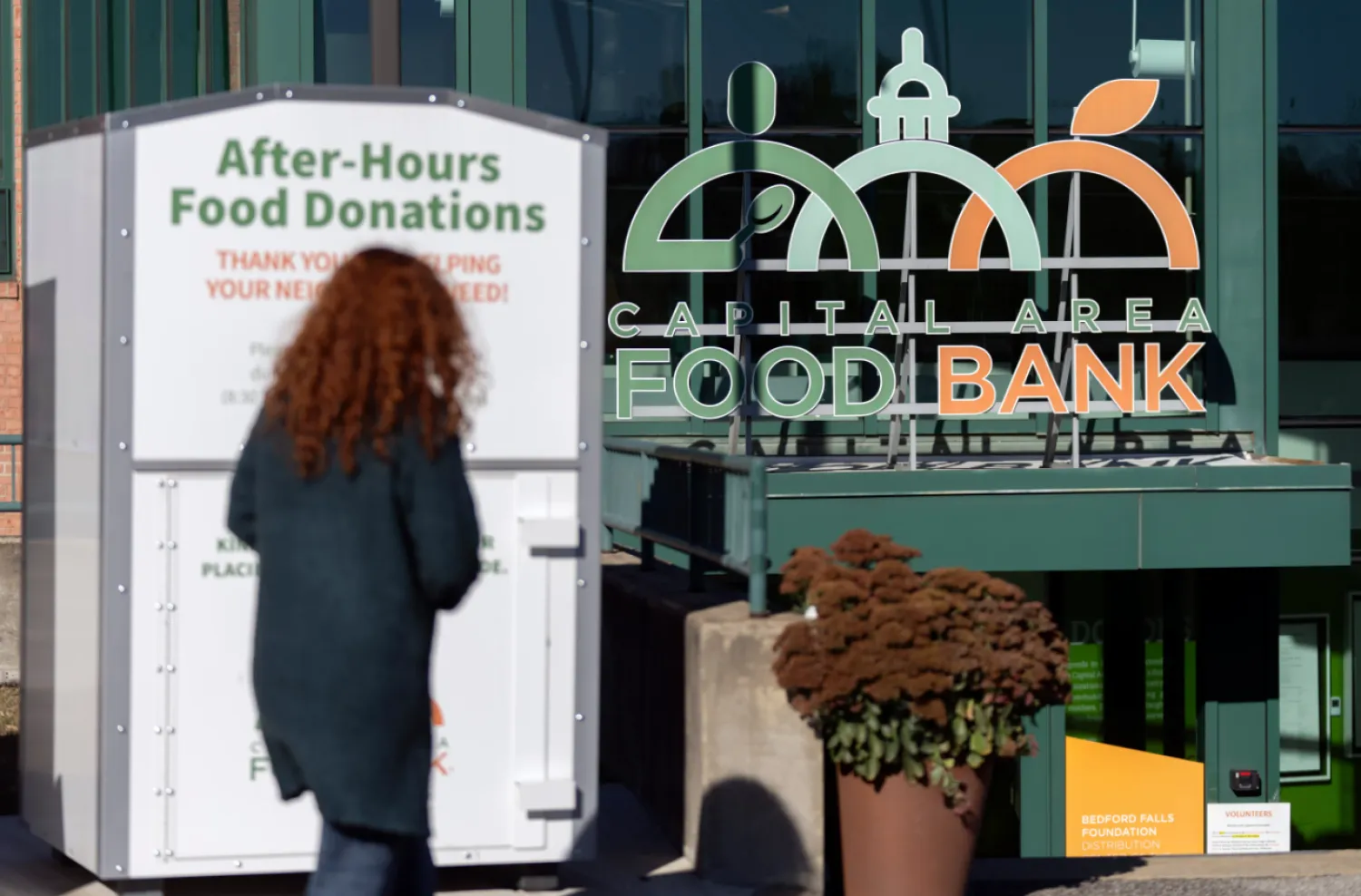
 A person walks toward the entrance of the Capital Area Food Bank, Thursday, Nov. 6, 2025, in Washington. (AP Photo/Mark Schiefelbein)
A person walks toward the entrance of the Capital Area Food Bank, Thursday, Nov. 6, 2025, in Washington. (AP Photo/Mark Schiefelbein)
TT

Washington's Struggling Economy Takes Another Economic Hit from the Government Shutdown

 A person walks toward the entrance of the Capital Area Food Bank, Thursday, Nov. 6, 2025, in Washington. (AP Photo/Mark Schiefelbein)
A person walks toward the entrance of the Capital Area Food Bank, Thursday, Nov. 6, 2025, in Washington. (AP Photo/Mark Schiefelbein)

With the combination of the longest government shutdown, the mass firings of government workers and a fresh cut in federal food aid, the Capital Area Food Bank in Washington is bracing for the swell of people who will need its help before the holiday season.

The food bank, which serves 400 pantries and aid organizations in the District of Columbia, northern Virginia and two Maryland counties, is providing 8 million more meals than it had prepared to this budget year — a nearly 20% increase, The AP news reported.

The city is being hit “especially hard," said Radha Muthiah, the group's CEO and president, "because of the sequence of events that has occurred over the course of this year."

The nation's capital has been battered by a series of decisions by the Trump administration, from the layoffs of federal workers to the ongoing law enforcement intervention into the district. The added blow of the shutdown, which has furloughed workers and paused money for food assistance, is only deepening the economic toll.

The latest figures from the D.C. Office of Revenue Analysis do not account for workforce changes since the shutdown that began Oct. 1. But even the September jobs report shows that the seasonally adjusted unemployment rate hovers at 6%, compared with the most recent national rate of 4.3%, and has been the highest in the nation for months.

The economic woes appear to be reverberating politically. Democrat Abigail Spanberger won election Tuesday as Virginia's governor after focusing her campaign message on the effects of President Donald Trump's actions on the state’s economy.

The shutdown's long-term impact on the regional economy will be felt long after the government reopens, experts say.

Local businesses feeling the crunch Washington has the country's largest share of federal workers — about 20%, according to official figures — and roughly 150,000 federal employees call the area home. By Monday, hundreds of thousands of federal workers across the country will have missed at least two full paychecks because of the shutdown. Nationally, at least 670,000 federal employees are furloughed, while about 730,000 are working without pay, according to the Bipartisan Policy Center.

During the shutdown, the number of federal employees on Washington’s transit system each weekday has dropped by about one-quarter compared with ridership in September. Eateries that the Restaurant Association of Greater Washington says were already dealing with thin margins from seasonal declines and the fallout from Trump’s deployment of armed National Guard members on city streets are facing more challenges at a time when owners had hoped for a rebound.

Tracy Hadden Loh, a fellow at Brookings Metro, a think tank, said that going without paychecks is causing significant cash flow issues for federal workers, potentially leading to defaults on mortgages and student loans. For local businesses, especially those reliant on federal workers’ discretionary spending, it could exacerbate the impact during the high-sales October-December quarter.

“A lot of businesses rely on higher spending in Q4 in order to have a revenue positive year,” Loh said.

Small businesses are feeling the loss of that spending.

The crowd watching Liverpool's Premier League game last weekend would have been standing room only at The Queen Vic, a bar in Northeast Washington. But that was not the case, said Ryan Gordon, co-owner of the British pub.

“We still had seats for people, which means the bars around us who get our overflow got nothing,” Gordon said.

Business is down about 50% compared with what it was before the shutdown, he said. He considers himself lucky in the local restaurant scene because he owns the building and does not have to pay rent.

“To the extent to which discretionary spending by D.C. area households is limited, that could push a lot of local businesses into the red,” Loh said. The culmination of the shutdown, cut in SNAP benefits and layoffs are weighing heavy on households that have never sought help before, she added.

A family gets squeezed out of the region Thea Price was fired from her job at the U.S. Institute of Peace in March of this year, part of the wave of layoffs meant to shrink the size of the federal government. Her husband, a government contractor, also lost his job at a museum. Since then, they have lived on savings, Medicaid and SNAP.

Price, 37, recently went to a food pantry in Arlington, Virginia, for the first time recently. The shutdown halted funding for SNAP, after it took her months to get it, and the $500 payments she receives each month were set to stop. Virginia sent a partial payment but it was not enough, Price said. With her options to sustain herself and her family running out, Price is moving back to her hometown in the Seattle area.

“We can’t afford to stay in the area any longer and hope that something might pan out,” she said. “We’re just in a much different place than when these things started in March.”

At the Capital Area Food Bank in Northeast Washington, forklifts sped around in a controlled chaos, unloading trucks, moving food and preparing for a distribution set up for federal employees and contractors, and preparations are intensifying with the holiday season in mind. The organization is expecting to provide 1 million more meals this month than it had anticipated before the shutdown.

“We’re very focused obviously on the immediacy of all of these impacts today and getting food to those who need it," said Muthiah, the group's director. But she cautioned there were long-term implications to the unfolding crisis, with people tapping their savings and retirement funds to get by.

“People are borrowing against their futures to be able to pay for basic necessities today,” she said.



UN's FAO: World Food Prices Fall for 3rd Month in November

FILE PHOTO: Prices of food are displayed at the Borough Market in London, Britain May 22, 2024. REUTERS/Maja Smiejkowska/File Photo
TT

UN's FAO: World Food Prices Fall for 3rd Month in November

FILE PHOTO: Prices of food are displayed at the Borough Market in London, Britain May 22, 2024. REUTERS/Maja Smiejkowska/File Photo

World food commodity prices fell for a third consecutive month in November, with all major staple foods except cereals showing a decline, the United Nations' Food and Agriculture Organization said on Friday.

The FAO Food Price Index, which tracks a basket of globally traded food commodities, averaged 125.1 points in November, down from a revised 126.6 in October and the lowest since January, Reuters reported.

The November average was also 2.1% below the year-earlier level and 21.9% down from a peak in March 2022 following Russia's full-scale invasion of Ukraine, the FAO said.

The agency's sugar price reference fell 5.9% from October to its lowest since December 2020, pressured by ample global supply expectations, while the dairy price index dropped 3.1% in a fifth consecutive monthly decline, reflecting increased milk production and export supplies.

Vegetable oil prices fell 2.6% to a five-month low, as declines for most products including palm oil outweighed strength in soy oil.

Meat prices declined 0.8%, with pork and poultry leading the decrease, while beef quotations stabilized as the removal of US tariffs on beef imports tempered recent strength, the FAO said.

In contrast, the FAO's cereal price benchmark rose 1.8% month-on-month. Wheat prices increased due to potential demand from China and geopolitical tensions in the Black Sea region, while maize prices were supported by demand for Brazilian exports and reports of weather disruption to field work in South America.

In a separate cereal supply and demand report, the FAO raised its global cereal production forecast for 2025 to a record 3.003 billion metric tons, compared with 2.990 billion tons projected last month, mainly due to increased wheat output estimates.

Forecast world cereal stocks at the end of the 2025/26 season were also revised up to a record 925.5 million tons, reflecting expectations of expanded wheat stocks in China and India as well as higher coarse grain stocks in exporting countries, the FAO said.


World Bank Forecasts 4.3% Growth for Saudi Economy, Supported by Non-Oil Activities

The Saudi flag. Asharq Al-Awsat
TT

World Bank Forecasts 4.3% Growth for Saudi Economy, Supported by Non-Oil Activities

The Saudi flag. Asharq Al-Awsat

The World Bank affirmed on Thursday that Saudi Arabia's economy has gained significant momentum for 2026-2027, driven by robust non-oil sector expansion under Vision 2030.

In a report titled “The Gulf’s Digital Transformation: A Powerful Engine for Economic Diversification,” the World Bank said growth is expected to persist in the Kingdom with non-oil activities expanding by 4% on average.

The report lifted its forecast for Saudi Arabia’s real GDP growth to 3.8% in 2025 compared to a 3.2% last October.

The forecast represents a major upward revision affirming the resilience of the Saudi economy and its ability to absorb external volatility. It also indicates growing confidence in the effectiveness of ongoing structural reforms within Vision 2030.

On Tuesday, Saudi Arabia approved its state budget for 2026, projecting real GDP growth of 4.6% in 2026.

The report showed that in the Kingdom, economic momentum is strengthening across oil and non-oil sectors with non-oil activities expanding by 4% on average and oil activities expanding by 5.4%, bringing overall real growth to an average of 4.3%.

It said oil activities grew by 1.7% y/y in the first half of 2025, benefiting from the phase-out of OPEC+ voluntary production cuts starting in April 2025.

At the financial level, the fiscal deficit between 2025 and 2027 is projected to remain at an average of 3.8% of GDP.

Meanwhile, the current account balance slightly recovered, settling at 0.5% of GDP in the first quarter of 2025 against -2.6% in the second half of 2024.

The report said real GDP growth remained stable at 3.6% y/y in the first half of 2025, thanks to the stabilization of the oil sector and sustained non-oil growth.

Non-oil activities expanded by 4.8% over the period, in line with the performance of 2024 while non-oil growth was driven by the wholesale, retail trade, restaurants, and hotels sector (+7.5% y/y in the first half of 2025), consolidating the role of hospitality and tourism as engines of economic diversification.

The report also indicated that oil activities grew by 1.7% y/y in the first half of 2025, benefiting from the phase-out of OPEC+ voluntary production cuts starting in April 2025.

These trends are expected to persist in 2026-2027, with non-oil activities expanding by 4% on average and oil activities expanding by 5.4%, bringing overall real growth to an average of 4.3%.

Job Market and Inflation
The report said the labor market mirrors the stabilization of the real economy and is rapidly becoming more inclusive to women.

Overall unemployment decreased by 0.7 point between the first quarter of 2024 and the first quarter of 2025, with the female unemployment rate dropping from 11.8% to 8.1% over the same period.

Also, inflation remained low and stable in Saudi Arabia, settling at an average of 2.2% in the first half of 2025.

However, price increases have been concentrated in the housing and utilities sector as rental prices have become a key issue, largely because rental supply has failed to match demographic growth, especially in Riyadh.

While this reflects the government’s efforts to dynamize the Kingdom’s urban centers, the price increases prompted the government to freeze rental prices in Riyadh for the next five years, as anticipated increases in housing supply should help control rental prices.

Finally, the report said Saudi Arabia’s external position stabilized in the second half of 2024 and the first quarter of 2025.

Although net foreign direct investment has remained relatively stable, the World Bank has emphasized that recent changes in foreign ownership regulations in Saudi Arabia, coupled with continued structural reforms, are positive steps to attract greater flows of foreign direct investment (FDI).


Visa Relocates European Headquarters to London's Canary Wharf

FILE PHOTO: A drone view of London's Canary Wharf financial district, two days before the government presents its critical pre-election budget, in London, Britain March 3, 2024. REUTERS/Yann Tessier/File Photo
TT

Visa Relocates European Headquarters to London's Canary Wharf

FILE PHOTO: A drone view of London's Canary Wharf financial district, two days before the government presents its critical pre-election budget, in London, Britain March 3, 2024. REUTERS/Yann Tessier/File Photo

Visa is relocating its European headquarters to London's Canary Wharf financial district, the Canary Wharf Group said on Friday.

The firm is leasing 300,000 square feet on a 15-year term at One Canada Square, and is set to relocate from Paddington in the summer of 2028, the group added.

Canary Wharf Group, which runs the wider financial district and is co-owned by QIA and Canada's Brookfield, was hit hard by the pandemic-induced fall in office demand.

The area is now enjoying a rebound as more firms push staff to return to office, Reuters reported.

"Canary Wharf continues to attract a diverse range of global businesses. We are delighted to welcome Visa who have chosen the Wharf for their European headquarters as the best location to support their business growth," Shobi Khan, Canary Wharf Group CEO, said.

JPMorgan Chase last week unveiled a plan to build a tower in the Canary Wharf financial district that will contribute 9.9 billion pounds ($13.2 billion) over six years to the local economy - including the cost of construction - and create 7,800 jobs.

Qatar's sovereign wealth fund is revising plans for a revamp of its HSBC skyscraper in the east London district to retain more office space, Reuters reported in November.