


GE Vernova, Siemens Energy in Talks to Supply Gas Turbines for Syria Reconstruction

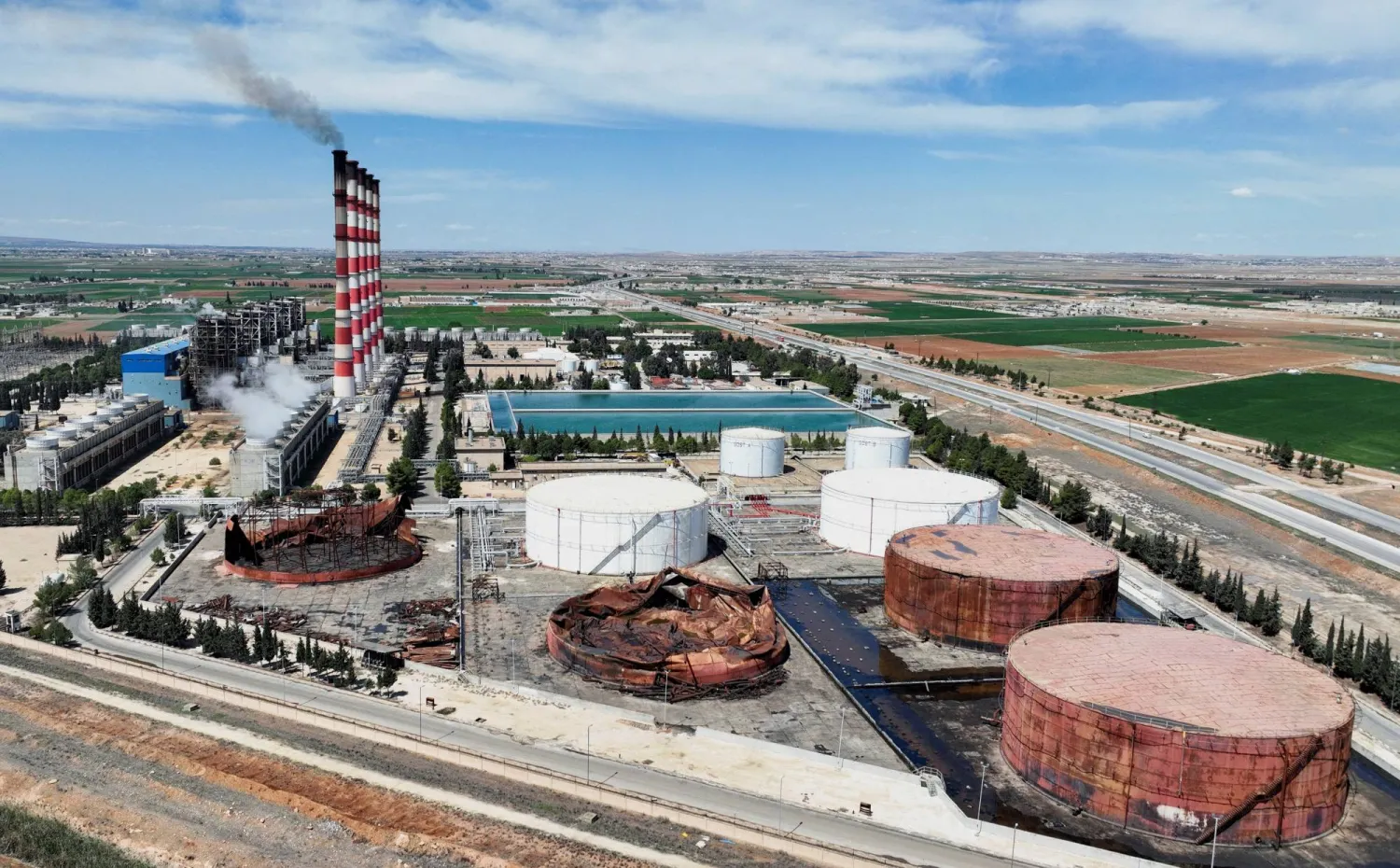
FILE PHOTO: A drone view shows the power plant in Aleppo, Syria, April 15, 2025. REUTERS/Mahmoud Hassano/File Photo
TT

GE Vernova, Siemens Energy in Talks to Supply Gas Turbines for Syria Reconstruction

FILE PHOTO: A drone view shows the power plant in Aleppo, Syria, April 15, 2025. REUTERS/Mahmoud Hassano/File Photo

US firm GE Vernova and Germany's Siemens Energy are in talks to supply gas turbines to a $7 billion project aiming to rebuild Syria's war-damaged power sector, three people familiar with the matter told Reuters.

Syria signed a deal with a subsidiary of Qatar's Power International Holding in May to build four combined-cycle gas turbine power plants with a total capacity of 4,000 megawatts. The agreement also includes a 1,000-MW solar component.

Siemens Energy and GE Vernova could both be awarded contracts for the project, one of the people said, adding, however, that it was too early to say when agreements might be concluded.

Details of the amount budgeted for the turbines under the project were not available. And none of the three sources would estimate how much the turbine contracts might be worth.

The talks could also lead to agreements beyond turbines, including the supply of critical power grid infrastructure, another of the sources said.

WESTERN COMPANIES LOOK TO BENEFIT FROM RECONSTRUCTION

The successful conclusion of deals would make Siemens Energy and GE Vernova among the first Western companies to benefit from the reconstruction of Syria's power sector, since US President Donald Trump lifted most sanctions on Damascus earlier this year.

Siemens Energy told Reuters that "a local delegation met with Syrian decision-makers to explore how the country's power supply could be improved in the short term."

"While no specific agreements or contracts have been made, we are ready to contribute our technical expertise if it can help establish and stabilize a reliable energy supply and support the population," a spokesperson for the company said.

GE Vernova and PIH did not respond to requests for comment. Syria's information ministry also did not immediately respond to a request for comment.

REVIVING AN ENERGY SECTOR CRIPPLED BY WAR

Following the opposition’s ouster of longtime President Bashar al-Assad late last year, Syria has pursued a strategic realignment away from Iran under its new leader, President Ahmed al-Sharaa, who met with Trump in Washington this week.

US firms Baker Hughes, Hunt Energy and Argent LNG said in July they planned to back post-war reconstruction with a masterplan to explore and extract oil and gas and produce power.

Due to the destruction of energy infrastructure during its 14-year civil war, Syria today produces just a fraction of the electricity it needs, though the supply of power has improved notably in recent months thanks to gas from Azerbaijan and Qatar.

On Wednesday, UAE-based Dana Gas, said it had signed a preliminary deal with Syria's state oil company to assess redeveloping natural gas fields crippled during the war.

Syria's domestic natural gas production is estimated to have declined to 3 billion cubic meters in 2023 from 8.7 bcm in 2011 due to the war.



China Shipping Giant Cosco Resumes Bookings to Some Gulf Countries

A cargo ship operated by Cosco Shipping is docked at the foreign trade container terminal of Qingdao Port, operated by Shandong Port Group, in China's eastern Shandong province on March 25, 2026. (Photo by CN-STR / AFP)
TT

China Shipping Giant Cosco Resumes Bookings to Some Gulf Countries

A cargo ship operated by Cosco Shipping is docked at the foreign trade container terminal of Qingdao Port, operated by Shandong Port Group, in China's eastern Shandong province on March 25, 2026. (Photo by CN-STR / AFP)

Chinese shipping giant Cosco said on Wednesday that it was resuming new bookings for container shipments to some Gulf countries, after a three-week suspension in response to the Middle East war.

The state-owned, Shanghai-based firm was among several major shipping groups to pause operations in the Strait of Hormuz, a key waterway through which one-fifth of the world's oil and gas passes normally.

Tehran has said several times it was not targeting friendly nations, but transits through the Strait had nevertheless largely ground to a halt.

Iran said in a statement circulated by the International Maritime Organization on Tuesday that "non-hostile vessels" would be granted safe passage through the waterway.

Cosco "resumed new bookings for general cargo containers for shipments" from the "Far East" to the UAE, Saudi Arabia, Bahrain, Qatar, Kuwait, and Iraq "with immediate effect", according to a company statement.

It did not mention shipments travelling in the opposite direction, from the Gulf.

"New booking arrangements and the actual carriage are subject to change due to the volatile situation in the Middle East region," it added.

Cosco, which operates one of the world's largest oil tanker fleets, announced on March 4 that it would suspend new bookings for services for routes through the Strait of Hormuz owing to the "escalating conflicts in the Middle East region and resultant restrictions on maritime traffic".


Qatar Emir Makes Minor Changes to QIA Board

People visit a mall in Doha on March 23, 2026. (Photo by AFP)
TT

Qatar Emir Makes Minor Changes to QIA Board

People visit a mall in Doha on March 23, 2026. (Photo by AFP)

Qatar's Emir Sheikh Tamim bin Hamad Al Thani issued a decree on Wednesday ⁠making minor changes to ⁠the board of the ⁠Qatar Investment Authority, while keeping Sheikh Bandar bin Mohammed bin Saud Al Thani as chairman and Sheikh ⁠Mohammed ⁠bin Hamad bin Khalifa Al Thani as deputy chairman.

The decision stipulated that QIA’s Board of Directors would be restructured as follows: Sheikh Bandar bin Mohammed bin Saud Al Thani as Chairman, Sheikh Mohammed bin Hamad bin Khalifa Al Thani as Deputy Chairman, Ali bin Ahmed Al Kuwari as a member, Saad bin Sherida Al Kaabi as a member, Sheikh Faisal bin Thani bin Faisal Al-Thani as a member, Nasser bin Ghanim Al Khelaifi as a member, and Hassan bin Abdullah Al Thawadi as a member.

The decision is effective starting from its date of issue and is to be published in the official gazette.


Oil Falls More Than 5% and World Shares Gain Over Possible de-escalation of Iran War

A man fills his car with petrol at the petrol station in Port Dickson, Negri Sembilan, Malaysia, 25 March 2026. EPA/FAZRY ISMAIL
TT

Oil Falls More Than 5% and World Shares Gain Over Possible de-escalation of Iran War

A man fills his car with petrol at the petrol station in Port Dickson, Negri Sembilan, Malaysia, 25 March 2026. EPA/FAZRY ISMAIL

Oil prices fell more than 5% and world shares gained on Wednesday over the possibility of a de-escalation of the Iran war and negotiations between the United States and Iran. US futures were up 0.9%.

In early European trading, Britain's FTSE 100 rose 1% to 10,072.60. France's CAC 40 was up 1.4% to 7,855.31, while Germany's DAX was 1.6% higher at 22,989.80.

Tokyo’s Nikkei 225 was up 2.9% to 53,749.62. South Korea’s Kospi gained 1.6% to 5,642.21.

Hong Kong’s Hang Seng rose 1.1% to 25,335.95, while the Shanghai Composite index was 1.3% higher at 3,931.84. Labubu doll maker Pop Mart's Hong Kong-listed shares fell 22.5%, after it announced annual revenue for last year that was largely in line with analysts’ estimates.

Australia’s S&P/ASX 200 climbed 1.9%. Taiwan’s Taiex was up 2.5%.

US President Donald Trump's claims of progress being made from talks with Iran this week and his postponement on Monday of a deadline to “obliterate” Iran’s power plants over the reopening of the Strait of Hormuz have also fueled optimism that an end to the Iran war could come soon.

Trump's administration has offered a 15-point ceasefire plan to Iran, but an Iranian military spokesperson mocked the US’ attempt at a ceasefire deal Wednesday.

With the Strait of Hormuz being a key waterway for crude oil and liquefied natural gas transport, oil and gas prices have spiked and fluctuated in recent days.

Oil prices fell again on growing hopes for a de-escalation. Brent crude, the international standard, fell 5.2% to $94.97 per barrel. It was around $104 on Tuesday.

Benchmark US crude was down 5.3% early Wednesday to $87.44 a barrel.

While Iran has denied negotiations were taking place, and attacks in the Middle East continued, Pakistan has offered to host talks between Washington and Tehran. And as Trump raised optimism of a de-escalation of the war, at least 1,000 more American troops from the 82nd Airborne Division are said to be deployed to the Middle East in the coming days.

On Tuesday, US stocks closed lower. The S&P 500 lost 0.4% to 6,556.37. The Dow Jones Industrial Average edged down 0.2% to 46,124.06, while the Nasdaq composite was 0.8% lower to 21,761.89.

Shares of Estee Lauder sank more than 9%, following confirmation that the US-listed company is in merger talks with Spanish beauty and perfume group Puig.

In other dealings early Wednesday, gold prices resumed its rise after falling earlier. It dropped in part because of rising US Treasury yields over dimming expectations of a Federal Reserve rate cut after the spike in oil prices threatened to fuel global inflation.

The price of gold was up 3.6% early Wednesday to $4,561.90 per ounce. It was above $5,000 earlier this month.

The US dollar was at 158.84 Japanese yen, up from 158.69. The euro was trading at 1.1602, down from $1.1608.