

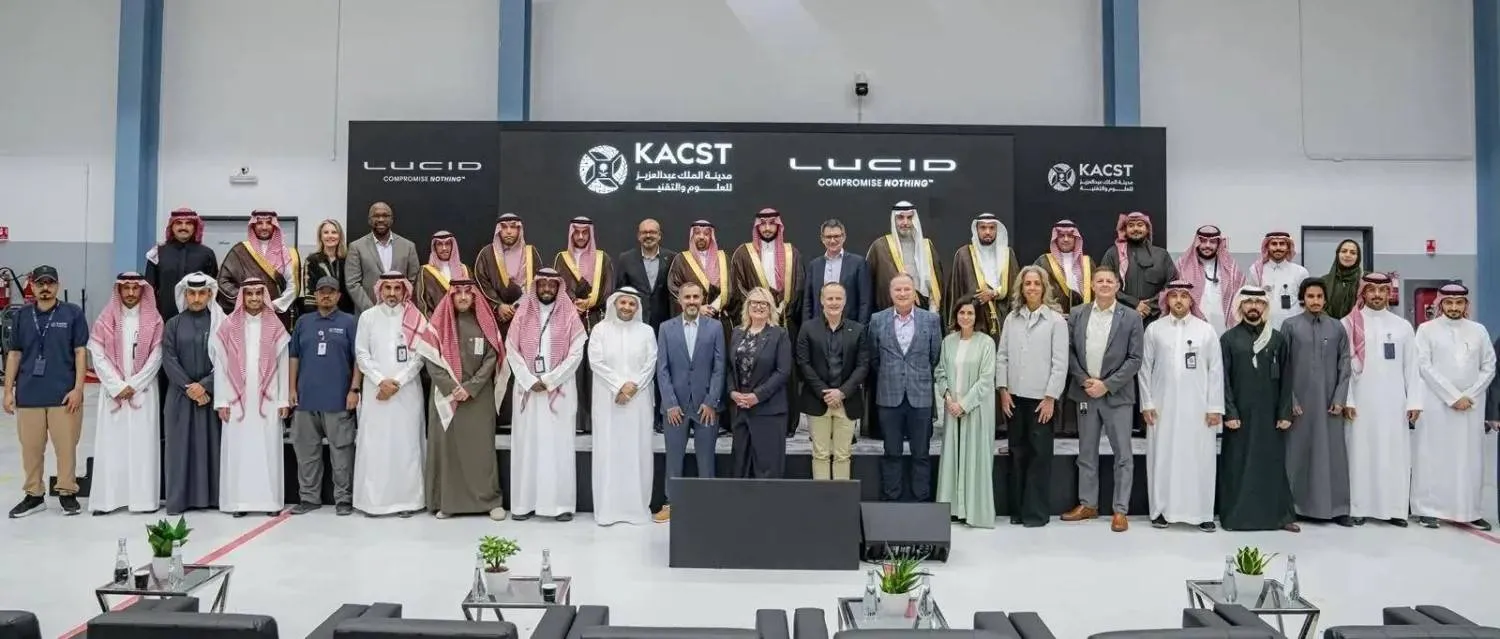

Innovation Center for Electric Vehicles Inaugurated in Saudi Arabia

The new center, inaugurated in Riyadh, will carry out high-level research into electric vehicle technology (Asharq Al-Awsat) 
TT

Innovation Center for Electric Vehicles Inaugurated in Saudi Arabia

The new center, inaugurated in Riyadh, will carry out high-level research into electric vehicle technology (Asharq Al-Awsat) 

King Abdulaziz City for Science and Technology (KACST) and Lucid Group, the manufacturer of some of the world’s most advanced electric vehicles, announced on Sunday the inauguration of the first Electric Vehicle Innovation Center in the Middle East, located in Saudi Arabia.

The new center, inaugurated in the presence of President of KACST Dr. Munir bin Mahmoud Eldesouki, serves as a key platform bringing together local, regional, and global research expertise.

It reflects KACST’s ongoing commitment to innovation and reinforces Lucid’s leadership in advanced technologies.

The center is also focused on enhancing the efficiency, functionality, and performance across Lucid’s product portfolio, contributing to their accelerated development, strengthening their leadership within their segment, and supporting the growth of the Kingdom’s future mobility sector.

“This new innovation center embodies our ongoing commitment to leading the advancement of electric vehicle technology, and our support toward strengthening Saudi Arabia a hub for technological innovation,” said Interim CEO at Lucid, Marc Winterhoff.

“By combining Lucid’s engineering expertise with KACST’s advanced research capabilities, we will continue to push the boundaries of what’s possible. Our teams are eager to begin the planned work together, recognizing this research will help shape the future of sustainable mobility,” he noted.

Senior Vice President for Research and Development at KACST, Dr. Talal bin Ahmed Alsedairy, emphasized that the center represents a pivotal step in enabling Saudi talent to develop future technologies in electric vehicles, batteries, and smart systems.

“The center enhances local content and bolsters the Kingdom’s capabilities in advanced industries, supporting the goals of Vision 2030 and broader national aspirations,” he said.

Alsedairy said this cooperation contributes to the transfer and localization of advanced, high-impact technologies, the establishment of new industrial value chains, and the strengthening of integration between the research, development, and innovation system, the industrial strategy, and the investment strategy, thereby accelerating the transformation of knowledge into products and technologies that support the future of sustainable mobility and enhance the competitiveness of the national economy.

For his part, President of Lucid Middle East, Faisal Sultan, said the opening of this center is a major step forward in Lucid’s commitment to the Kingdom.

“This collaboration strengthens our regional presence, nurtures local talent, and contributes to building a vibrant technology ecosystem aligned with Vision 2030,” he noted.

The center was developed in collaboration with KACST, one of the Kingdom’s leading research, development, and innovation institutions, forming the second phase of the ongoing strategic partnership between the two parties.

Its purpose is to advance scientific research, support innovation, and develop sustainable technologies by leveraging specialized Saudi expertise.

The center began its operations as a specialized facility for testing and validation and has since evolved to cover all stages of electric vehicle development. It represents a qualitative leap in the collaborative efforts between the two parties and serves as an extension of Lucid's comprehensive network of facilities in the US.

It will dedicate its efforts to advanced research, support the dissemination of the company’s world-leading technologies, and play a pivotal role in developing future products and will serve as a key pillar of the Kingdom’s national research and development infrastructure and actively contribute to the innovation and industrial application of future technologies within the country.



Saudi Finance Minister at Davos: Fiscal Discipline Drove Our Credit Upgrades

Finance Minister Mohammed Al-Jadaan and senior Saudi officials at a panel at the World Economic Forum in Davos on Tuesday.
TT

Saudi Finance Minister at Davos: Fiscal Discipline Drove Our Credit Upgrades

Finance Minister Mohammed Al-Jadaan and senior Saudi officials at a panel at the World Economic Forum in Davos on Tuesday.

Saudi Finance Minister Mohammed Al-Jadaan said on Tuesday strict fiscal discipline lay behind the Kingdom’s string of credit rating upgrades, arguing that Saudi Arabia has built a buffer against oil price shocks after restructuring its economy to lift the non-oil sector’s share to 56%.

Speaking to CNBC on the sidelines of the World Economic Forum in Davos, Al-Jadaan said dialogue, not confrontation, remains the only viable path to rebalancing global geoeconomic power.

He stressed that the Kingdom’s receipt of three credit rating upgrades last year was no coincidence, describing it as an international vote of confidence in the government’s fiscal discipline.

Global rating agencies and the International Monetary Fund are now clearly seeing the results of structural transformation, he remarked, noting that the Saudi budget is no longer hostage to energy price volatility, but instead rests on strong institutional foundations.

He also reaffirmed that Saudi-US relations remain “strategic” and ongoing at all levels of leadership and the ministerial level, adding that a previously cited figure of one trillion dollars in Saudi investment in the United States is not only realistic but could be exceeded.

The US market represents a core growth area, offering the Kingdom financial returns as well as knowledge and expertise transfers that serve national interests, the minister added.

In the face of the threat of global tariff hikes, Al-Jadaan called for resolving trade disputes through multilateral institutions, stressing that companies need certainty and that constructive dialogue with Washington and other strategic partners is essential to safeguarding global trade stability.

Investment discipline

Responding to questions about budget deficits alongside massive investments, Al-Jadaan outlined a different fiscal philosophy, describing the deficit as a deliberate policy design rather than a result of financial strain.

The Kingdom is borrowing to finance tomorrow’s growth, not today’s operating expenses, he said.

He pointed to last year’s three credit upgrades as evidence of the policy’s success, saying fiscal space is being managed with high discipline to channel resources toward jobs and gross domestic product, particularly as the non-oil economy now accounts for about 56% of total output.

Breaking the historical link

Asked about the US administration’s preference for oil prices around $50 a barrel, Al-Jadaan said Saudi Arabia has succeeded over the past decade in decoupling its economy from oil volatility, with non-oil revenues now making up 30% of total revenues.

He warned that excessively low prices could discourage global investment and trigger sharp price spikes in the future due to supply shortages, stressing that Saudi Arabia’s priority is market stability that balances the interests of both investors and consumers.

On monetary policy, Al-Jadaan underlined the Kingdom’s firm commitment to the riyal’s peg to the US dollar, calling it a cornerstone of stability and investor expectations.

He downplayed the impact of ongoing investigations into the US Federal Reserve on the Saudi economy, saying the Kingdom has policy tools beyond monetary policy that have kept inflation at very safe levels.

He added that markets determine long-term borrowing costs based on supply and demand, rather than short-term Federal Reserve decisions, helping reduce currency volatility risks and boost investor confidence.

Al-Jadaan announced a landmark step, starting on February 1, when the stock and real estate markets will be further opened to foreign investors.

The rise in institutional investor ownership in 2025 is a vote of confidence in the Saudi market's value, despite challenges, he stressed.

He warned, however, that the greatest risk facing any economy is complacency, stressing that Saudi Arabia is working institutionally to ensure sustainable results and that reforms no longer depend on daily interventions but have become a default approach whose benefits are felt by citizens and investors alike.


Saudi Crown Prince’s Directives Cut Riyadh Property Prices by 3%

A general view of Riyadh, Saudi Arabia. (SPA)
TT

Saudi Crown Prince’s Directives Cut Riyadh Property Prices by 3%

A general view of Riyadh, Saudi Arabia. (SPA)

Real estate prices in Saudi Arabia’s capital fell 3% in the final quarter of last year, reversing a 1% rise in the previous quarter, in a shift that highlights the on-the-ground impact of policy moves ordered by Prince Mohammed bin Salman bin Abdulaziz, Crown Prince and Prime Minister, to rein in soaring property costs across the Kingdom, particularly in Riyadh.

According to an index issued by the General Authority for Statistics on Tuesday, the real estate price index in Saudi Arabia fell 0.7% in the fourth quarter of last year compared with the same period of 2024.

The decline was driven mainly by weaker performance in the residential sector, which carries the most significant weight in the index, as its annual rate of change fell 2.2%.

The commercial sector continued to see a slight slowdown in growth momentum, while maintaining positive annual growth of 3.6%.

A real balance

Real estate specialists told Asharq Al-Awsat that the Crown Prince’s directives have become evident on the ground after property prices in Riyadh surged to unprecedented levels, prompting government intervention to curb the increases and enable citizens to own their first homes without excessive financial burdens.

Real estate analyst Khaled Al-Mobid said the 0.7 % decline in the real estate price index in the fourth quarter of 2025 reflects the market’s entry into a phase of real balance after years of rapid price increases, describing it as a healthy indicator that supports, rather than weakens, market sustainability.

“What we are witnessing today is not a loss in value, but a logical price correction, particularly in the residential sector, due to increased supply, improved regulation, and greater awareness among market participants, whether buyers or investors,” Al-Mobid told Asharq Al-Awsat.

He added that this balance creates better opportunities for end users, redirects investment toward appropriate products at fair prices, and curbs short-term speculation, serving the real estate economy over the medium and long term.

Housing stability

Real estate specialist Ahmed Omar Basudan told Asharq Al-Awsat that the sector has seen declines in many regions of the Kingdom, as buyers await the effects of government decisions issued under the Crown Prince’s direction.

He cited recent measures, including the announcement of the names of beneficiaries of subsidized land grants in northern Riyadh, located in some of the area’s best neighborhoods.

Basudan said the decision to fix residential rental prices in Riyadh for five years also contributed to the decline in the capital’s real estate market, as tenants are experiencing a period of housing stability, reducing demand for purchases at this stage.

He added that recent amendments to fees on undeveloped land and vacant properties, which have been implemented and are now being collected, also played a role, prompting landowners to move quickly to sell some plots at competitive prices to avoid bearing those fees.

Data from the General Authority for Statistics showed that residential real estate prices fell in the fourth quarter of last year compared with the same quarter of 2024, with the sector declining 2.2%. The drop was driven by a 2.4% fall in residential land prices, a 2.5% decline in apartment prices, a 1.3% decrease in villa prices, and a 0.2% drop in residential floor prices.

Quarterly comparison

The real estate price index fell 0.4% in the fourth quarter of last year, at a slower pace than in the third quarter.

The index was affected by a 0.4% decline in the residential sector, driven by a 0.7% drop in residential land prices, a 0.4% fall in apartment prices, and a 0.2% decrease in residential floor prices, while villa prices rose 0.8%.

At the regional level, the annual real estate price index fell 0.7% nationwide in the fourth quarter of last year, with Riyadh recording a 3% decline, compared with a 1% increase in the third quarter.

The Eastern Province posted the highest real estate price increase at 4%, followed by Makkah at 2.5%, Tabuk and Jazan at 1.1% each, and Al-Jawf at 0.4%.

By contrast, Hail, the Northern Borders region, and Madinah recorded the steepest declines, at 8.9%, 6.8%, and 6.1%, respectively.


Saudi Industry Minister Meets with Global Leaders at World Economic Forum to Advance Partnerships

Saudi Minister of Industry and Mineral Resources Bandar Alkhorayef held a series of high-level meetings with government officials and global business leaders at the World Economic Forum. (SPA)
TT

Saudi Industry Minister Meets with Global Leaders at World Economic Forum to Advance Partnerships

Saudi Minister of Industry and Mineral Resources Bandar Alkhorayef held a series of high-level meetings with government officials and global business leaders at the World Economic Forum. (SPA)

Saudi Minister of Industry and Mineral Resources Bandar Alkhorayef held on Tuesday a series of high-level meetings with government officials and global business leaders on the sidelines of the Kingdom's participation in the 2026 World Economic Forum in Davos.

As part of the Saudi delegation, Alkhorayef participated in a meeting with Swiss President Guy Parmelin. The meeting reviewed the robust strategic partnership between their nations and explored avenues to deepen cooperation in the industrial and mining sectors, aiming to expand bilateral ties to serve mutual interests.

Alkhorayef met with CEO of BlackRock Larry Fink, and President and CEO of the World Economic Forum Børge Brende. Talks focused on boosting the partnership between the Kingdom and the forum, exploring new cooperation in advanced manufacturing and critical minerals, and strengthening joint efforts to fortify industrial and mining supply chains.

In a series of bilateral meetings, Alkhorayef met with leaders of major global firms, including CEO of Capgemini Aiman Ezzat, Senior Partner at Bain & Company Dr. Jörg Gnamm, and CEO of Copa-Data Stefan Reuther. The meetings focused on unlocking opportunities for collaboration in advanced manufacturing, digital solutions, industrial automation, and smart systems. The officials emphasized leveraging global consulting expertise to boost factory efficiency, accelerate the Kingdom's industrial transformation, and bolster the competitiveness of its industrial and mining sectors.