
IMF's Growth Forecasts to Show Resilience to Global Trade Shocks, Georgieva Says

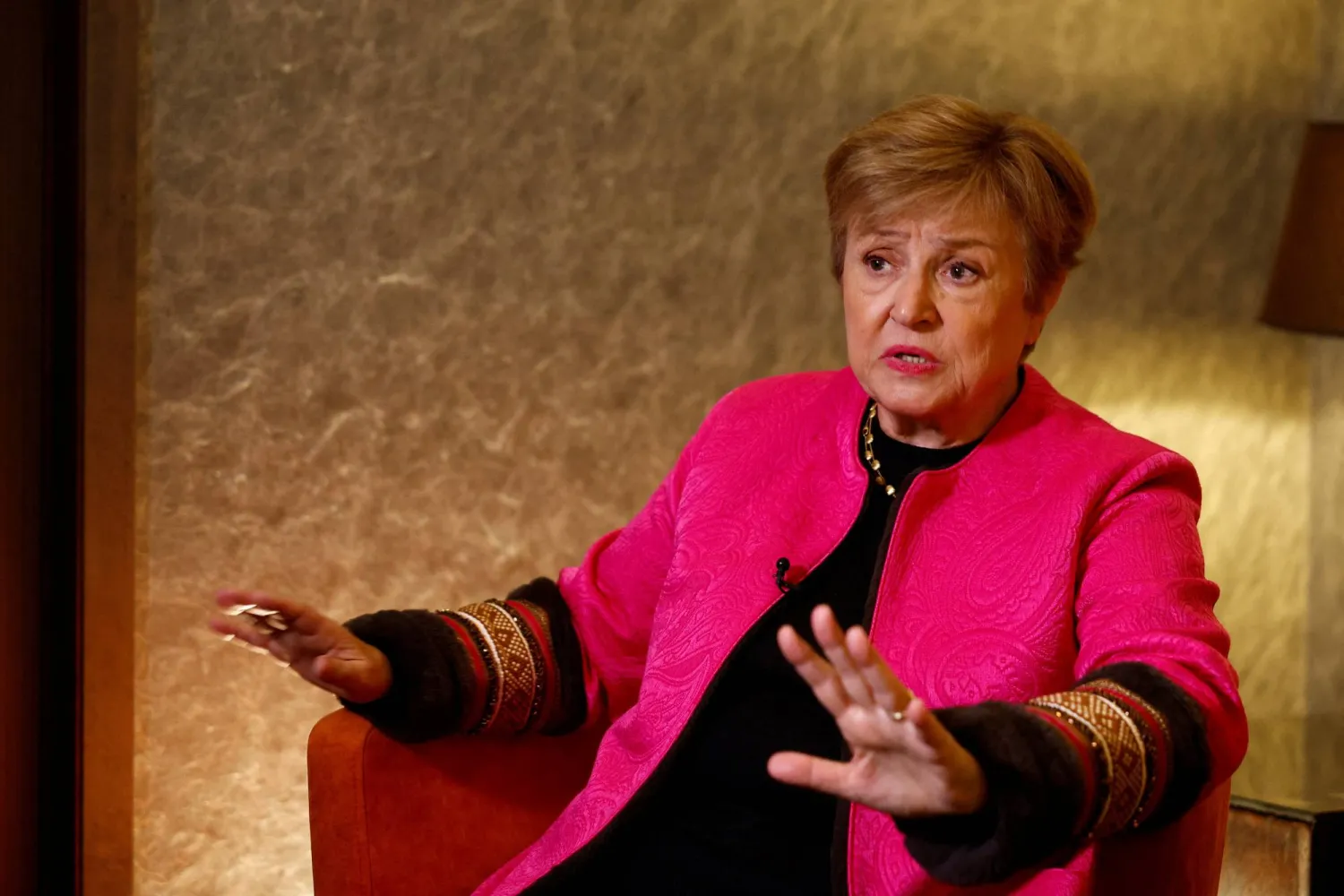
International Monetary Fund (IMF) Managing Director Kristalina Georgieva speaks during an interview with Reuters, amid Russia's attack on Ukraine, in Kyiv, Ukraine January 15, 2026. REUTERS/Valentyn Ogirenko
TT

IMF's Growth Forecasts to Show Resilience to Global Trade Shocks, Georgieva Says

International Monetary Fund (IMF) Managing Director Kristalina Georgieva speaks during an interview with Reuters, amid Russia's attack on Ukraine, in Kyiv, Ukraine January 15, 2026. REUTERS/Valentyn Ogirenko

The International Monetary Fund's latest economic forecasts due next week will show the global economy's continued resilience to trade shocks and "fairly strong" growth, IMF Managing Director Kristalina Georgieva told Reuters on Thursday.

In an interview during a visit to Kyiv to discuss the IMF's loan to Ukraine, Georgieva suggested the IMF could again revise its forecasts slightly upward as the World Bank did this week.

In October, the IMF edged its 2025 global GDP growth forecast higher to 3.2% from 3.0% in July as the drag from US tariffs was less than initially ‌feared. It kept ‌its 2026 global growth outlook unchanged at 3.1%.

Asked what ‌the ⁠January forecasts ‌would show after the upgrade in October, Georgieva said: "More of the same - that the world economy is remarkably resilient, that trade shock has not derailed global growth, that risks are more tilted to the downside, even if performance now is fairly strong."

The IMF is expected to release its World Economic Outlook update on January 19.

Georgieva said risks were focused on geopolitical tensions and rapid technological shifts. Things could turn out well, ⁠she said, but the global economy could also face significant financial distress if the huge resources flowing into ‌artificial intelligence did not result in promised productivity gains.

"We ‍are in a more unpredictable ‍world, and yet, quite a number of businesses and policymakers operate as if ‍the world hasn't changed."

Georgieva said she worried that many countries had failed to build up sufficient reserves to deal with any new shock that could occur. The IMF currently has 50 lending programs, a high number by historic standards, but was bracing for more countries to seek funds, she said.

The IMF chief said US economic performance had been "quite impressive" despite a raft of tariffs imposed by President Donald ⁠Trump last year on nearly every country in the world.

She said overall tariff levels were lower than initially threatened, and the US accounted for only about 13% to 14% of global trade. Most other countries had also refrained - at least so far - from imposing retaliatory measures, which had helped limit the impact of the wave of US tariffs.

She said inflation and macroeconomic conditions could still worsen, though, if the trade picture darkened.

Geopolitical factors were also clouding the outlook and now played a more significant role than in years past, said Georgieva, who took office in October 2019, just months before the COVID-19 pandemic hit in early 2020.

"Regrettably, since I took ‌this job (in 2019), there has been one shock after another after another," she said.


IMF Board to Review Staff-level $8.1 Bln Agreement for Ukraine

The city's downtown on a frosty winter day, amid Russia's attack on Ukraine, in Kyiv, Ukraine February 19, 2026. REUTERS/Alina Smutko
TT

IMF Board to Review Staff-level $8.1 Bln Agreement for Ukraine

The city's downtown on a frosty winter day, amid Russia's attack on Ukraine, in Kyiv, Ukraine February 19, 2026. REUTERS/Alina Smutko

The International Monetary Fund on Thursday said its board ​would review a staff-level agreement for a new $8.1 billion lending program for Ukraine in coming days.

IMF spokeswoman Jule Kozack told reporters that Ukrainian authorities had completed the prior actions needed to move forward with the request ⁠of a new ⁠IMF program, including submission of a draft law on the labor code and adoption of a budget.

She said Ukraine's economic growth in 2025 ⁠was likely under 2%. After four years of war, the country's economy had settled into a slower growth path with larger fiscal and current account balances, she said, noting that the IMF continues to monitor the situation closely.

"Russia's invasion continues to take a ⁠heavy ⁠toll on Ukraine's people and its economy," Kozack said. Intensified aerial attacks by Russia had damaged critical energy and logistics infrastructure, causing disruptions to economic activity, Reuters quoted her as saying.

As of January, she said, 5 million Ukrainian refugees remained in Europe and 3.7 million Ukrainians were displaced inside the country.


US Stocks Fall as Iran Angst Lifts Oil Prices

A screen displays a stock chart at a work station on the floor of the New York Stock Exchange (NYSE) in New York City, US, April 6, 2022. REUTERS/Brendan McDermid
TT

US Stocks Fall as Iran Angst Lifts Oil Prices

A screen displays a stock chart at a work station on the floor of the New York Stock Exchange (NYSE) in New York City, US, April 6, 2022. REUTERS/Brendan McDermid

Wall Street stocks retreated early Thursday as worries over US-Iran tensions lifted oil prices while markets digested mixed results from Walmart.

US oil futures rose to a six-month high as Iran's atomic energy chief Mohammad Eslami said no country can deprive the Islamic republic of its right to nuclear enrichment, after US President Donald Trump again hinted at military action following talks in Geneva.

"We'd call this an undercurrent of concern that is bubbling up in oil prices," Briefing.com analyst Patrick O'Hare said of the "geopolitical angst."

About 10 minutes into trading, the Dow Jones Industrial Average was down 0.6 percent at 49,379.46, AFP reported.

The broad-based S&P 500 fell 0.5 percent to 6,849.35, while the tech-rich Nasdaq Composite Index declined 0.6 percent to 22,621.38.

Among individual companies, Walmart rose 1.7 percent after reporting solid results but offering forecasts that missed analyst expectations.

Shares of the retail giant initially fell, but pushed higher after Walmart executives talked up artificial intelligence investments on a conference call with analysts.

The US trade deficit in goods expanded to a new record in 2025, government data showed, despite sweeping tariffs that Trump imposed during his first year back in the White House.


Gold Advances on US–Iran Tensions as Markets Weigh Fed Policy Path

UK gold bars and gold Sovereign coins are displayed at Baird & Co in Hatton Garden in London, Britain, October 8, 2025. REUTERS/Hiba Kola/File Photo
TT

Gold Advances on US–Iran Tensions as Markets Weigh Fed Policy Path

UK gold bars and gold Sovereign coins are displayed at Baird & Co in Hatton Garden in London, Britain, October 8, 2025. REUTERS/Hiba Kola/File Photo

Gold prices extended gains on Thursday after rising more than 2% in the previous session, as lingering tensions between the United States and Iran prompted a flight to safety, while investors evaluated the Federal Reserve's monetary policy path.

Spot gold rose 0.2% to $4,989.09 per ounce by 1227 GMT. US gold futures for April delivery held steady at $5,008.60.

"Geopolitical concerns are front and centre with reports that, if the US were to take military action against Iran, it could go on for several weeks," said Jamie Dutta, market analyst at Nemo.money, Reuters reported.

Some progress was made during Iran talks this week in Geneva but distance remained on some issues, the White House said on Wednesday.

FED LARGELY UNITED

Top US national security advisers met in the White House Situation Room on Wednesday to discuss Iran and were told all US military forces deployed to the region should be in place by mid-March.

Meanwhile, the Fed's January minutes showed it largely united on holding interest rates steady, but divided over what comes next, with "several" open to rate hikes if inflation remains elevated, while others were inclined to support further cuts if inflation recedes.

The weekly jobless claims data, due later in the day, and Friday's Personal Consumption Expenditures report, the Fed’s preferred inflation gauge, will provide further clues on the central bank's policy trajectory.

Markets currently expect this year's first interest rate cut to be in June, according to CME's FedWatch Tool.

Non-yielding bullion tends to do well in low-interest-rate environments.

Spot silver rose 0.9% to $77.87 per ounce after climbing more than 5% on Wednesday.

Silver is "supported by tight supply and low COMEX stock levels ahead of the delivery period of the March contract. However, given the extent of the historic correction earlier this month, silver is not back on safer ground until it trades back above $86," said Ole Hansen, head of commodity strategy at Saxo Bank.

Spot platinum fell 0.6% to $2,059.55 per ounce, while palladium lost 1.7% to $1,686.47.