Kuwait: KPC to Invite Int’l Oil Companies to Help Develop Offshore Oil and Gas

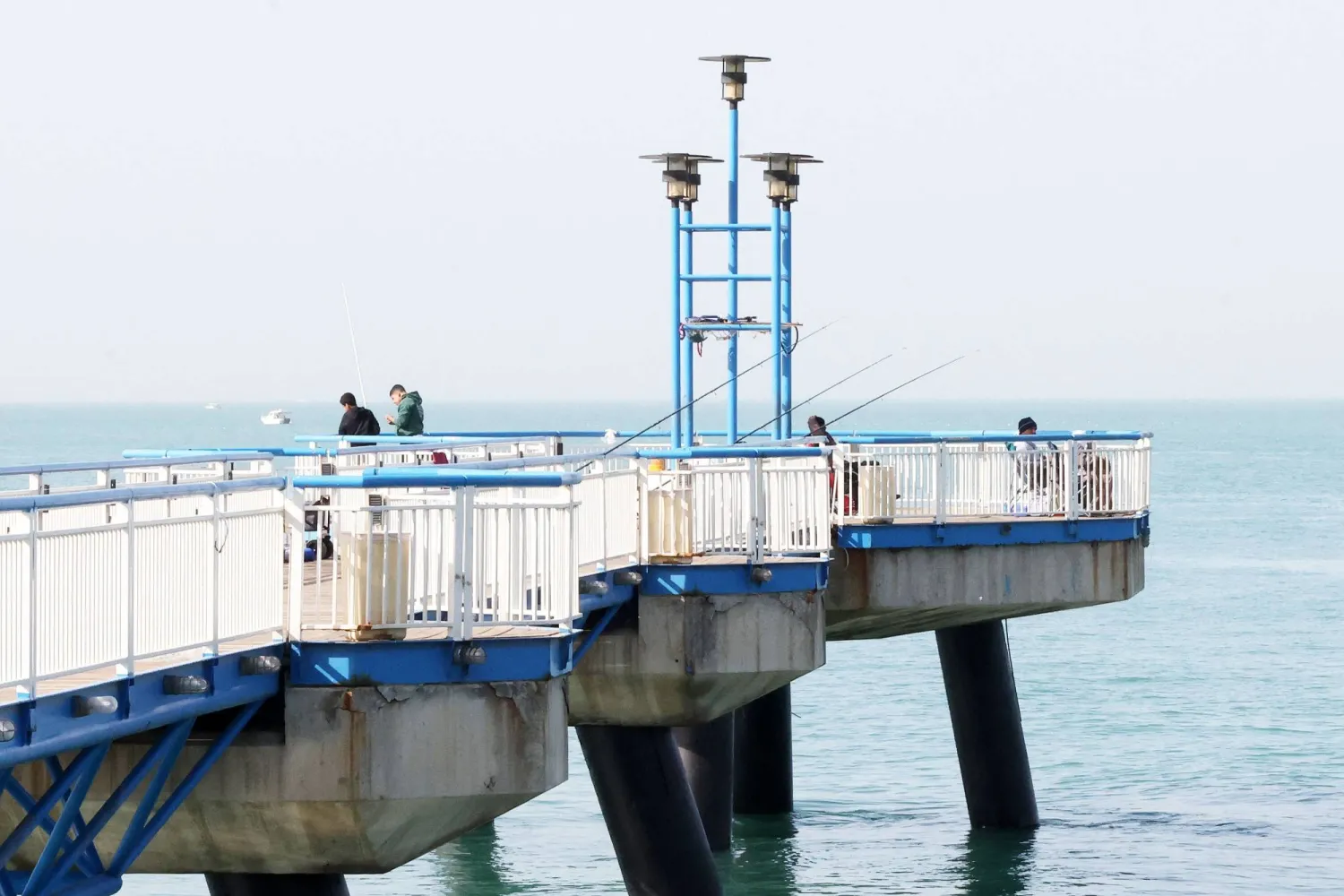
People cast their fishing rods on a pier in Kuwait City on January 31, 2026. (Photo by YASSER AL-ZAYYAT / AFP)
TT

Kuwait: KPC to Invite Int’l Oil Companies to Help Develop Offshore Oil and Gas

People cast their fishing rods on a pier in Kuwait City on January 31, 2026. (Photo by YASSER AL-ZAYYAT / AFP)

Kuwait's Prime Minister Ahmad Abdullah al-Ahmad al-Sabah said on Tuesday that Kuwait Petroleum Corporation plans to invite international oil companies to assist Kuwait Oil Company in developing recently announced offshore oil and ‌gas discoveries.

Al-Sabah ‌added ‌in ⁠his opening ‌remarks at the Kuwait Oil and Gas Show that KPC is in talks with global financial institutions to establish a lease ⁠and lease-back of Kuwait's domestic ‌crude oil pipeline network.

In ‍January, ‍sources told Reuters that ‍Kuwait was set to launch an oil pipeline network stake sale as soon as February in a deal that could raise up to $7 ⁠billion.

Kuwait's Oil Minister Tariq Al-Roumi told Reuters on Monday that he expects tenders for the Durra oil and gas field project, in cooperation with Saudi Arabia, to be launched this year.


Iraqi Oil Production Collapses as Hormuz Still Blocked by US-Iran War, Sources Say

Pumping station at the end of the Druzhba oil pipeline in Schwedt, Germany (AP)
TT

Iraqi Oil Production Collapses as Hormuz Still Blocked by US-Iran War, Sources Say

Pumping station at the end of the Druzhba oil pipeline in Schwedt, Germany (AP)

Iraqi oil production from its main southern oilfields has fallen by 70% to just 1.3 million barrels per day as the country is unable to export oil via the Strait of Hormuz due to the Iran war, 3 industry sources said on Sunday.

According to Reuters, production from the fields stood at around 4.3 million bpd before the war.


Egyptian Pound Hits Record Low as Mideast War Roils Markets

One of the ATMs in downtown Cairo, the Egyptian capital (AFP)
TT

Egyptian Pound Hits Record Low as Mideast War Roils Markets

One of the ATMs in downtown Cairo, the Egyptian capital (AFP)

Egypt's currency fell to a record low, trading at over 52 to the US dollar on Sunday, as the economic fallout of the war in the Middle East hits the region's most populous country.

The US-Israeli war on Iran has expanded across the Gulf and beyond, upending global energy markets and trade, and virtually halting traffic in the Strait of Hormuz, through which a fifth of the world's crude oil travels.

President Abdel Fattah al-Sisi last week warned that the country was in a "state of near-emergency", warning of renewed inflationary pressures.

Despite Egypt not having been directly hit by the war, the fighting has nonetheless pushed some shipping companies away from its Suez Canal, a key source of foreign currency.

Egypt's import-dependent economy has proved highly sensitive to currency fluctuations in the past.

Inflation -- 11.9 percent in January -- peaked at nearly 40 percent in August 2023, on the back of a punishing economic crisis that has since eased, thanks in part to an over $50 billion bailout.


Saudi Index Extends Gains

An investor monitors the Saudi stocks (AFP)
TT

Saudi Index Extends Gains

An investor monitors the Saudi stocks (AFP)

Most Gulf stock markets rose in early trade on Sunday, with the Saudi index extending gains to a fifth session.

Saudi Arabia's benchmark index .TASI climbed 2%, with all of its constituents posting gains, led by energy and materials stocks.

Saudi Aramco advanced 4% and Yanbu National Petrochemical surged 10%.

The Qatari benchmark .QSI rose 0.1%, with Mesaieed Petrochemical Holding gaining 5.3% and telecommunications company Ooredoo adding 2.1%.

In Muscat, ⁠the ⁠share index .MSX30 was up 1.4% and Bahrain's index .BAX edged up 0.2%.

Kuwait's index .BKP eased 0.5%, with most stocks in negative territory.

Kuwait Petroleum Corporation began cutting oil output on Saturday and declared force majeure, adding to earlier oil and gas reductions from Iraq and Qatar as the US-Iran war blocked shipments from the Middle East for the eighth consecutive day.