


OPEC+ Agrees to Raise Output by 206,000 bpd

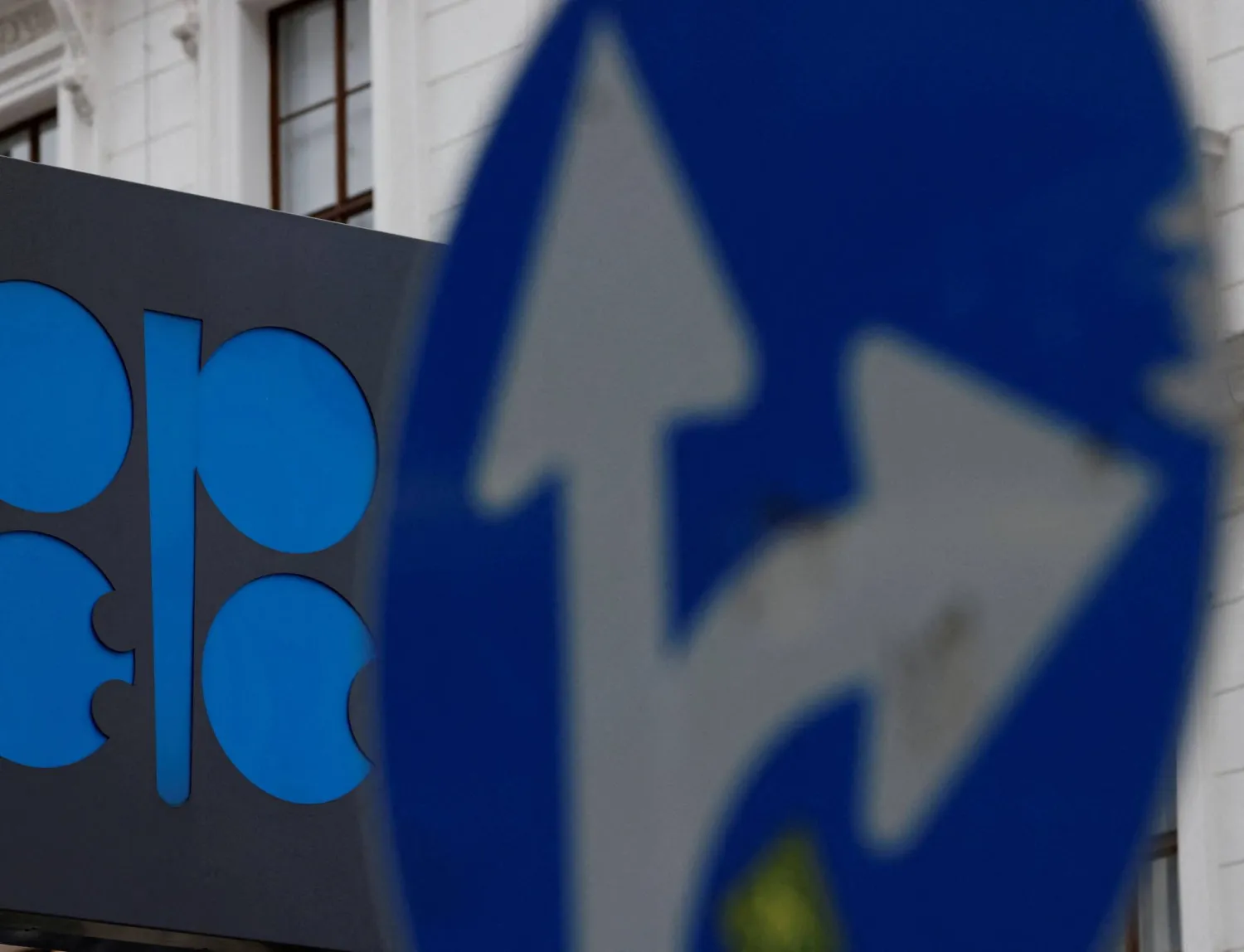
FILE PHOTO: A view of the logo of the Organization of the Petroleum Exporting Countries (OPEC) outside their headquarters in Vienna, Austria, November 30, 2023. REUTERS/Leonhard Foeger/File Photo
TT

OPEC+ Agrees to Raise Output by 206,000 bpd

FILE PHOTO: A view of the logo of the Organization of the Petroleum Exporting Countries (OPEC) outside their headquarters in Vienna, Austria, November 30, 2023. REUTERS/Leonhard Foeger/File Photo

The eight OPEC+ countries on Sunday agreed to a modest oil output boost of 206,000 barrels per day for April, a decision framed as a response to steady market fundamentals and global economic growth.

The action comes at a time when energy markets are on high alert as navigation in the Strait of Hormuz has been halted following the US-Israeli strikes on Iran.

The meeting on Sunday involved only eight members of OPEC+ - Saudi Arabia, Russia, the UAE, Kazakhstan, Kuwait, Iraq, Algeria and Oman.

OPEC+ groups the Organization of the Petroleum Exporting Countries and allies like Russia but most production changes in the past years have been done by the eight members.

“In view of a steady global economic outlook and current healthy market fundamentals, as reflected in the low oil inventories, the eight participating countries decided to resume the unwinding of the 1.65 million barrels per day of additional voluntary adjustments announced in April 2023 and agreed on a production adjustment of 206 thousand barrels per day,” the eight members said in a statement.

“This adjustment will be implemented in April 2026 as detailed in the table below. The 1.65 million barrels per day may be returned in part or in full subject to evolving market conditions and in a gradual manner,” they added.

Also, the countries said they will continue to closely monitor and assess market conditions, and in their continuous efforts to support market stability, they reaffirmed the importance of adopting a cautious approach and retaining full flexibility to increase, pause or reverse the phase out of the voluntary production adjustments, including reversing the previously implemented voluntary adjustments of the 2.2 million barrels per day announced in November 2023.

The eight OPEC+ countries also noted that this measure will provide an opportunity for the participating countries to accelerate their compensation.

They reiterated their collective commitment to achieve full conformity with the Declaration of Cooperation, including the additional voluntary production adjustments that will be monitored by the Joint Ministerial Monitoring Committee (JMMC).

They confirmed their intention to fully compensate for any overproduced volume since January 2024.

The eight OPEC+ countries will hold monthly meetings to review market conditions, conformity, and compensation. They will meet on April 5.

The eight members had raised production quotas by about 2.9 million bpd from April through December 2025, roughly 3% of global demand, before pausing increases for January to March 2026 due to seasonal weakness.

Oil, gas and other shipments from the Middle East via the Strait of Hormuz have come to a halt since Saturday after shipowners received a warning from Iran saying the area was closed for navigation.

Hundreds of ships dropped anchor and were not moving on Sunday and several ships came under attack. Hormuz is the world's most important oil route accounting for over 20% of global oil transit.



Demand Remained Strong in Saudi Arabia's Non-oil Business in February, PMI Shows

A general view of the city of Riyadh (AFP)
TT

Demand Remained Strong in Saudi Arabia's Non-oil Business in February, PMI Shows

A general view of the city of Riyadh (AFP)

Growth in Saudi Arabia's non-oil private sector slowed slightly in February, a survey showed on Tuesday, although demand remained strong.

The seasonally adjusted Riyad Bank Saudi Arabia Purchasing Managers' Index (PMI) slipped to a reading of 56.1 in February from January's 56.3, but remained well above the 50.0 threshold that separates growth from contraction.

"This performance was driven by ⁠robust domestic demand ⁠and a steady flow of new project approvals," said Naif Al-Ghaith, Riyad Bank's chief economist.

In February's PMI survey, the new orders sub-index remained steady at 61.8, similar to the previous month, indicating strong demand with businesses continuing to report strong output growth and a sharp rise in employment.

The rate of ⁠employment ⁠growth accelerated to a four-month high, driven by increased sales and a build-up of backlogs, according to the survey. However, the rate of staff cost inflation hit its highest since the survey began in August 2009.


Qatar LNG Halt Won't Immediately Affect Japan's Energy Supply, Minister Says

FILE PHOTO: Model of LNG tanker is seen in this illustration taken May 19, 2022. REUTERS/Dado Ruvic/Illustration/File Photo
TT

Qatar LNG Halt Won't Immediately Affect Japan's Energy Supply, Minister Says

FILE PHOTO: Model of LNG tanker is seen in this illustration taken May 19, 2022. REUTERS/Dado Ruvic/Illustration/File Photo

Qatar's LNG production halt due to Iranian strikes will not immediately affect Japan's energy supply, and if there is any impact, Japan could tap the spot market or utilities could buy from each other, Trade Minister Ryosei Akazawa said on Tuesday.

Akazawa told a regular press conference that Qatari liquefied natural gas accounts for 4% of Japan's total LNG imports and reiterated the government has no specific plans to release oil ⁠from stockpiles, while ⁠some Japan-bound ships are stranded in the Middle East.

If needed, Japanese companies have LNG inventory equivalent to about three weeks of consumption, according to the government, with the country's oil stockpiles holding the equivalent of 254 days of net imports.

The US and Israeli attack on Iran has pitched the Gulf into war, killed scores of people in Iran, ⁠Israel and Lebanon, thrown global air transport into chaos and shut down shipping through the Strait of Hormuz, where a fifth of the world's oil trade and a large amount of LNG skirt the Iranian coast.

Some 42 Japan-related ships are waiting in the Gulf, the country's foreign ministry said on Tuesday.

Qatar halted its LNG production on Monday, as Iran continued to strike Gulf countries in retaliation for Israeli and US strikes against it, prompting precautionary shutdowns of oil and gas facilities across the Middle East.

Japan, the world's second largest LNG importer, bought 3.4 million ⁠metric tons ⁠of LNG from Qatar last year, customs data shows, according to Reuters.

Together with LNG supply from Oman and the United Arab Emirates, Japan imported around 7 million tons of LNG from the Middle East last year, making up about 11% of its supply.

Some of Japan's biggest LNG importers, including JERA and Kansai Electric Power Co, have offtake contracts with the Middle Eastern producers.

Japan trades around 40 million tons of LNG annually and could redirect some of that back home in case of emergency. It also has a mechanism in place to buy at least one LNG cargo – or 70,000 metric tons – per month to mitigate supply risks.


Turkish Monthly Inflation Near 3%, Keeping Pressure on Central Bank

A woman holding an umbrella on a rainy day during the holy fasting month of Ramadan outside the Hagia Sophia mosque in Istanbul, Türkiye, Friday, Feb. 27, 2026. (AP)
TT

Turkish Monthly Inflation Near 3%, Keeping Pressure on Central Bank

A woman holding an umbrella on a rainy day during the holy fasting month of Ramadan outside the Hagia Sophia mosque in Istanbul, Türkiye, Friday, Feb. 27, 2026. (AP)

Turkish inflation cooled to 2.96% on a monthly basis in February while the annual figure rose to 31.53%, largely as expected, according to official data on Tuesday that tees up a tough rate decision for the central bank next week.

Beyond the price pressure, market turmoil due to war between US-Israel and neighboring Iran prompted emergency measures by the central bank, including some $8 billion in FX sales on Monday, resulting in a roughly 300 basis-point rise in ‌the overnight rate to ‌about 40%.

Analysts say the central bank could respond ‌by ⁠officially halting an easing ⁠cycle that began in late 2024. In January, the monetary policy committee trimmed the bank's main policy interest repo rate by 100 basis points to 37%.

In January, monthly consumer price inflation surged to a higher-than-expected 4.84% while the annual rate slipped to 30.65%.

In February, monthly inflation was driven by a 6.89% surge in food and drinks prices, according to the Turkish Statistical Institute, marking ⁠the second month of pressure that has raised worries ‌about a disinflation trend that began in ‌2024 but recently slowed.

Finance Minister Mehmet Simsek said he expected the recent high food ‌price increases to be offset in the coming period, depending on weather ‌conditions, while acknowledging the energy price rises triggered by the Iran conflict.

"We are working to limit the inflationary impact of rising oil prices due to geopolitical developments," he said, adding that all policy tools are being used in coordination to sustain the ‌disinflation process.

In a Reuters poll, monthly inflation was forecast to be 3% with the annual rate seen at ⁠31.55%.

The data ⁠also showed the domestic producer price index rose 2.43% month-on-month in February for an annual increase of 27.56%.

The central bank has in recent weeks kept rate-cut expectations on track even as it has repeated it was ready to tighten policy if needed.

JPMorgan - which like most analysts had previously predicted another cut at the central bank's March 12 policy meeting - said on Monday it now expects the bank to hold rates. It also revised its year-end inflation forecast to 25% from 24%.

Last month, the central bank nudged up its year-end inflation forecast range by two percentage points to 15–21% and maintained its interim 16% target, despite market doubts over whether the downward trend seen throughout 2025 is on track.