


WTO Reform Talks Face US-Indian Obstacles

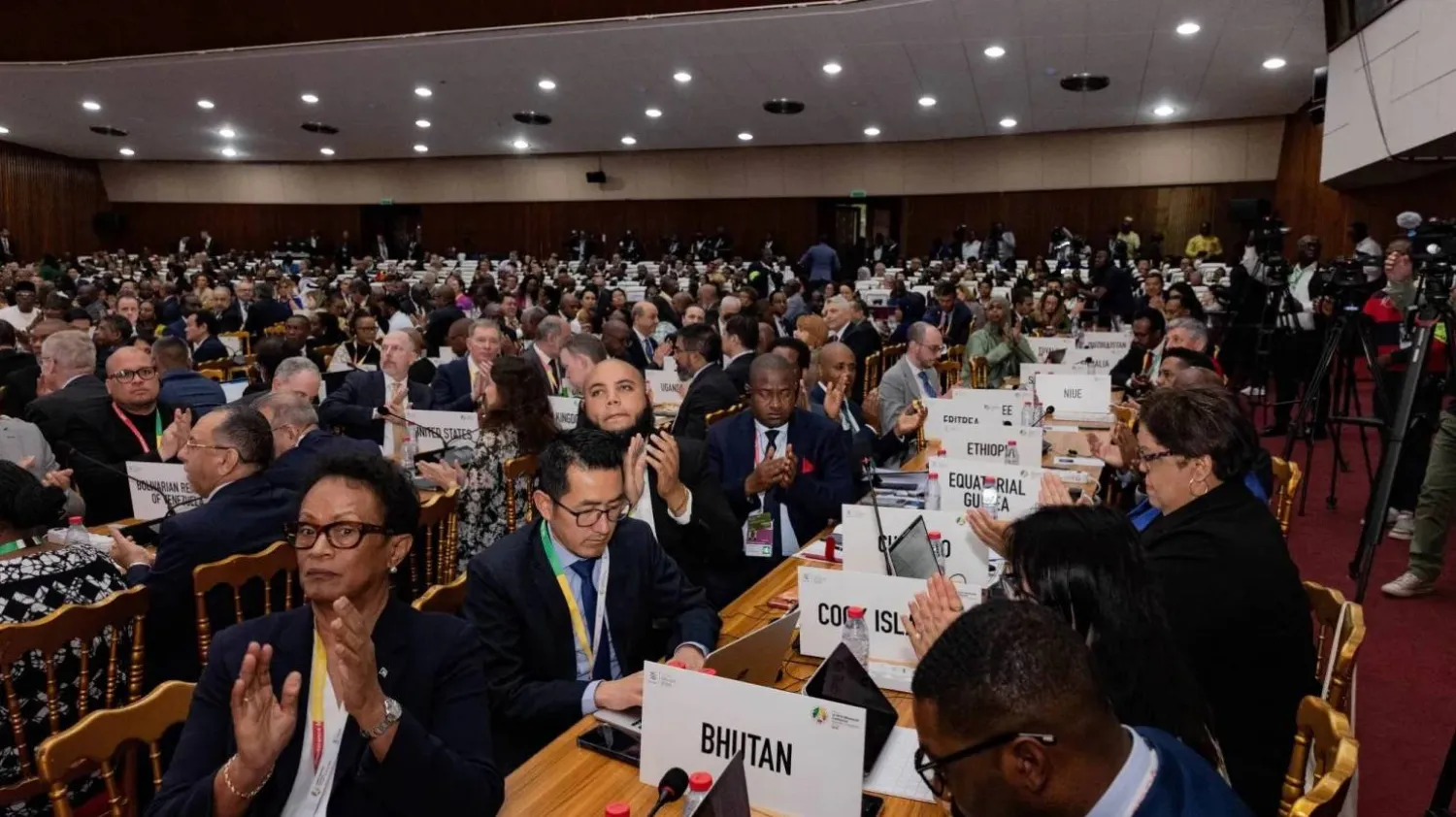
Delegates applaud during the opening of the World Trade Organisation (WTO) 14th ministerial meeting in Yaounde, Cameroon, on 26th March, 2026.  (WTO/Handout via Reuters)
TT

WTO Reform Talks Face US-Indian Obstacles

Delegates applaud during the opening of the World Trade Organisation (WTO) 14th ministerial meeting in Yaounde, Cameroon, on 26th March, 2026.  (WTO/Handout via Reuters)

Large differences remain between most countries and the US and India as trade ministers meet to discuss reforms at the World Trade Organization, two diplomats told Reuters on Friday.

The ministers are meeting in Yaounde, Cameroon, as the organization faces a critical test to its future amid a year of tariff-fueled trade turmoil and major disruption to shipping, energy prices and supply chains due to the Middle East conflict.

“There is a real commitment among ministers to reach an agreement on reforms, but there is a big elephant in the room blocking: India and the US,” a senior diplomat told Reuters.

Another diplomat from an African country said India so far has not shown signs of a change in position. Some flexibility, however, might be possible, the person added. The diplomats declined to be named due to the sensitivity of the negotiations.

While the US and India acknowledge the need to reform the global trading system, they have resisted proposals of a substantive workplan on reforms.

“Unfortunately on reform I don't see much room for maneuver between ⁠the US and India's positions,” said the senior diplomat.

India has also opposed an agreement to aid investment into developing countries and the US desire to permanently extend an e-commerce moratorium on customs duties on electronic transmissions like digital downloads, which expires this month.

“The US, China, EU and UK positions are reasonable, but there is one party that we need to see compromise from to make progress - India,” said Chris Southworth, the Secretary General of the UK International Chamber of Commerce.

“I think frustration among members will start to spillover here in Yaounde if we see no progress,” he added.

India’s Position

India's Minister of Commerce and Industry Piyush Goyal has cast doubt on US efforts to extend the e-commerce moratorium, saying it warranted a “careful reconsideration.” India is concerned about a loss of tariff revenue.

US Trade Representative Jamieson Greer said on Thursday Washington ⁠was not interested in a temporary extension to the ban, only a permanent one.

Goyal has also challenged moves by the EU, US, Canada and others for a subset of members to take decisions plurilaterally, saying any outcome should be agreed by consensus.

That has cast a shadow over whether an Investment Facilitation for Development Agreement to encourage foreign direct investment in developing and least-developed countries can be incorporated into the WTO rule book in Yaounde.

Türkiye on Thursday lifted its opposition to it.

Goyal's position showed India wants to protect the WTO's core architecture, said Ajay Srivastava, founder of think ⁠tank Global Trade Research Initiative and a former Indian negotiator.

“Together, these risk turning the WTO from a rules-based body into one driven by power and selective coalitions,” he said.

There is also deadlock over one of New Delhi's key priorities: a permanent solution on public stock holding to allow developing countries to give subsidies to rice and wheat farmers through a price support mechanism.

Big agricultural exporters ⁠like the US, EU and Australia fear it would let countries like India build large stocks of foodstuffs and dispose surpluses, potentially distorting trade.

Randa Sengupta, a senior researcher at think tank, the Third World Network, said PSH was important for supporting farmers and enabling food security for poorer communities in India.

‘Constructive’ Talks

Still, a concrete reform workplan was within ⁠reach, Norway's Foreign Minister Espen Barth Eide told Reuters.

“People are beginning to engage in the real questions,” he said, pointing to talks on the WTO's Most Favored Nation principle to treat states equally, while allowing exceptions to national security.

Similarly, Britain's Business Secretary Peter Kyle said a text on reforms was emerging and that constructive talks were taking place to ensure broad agreement.

Caption: Delegates applaud during the opening of the World Trade Organisation (WTO) 14th ministerial meeting in Yaounde, Cameroon, on 26th March, 2026. (WTO/Handout via Reuters)



A Year After Crown Prince’s Decisions, Riyadh Real Estate Exits Speculation, Transaction Values Down 64%

File photo of Saudi Arabia's capital Riyadh - SPA
TT

A Year After Crown Prince’s Decisions, Riyadh Real Estate Exits Speculation, Transaction Values Down 64%

File photo of Saudi Arabia's capital Riyadh - SPA

One year after a package of landmark decisions issued by Crown Prince Mohammed bin Salman on March 29, 2025 to rebalance Riyadh’s real estate market, a new trajectory is taking hold across the capital, particularly in its northern districts.

Data from the Real Estate Exchange showed a clear retreat in speculative activity that had strained the market for years, with transaction values recording a sharp 64% decline, marking the start of a “major correction” toward a more a sustainable real estate model that places the needs of citizens and genuine developers at the center of the market.

The Crown Prince’s directives outlined a new path for the market through a set of key executive measures, including lifting restrictions on millions of square meters in northern Riyadh, activating fees on vacant land to boost housing supply, freezing rent increases, and regulating contractual relations between landlords and tenants. These steps have contributed directly to stabilizing housing costs and curbing unjustified price surges seen in recent years.

The impact of these structural reforms was reflected in data from the Real Estate Exchange affiliated with the Ministry of Justice, which showed a 64% drop in transaction values. Transactions stood at around 53,000 deals worth more than $17.3 billion (65 billion riyals), compared with approximately $48.3 billion (181 billion riyals) in the year preceding the decisions. Total traded land area also declined to 153,000 square meters from 228,000 square meters, which experts attribute to a shift in liquidity from large-scale land speculation to organized residential development projects.

Reshaping the real estate market

Real estate specialists told Asharq Al-Awsat that these measures have reshaped Riyadh’s property market toward a more sustainable model driven by real development and genuine housing demand, guiding it toward greater balance, maturity, price stability, and closer alignment between real estate products and actual market needs. They added that this transformation represents a significant step toward building a more sustainable market capable of keeping pace with the Kingdom’s economic changes.

Real estate expert and marketer Saqr Al-Zahrani told Asharq Al-Awsat that the impact of these decisions has led to a clear structural shift in the market. He said the decline in transaction values does not reflect weak activity as much as it reflects a retreat in speculative practices that had pushed prices beyond levels linked to real housing demand.

He added that the balancing measures helped establish a new pricing benchmark for residential land, particularly with the offering of supported land at around 1,500 riyals per square meter, which has reset price expectations in several districts and curbed unjustified increases seen in recent years.

He noted that undeveloped land in northern Riyadh has experienced what he described as a “free fall” in prices, according to market reports, with some locations seeing significant declines after years of rapid increases fueled by speculation and growth expectations. He said this decline is viewed as part of a natural correction process that re-prices land based on more realistic criteria tied to development value and actual housing demand.

From speculation to development

Al-Zahrani said that over the past year, several key trends have emerged, most notably a shift in liquidity from speculation toward real estate development, with greater focus on structured development projects instead of trading undeveloped land. He added that the genuine homebuyer has re-emerged as the main driver of the market following a decline in short-term investors.

He also said early off-plan sales projects have begun to emerge, both in housing units and developed land, a model expected to expand in the coming period as it helps increase housing supply and reduce ownership costs. The market is also awaiting new regulations, particularly fees on vacant properties, which are expected to bring idle assets into use and improve the efficiency of real estate stock within cities.

Al-Zahrani said the Riyadh real estate market is likely to move toward a more mature and sustainable phase, with expected growth in off-plan projects and increased supply driven by continued regulatory reforms, which could lead to price stability and a better balance between supply and demand.

He added that current market conditions do not reflect a slowdown as much as a restructuring phase toward a more sustainable model based on real development and genuine housing demand, supporting urban development goals and enhancing quality of life in the capital.

Market behavior

For his part, real estate expert and marketer Abdullah Al-Mousa told Asharq Al-Awsat that Riyadh’s real estate market has entered a pivotal stage in its economic cycle. He said the changes seen over the past year cannot be explained solely by transaction volumes or values, but must be understood within a broader context of reshaping market behavior and recalibrating the relationship between supply and demand.

He added that in the years preceding these decisions, the market saw rapid price increases driven by several factors, including rising demand, accelerated urban growth, and the entry of various investment segments. Over time, rebalancing became necessary to ensure market sustainability and limit unjustified price increases.

Al-Mousa said the decline in transactions over the past year can be seen as a natural reflection of a recalibration phase, during which buyers tend to pause and reassess investment decisions, while developers and owners review pricing and marketing strategies in line with new conditions.

He noted that one of the most prominent features of this period has been increased awareness among market participants, with purchasing decisions becoming more closely tied to value and economic feasibility rather than short-term price expectations. Some real estate companies have also begun restructuring their sales and marketing models, including offering longer payment plans and redesigning products to better match market needs.

The expert said this phase has contributed to reducing speculative activity that previously influenced price movements in some areas, encouraging a stronger shift toward actual land development rather than holding land as idle assets awaiting price increases.

He added that what is happening in Riyadh’s real estate market today does not represent a downturn but a transitional phase reshaping market rules- from one driven by price speculation to a more mature and stable market based on real asset value and long-term development efficiency. This, he said, marks an important step toward building a more sustainable market aligned with the Kingdom’s economic transformation.

Al-Mousa concluded that the Riyadh real estate market is expected to continue on a more balanced and mature path in the coming period, with competition increasingly tied to product quality, development efficiency, and alignment with actual market needs, alongside ongoing major projects that will keep the sector a key driver of economic growth.


FII PRIORITY Miami Concludes with Focus on Investment Strategies and Critical Minerals

The race for critical minerals was framed as a key issue for the global economy, underpinning the energy transition, AI infrastructure, and industrial growth - SPA
TT

FII PRIORITY Miami Concludes with Focus on Investment Strategies and Critical Minerals

The race for critical minerals was framed as a key issue for the global economy, underpinning the energy transition, AI infrastructure, and industrial growth - SPA

The Future Investment Initiative (FII) Institute concluded FII PRIORITY Miami 2026 with conversations about how the global economic outlook is being reshaped in real time by disruption, and how capital is adapting and reinventing itself accordingly.

Across the day’s plenary sessions, speakers provided insight into markets, investment strategy, and economic direction, addressing geopolitical instability, energy volatility, supply chain fragmentation, and the transformative impact of artificial intelligence, SPA reported.

The summit focused on green urban development, where speakers reframed cities as integrated, long-term investment platforms. New Murabba CEO Michael Dyke said: “We are not just creating a collection of assets; we are building a place where people genuinely want to live, work, and play, which fundamentally changes how you think about urban development.”

In ‘Redefining Asset Management Amid Constant Change’, the audience heard how the industry is being reshaped by technology, scale, and structural market shifts. State Street Investment Management President and CEO Yie-Hsin Hung said: “AI enables mass customization at scale at much lower cost, and ultimately those companies that can harness these technologies to build sustainable advantage and compound value over time are the ones that will endure.”

In a panel on the “World Economic Outlook,” 26North Founder Josh Harris warned: “In today’s environment, you have to move very slowly, stay focused on high-quality assets, and be ready with capital, because we are at the beginning of a period where volatility is rising significantly after years of stability.”

In discussions on aerospace, speakers highlighted the sector as a strategic growth engine tied to industrial policy and global supply chains. Bombardier President and CEO Éric Martel said: “Commercial aviation demand is projected to double over the next 20 years, reshaping supply chains, capital flows, and industrial priorities.”

A recurring theme across sessions was how investors are reassessing what it means to invest in a nation. Capital is increasingly flowing toward markets that demonstrate policy clarity and regulatory stability; execution capability at scale; and alignment between public and private sector priorities.

The race for critical minerals was framed as a key issue for the global economy, underpinning the energy transition, AI infrastructure, and industrial growth.

Speakers also provided real-time insight into how geopolitical disruption is reshaping global industries. World Travel and Tourism Council Chairman Manfredi Lefebvre d’Ovidio said: “Cruising depends a lot on the cost of fuel; it makes a big difference.”

A session titled “Which Compute Hubs Will Win the Next Wave of AI?” examined the global race to dominate AI infrastructure, highlighting how energy, data, and sovereign ambition are converging to determine the next centres of economic power.

In “Building a Worldwide Mythology, Not Just a Blockbuster”, Mythos Studios Founding Partner David Maisel revealed how long-term value creation is increasingly tied to the ability to build enduring intellectual property and cultural franchises that transcend markets and platforms.

The panels concluded with FIFA President Gianni Infantino talking about "the biggest show on earth," the FIFA World Cup. Explaining the economic, cultural, and human impact of the great game, he brought onto stage football legend Ronaldo Luís Nazário de Lima.


Maersk Halts Operations at Oman's Salalah Port Due to Security Incident

(FILES) Containers of Danish shipping and logistics company Maersk stand on a vessel in Copenhagen on September 14, 2023. (Photo by SERGEI GAPON / AFP)
TT

Maersk Halts Operations at Oman's Salalah Port Due to Security Incident

(FILES) Containers of Danish shipping and logistics company Maersk stand on a vessel in Copenhagen on September 14, 2023. (Photo by SERGEI GAPON / AFP)

Danish container shipping group Maersk has temporarily halted its operations at the Port of Salalah in Oman, it said, following a security incident that occurred early on Saturday.

All Maersk crew were safe ⁠and accounted for, and ⁠no company cargo or vessels were affected, the shipping giant said in a statement.

The port was evacuated ⁠after an incident damaged a terminal crane, prompting a temporary suspension of operations across the facility.

Maersk currently estimates that operations will be halted for approximately 48 hours, Reuters quoted it as saying.

The disruption comes as the ⁠conflict ⁠in the region has unsettled energy and transport markets, with shipping affected by the effective closure of the Strait of Hormuz.