


Euro Zone Inflation Surges Past ECB Target on Oil Shock

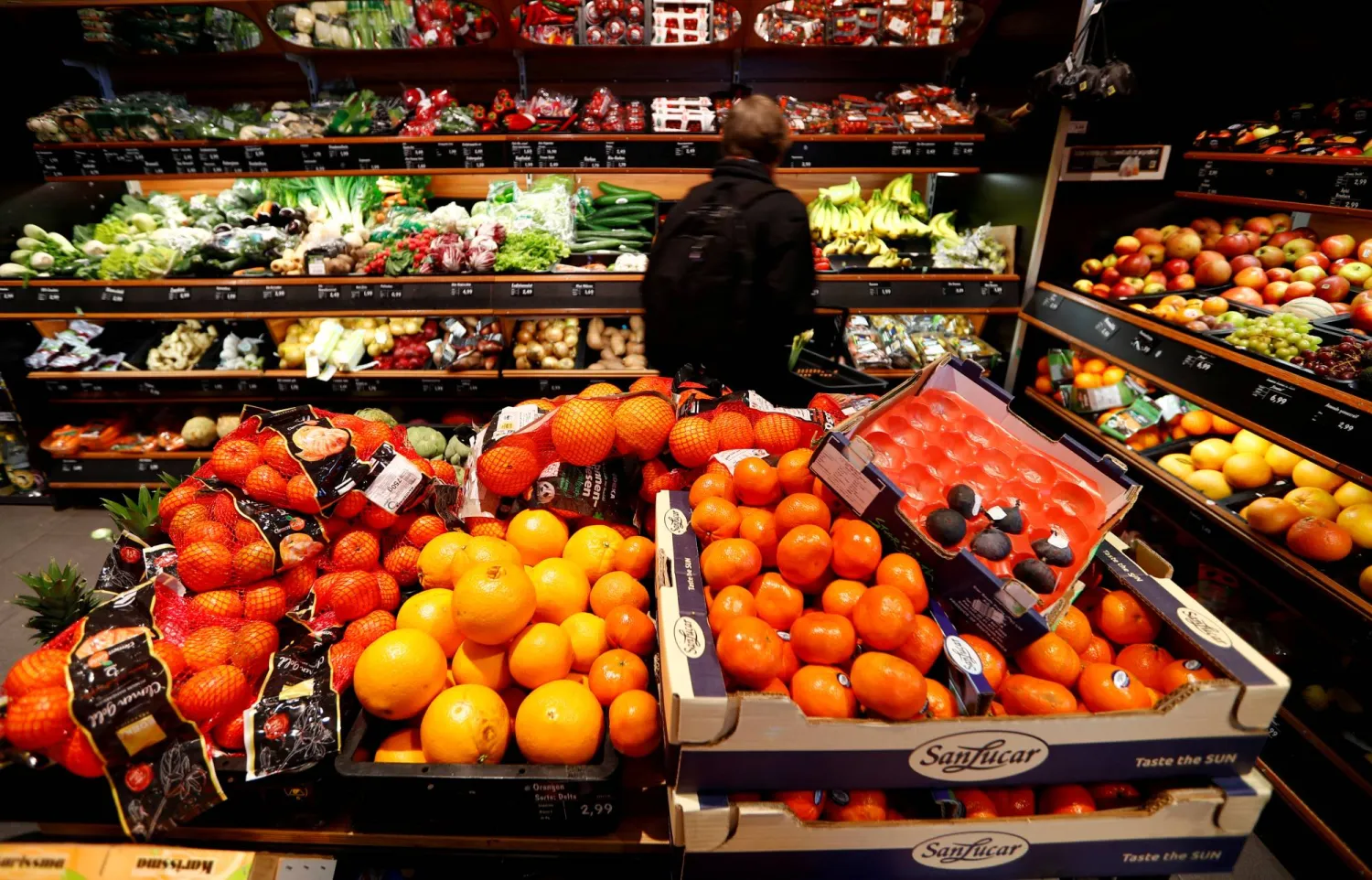
Shelves filled with fruit inside a supermarket in Berlin (Reuters)
TT

Euro Zone Inflation Surges Past ECB Target on Oil Shock

Shelves filled with fruit inside a supermarket in Berlin (Reuters)

Euro zone inflation soared past the European Central Bank's 2% target this month due to surging oil and gas prices, heightening a policy dilemma as expensive energy drags growth and risks generating a self-reinforcing inflation spiral.

Oil prices have nearly doubled as a result of the Iran war and the ECB is now debating whether to raise interest rates to prevent this surge from becoming entrenched in the price of other goods and services, Reuters reported.

Overall inflation in the 21 countries sharing the euro currency jumped to 2.5% in March from 1.9% a month earlier, below expectations for 2.6% in a Reuters poll of economists, as energy costs rose 4.9%.

"The previously price-stable environment is saying goodbye" said Alexander Krueger, chief economist at Hauck Aufhaeuser Lampe. "What matters is that this inflationary dirt does not feed through into the core rate." A closely-watched figure on underlying inflation, which excludes volatile ⁠food and energy, ⁠meanwhile, fell to 2.3% from 2.4%, data from Eurostat, the EU's statistics agency showed on Tuesday.

Basic economic theory argues that central banks should look past one-off price shocks generated by supply disruptions, especially because monetary policy works with long lags.

But a quick rise in energy inflation can easily broaden out if companies start building this into selling prices and workers begin demanding higher wages for the loss of disposable income.

High energy prices should increasingly make other goods more expensive and push up core inflation, said Commerzbank's chief economist ⁠Joerg Kraemer, forecasting headline inflation will rise above 3% by May unless the war ends quickly. The public may also start doubting the ECB's resolve if it remains idle, firming the case for rate hikes even in the event of large but not so persistent inflation episodes, ECB President Christine Lagarde said last week.

Financial markets now see three interest rate hikes from the ECB this year, with the first in either April or June.

"The mounting inflation pressure suggests that the ECB will raise its key interest rates in April or, at the latest, in June," Kraemer said. While some policymakers, such as the influential Bundesbank head Joachim Nagel, said that a rate hike as soon as April was an option, others, including ECB board member Isabel Schnabel, have warned against hasty action.

But policymakers agree that the ECB must act if energy starts ⁠generating second round ⁠price pressures, especially since domestic inflation had been above 2% for years.

Services inflation, the single largest item in the consumer price basket and the key gauge for domestic inflation, fell to 3.2% in March from 3.4% a month earlier.

Part of the issue is that the ECB was late in recognizing the inflation problem in 2021/22, arguing for months that the surge was transitory and would pass. It only raised rates when price growth hit 8%, forcing the central bank into its steepest tightening cycle in its history.

But the bloc is now in a very different position, so comparisons with 2022 are not entirely valid.

Rates are already higher, budget policy is tighter, the labor market has been weakening for months and there is no pent-up demand created by pandemic-era lockdowns.

The ECB will next meet on April 30.

"We find it hard to see the ECB moving at the next meeting at the end of April," said Carsten Brzeski, global head of macro at ING. "Unless the ghosts of 2022 are really keeping policymakers awake at night."



Spain's Repsol Reportedly Wins Back Control of Venezuelan Oil Operations

FILE PHOTO: Logo of the Spanish oil company Repsol at a gas station in Vecindario, on the island of Gran Canaria, Spain, January 9, 2026. REUTERS/Borja Suarez/File Photo
TT

Spain's Repsol Reportedly Wins Back Control of Venezuelan Oil Operations

FILE PHOTO: Logo of the Spanish oil company Repsol at a gas station in Vecindario, on the island of Gran Canaria, Spain, January 9, 2026. REUTERS/Borja Suarez/File Photo

Spanish energy group Repsol is poised to take back operational control of its Venezuelan oil assets and boost production following a deal signed with the South American government, the Financial Times reported on Thursday.

Repsol is expected to announce the agreement as early as Thursday, FT added, citing a person familiar with ⁠the matter.

The agreement ⁠will include plans to triple production from its Venezuelan oil operations within three years and establish a "guaranteed" payment system that will avoid previous pitfalls under which the capital city ⁠of Caracas failed to pay up, according to the report.

Reuters could not immediately verify the report. Repsol did not immediately respond to Reuters' request for a comment.

Venezuela holds one of the largest oil reserves in the world but has dilapidated energy infrastructure.

In 2023, Repsol reached an agreement with Venezuela to continue operating its ⁠facilities ⁠there. The deal later lapsed after US President Donald Trump revoked licenses granted to Repsol and other Western companies to operate in the country.

After the US captured President Nicolas Maduro in January, Washington eased sanctions on Venezuela's energy sector, issuing general licenses that allow global energy companies to operate oil and gas projects in the OPEC member.


China's Economy Beats Forecasts, but War Darkens Outlook

China's exports have helped support the economy but there are concerns about the impact on trade from the Middle East crisis. CN-STR/AFP
TT

China's Economy Beats Forecasts, but War Darkens Outlook

China's exports have helped support the economy but there are concerns about the impact on trade from the Middle East crisis. CN-STR/AFP

China's economy expanded more than expected in the first three months of the year, with official data Thursday indicating resilience in the face of a Middle East crisis that threatens to hit global growth.

The figures came despite a surge in world energy prices caused by the US-Israel war on Iran, which has stymied shipping through the crucial Strait of Hormuz, through which a fifth of the world's oil and natural gas passes.

Analysts say China's diversified energy supply shields it from immediate shocks, though a potential global downturn caused by the war could weaken demand for its exports, which have been propping up the country's economy.

Gross domestic product in the world's second-largest economy expanded 5.0 percent year-on-year in January-March, according to the National Bureau of Statistics (NBS).

The reading was slightly higher than an AFP forecast of 4.8 percent based on a survey of economists.

During the first quarter, China's economy "achieved a strong start to the year, further demonstrating its resilience and vitality", the NBS said in a statement announcing the data.

The reading came days after the International Monetary Fund cut its 2026 global growth projection, warning that the world economy could be "thrown off course" by the Middle East war.

It also reduced its forecast for China to 4.4 percent growth, from a previous estimate of 4.5 percent.

"The global economy is facing this next test of resilience as signs of unevenness lie beneath the surface," it said, noting that China's "domestic activity -- especially in the housing sector -- lags behind exports".

Beijing has set a 2026 target of 4.5-5.0 percent growth -- the lowest in decades.

A years-long crisis in the property sector and a persistent slump in domestic spending have left leaders reliant on exports to meet growth targets.

- Trade headwinds -

Outbound shipments have boomed, exemplified by the country's whopping $1.2 trillion trade surplus last year.

But data this week showed export growth slowed sharply in March, indicating that war in the Middle East was already taking a toll.

Thursday's NBS data also showed retail sales grew 1.7 percent on-year in March, well short of a Bloomberg forecast of 2.4 percent.

Industrial production rose 5.7 percent, the NBS said, beating a Bloomberg estimate of 5.3 percent but well down from the 6.3 percent seen in January and February combined.

The first-quarter acceleration in growth was fueled by exports, Zichun Huang of Capital Economics wrote in a note.

"We think growth will soften a bit over the rest of the year," she said.

"While the Chinese economy is holding up well, it is becoming ever more dependent on external demand," she said, noting that the Iran war "is likely to add to this trend".

A major international trade fair kicked off this week in Guangzhou -- a metropolis in China's southern manufacturing heartland -- where attendees told AFP the war is impacting their business.

Chinese exporters and Middle Eastern buyers at the opening day of the Canton Fair on Wednesday gloomily told AFP the Iran war had pummeled orders and led to price hikes.

Wang Jun, the deputy head of China's customs administration, this week acknowledged "many uncertainties and instabilities in the external environment".

"The impact of international geopolitical conflicts on global industrial and supply chains is still evolving in a complex manner," he said.


Saudi Arabia, US Sign Tax Information Exchange Agreement

Al-Jadaan and Bessent shake hands after signing the Tax Information Exchange Agreement in Washington. (X)
TT

Saudi Arabia, US Sign Tax Information Exchange Agreement

Al-Jadaan and Bessent shake hands after signing the Tax Information Exchange Agreement in Washington. (X)

Saudi Minister of Finance Mohammed Al-Jadaan has held a series of meetings in Washington, D.C. to discuss strengthening bilateral economic cooperation and addressing challenges facing the global economy.

Al-Jadaan began his meetings on Wednesday by holding talks with US Treasury Secretary Scott Bessent. They discussed the latest developments in the global economy and financial issues of common interest.

They signed a Tax Information Exchange Agreement to enhance tax cooperation, as well as facilitate the exchange of knowledge and technical expertise between the two sides.

As part of strengthening European economic relations, Al-Jadaan met with French Minister of the Economy, Finance, and Industrial, Energy, and Digital Sovereignty Roland Lescure.

The two sides discussed economic developments in the world, focusing on exploring new ways to deepen financial and industrial cooperation between the Kingdom and France, in a way that serves common interests.

Regarding relations with Pakistan, the Minister of Finance discussed with both his Pakistani counterpart, Muhammad Aurangzeb, and the Governor of the State Bank of Pakistan, Jameel Ahmad, prospects for financial and economic cooperation.

The discussions addressed ways to support financial stability and enhance joint work between financial institutions in both countries.