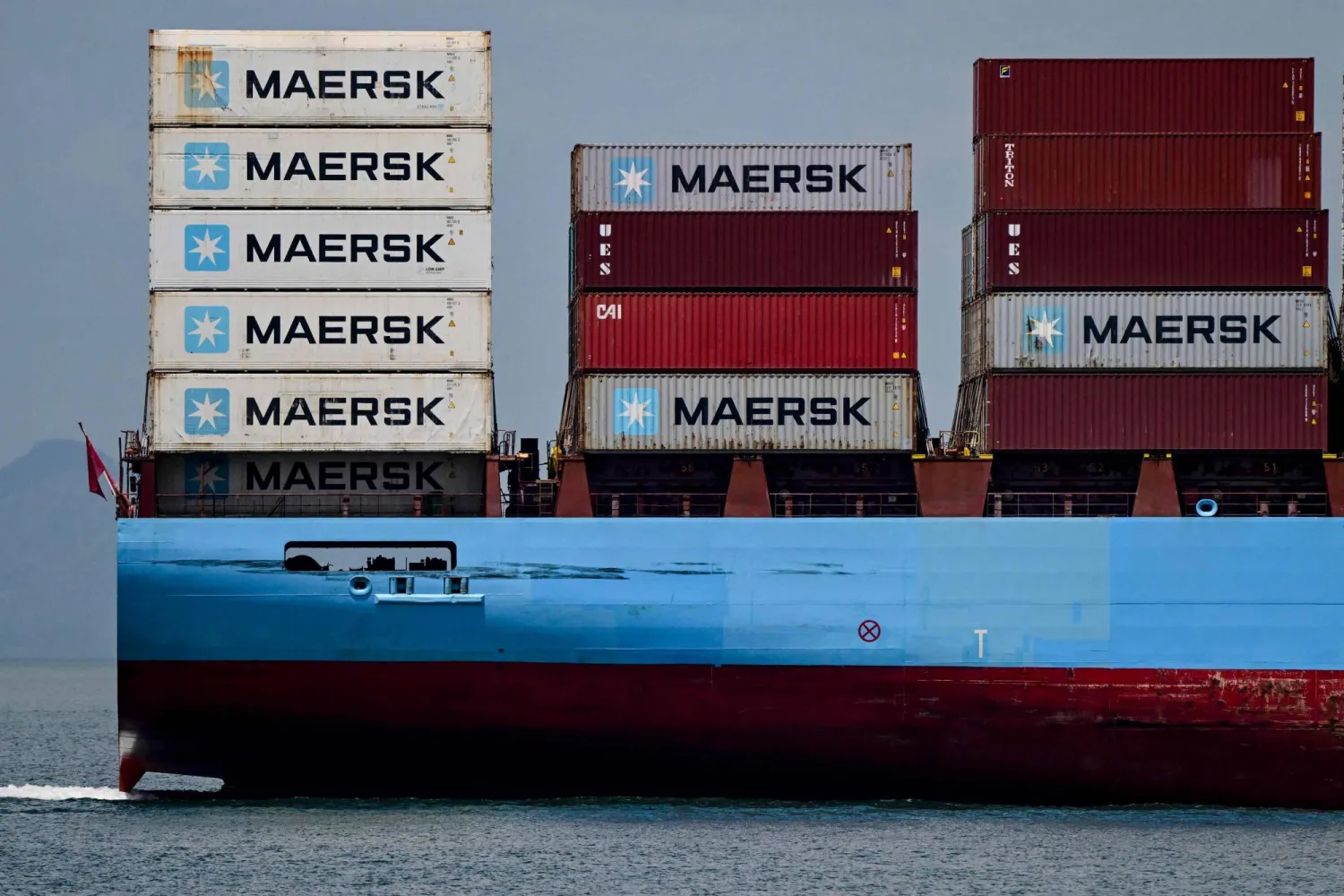
Maersk First-quarter Profit Beats Forecasts, Keeps Outlook Unchanged

A cargo ship carrying containers from the Danish company Maersk sails into the Pacific entrance of the Panama Canal in Panama City on April 21, 2026. (Photo by MARTIN BERNETTI / AFP)
TT

Maersk First-quarter Profit Beats Forecasts, Keeps Outlook Unchanged

A cargo ship carrying containers from the Danish company Maersk sails into the Pacific entrance of the Panama Canal in Panama City on April 21, 2026. (Photo by MARTIN BERNETTI / AFP)

Shipping group Maersk posted first-quarter operating profits slightly above analyst forecasts on Thursday and kept its full-year earnings guidance unchanged.

Underlying earnings before interest, tax, depreciation, and amortization (EBITDA) for the January-March period came in at $1.73 billion, compared to a median forecast of $1.66 billion in a company-provided poll of 10 analysts.

Maersk, which is often seen as a bellwether for global trade, still projects global container volume growth of between 2% ⁠and 4% this ⁠year.

"We've seen strong demand across most regions this quarter, supporting robust volume growth in our three business segments," Reuters quoted Chief Executive Vincent Clerc as saying in a statement.

The first quarter does not capture the Middle East war's full impact on global supply ⁠chains as the conflict began on February 28 when the United States and Israel launched coordinated strikes on Iran.

The war has disrupted shipping routes across the region after Iran closed the Strait of Hormuz to commercial traffic, pushing up costs such as fuel.

The security situation remained fragile, with French shipping group CMA CGM saying on Wednesday that one of its container ships was hit while transiting the Strait of Hormuz, injuring ⁠crew ⁠and damaging the vessel.

The Middle East security situation also impacts shipping in the Red Sea, forcing Maersk to continue to reroute vessels around Africa, away from the Suez Canal and the Bab el-Mandeb Strait.

This marked an abrupt stop to Maersk's tentative efforts for a gradual return of some services to the Suez route, seen as a key step towards ending years of global trade disruption caused by attacks on ships in the Red Sea by Yemen's Houthis.


Australia to Force Gas Giants to Reserve Fuel for Domestic Use

An LNG tanker berthed at the Karratha gas plant loading terminal in Western Australia. Handout / WOODSIDE ENERGY LTD/AFP
TT

Australia to Force Gas Giants to Reserve Fuel for Domestic Use

An LNG tanker berthed at the Karratha gas plant loading terminal in Western Australia. Handout / WOODSIDE ENERGY LTD/AFP

Australia will look to stave off energy shortages by forcing major gas companies to reserve 20 percent of their exports for domestic use, Energy Minister Chris Bowen said Thursday.

The country is one of the world's largest exporters of liquefied natural gas (LNG), a key fuel source in hot demand as war in the Middle East upends global energy markets.

In a bid to shield the nation from "global price volatility", Australia's largest gas firms will be forced to ring fence fuel for the domestic market -- equivalent to 20 percent of their exports.

"We've been acting to shield Australians from global energy shocks by investing in reliable, sovereign renewables and keeping more of the gas we need onshore," Bowen told reporters.

Australia is a major supplier of LNG throughout Asia, where prices have soared since the United States and Israel launched strikes on Iran at the end of February.

Around 40 percent of Japan's LNG comes from Australia, according to the Asia Natural Gas and Energy Association.

Australia is Singapore's largest source of LNG, supplying more than 30 percent of its needs, according to government figures.

Bowen sought to soothe any concerns that the decision could hurt trading partners.

- 'Reliable' partner -

"We will not disturb any existing contracts.

"We have consulted closely with trading partners to ensure that it's well understood around the world that Australia will always be a reliable supplier of energy."

The government would pass laws to have the reservation scheme in place from July 2027, Bowen said.

Geographically isolated and with only two oil refineries, Australia is heavily exposed to disruptions to global fuel supplies.

With Iran halting a fifth of world fuel shipments through its effective closure of the crucial Strait of Hormuz, Australia has moved to shore-up its fuel security.

Prime Minister Anthony Albanese announced Wednesday that Australia would establish a national fuel stockpile of one billion liters.

Australia's major gas companies -- including Shell, Chevron and Woodside -- reap huge profits selling LNG overseas.

Critics have been piling pressure on the government to drastically increase taxes on these exports -- an idea that Canberra shot down last week.

World oil prices dived on Wednesday after US President Donald Trump raised hopes of an end to the Iran war.


French Utility Engie Not Changing Middle East Strategy Despite Disruptions

(FILES) This photograph shows the "Tour First" also known as "Tour CB31", headquarters to French multinational energy group Engie, in the La Defense business district in Courbevoie, western suburb of Paris, on March 25, 2025. (Photo by JOEL SAGET / AFP)
TT

French Utility Engie Not Changing Middle East Strategy Despite Disruptions

(FILES) This photograph shows the "Tour First" also known as "Tour CB31", headquarters to French multinational energy group Engie, in the La Defense business district in Courbevoie, western suburb of Paris, on March 25, 2025. (Photo by JOEL SAGET / AFP)

French utility Engie is still looking to grow and develop its profile of energy assets in the Middle East despite the disruptions ⁠from the Iran War, Engie's ⁠finance chief Pierre-Francois Riolacci told reporters on Thursday.

"We don't see ⁠any questioning of our development plan in the Middle East at all. It's not necessarily the largest region, but it still is part ⁠of ⁠our plans, and we do not see the crisis prompting us to revise our strategy," Riolacci said.

Engie met expectations as it reported a drop in first-quarter earnings on Thursday after warmer weather lowered domestic gas sales and deliveries.

The company, which produces, transports and sells gas and electricity, said earnings before interest ⁠and tax (EBIT) excluding nuclear, ⁠were 3.4 billion euros ($4 billion), down 8.4% from a year earlier.

That matched the consensus forecast of 3.4 billion euros from analyst estimates compiled ⁠by LSEG.

Engie also confirmed a media report this week that said onshore wind project development had slowed in the United States, but it added that solar and battery sector development continues.

"Some permits are being revoked for onshore wind power. It's clear ⁠that ⁠obtaining the necessary authorizations is indeed difficult," Riolacci told reporters.

"Even when permitting isn't required on federal lands, we still face challenges getting approval from agencies."


IBM CEO to Asharq Al-Awsat: Saudi Arabia Enters AI Implementation Phase

IBM: Saudi Arabia should use digital technologies to boost productivity and make them part of the workforce, not just an added technology layer.
TT

IBM CEO to Asharq Al-Awsat: Saudi Arabia Enters AI Implementation Phase

IBM: Saudi Arabia should use digital technologies to boost productivity and make them part of the workforce, not just an added technology layer.

At IBM Think 2026 in Boston, IBM’s bet on Saudi Arabia went beyond expanding its role in AI infrastructure. The US technology company sought to position itself as a partner in a tougher phase, turning that investment into large-scale industrial and institutional execution.

That message came through in remarks by IBM Chief Executive Arvind Krishna to Asharq Al-Awsat. Speaking about the kingdom and the challenge it now faces, Krishna said infrastructure is not the problem in itself, adding that what needs to be done on that front is already largely clear.

It is now closer to a matter of spending and execution than a strategic dilemma.

But Krishna quickly shifted to what he sees as the more important question: how these technologies can improve citizens’ lives and help new industries emerge faster.

Krishna linked Saudi Arabia’s AI path to broader economic and operational needs. He said the kingdom, given its population size and development ambitions, needs digital tools that raise operational capacity and productivity. Digital technologies and AI, he said, should become “part of the workforce” and help lift productivity over the long term.

Beyond infrastructure

To make his point, Krishna did not use a purely technical example. He turned instead to a Saudi case tied to Hajj, tourism, and related services.

He said that if Saudi Arabia wants to receive tens of millions of visitors, it cannot simply bring in millions more workers to run hospitality, logistics, and services.

Digitalization and AI must become part of the solution, he said, allowing those sectors to scale within five years rather than twenty.

The discussion, in other words, moved beyond energy and major government projects. It extended into services, the daily economy, and how they can grow faster. Krishna said he sees little disagreement over the kingdom’s vision.

The challenge now, he added, is the cultural and operational adoption of technology across industries.

A new operating model

That Saudi reading fit the broader message Krishna pressed throughout the conference.

In his keynote, he presented AI not as a tool to improve certain functions or speed up tasks, but as the start of a new “operating model” for institutions.

The question, he said, is no longer about budget size or computing investment. It is about how deeply AI is embedded in business operations, and whether it becomes part of the institution itself or remains on the margins.

Krishna supported that argument with figures meant to show that the debate has moved beyond promises. He spoke of the potential to achieve productivity gains of around 40% by 2030.

He said more than two-thirds of organizations plan to reinvest those gains in innovation and growth, rather than treating them only as cost cuts.

He also said IBM itself has achieved $4.5 billion in annual productivity gains from using AI and automation inside its own operations.

With that message, IBM seemed to tell the market that AI is no longer just a technology upgrade or a new tool. It is becoming a business model issue.

Redesigning the enterprise

In an “Ask Me Anything” session, Krishna compared many current AI uses to the “light bulb” phase of the electricity era. They are useful and convenient, he said, but they do not fundamentally change how a company operates.

Speaking to Asharq Al-Awsat, he said real transformation begins when AI is used to rebuild processes from end to end, across procurement, human resources, accounts payable, compliance, and other functions.

Only then does the real impact appear, and productivity in some areas can rise sharply.

IBM is no longer framing AI as an assistant for some employees. It is presenting it as an operating layer that must move into the heart of the institution.

The Saudi market moves to scale

IBM’s view of the Saudi market follows the same logic.

In a separate interview with Asharq Al-Awsat, Ayman AlRashed, IBM’s regional vice president in Saudi Arabia, said companies in the kingdom are moving from “isolated experiments” to “deployment at scale.” AI, he said, is no longer a side addition, but “a core part of how companies operate and compete.”

AlRashed said computing power is no longer the main bottleneck. The bigger challenges are now “AI-ready data, governance, and enterprise execution.”

He said the sectors closest to moving AI from pilots to large-scale production are banking and financial services, telecommunications, energy, and government. Progress in those sectors, he said, depends on data maturity, clear regulatory frameworks, and operational scale.

AlRashed added that the sovereignty debate in Saudi Arabia is no longer limited to where data is stored. It now includes how workloads are governed while running, especially as AI moves into more sensitive and regulated environments.

Saudi clients, he said, are asking sharper questions about return on investment, ranging from cost savings and higher productivity to lower risk and measurable outcomes, rather than merely focusing on launching new pilots.

In that sense, IBM’s local reading echoed Krishna’s message on stage in Boston. The Saudi market lacks neither ambition nor infrastructure. It is entering a phase in which AI will be measured by its ability to deliver real operational impact within institutions.

Sovereignty as operating power

Other parts of IBM’s message made its Saudi positioning more coherent.

This year, the company presented hybrid infrastructure, digital sovereignty, live data, automation, and governance as connected elements, not separate products.

Krishna repeatedly said countries and institutions need infrastructure they can control, systems that cannot be shut down, tampered with, or exposed to geopolitical risk, including disruptions to undersea cables.

In Saudi Arabia, that message carries added weight. Sovereignty over infrastructure is not an end in itself. It is part of the ability to run AI across strategic sectors with flexibility and stability over the long term.

Aramco takes the stage

Saudi Aramco’s Senior Vice President for Digital and Information Technology, Sami Al-Ajmi, appeared on the opening stage at IBM Think 2026 as the practical example IBM wanted to highlight.

IBM did not put Aramco in the spotlight simply to present it as a major client or longtime partner. It used Aramco as proof that the move from pilots to industrial execution is no longer theoretical.

Krishna recalled that the relationship between the two companies dates back to 1947, when IBM helped install Aramco’s first information processing system, the first of its kind in Saudi Arabia. But the conference was not focused only on that history. It was focused on what the relationship looks like today.

Al-Ajmi said the relationship is no longer one between a vendor and a buyer. It has become “a strategic alliance around joint innovation.” He said IBM’s opening in Saudi Arabia brought the company closer to Aramco and helped “localize some expertise.”

He summed up the shift in a phrase that captured IBM’s message: “Eighty years ago we were buying machines from IBM, today we are working together to build the future of digital technologies.”

In that sense, IBM is no longer presenting itself only as a technology seller. It is presenting itself as a partner that wants to help build the kingdom’s next industrial AI use cases.

From pilots to the field

The strongest part of Al-Ajmi’s remarks was his definition of what Aramco wants from AI.

He said the company is “not interested in proofs of concept or early experiments.” It wants to “move ideas from the lab into the field.”

That statement placed Aramco at the center of IBM’s message this year. The next phase, IBM argues, will not be won by the number of experiments a company launches. It will be won by the ability to build a real and operational AI model.

Al-Ajmi said the two sides can “close the loop from idea to impact” by identifying real problems, designing solutions, testing them, and scaling them when they work.

His figures gave weight to that argument. Aramco generates nearly 10 billion data points a day from its assets, he said, describing data as “the fuel of the AI journey.”

He also said Aramco has trained more than 6,000 AI specialists, speeding up idea generation and deployment and bringing the technology closer to field operations.

Al-Ajmi said digital technology initiatives created $5.2 billion in value last year, with “more than 50%” of that coming from AI deployments.

With those numbers, Aramco was not talking about AI’s theoretical promise. It was talking about direct financial and operational impact.

AI and energy

Al-Ajmi added another important dimension. AI, he said, is changing the energy sector in two ways at once. It raises efficiency and reliability while lowering costs, but it also increases energy demand.

He pointed to practical applications within Aramco, including petrophysical models that address rock formations and fluids, enhancing reserve value, reducing drilling time, and lowering costs. He also cited global optimization tools that provide a full view of assets and help improve refinery and petrochemical margins, an “engineering adviser” that supports engineers in the field, and AI applications in finance and supply chains.

AI at Aramco, in other words, is no longer a limited office tool or a digital assistant. It is spreading across the value chain.

IBM’s Saudi bet

In Boston, IBM was not making a conventional technology pitch to Saudi Arabia. It was offering a full narrative.

Infrastructure matters, but the real challenge begins after it is built. The vision exists, but adoption and execution will decide the outcome. AI will not prove its value in the kingdom through demonstrations, but by entering energy, tourism, services, government, and finance as part of how those sectors operate.

IBM’s message from Boston was not that Saudi Arabia simply needs more computing power. It is that the kingdom is entering a phase in which AI will be judged by its ability to change how institutions and industries operate on the ground.