

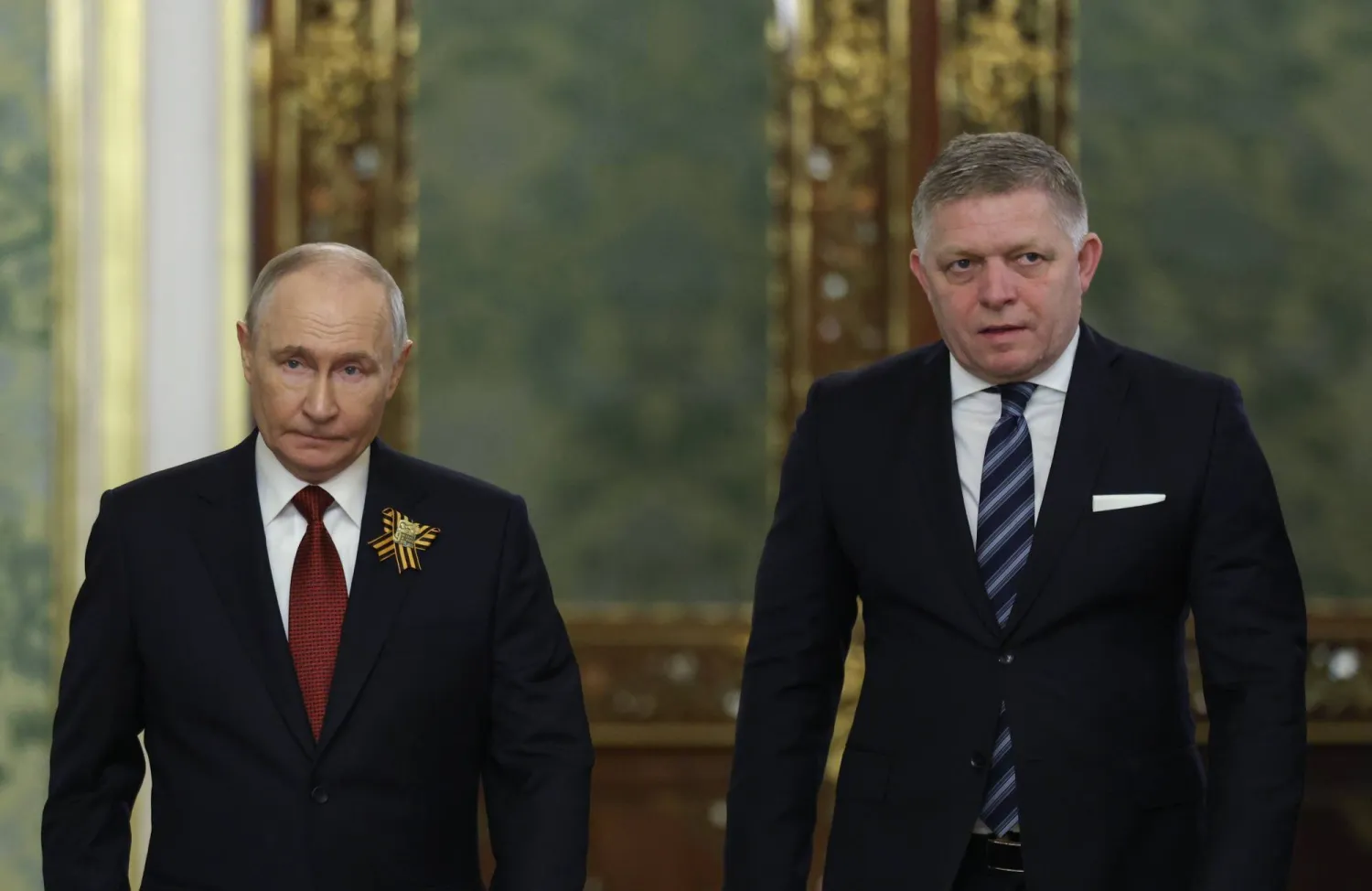

Putin Says Russia Will Meet Slovakia's Energy Demand

Russian President Vladimir Putin and Slovak Prime Minister Robert Fico attend a meeting at the Kremlin in Moscow on May 9, 2026 (EPA)
TT

Putin Says Russia Will Meet Slovakia's Energy Demand

Russian President Vladimir Putin and Slovak Prime Minister Robert Fico attend a meeting at the Kremlin in Moscow on May 9, 2026 (EPA)

President Vladimir Putin told Slovakian Prime Minister Robert Fico at a meeting in the Kremlin on Saturday that Russia will do everything to meet Slovakia's energy demand.

Slovakia is among only a few countries in Europe that are still buying Russia's oil and gas. ⁠Slovakia gets Russian ⁠oil via the Soviet-built Druzhba pipeline, while natural gas from Russia flows there through the TurkStream pipeline.

Fico arrived in Moscow for the festivities to ⁠mark the Soviet Union's victory over Nazi Germany in World War Two.

"We will do everything to satisfy Slovakia's needs in energy resources," Putin told Fico, who chose not to attend the Victory Parade on Moscow's Red Square, in comments broadcast on national TV.

According to Reuters, Russian state media ⁠had ⁠previously reported that Fico was due to attend the parade.

Slovakia, an EU member, has sought to maintain political ties with Russia and has argued that it would be too costly to wean itself off Russian supplies after building its infrastructure around it.



Sri Lanka Raise Fuel Prices after IMF Loan Instalment

People enter the Central Bank of Sri Lanka headquarters in Colombo, Sri Lanka, May 26, 2026. REUTERS/Akila Jayawardena
TT

Sri Lanka Raise Fuel Prices after IMF Loan Instalment

People enter the Central Bank of Sri Lanka headquarters in Colombo, Sri Lanka, May 26, 2026. REUTERS/Akila Jayawardena

Sri Lanka raised fuel prices by up to six percent on Sunday, in line with IMF plans to recover energy costs and phase out subsidies to stabilize the economy.

Petrol was raised to 434 rupees ($1.33), up from 410, while diesel increased to 407 rupees a liter from 392, AFP quoted the state-run Ceylon Petroleum Corporation as saying.

The price hike came days after the International Monetary Fund released a $695 million instalment of a $2.9 billion bailout loan, agreed in early 2023 to stabilize the cash-strapped South Asian nation.

The IMF wants Sri Lanka to ensure cost recovery for both fuel and electricity tariffs, which have been subsidized by the government since the start of the conflict in the Middle East in February.

President Anura Kumara Dissanayake, in a letter to the IMF made public by the Washington-based international lender, said fuel subsidies will be phased out by September.

Since the United States and Israel began attacking Iran on February 28, triggering a global energy crisis, Sri Lanka has raised petrol and diesel prices by about 48 percent. Electricity has increased by a third.

The Strait of Hormuz, a key waterway through which about 20 percent of global oil exports pass in peacetime, has been effectively closed by Iran.

Sri Lanka imports all its oil and also buys coal for electricity generation.

Colombo has warned that the fighting in the Middle East, and any prolonged conflict, could seriously undermine its efforts to emerge from the economic meltdown of 2022.

Sri Lanka defaulted on its $46 billion foreign debt in 2022 after running out of foreign exchange. Since then, Colombo has been drawing down the IMF bailout loan to stabilize the country.


European Commission Vows Tougher Action on Trade with China

 Worker use a forklift to transfer goods at the Xiaomi logistic center, in Beijing, China on Friday, May 29, 2026. (AP)
Worker use a forklift to transfer goods at the Xiaomi logistic center, in Beijing, China on Friday, May 29, 2026. (AP)
TT

European Commission Vows Tougher Action on Trade with China

 Worker use a forklift to transfer goods at the Xiaomi logistic center, in Beijing, China on Friday, May 29, 2026. (AP)
Worker use a forklift to transfer goods at the Xiaomi logistic center, in Beijing, China on Friday, May 29, 2026. (AP)

The EU's trade and investment relationship with China is "not sustainable", the European Commission said on Friday, vowing a stronger response as commissioners discussed how best to shield Europe's industries from surging Chinese imports.

Commissioners were pitching ideas ahead of an EU leaders' summit on June 18 to 19, and possible proposals could include forcing EU firms to diversify supply chains or introducing new trade mechanisms to curb China's access to the EU market in chemicals, metals and clean energy technology.

"As economic and security interests become ever more intertwined, both dimensions will require a more robust and coherent response," the Commission said.

Any concrete proposals for the response ‌are not expected ‌to be announced until the third quarter of this year.

Western governments are ‌trying ⁠to reverse some ⁠of the offshoring to China that peaked in the early 2000s, depleting industrial know-how and hubs in their countries, particularly in the US and EU members.

China's commerce ministry said on Saturday in response that Europe should abide by World Trade Organization rules, uphold free trade and fair competition, and firmly oppose protectionism and unilateralism.

"Should the EU insist on unilaterally introducing new trade instruments and imposing discriminatory restrictions, China will resolutely take countermeasures and adopt effective measures to safeguard its own interests," it said in an online statement.

TRADE ⁠IMBALANCES, OVERCAPACITY IN FOCUS

The Group of Seven (G7) wealthy nations will ‌also tackle trade imbalances and overcapacity at a mid-June summit ‌as China increasingly flexes its dominance on rare earths and other metals that are critical for sectors including defense, ‌tech, energy and automotive industries.

US President Donald Trump has pitched "America First" and, early this year, the ‌EU proposed a new "Buy European" policy and RESourceEU to accelerate the development of critical mineral supply chains in the EU as well as partnerships with mineral-rich countries from Central Asia to Australia and Brazil.

China's Foreign Ministry accused the EU on Thursday of using trade data selectively to justify claims of imbalances, and it has repeatedly threatened "strong ‌countermeasures" should the EU adopt "Buy European" and revised tech sovereignty policies. China rejects the notion that its trade practices are unjust.

Europe's industry faces ⁠a tougher climate than ⁠US rivals, constrained by higher energy costs and stricter regulation.

Industry Commissioner Stephane Sejourne said this week he wants the bloc's existing trade tools such as import duties and quotas to be used "more systematically" across sectors, rather than targeting specific companies or materials.

The EU has tried to curb some Chinese imports, with mixed results.

The bloc imposed tariffs on heavily subsidized Chinese electric vehicles, but not hybrid models. Hybrids accounted for nearly 40% of new car registrations so far this year and China's market share in Europe continues to rise.

While the Commission is keen to adopt a tougher stance, it will have to navigate differences between France and Germany to pass major legislation.

"Paris argues that Europe's open market is absorbing the combined effects of Chinese subsidies and US protectionism," Carsten Nickel, deputy research director at Teneo, wrote in a report.

"Germany's position is more conflicted," Nickel said, with concerns about mounting pressure on German manufacturing constrained by the deep dependency of big industrial groups on China's market.


Regional Turmoil Drives Growth at Egyptian Ports While Cutting Suez Canal Revenues

Egypt has an extensive network of seaports along both the Red Sea and the Mediterranean. (Egyptian Ministry of Transport)
TT

Regional Turmoil Drives Growth at Egyptian Ports While Cutting Suez Canal Revenues

Egypt has an extensive network of seaports along both the Red Sea and the Mediterranean. (Egyptian Ministry of Transport)

The Suez Canal may have incurred heavy losses due to regional tensions and instability in recent years — from the war in Gaza to the conflict involving Iran — those same disruptions have contributed to a significant surge in activity at Egyptian ports and in transit trade.

However, Egyptian economists said the strong increase in container traffic at the country’s ports is not enough to compensate for the canal’s losses.

They stressed that government initiatives, including efforts to expand transit trade, may only help reduce part of the revenue shortfall.

At the end of April, Egyptian President Abdel Fattah al-Sisi said Egypt had lost nearly $10 billion in Suez Canal revenues because of attacks on ships in the Bab el-Mandeb Strait.

Egyptian ports have experienced increased activity in recent months amid supply-chain disruptions linked to the Iran conflict. Maritime connections with regional countries have expanded, including the launch of the NEOM–Safaga multimodal logistics corridor linking Gulf Cooperation Council countries with Europe.

The Egyptian government has also reinforced trade links between the Gulf and Europe through the “Ro-Ro” shipping line connecting Damietta Port with Italy’s Port of Trieste to increase trade volumes.

In the energy sector, oil flows through Egypt’s SUMED pipeline rose following disruptions in global energy supply chains caused by the closure of the Strait of Hormuz.

Amr El-Samadouni, secretary-general of the International Transport and Logistics Division at the Cairo Chamber of Commerce, said the recent tensions in the Strait of Hormuz have “strengthened Egypt’s position as a regional hub for logistics services and supply-chain management.”

In a statement, El-Samadouni said the developments provide Egypt with “an important opportunity to offset part of the decline in Suez Canal revenues by attracting a share of urgent shipments that cannot tolerate long delays, especially in sectors linked to fast-moving trade and time-sensitive supply chains.”

According to a statement by Egypt’s Ministry of Transport on Thursday, the country’s port sector recorded a major increase in cargo and container handling. Egyptian ports handled 11.1 million twenty-foot equivalent units (TEUs) in 2025, compared with 8.9 million in 2024, representing growth of 24.3 percent.

Transit container traffic also increased sharply, reaching 6.7 million containers in 2025, a rise of 36 percent. The number of ships calling at Egyptian ports climbed to 17,288 voyages in 2025, up 6.6 percent, according to the ministry.

Egypt has an extensive network of seaports along both the Red Sea and the Mediterranean and is investing heavily in upgrades to strengthen its role in regional and international trade.

The Ministry of Transport said the modernization program aims to transform Egypt into a regional hub for transport, logistics, and transit trade while boosting the ports’ ability to attract investment and handle growing trade volumes.

Despite the improvements in port activity, “they cannot compensate for the losses of the Suez Canal,” said Walid Gaballah, a member of the Egyptian Association for Political Economy, Statistics and Legislation.

He noted that revenues from trade and container handling “may reduce the losses but cannot fully replace them,” adding that shipping traffic through the canal has yet to return to pre-Gaza war levels.

Gaballah told Asharq Al-Awsat that continued regional instability makes recovery in Suez Canal traffic increasingly difficult.

Egyptian economist Mostafa Badra also said there can be no direct comparison between canal revenues and port trade income. “There is no substitute for the canal as a major source of foreign currency,” he told Asharq Al-Awsat, noting that revenues generated by port trade remain far below the canal’s earnings under normal conditions.

Badra added that the government’s port-development strategy is intended to strengthen Egypt’s logistics capabilities and reinforce the Suez Canal’s role as a global trade corridor while primarily supporting domestic trade. By contrast, he said, the canal itself remains a vital artery in global supply chains.

Egypt recently rose three places in the UNCTAD Liner Shipping Connectivity Index, ranking 19th globally, first in Africa, and second in the Arab world, according to the Ministry of Transport.