


China's Producer Inflation Jumps to 4-year High, Squeezing Manufacturers

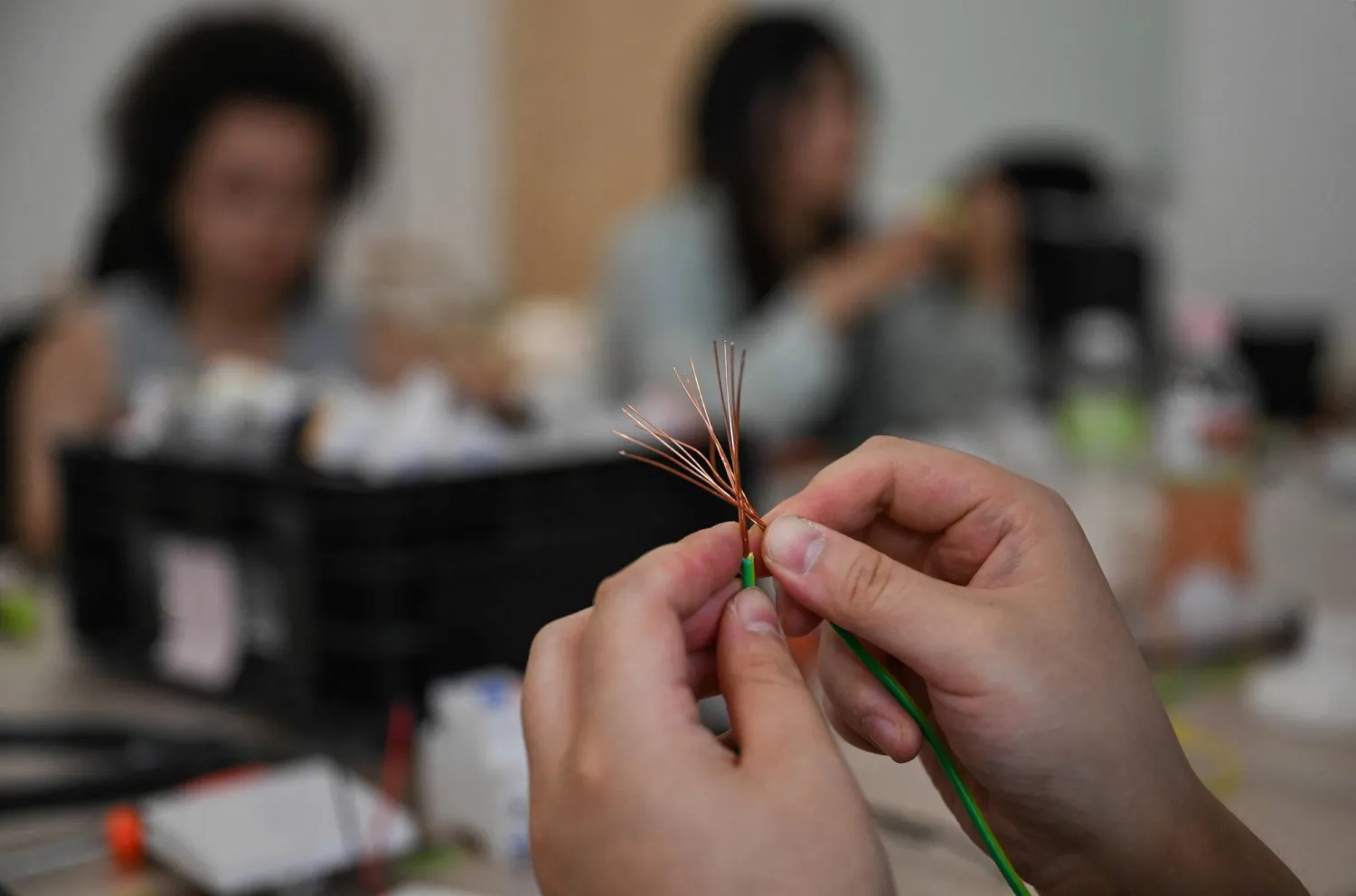
This picture taken on June 28, 2026 shows women attending an electricity course at the Mulan Build workshop in Hangzhou, in eastern China's Zhejiang province. (Photo by Pedro PARDO / AFP)
TT

China's Producer Inflation Jumps to 4-year High, Squeezing Manufacturers

This picture taken on June 28, 2026 shows women attending an electricity course at the Mulan Build workshop in Hangzhou, in eastern China's Zhejiang province. (Photo by Pedro PARDO / AFP)

China's producer price inflation surged to its highest level in four years in June, piling pressure on manufacturers' profit margins as weak domestic demand limits their pricing power.

China's economy is developing a two-track dynamic as a global AI-fueled export surge is lifting advanced manufacturing, while weak household spending, lackluster investment and the property downturn continue to restrain domestic activity.

The producer price index (PPI) rose 4.1% year-on-year, the highest rate since July 2022, National Bureau of Statistics (NBS) data showed on Thursday, matching the forecast in a Reuters poll and up for the fourth straight month.

The gauge, which logged a 3.9% gain in May, had snapped a years-long deflationary streak in March as energy prices soared in the wake of the Iran war.

The faster growth in factory-gate prices owed partly to a low base of comparison a year earlier, though analysts said soft domestic demand meant deflationary pressures had ⁠yet to ease meaningfully.

"The ⁠latest escalation in US-Iran tensions could deliver some renewed upward pressure on inflation in the near term," said Julian Evans-Pritchard, head of China economics at Capital Economics. "But this will remain limited to a few narrow areas and inflation still looks set to return near zero once energy supply normalizes."

Higher prices in coal mining, electrical machinery, electronics and ferrous metals were among the main factors contributing to the rises in producer prices, according to the NBS. Prices declined in sectors including alcoholic beverages and automobile manufacturing.

Compared with the previous month, PPI fell 0.3% in June following a sharp drop in global oil prices after ⁠the US and Iran agreed on a ceasefire. In contrast, some high-tech and green-transition industries, such as virtual reality equipment, wearables and carbon-based nanomaterials, recorded month-on-month price gains.

Markets hardly budged on the data, with stocks holding steady and the yuan moving up slightly.

Although firmer prices have boosted profits in some upstream and high-tech sectors, manufacturers more reliant on the home market are struggling to pass higher costs on to consumers. This backdrop highlights headwinds policymakers face in their efforts to support the job market and bolster still-soft domestic demand.

Evidence of subdued domestic demand was underscored by China's auto sales, which fell for a ninth consecutive month in June, prompting carmakers to turn to external markets.

Data on consumer prices, which was released alongside PPI, showed some moderation. The consumer price index (CPI) climbed 1.0% last month year-on-year, slowing from a 1.2% increase in May and below an expected 1.1% rise, as price increases for industrial consumer goods eased, ⁠including those for gold jewelry ⁠and gasoline.

On a monthly basis, CPI edged down 0.3%, compared with an expected 0.2% drop and a 0.1% dip in May, Reuters reported.

Core CPI, which excludes volatile food and energy costs, rose 1.0%, the slowest pace since January. Food prices dropped 1.6% year-on-year.

"The data is moving from near-deflation to low positive inflation," said Lynn Song, ING's chief economist for Greater China. "This sort of inflation level is not likely to impede the People's Bank of China from monetary policy action, should it deem it necessary."

China's market regulator has renewed its crackdown on "involution-style" competition, pressing ahead with a campaign to rein in cut-throat price wars that have fueled deflationary pressures.

Excessive competition has led to shrinking corporate profit margins across multiple sectors, including electric vehicles (EVs), solar panels, lithium batteries, steel, cement and food delivery.

Analysts contend that stronger policy intervention is essential to rebalance an economy marked by excess production capacity and weak domestic demand. The export boom has allowed policymakers to postpone more decisive stimulus measures.

"The anti-involution campaign and low base effects would boost inflation again in the first quarter of 2027," Zhaopeng Xing, ANZ's senior China Strategist, said.

"The inflation outlook allows policymakers to remain patient and keep interest rate cut on hold in 2026."



Egyptian Central Bank Issues Regulations for Digital Financial Identity Services

The headquarters of the Central Bank of Egypt in downtown Cairo (Photography: Abdul Fattah Faraj)
TT

Egyptian Central Bank Issues Regulations for Digital Financial Identity Services

The headquarters of the Central Bank of Egypt in downtown Cairo (Photography: Abdul Fattah Faraj)

Egypt's central bank has approved regulations for a digital financial identity platform that will enable remote customer verification and identification, it said on Sunday, as it seeks to expand access to ⁠financial services.

According to Reuters, it said ⁠the move was part of efforts to support digital transformation, promote financial inclusion ⁠and modernize the banking sector's digital infrastructure.

Governor Hassan Abdalla said the platform will enable more citizens to open bank accounts and access banking products and services online without visiting branches.

The ⁠regulations set out a governance framework, defining the roles and responsibilities of relevant parties, along with technical, data protection, and cybersecurity requirements, the central bank said.


Sinopec's Half-year Profit Grew 19.3% on Year Despite Iran War

Oil storage tanks and facilities of a Sinopec plant in Shanghai, China, March 26, 2026. REUTERS/Go Nakamura
TT

Sinopec's Half-year Profit Grew 19.3% on Year Despite Iran War

Oil storage tanks and facilities of a Sinopec plant in Shanghai, China, March 26, 2026. REUTERS/Go Nakamura

China's Sinopec reported an unexpected 19.3% year-on-year increase in net profit for the first half of 2026, despite a litany of issues including the Middle East conflict and falling demand for fuel domestically, but said it had to write down its inventories by 16 billion yuan.

Net profit over the January-June period stood at 25.63 billion yuan ($3.81 billion) under Chinese accounting standards, versus the 21.48 billion yuan a year earlier, Sinopec said in a filing at the Shanghai stock exchange on Sunday.

In a separate filing, the company said it set aside provisions for asset impairment of 16 billion yuan as a result of the volatility in oil and fuel prices in the first six months of this year.

Sinopec, ⁠the world's biggest ⁠refiner, relies on the Middle East for half of its crude oil needs, making it vulnerable to the worst supply crisis in history as the Strait of Hormuz - through which it usually imports large quantities of oil - has remained largely closed since March.

It also processed 5.6% less crude oil between January and June versus the same year-ago period, at 113.31 million metric tons, or 4.57 million barrels per day (bpd), according to the filing.

The company said its refining margin was up 44.1% on ⁠the year in the first half of 2026 - up 139 yuan per metric ton to 453 yuan per metric ton - a surprising jump given domestic fuel price hikes lagged the surges in crude oil cost.

Its refining segment reported a 381.5% growth in operating profit by "broadening crude oil sourcing outside the Middle East, closely managing the timing of purchases in line with market conditions, and optimizing its product mix based on product profitability," the filing showed, according to Reuters.

China has drastically cut oil imports since the war began in March, freeing up barrels for others and keeping a lid on global prices. Sinopec's result is all the more surprising given how exposed it was to the Strait and the way in which Beijing has forced the refiner, and others like it, to ⁠absorb the oil price shock ⁠by limiting their ability to pass higher oil prices through to fuel consumers

Conflict in the Middle East caused "sharp volatility in international crude oil prices and a substantial increase in imported crude procurement costs", while the domestic refined product and chemicals markets remained weak, the management stated in the filing.

But the company said it "closely monitored changing conditions, dynamically adjusted production and operating arrangements, and effectively responded to unexpected shocks and challenges on multiple fronts."

The chemicals segment remained loss-making, recording an operating loss of over 200 million yuan, but losses narrowed sharply by around 4 billion yuan, it said.

Output of ethylene, a key building block for petrochemicals, sank 15.5% on the year to 6.4 million tons in the first half, as the company faced industry over-capacity and competition from the private sector.

Sinopec projects crude throughput for July–December at 113 million metric tons, roughly flat versus the amount processed in the first half.


ECB Chief Lagarde Reportedly 'Ready to Serve' WEF

President of European Central Bank Christine Lagarde addresses the media in Frankfurt, Germany, Thursday, July 23, 2026, after a meeting of the ECB's governing council. (AP Photo/Michael Probst)
TT

ECB Chief Lagarde Reportedly 'Ready to Serve' WEF

President of European Central Bank Christine Lagarde addresses the media in Frankfurt, Germany, Thursday, July 23, 2026, after a meeting of the ECB's governing council. (AP Photo/Michael Probst)

Christine Lagarde, chief of the European Central Bank, could take over the presidency of the World Economic Forum at some point in 2027, Swiss newspaper NZZ reported on Sunday.

At a board meeting near Geneva this week, Lagarde was reportedly described as a "putative candidate" to lead the organization behind the annual Davos gathering of political and business leaders.

According to sources cited by the newspaper, she also said she was "ready to serve.”

The WEF's board ⁠is currently co-chaired ⁠by Roche vice-chairman André Hoffmann and BlackRock CEO Larry Fink, who are navigating a leadership transition after founder Klaus Schwab stepped down last year.

At the board meeting, Singapore's President Tharman Shanmugaratnam said that the succession to Fink ⁠and Hoffmann should be resolved internally as suitable candidates were available, NZZ reported.

Lagarde, who has been a member of the WEF's board for several terms, thanked the members of the 28-strong body for their confidence in her, according to the paper's reporting.

The board did not determine exactly when Lagarde should take over the presidency, NZZ said, based on sources, adding that the ⁠only point ⁠of agreement was that Fink and Hoffmann should still chair the annual meeting in Davos in January 2027.

The WEF did not immediately reply to a Reuters request for comment.

Christine Lagarde said last year she was determined to complete her term at the ECB, following speculation she might leave early to take up a role leading the WEF.

Her eight-year presidential term at the ECB runs out at the end of October 2027.