


European Chamber of Commerce Looks to Expand Trade and Investment With Saudi Arabia

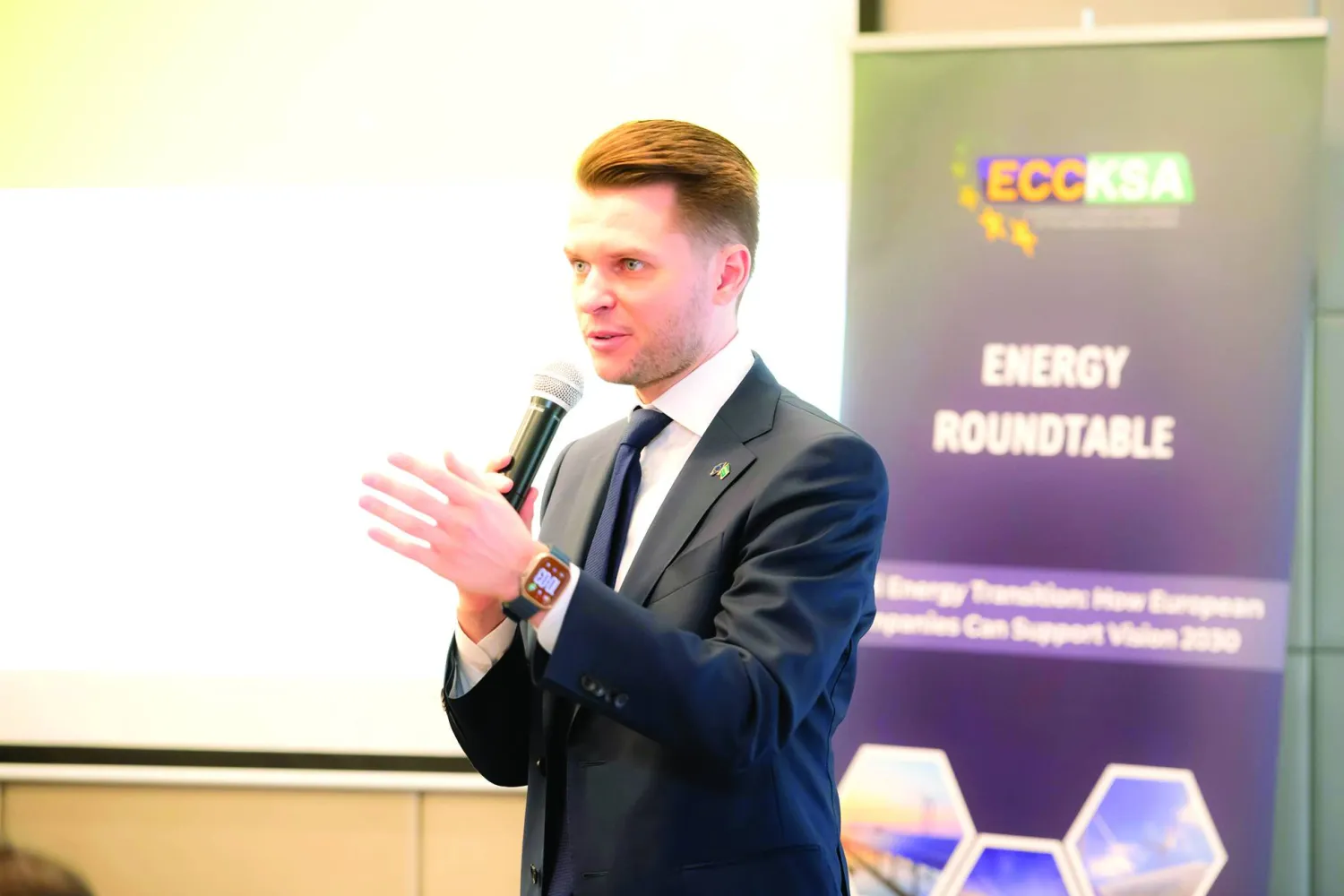
ECCKSA CEO Kristijonas Gedvilas at an event (Asharq Al-Awsat)
TT

European Chamber of Commerce Looks to Expand Trade and Investment With Saudi Arabia

ECCKSA CEO Kristijonas Gedvilas at an event (Asharq Al-Awsat)

The European Chamber of Commerce in Saudi Arabia (ECCKSA) said economic relations between the European Union and Saudi Arabia are entering a new phase of expansion, driven by new partnerships, more European companies entering the Kingdom's market, and deeper investment commitments, as the chamber seeks to broaden the base of European companies operating in Saudi Arabia and increase bilateral trade and investment.

"There is real momentum to build on, and it points clearly toward more European investment landing in the Kingdom," said Kristijonas Gedvilas, CEO of the European Chamber of Commerce in Saudi Arabia, noting that the coming years are expected to bring a significant step forward in economic relations between the two sides.

In an interview with Asharq Al-Awsat, he said the upcoming 10th EU-GCC Business Forum, if confirmed to take place in Riyadh, would mark a key milestone in strengthening the economic partnership and converting high-level political dialogue into tangible trade and investment opportunities for European companies.

Deepening Institutional Dialogue

Gedvilas noted that EU Ambassador to Saudi Arabia Christophe Farnaud said earlier this year that European investment in the Kingdom is expected to see notable growth over the next five years, particularly in clean energy, metals, critical raw materials, advanced industries, and the digital economy.

He said those expectations are based on continued progress toward the goals of Saudi Vision 2030, alongside the growing maturity of the chamber's sectoral committees, deeper institutional dialogue with Saudi and European authorities, and the transition of strategic initiatives such as the India-Middle East-Europe Economic Corridor (IMEC) move from early implementation toward larger scale.

He added that these developments are expected to bring more European companies into the Saudi market, increase invested capital, and strengthen partnerships with Saudi institutions and businesses.

ECCKSA's role, he said, is to ensure its members, from established multinationals to newer entrants, are positioned not just to benefit from this growth, but to help drive it.

With the foundations of its first two years now firmly in place, he added, ECCKSA has already become a meaningful actor in the bilateral relationship and is expected to play an even greater role as EU-Saudi economic ties continue to deepen.

New Partnerships

Gedvilas said ECCKSA has, over the past two years, become a genuine bridge between the Saudi government and the European private sector, giving Saudi authorities a more structured and effective channel to engage European companies on policies affecting trade, investment, and market development.

He explained that this institutional framework has been built through sectoral committees and working groups covering transport and logistics, energy, healthcare, as well as legal and taxation matters, enabling regular and direct dialogue between European businesses and Saudi and European authorities.

He said this mechanism has helped translate policy engagement into concrete business outcomes, including new partnerships, new market entrants, and deeper investment commitments.

He added that the chamber's Annual General Meeting, held in May 2026, marked a significant step toward organizational maturity, with its Board of Directors strengthened by additional leading European companies, reflecting the growing breadth of European business interests represented in the Kingdom.

As its membership continues to expand, the chamber is also scaling up its operations to deliver greater value to members and provide access to a broader and more diverse community of European companies.

Gedvilas said the inauguration of ECCKSA's new headquarters in Riyadh last June, attended by European Union and Saudi government officials, representatives of EU member state embassies, partners, and chamber members, marked another milestone reflecting its long-term commitment to supporting European businesses and strengthening dialogue between governments and the private sector.

He added that member companies now employ more than 25,000 people across Saudi Arabia, while more than 2,500 European companies operate in the Kingdom, with chamber members accounting for a growing share of that total.

The chamber has already begun bringing this broader business community together under one umbrella, he said, with the strategic objective of expanding the base of European companies to boost bilateral trade and investment while maintaining close ties with both the Saudi government and the private sector.

Trade and Investment

On economic relations, Gedvilas said trade in goods and services between the European Union and Saudi Arabia reached €88.8 billion in 2025, while EU exports to the Kingdom increased 2.6 percent to €38 billion compared with 2024.

Looking at longer-term trends, he said EU exports to Saudi Arabia have grown at an average annual rate of 11 percent since 2021, while imports have increased by 7.8 percent, reflecting the continued deepening of trade ties despite volatility in the global economy.

He added that investment tells an even stronger story than trade, with the European Union accounting for 29 percent of Saudi Arabia's total foreign direct investment stock, making it the Kingdom's largest source of foreign capital.

More than a quarter of the multinational companies that have established regional headquarters in Saudi Arabia are European, out of more than 700 global firms. He said choosing the Kingdom as a regional headquarters reflects a long-term commitment that goes beyond traditional commercial investment and underscores Saudi Arabia's growing role as a strategic destination for European capital.

Strategic Partnership

Gedvilas said European companies working collectively through ECCKSA help address the regulatory and institutional issues affecting their operations, improving market efficiency, strengthening relationships with Saudi institutions and businesses, and encouraging greater flows of European investment.

He said the chamber works to align the needs of European companies with the priorities of Saudi and European institutions so that political cooperation translates into tangible economic outcomes.

He explained that the chamber's success rests on two main factors. The first is access, as both Saudi and European governments have shown a strong willingness to work with a structured and credible organization representing the European private sector.

The second is its convening power. When European institutions seek direct input from companies operating in Saudi Arabia, the chamber organizes that dialogue with its members to ensure on-the-ground business realities are reflected in EU policymaking. Likewise, it provides Saudi authorities with a unified platform for engaging European industry rather than dealing with companies individually.

Gedvilas noted that ECCKSA is part of the EBO Worldwide Network (EBOWN), which represents European business interests across more than 60 markets outside the European Union, helping strengthen Saudi Arabia's position within regional and global economic cooperation.

He added that this role makes the Kingdom not only a bilateral partner of the European Union but also a key connection point within a broader international business network.

He pointed to the India-Middle East-Europe Economic Corridor (IMEC), part of the EU's Global Gateway strategy, as an example of that vision. The initiative aims to develop new electricity and subsea telecommunications cables, data infrastructure, and green hydrogen pipelines, reinforcing the Gulf's position as a hub linking Europe with Asia and Africa while cementing Saudi Arabia's role as a central node in that network, with gains in trade, logistics, and foreign direct investment.

He noted that the European Parliament adopted a resolution on EU-Saudi relations in December 2025 recognizing the role of EU-GCC cooperation in advancing this type of infrastructure. He added that the chamber's work with its members in Riyadh contributes to shaping this strategic project.

Gedvilas reaffirmed the chamber's support for the upcoming 10th EU-GCC Business Forum and expressed hope that it will be held in Riyadh following the previous edition in Kuwait. If confirmed, he said, the forum would mark a pivotal milestone in strengthening the economic partnership between the two sides and turning high-level political dialogue into tangible trade and investment opportunities.



Diesel Prices Overtake Jet Fuel in Europe as Global Shortage Widens

Petrol prices are displayed at a filling station, as the price of oil and gas has surged amid the conflict in the Middle East, in London, Britain, March 5, 2026 REUTERS/Jack Taylor
TT

Diesel Prices Overtake Jet Fuel in Europe as Global Shortage Widens

Petrol prices are displayed at a filling station, as the price of oil and gas has surged amid the conflict in the Middle East, in London, Britain, March 5, 2026 REUTERS/Jack Taylor

Diesel cargoes are costing more than jet fuel in Europe for the first time in more than a year, LSEG data showed, as the continent replaces lower Middle East air fuel shipments with other sources of supply, but struggles to secure more diesel for industry and agriculture.

Europe has been able to pull in jet cargoes from the US and other countries like Nigeria as prices surged after the start of the Iran war, which disrupted crude and fuel supply. Global diesel supply tightened even further when Russia banned exports amid Ukrainian attacks on its refineries.

"We see a higher risk of persistent scarcity pricing in diesel than in crude heading into winter," analysts at Goldman Sachs said in a note.

Europe boosted imports of jet fuel to 750,000 barrels per day in June — the highest since October 2025 — and a similar rate in July from 612,000 bpd in January, according to Kpler.

By contrast, European diesel imports have dropped to 1.56 million bpd in July from 1.97 million bpd in January. Against that backdrop, the price of diesel overtook that of jet fuel this week, LSEG data showed.

Diesel prices have resumed their rally in recent weeks amid an impasse in Iran peace talks and Russian export disruptions, and are now only 14% below their April peaks. Jet fuel prices, which have also risen in recent weeks, are meanwhile 25% below their March records.

"A brief period of cautious optimism for refined product markets has been quickly overtaken by renewed hostilities in the Strait of Hormuz, the collapse of Russian product supply and a diesel exports ban," said Karim Fawaz of S&P Global Energy.

WEAKENING JET DEMAND LIKELY WEIGHS ON PRICES, ANALYST SAYS

In a further sign of jet's relative weakness, it has dropped against the price of gasoil futures - the benchmark against which it is priced in Europe.

The price assessment of a jet cargo coming into Europe stood at a discount of $24 a metric ton to gasoil futures on August 10, according to LSEG.

This is the widest discount since July 2025, according to LSEG and Argus Media. At the height of the Iran war in March, LSEG and Argus assessed jet's premium at more than $500 a barrel. Weakening jet demand after the summer travel seasonal high and the expectation of higher European imports are likely weighing on prices, said Jay Maroo, analyst at Sparta Commodities.


Türkiye Central Bank Raises End-2026 Inflation Forecast to 28%, Leaves Target Unchanged

 Stray cats wait next to a fisherman at Karakoy sea promenade in Istanbul, Türkiye, Wednesday, June 24, 2026. (AP)
Stray cats wait next to a fisherman at Karakoy sea promenade in Istanbul, Türkiye, Wednesday, June 24, 2026. (AP)
TT

Türkiye Central Bank Raises End-2026 Inflation Forecast to 28%, Leaves Target Unchanged

 Stray cats wait next to a fisherman at Karakoy sea promenade in Istanbul, Türkiye, Wednesday, June 24, 2026. (AP)
Stray cats wait next to a fisherman at Karakoy sea promenade in Istanbul, Türkiye, Wednesday, June 24, 2026. (AP)

Türkiye's central bank raised its inflation forecast for the end of 2026 to 28% from 26% but left its interim inflation target for the same period at 24%, Governor Fatih Karahan said on Thursday.

Presenting the central bank's quarterly inflation report ‌in Istanbul, Karahan said ‌the bank kept ‌its ⁠interim inflation target for ⁠end-2027 steady at 15% and the interim target for end-2028 stayed at 9%.

"The CBRT will ensure the tightness required by the projected disinflation path in line with ⁠the interim targets," Karahan said.

He said ‌the upward ‌revision of the end-2026 forecast was "driven ‌by the increase in the ‌assumption for Turkish lira-denominated import prices in view of the developments in prices of diesel oil, natural gas, and some ‌other commodities".

Last month, the central bank left its key interest ⁠rate ⁠at 37%, as expected, keeping borrowing costs unchanged for a fourth consecutive meeting as it monitors the inflationary impact of the Iran war.

Turkish consumer price inflation rose to 1.78% month-on-month in July while annual inflation dipped slightly from a month earlier to 31.75%.


UK Economy Slows Amid Political Unrest, Middle East War

A person cycles through parched parkland in Birmingham, Britain, 13 August 2026. (EPA)
TT

UK Economy Slows Amid Political Unrest, Middle East War

A person cycles through parched parkland in Birmingham, Britain, 13 August 2026. (EPA)

Britain's economy slowed in the second quarter, the national statistics office reported Thursday, saying that output remained "robust" despite domestic political unrest and fallout from the US-Iran war.

Gross domestic product increased 0.4 percent in the April-June period after GDP expansion of 0.6 percent in the first quarter, the Office for National Statistics (ONS) said in a statement.

Keir Starmer resigned as British prime minister in late June and was replaced around one month later by Andy Burnham, as the Labour government was overtaken in opinion polls by the hard-right party Reform UK.

Following Thursday's data, the country's new finance minister, John Healey, said that under Burnham, Labour was a "hands-on government, putting British interests first -- giving breathing space to those feeling the strain, making our country more resilient and bringing hope back".

Struggling already with elevated inflation, millions of Britons have seen their situation worsen after the US-Iran war sent energy costs soaring.

"I know people are worried about the impact of the conflict in the Middle East on their cost of living, which has been too high for too long and it has added pressure on British businesses," Healey added in a statement.

- World Cup boost -

The latest GDP data showed that output from the services sector grew 0.5 percent in the second quarter, and construction also expanded while production flattened.

"Growth (overall) slowed in the second quarter of the year, following a strong start to 2026, but remained relatively robust," said ONS director of economic statistics, Liz McKeown.

"Services were once again the main driver of growth," she added.

The second quarter had a strong finish, growing 0.3 percent in June after zero expansion in May and a slight dip in April, the ONS said.

It cited the recent football World Cup "as a reason for an increase in turnover in June... by businesses in industries such as wholesale, food and beverage serving activities, publishing activities, television production and advertising".

But Stuart Morrison, research manager at the British Chambers of Commerce, said in a statement that "the headline figures shouldn't disguise the cocktail of cost pressures choking long-term business growth".

He said Healey's first budget, due October 28, "must be a game changer for stronger, sustainable growth", adding that Britain needed "measures that boost trade, investment and productivity".

Burnham has so far concentrated on easing the cost of living for households, with tax on their electricity bills set to be removed this winter.

The Bank of England recently warned that British inflation was set to rise as the Middle East war keeps energy prices high.