


From Piñata to Postage Stamp, US Celebrates Centuries-Old Hispanic Tradition

Arica Reed, owner of Big Daddy Pinatas, assembles a piñata at her home, Friday, Sept. 8, 2023, in Mesa, Ariz. (AP)
TT

From Piñata to Postage Stamp, US Celebrates Centuries-Old Hispanic Tradition

Arica Reed, owner of Big Daddy Pinatas, assembles a piñata at her home, Friday, Sept. 8, 2023, in Mesa, Ariz. (AP)

The US Postal Service on Friday rolled out its latest special edition postage stamps, paying homage to a tradition with global roots that has evolved over centuries to become a universal symbol of celebration.

The release of four new stamps featuring colorful piñatas coincides with a monthlong recognition of Hispanic heritage in the US and the start of an annual festival in New Mexico where the handmade party favorites are cracked open hourly and children can learn the art of pasting together their own creations.

Piñatas are synonymous with parties, although their history is layered and can be traced to 16th century trade routes between Latin America and Asia and the efforts of Spanish missionaries to convert Indigenous communities to Christianity. It was through dance, music and the arts — including the making of piñatas — that biblical stories were spread throughout the New World.

Piñatas became a key part of celebrating Las Posadas — the festivities held each December in Mexico and other Latin American countries to mark the birth of Christ. The religious origins are evident in the classic piñata designs of the seven-point star and the burro, or donkey, said Cesáreo Moreno, chief curator at the National Museum of Mexican Art in Chicago.

“Those early missionaries really were creative in the ways in which they wanted to teach the biblical stories to the Indigenous people,” Moreno said. “Nativity scenes, piñatas, posadas — all those things really worked well. They worked so well that they became a part of the popular culture of Mexico.”

And they still are part of the Mexican and larger Hispanic communities, whether it's in Chicago, San Antonio or Los Angeles, he said.

“Culture has no borders. Wherever community gathers, they have their culture with them. They bring it with them and so the piñata is no different,” he said.

Piñatas imported from Mexico line parts of Olympic Boulevard in Los Angeles. In Nevada, Arizona and New Mexico, people have turned their kitchen tables and garages into makeshift piñata factories, turning out custom shapes for birthday parties and special events.

Inside Casa de Piñatas in Albuquerque, giant characters hang from the ceiling and crowd the walls. For more than half his life, shop owner Francisco Rodríguez has been bringing to life super heroes, dinosaurs, sea creatures and other animals with strips of old newspaper and a simple paste of flour and water.

Some customers come from El Paso, Texas, and others from as far away as Michigan.

Rodríguez stared out the window, watching traffic zip by as he waited for his work to dry. With residue still on his apron and the fans blowing, he contemplated the future of the industry, hoping the next generation will take an interest in the craft.

He said many older piñata artists have retired or closed up their shops and he’s concerned the materials needed — like newspapers — will be harder to get as more things go digital.

It's likely piñatas will keep evolving as they have over the centuries. No longer are they made from clay ollas — used for hauling water or storing food — that would make a loud pop when cracked. Gone are the shards that would litter the ground as children scrambled for the tangerines, pieces of sugar cane and candy that poured out.

The stamps were inspired by the childhood memories of graphic designer Victor Meléndez, who grew up in Mexico City and remembers spending days with cousins and other relatives making piñatas to celebrate Las Posadas. His mother also would make piñatas for birthdays.

“That’s a dear, dear memory of just fun and happiness,” he told The Associated Press as he took a break from painting a mural in Seattle. “And I wanted to show a little bit of that and pay homage to some of those traditions.”

Meléndez's artwork also is influenced by the colors of homes in Mexico — bright pinks and deep blues, yellows and oranges.

This marks the third consecutive year the US Postal Service has issued a collection of stamps dedicated to Hispanic culture. Previous collections highlighted mariachi music and Day of the Dead.

Designing the stamps was certainly a dream project for Meléndez, who is known for his murals and design work for Starbucks. He's been a longtime fan of stamp work, having collected what he described as a ton of little bits of paper just because he likes the art.

Meléndez hopes the new stamps will ignite conversations and encourage people to learn about other cultures. They might discover they have more in common, he said.

“In the end, I feel that there must be a connection and there must be some sort of mutual understanding,” he said. “That eventually leads to better relations and more people being happy without fighting.”


Once a National Obsession, Traditional Korean Wrestling Fights for Survival 

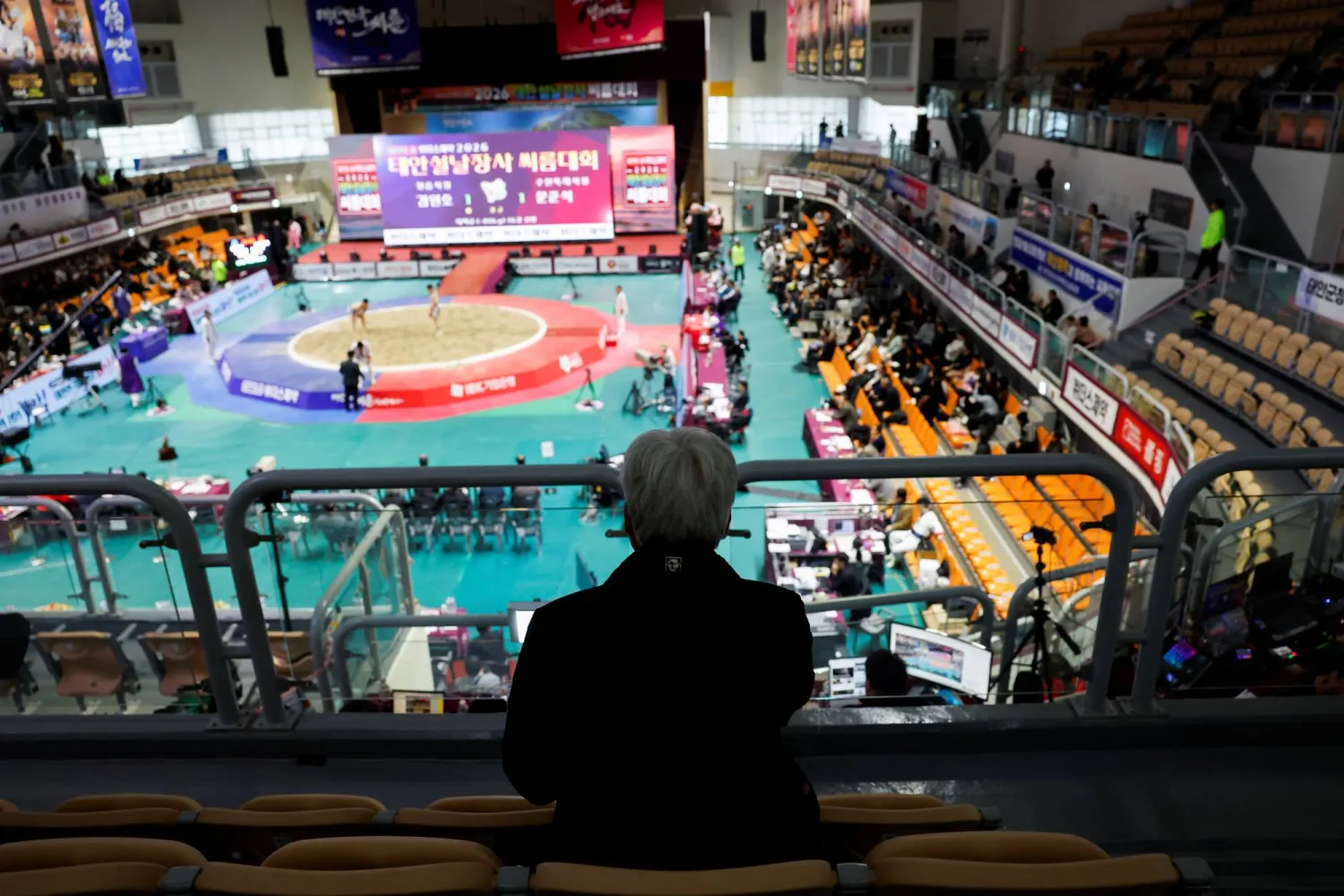
An elderly spectator watches a ssireum match during a Lunar New Year Ssireum championship at the Taean Complex Indoor Gymnasium in Taean, South Korea, February 14, 2026. (Reuters)
TT

Once a National Obsession, Traditional Korean Wrestling Fights for Survival 

An elderly spectator watches a ssireum match during a Lunar New Year Ssireum championship at the Taean Complex Indoor Gymnasium in Taean, South Korea, February 14, 2026. (Reuters)

As South Korea's global cultural influence expands in areas such as music, film and television, one form of entertainment struggling to attract attention even at home is Korea's traditional style of wrestling, known as ssireum.

Ssireum - pronounced like "see room" - had its heyday in the 1980s and early 1990s, when there were as many as eight professional teams and the top wrestlers became household names. Since then, it has been squeezed by tighter budgets and a public quick to move on to new trends.

Twenty-year-old Lee Eun-soo, who began training at the age ‌of nine, is ‌taking part in this year's Lunar New Year ‌tournament, ⁠the showcase event ⁠for the more than 1,500-year-old sport.

Lee lamented that at his former high school, the ssireum team currently has no members and there is talk of disbanding it.

"I once tried to imagine my life if I hadn’t done ssireum," Lee said. "I don’t think I could live without it."

A ssireum match involves two wrestlers facing off in an ⁠eight-meter (26.25 ft) sandpit ring, gripping each other by a ‌cloth belt called a "satba" and using ‌strength, balance, timing and stamina to force the opponent to the ground.

Ssireum ‌was inscribed on UNESCO's Representative List of the Intangible Cultural Heritage ‌of Humanity in 2018, but that international recognition has not translated into commercial success. Its relative obscurity contrasts with the high profile of Japan's sumo, another centuries-old form of wrestling.

Unlike sumo, which is supported by ‌a centralized professional ranking system and six major annual tournaments - or Olympic wrestling, with its global reach - ⁠ssireum remains ⁠largely domestic.

"Sport is something people won't come to watch if they don’t know the wrestlers or even the sport itself," said Lee Tae-hyun, a former ssireum wrestler and Professor of Martial Arts at Yong In University, who has promoted the sport overseas and believes it has commercial potential with the right backing.

Lee Hye-soo, 25, a spectator at the Lunar New Year tournament, said many Koreans are now unfamiliar with ssireum.

"My grandfather liked watching ssireum, so I watched it with him a lot when I was young," she said.

"I like it now too, but I think it would be even better if it became more famous."


Saudi Arabia Concludes Guest of Honor Role at Damascus International Book Fair 2026

The Kingdom’s pavilion, led by the commission, attracted strong attendance and active engagement through its cultural activities - SPA
TT

Saudi Arabia Concludes Guest of Honor Role at Damascus International Book Fair 2026

The Kingdom’s pavilion, led by the commission, attracted strong attendance and active engagement through its cultural activities - SPA

The Literature, Publishing and Translation Commission concluded the Kingdom’s Guest of Honor participation at the Damascus International Book Fair 2026, held in the Syrian capital from February 6 to 16, drawing strong attendance and engagement from visitors and cultural enthusiasts.

The Kingdom's pavilion was highly praised for its rich cultural content and high-quality programs, reflecting the vitality and growth of the Kingdom’s literary and cultural scene, SPA reported.

Literature, Publishing and Translation Commission CEO Dr. Abdullatif Abdulaziz Al-Wasel stated that the Kingdom’s role as Guest of Honor at the Damascus International Book Fair 2026, represented by a high-level cultural delegation led by Minister of Culture Prince Bader bin Abdullah bin Farhan, highlights the depth of Saudi-Syrian cultural relations based on partnership and mutual respect.

He noted that the participation demonstrates the Kingdom’s commitment to enhancing cultural exchange, a key objective of the National Culture Strategy under Saudi Vision 2030. Through this strategy, the commission emphasizes fostering constructive dialogue among peoples, exchanging knowledge and expertise, and consolidating the Kingdom’s active role in the Arab and international cultural landscape.

The Kingdom’s pavilion, led by the commission, attracted strong attendance and active engagement through its cultural activities. It showcased the commission’s programs and initiatives in literature, publishing, and translation, and featured a comprehensive cultural program, including literary seminars, cultural discussions, and poetry evenings with prominent Saudi writers and intellectuals.

These efforts enriched cultural dialogue with fair visitors and strengthened the presence of Saudi literature in the Arab cultural scene.

This edition of the Damascus International Book Fair marks a significant cultural milestone, reaffirming the value of books as carriers of meaning, spaces for dialogue, and starting points for a cultural journey that reflects the aspirations of the Arab cultural landscape toward a more open and aware phase.


Qiddiya City Begins Construction of Landmark Performing Arts Center

The Qiddiya Performing Arts Center supports the city’s positioning as a destination for creativity and cultural expression - SPA
TT

Qiddiya City Begins Construction of Landmark Performing Arts Center

The Qiddiya Performing Arts Center supports the city’s positioning as a destination for creativity and cultural expression - SPA

Qiddiya Investment Company has announced the commencement of construction works for the Performing Arts Center in Qiddiya City, marking an important milestone in the development of Qiddiya City as a destination for entertainment, sports and culture.

The announcement coincided with the laying of the foundation stone, signaling the start of construction works to be carried out by Nesma and Partners.

During the ceremony, held at the project site perched on the edge of the Tuwaiq Mountains, Managing Director of Qiddiya Investment Company Abdullah Aldawood delivered a speech announcing the official start of construction. He highlighted the importance of the project as a transformative addition that strengthens Qiddiya City’s cultural offering.

The Qiddiya Performing Arts Center supports the city’s positioning as a destination for creativity and cultural expression, while contributing to the development of local talent and attracting international artistic experiences.

The Qiddiya Performing Arts Center has been designed by Tom Wiscombe Architecture, in collaboration with BSBG, and features a futuristic architectural style defined by monumental forms. The design comprises interlocking architectural panels and five illuminated blades that blend harmoniously with the desert landscape, forming a prominent cultural landmark within Qiddiya City.

The start of construction follows the launch of the first phase of Qiddiya City in December 2025, which included the opening of Six Flags Qiddiya City. It’s part of the company’s broader approach to developing integrated destinations that enhance quality of life and deliver distinctive experiences across entertainment, sports and culture.