Thailand Hunts for Missing Ancient Site Treasures 

This photograph taken on September 14, 2023 shows a tourist visiting at the Si Thep historical site in Thailand's Phetchabun province. (AFP)
TT

Thailand Hunts for Missing Ancient Site Treasures 

This photograph taken on September 14, 2023 shows a tourist visiting at the Si Thep historical site in Thailand's Phetchabun province. (AFP)

Under the scorching sun, Thai archaeologist Tanachaya Tiandee clambers through ruined pagodas in the ancient town of Si Thep, trying to unlock their mysteries -- a task made harder because parts of the puzzle are missing thanks to decades of looting.

Thailand has a rich collection of historical sites, but foreign looting has stripped many of them, leaving the country scrambling to repatriate its stolen cultural wealth.

"The big picture like the building was discovered, but the artifacts which tell little details are missing, making a lot of stories untold about Si Thep," Tanachaya told AFP.

"It's like a piece of puzzle was missing," she said.

The 400-hectare complex, which archaeologists date back to between 1,500 to 1,700 years ago, may be inscribed in UNESCO's cultural world heritage list this week -- Thailand's first addition since 1992.

As 33-year-old Tanachaya carefully excavates the ancient stone constructions, she faces a difficult task piecing together the stories of Si Thep, which lies around 200 kilometers (120 miles) north of Bangkok.

It is believed that over the years, at least 20 objects have been stolen from the site, with experts identifying 11 in museums in the United States.

The real number of looted objects is suspected to be far higher, thanks to a lack of documentation.

Now Tanachaya -- who decided when she was young that she wanted to become a Thai version of movie character Indiana Jones -- and her colleagues face their own quest.

Can they bring their culture's treasures home?

'Won't accelerate'

Thailand's government, led at the time by the military, established the Committee to Monitor Thai Antiquities Abroad in 2017.

About 340 objects have been voluntarily repatriated to Thailand since then, according to the latest report by the committee.

But the process is slow, partly because government officials are wary of jeopardizing diplomatic relations with important allies like the United States.

Instead, Thai authorities have pursued a "discreet" diplomatic route, explained the director-general of Thailand's Department of Fine Arts Phnombootra Chandrachoti.

"We won't accelerate anything," he told AFP.

The Norton Simon Museum, located in the US state of California, holds nine Thai artifacts, according to a recent statement from the committee -- including one item an independent expert says is from Si Thep park.

The items were among 32 scattered in museums across the United States, the committee said.

The Norton Simon is only one of a number of US institutions -- including New York's Metropolitan and San Francisco's Asian Art Museum -- that have been named in the growing scandal around art that investigators claim was illegally removed from its country of origin.

The museum told AFP it had not heard from the Thai government, but would cooperate with authorities if contacted, and defended holding the items.

The works, which it claimed were legally purchased, "have been carefully preserved and displayed" said Leslie Denk, vice-president of external affairs at the institution.

Dilemma over tourism

Thai historians face another dilemma: Si Thep's bid to become a UNESCO site could boost the local economy -- but it could also put the fragile ancient site under strain.

Presently, only one percent of visitors to Phetchabun -- the province that is home to Si Thep -- are foreigners, according to official 2019 data.

The Thai government hopes UNESCO designation will help boost the kingdom's tourism sector, which accounts for almost 20 percent of the country's GDP.

There are, however, concerns about conservation.

The site is already "almost reaching its fullest capacity" of around 2,000 tourists a day, said Si Thep Historical Park head Sittichai Pooddee.

"We will try to balance things. We will try to not over-promote," he said.

Missing items mean gaps in the record, which makes it harder to satisfy the curiosity of tourists visiting the site, said Thai historian Tanongsak Hanwong.

"Artifacts dignify Thailand's past civilization, and when some of the parts are missing, we get stuck and we can't tell important pieces of the story to the world," Tanongsak said.

At Si Thep's peaceful complex, domestic visitors gaze at a carefully carved pagoda wall.

"It's the heritage that belongs to Thai people, and that we are proud of. It would be a pity not to get it back," said Chaowarat Munprom, a 66-year-old retiree.

"It once belonged here."


Culture Ministry Continues Preparations in Historic Jeddah to Welcome Visitors during Ramadan 

Historic Jeddah has emerged as a leading cultural tourism destination during Ramadan. (SPA)
TT

Culture Ministry Continues Preparations in Historic Jeddah to Welcome Visitors during Ramadan 

Historic Jeddah has emerged as a leading cultural tourism destination during Ramadan. (SPA)

The Saudi Ministry of Culture is continuing its efforts to revitalize Historic Jeddah in preparation for welcoming visitors during the holy month of Ramadan, offering cultural programs, events, and heritage experiences that reflect the authenticity of the past.

The district has emerged as a leading cultural tourism destination at this time of year as part of the “The Heart of Ramadan” campaign launched by the Saudi Tourism Authority.

Visitors are provided the opportunity to explore the district’s attractions, including archaeological sites located within the geographical boundaries of the UNESCO World Heritage-listed area, which represent a central component of the Kingdom’s urban and cultural heritage.

The area also features museums that serve as gateways to understanding the city’s rich heritage and cultural development, in addition to traditional markets that narrate historical stories through locally made products and Ramadan specialties that reflect authentic traditions.

These initiatives are part of the ministry’s ongoing efforts to revitalize Historic Jeddah in line with the objectives of Saudi Vision 2030 and aiming to transform it into a vibrant hub for arts, culture, and the creative economy, while preserving its tangible and intangible heritage.


Thousands of Animals, Rare Specimens Stolen from Sudan Museum

Skulls of several mammals before the destruction (Asharq Al-Awsat)
TT

Thousands of Animals, Rare Specimens Stolen from Sudan Museum

Skulls of several mammals before the destruction (Asharq Al-Awsat)

“Everything is over.” With that short and painful phrase, a Sudanese government official summed up the loss of nearly a century and a half of history after war destroyed the headquarters of the Sudan Natural History Museum in central Khartoum, stripping the country of thousands of taxidermied and live endangered animals, as well as rare reference specimens.

In the first days after fighting erupted in April 2023, activists on social media called for food and water to be provided to save the live animals. When that proved impossible, cages were opened, and the animals fled, even though some of the reptiles were venomous snakes.

The museum, officially affiliated with the University of Khartoum, lies about one kilometer from the Sudanese army’s general command headquarters in central Khartoum.

Its close proximity led to severe damage from clashes and shelling between the Sudanese army and the Rapid Support Forces, which later took control of the surrounding area for more than a year.

Dr. Othman Ali Haj Al-Amin, Dean of the Faculty of Science at the University of Khartoum, said: “We lost thousands of taxidermied animals, birds, and reptiles that are more than 150 years old.”

“It is most likely that the live animals were stolen or looted and did not die,” he added. “We did not find remains or skeletons of those animals inside the museum.”

Al-Amin broke down in tears as he described to Asharq Al-Awsat the scale of devastation inflicted on one of the world’s oldest natural history museums.

“We lost about 2,000 taxidermied animal specimens, in addition to more than 600 endangered reference specimens that were on display, and nearly all geological records, including animal, plant, and rock fossils,” he said.

“The greatest loss was around 100 species representing all families of animals, birds, and reptiles that had been cared for and preserved for decades.”

Among them were fossil bird specimens collected between 1885 and 1945 that cannot be replaced, as well as a Kordofan giraffe, an endangered subspecies.

The war also claimed “the oldest crocodile, which had lived in the museum for many years and had been cared for since it was an egg,” along with numerous reptiles, including venomous snakes, scorpions, and a Nile monitor lizard.

A taxidermied lioness was recovered and transferred to the university’s veterinary faculty.

Asharq Al-Awsat learned that the International Committee of the Red Cross attempted in those early days to evacuate civilians, including university students who were trapped inside the museum for weeks, as well as to move live and taxidermied animals. The effort failed due to intense fighting in the heart of Khartoum.

According to the Sudanese official, the preserved specimens were collected in the mid-19th century by British army officers.

During World War II, they were transferred from the Sudan National Museum to the Natural History Museum next to the University of Khartoum, which has managed them since its establishment in 1929.

Al-Amin said the museum housed specimens illustrating biodiversity from across Sudan, including South Sudan before its secession, as well as samples gifted to Sudan by international museums.

The Sudan Natural History Museum included multiple sections, among them halls displaying rare bird species, another devoted to animal skulls preserved for decades, a section for medicinal and aromatic plants, geological rock samples collected from ancient eras and environments, and enclosures for live animals.

The dean said restoring the museum to its original state would require many years of work and significant funding. He voiced pessimism about recovering the rare animals, historical specimens, and old records lost during the war.

Many live animals were likely deliberately killed or died of hunger and thirst, he said, while taxidermied animals and rare rock and herb specimens — painstakingly collected, sorted, and classified over many years by researchers — were looted.

The Natural History Museum was a scientific and cultural institution dedicated to the study of biodiversity and natural specimens, and one of the oldest museums in Sudan.


Once a National Obsession, Traditional Korean Wrestling Fights for Survival 

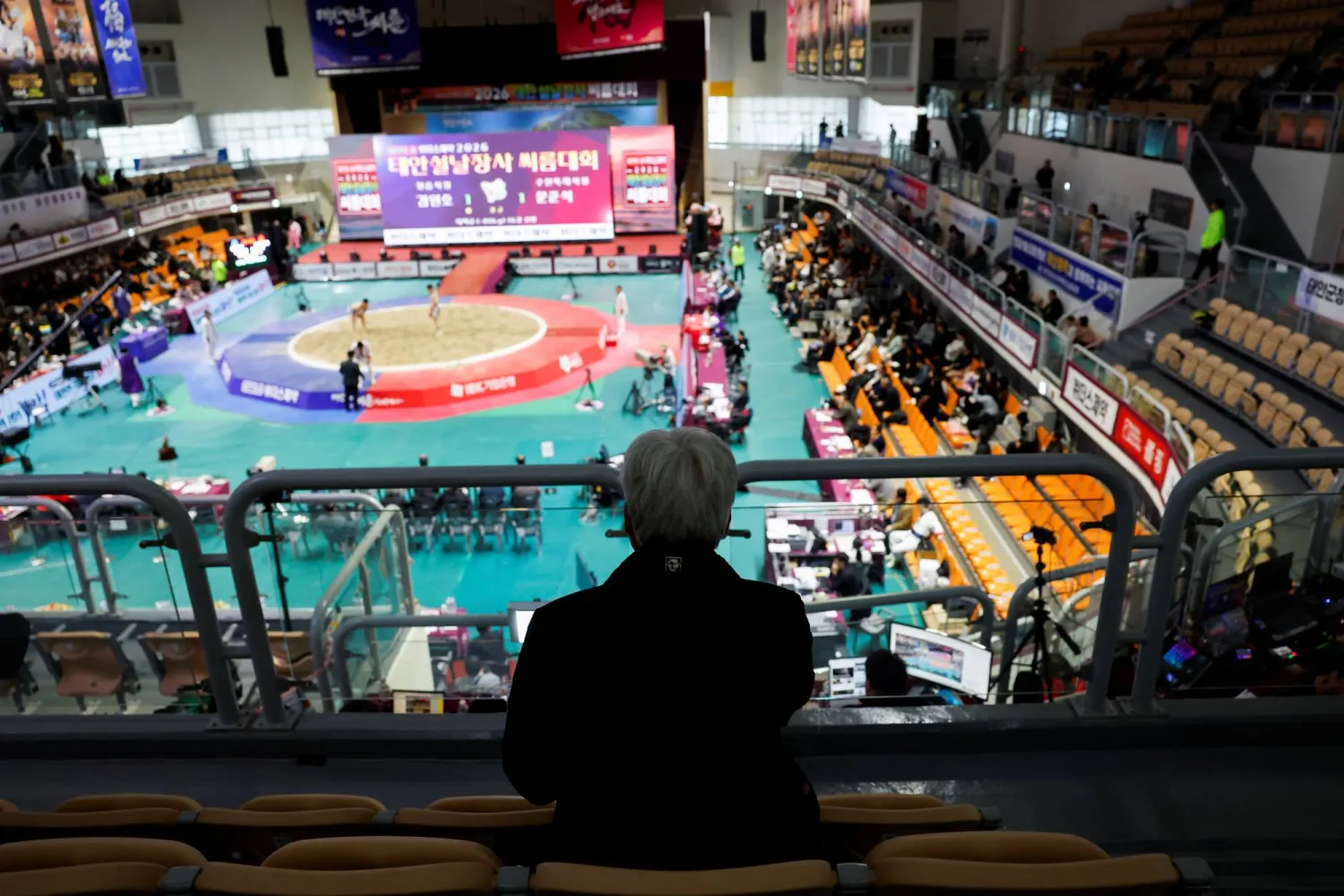
An elderly spectator watches a ssireum match during a Lunar New Year Ssireum championship at the Taean Complex Indoor Gymnasium in Taean, South Korea, February 14, 2026. (Reuters)
TT

Once a National Obsession, Traditional Korean Wrestling Fights for Survival 

An elderly spectator watches a ssireum match during a Lunar New Year Ssireum championship at the Taean Complex Indoor Gymnasium in Taean, South Korea, February 14, 2026. (Reuters)

As South Korea's global cultural influence expands in areas such as music, film and television, one form of entertainment struggling to attract attention even at home is Korea's traditional style of wrestling, known as ssireum.

Ssireum - pronounced like "see room" - had its heyday in the 1980s and early 1990s, when there were as many as eight professional teams and the top wrestlers became household names. Since then, it has been squeezed by tighter budgets and a public quick to move on to new trends.

Twenty-year-old Lee Eun-soo, who began training at the age ‌of nine, is ‌taking part in this year's Lunar New Year ‌tournament, ⁠the showcase event ⁠for the more than 1,500-year-old sport.

Lee lamented that at his former high school, the ssireum team currently has no members and there is talk of disbanding it.

"I once tried to imagine my life if I hadn’t done ssireum," Lee said. "I don’t think I could live without it."

A ssireum match involves two wrestlers facing off in an ⁠eight-meter (26.25 ft) sandpit ring, gripping each other by a ‌cloth belt called a "satba" and using ‌strength, balance, timing and stamina to force the opponent to the ground.

Ssireum ‌was inscribed on UNESCO's Representative List of the Intangible Cultural Heritage ‌of Humanity in 2018, but that international recognition has not translated into commercial success. Its relative obscurity contrasts with the high profile of Japan's sumo, another centuries-old form of wrestling.

Unlike sumo, which is supported by ‌a centralized professional ranking system and six major annual tournaments - or Olympic wrestling, with its global reach - ⁠ssireum remains ⁠largely domestic.

"Sport is something people won't come to watch if they don’t know the wrestlers or even the sport itself," said Lee Tae-hyun, a former ssireum wrestler and Professor of Martial Arts at Yong In University, who has promoted the sport overseas and believes it has commercial potential with the right backing.

Lee Hye-soo, 25, a spectator at the Lunar New Year tournament, said many Koreans are now unfamiliar with ssireum.

"My grandfather liked watching ssireum, so I watched it with him a lot when I was young," she said.

"I like it now too, but I think it would be even better if it became more famous."