


UNESCO Planning Virtual Museum of Stolen Cultural Artifacts

Antiquities returned to Italy from the US were displayed during a ceremony held in New York. (Reuters)
TT

UNESCO Planning Virtual Museum of Stolen Cultural Artifacts

Antiquities returned to Italy from the US were displayed during a ceremony held in New York. (Reuters)

UNESCO, the United Nations culture body, has announced plans for a virtual museum of stolen cultural artifacts, aimed at raising public awareness of trafficking and the unique importance of cultural heritage.

Visitors will be able to navigate a succession of virtual spaces containing detailed 3D images of the artifacts, each accompanied by materials explaining their unique cultural significance including stories and testimonies from local communities.

UNESCO does not expect to be able to name the items that will make up the initial collection until shortly before the museum’s opening.

It will be conducted jointly by UNESCO and INTERPOL, whose database of cultural objects stolen from museums, collections, and archeological sites worldwide lists more than 52,000 artifacts, worth $2.5m (£2.05m)

The virtual museum should open in 2025.

“Behind every stolen work or fragment lies a piece of history, identity, and humanity that has been wrenched from its custodians, rendered inaccessible to research, and now risks falling into oblivion,” said the UNESCO director-general, Audrey Azoulay.

“Our objective with this is to place these works back in the spotlight, and to restore the right of societies to access their heritage, experience it, and recognize themselves in it,” Azoulay told a meeting of national representatives in Paris.

According to the Antiquities Coalition, a US-based NGO, the most significant looted and stolen artifacts currently missing globally include a third-century alabaster stone inscription taken from Awwam temple in Yemen between 2009 and 2011.

Also on the coalition’s list are a seventh-century BC ivory relief of a lion attacking a Nubian, stolen from the Baghdad Museum in 2003; a green stone mask looted from the Maya site of Rio Azul, Guatemala in the 1970s; and a fifth-sixth century figurine of Varaha taken from a temple complex in Rajasthan, India in 1988.

“These are objects that exist physically, but we don’t know where,” Ernesto Ottone, the organization’s assistant director general for culture, told the Guardian. “We will exhibit them virtually, in a space where we can really tell the story and the context behind them.”

Ottone said the aim was to “help young people especially to understand that a stolen artifact is one that has been ripped from its community, but also to help recover stolen objects and promote the repatriation of cultural property generally”.

Logically, he said, the museum’s ultimate aim should be its own disappearance: “It’s the opposite of a regular museum, whose collection will continue to expand. With this one, we hope its collection will shrink, as items are recovered one by one.”

The project’s architect, Francis Kéré, the 2022 – and first African – winner of the prestigious Pritzker prize for architecture, said the project was about “awakening the imagination”. Cultural artifacts embody “a value in their physical presence, but also a value to their communities ... that we cannot describe”, he said.

Kére, who was born in Burkina Faso, compared an object torn from its community to a tree uprooted from its soil. “Something happens that we don’t fully understand in the relationship between a tree, its roots, and its nourishment,” he said.

“Something similar happens, that we also don’t understand, in the relationship between a cultural artifact and its community. Cultures that have been robbed of artifacts are like a tree’s roots looking for nourishment.”

The architect has designed an extendable virtual “ramp”, contained within a globe connecting regions, countries, cultures, and the 600 artifacts that will make up the opening collection, and has begun work with web developers to turn the concept into a digital reality.

Ottone said that while designing and building the virtual museum was a complex job, the most time-consuming task was creating scalable 3D images of the artifacts, for many of which there is no physical record beyond a small black-and-white photo.

“No one has imagined a museum like this,” Azoulay said. “The works’ presentation is enhanced by a deep dive into their universe, into the cultural and social movements from which they were born – linking the material and the immaterial.”

UNESCO’s 1970 convention on prohibiting and preventing the illicit import, export, and sale of cultural property urges signatory states to take measures to stop trafficking, which INTERPOL has said is increasingly the preserve of organized crime.
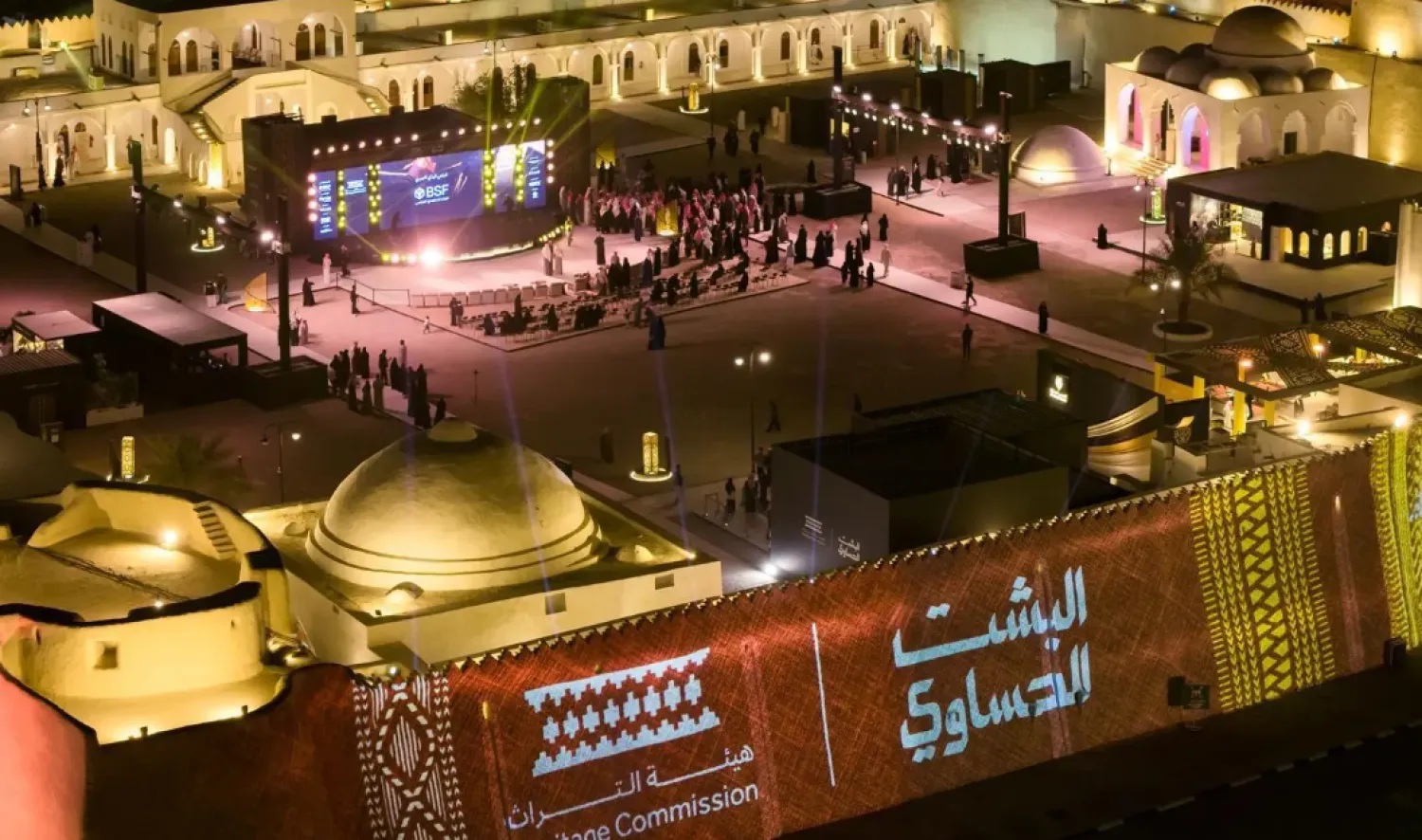


Jazan Festival 2026 Kicks Off Thursday with Grand Parade

his year’s festival offers an unprecedented experience that brings together the charm of the region’s unique geographic diversity - SPA
TT

Jazan Festival 2026 Kicks Off Thursday with Grand Parade

his year’s festival offers an unprecedented experience that brings together the charm of the region’s unique geographic diversity - SPA

The Jazan Festival 2026 will launch on Thursday in a carnival anticipated by thousands of visitors from within the region and beyond.

The festival will open with a grand celebratory parade starting at 3:45 p.m. along the Jazan city waterfront, signaling the start of an entertainment and cultural season that will extend for several months, according to SPA.

This year’s festival offers an unprecedented experience that brings together the charm of the region’s unique geographic diversity, from its towering green mountains and golden beaches to its picturesque islands, alongside the authenticity of its rich heritage, complemented by modern touches in entertainment programs designed to meet the aspirations of all age groups.

Performing arts inspired by local folklore will add an authentic dimension, while moving installations will flow in harmonious rhythm.

Completing the visual spectacle, integrated light and sound shows will create an enchanting atmosphere before the festivities conclude with a dazzling fireworks display lighting up the Jazan sky in vibrant colors.


UNESCO Chair in Translating Cultures Hosts Lectures on Safeguarding Intangible Cultural Heritage

The program was presented as an advanced knowledge initiative that combined theoretical perspectives with practical application - SPA
TT

UNESCO Chair in Translating Cultures Hosts Lectures on Safeguarding Intangible Cultural Heritage

The program was presented as an advanced knowledge initiative that combined theoretical perspectives with practical application - SPA

The United Nations Educational, Scientific and Cultural Organization (UNESCO) Chair in Translating Cultures at the King Faisal Center for Research and Islamic Studies (KFCRIS), with support from the Literature, Publishing, and Translation Commission, organized a training course and a series of specialized lectures on the translation and safeguarding of intangible cultural heritage, SPA reported.

The program was presented as an advanced knowledge initiative that combined theoretical perspectives with practical application, opening space for in-depth discussion of the challenges of translating intangible heritage as a living, evolving form of culture closely tied to its cultural, social, and performative contexts.

The course and lectures adopted a comprehensive approach that views translation as a cultural tool for preserving oral memory and building bridges between local specificity and the global sphere.

This approach was reflected through applied models, field experiences, and contemporary conceptual frameworks.


Ancient Egyptian Pharaoh’s Boat Is Being Reassembled in Public at Grand Egyptian Museum

People walk next to King Khufu's boat gem, also known as the Solar Boat, as work to restore the second solar boat has started with wooden planks part of the 1,650-piece structure being installed on a metal frame through Egyptian-Japanese cooperation with two Japanese universities, marking the start of preparations for the second boat's public display at the Grand Egyptian Museum (GEM), near the Giza Pyramid Complex, in Giza, Egypt, December 23, 2025.
TT

Ancient Egyptian Pharaoh’s Boat Is Being Reassembled in Public at Grand Egyptian Museum

People walk next to King Khufu's boat gem, also known as the Solar Boat, as work to restore the second solar boat has started with wooden planks part of the 1,650-piece structure being installed on a metal frame through Egyptian-Japanese cooperation with two Japanese universities, marking the start of preparations for the second boat's public display at the Grand Egyptian Museum (GEM), near the Giza Pyramid Complex, in Giza, Egypt, December 23, 2025.

A boat belonging to an Egyptian pharaoh is being assembled in full view at the Grand Egyptian Museum’s exhibition hall.

Staff began piecing together the cedarwood boat, one of two that were found that belong to King Khufu, Tuesday morning as dozens of visitors watched.

The assembly of the 42-meter (137-foot) -long vessel, which sits next to its already-assembled twin that has been on display, is expected to take around four years, according to Issa Zeidan, head of restoration at the Grand Egyptian Museum. It contains 1,650 wooden pieces.

King Khufu ruled ancient Egypt more than 4,500 years ago and built the Great Pyramid of Giza.

“You’re witnessing today one of the most important restoration projects in the 21st century,” said Tourism and Antiquities Minister Sherif Fathy, who attended the event.

The $1 billion museum, also known as GEM, was touted as the world’s largest when it was lavishly inaugurated last month. It's home to nearly 50,000 artifacts, including the collection of treasures from the tomb of the famed King Tutankhamun, which was discovered in 1922. The museum, located near the pyramids at the edge of Cairo, is expected to boost Egypt’s tourism revenues and help bolster its economy.

The boat was one of two discovered in 1954, opposite the southern side of the Great Pyramid. The excavation of its wooden parts began in 2014, according to the museum’s website.

The exact purpose of the boats remains unclear, but experts believe they were either used to transport King Khufu’s body during his funeral or were meant to be used for his afterlife journey with the sun god Ra, according to the museum.