


State-of-the-Art Home for an Ancient Pharaoh

Atelier Brueckner's bold design for Tutankhamun's Treasures

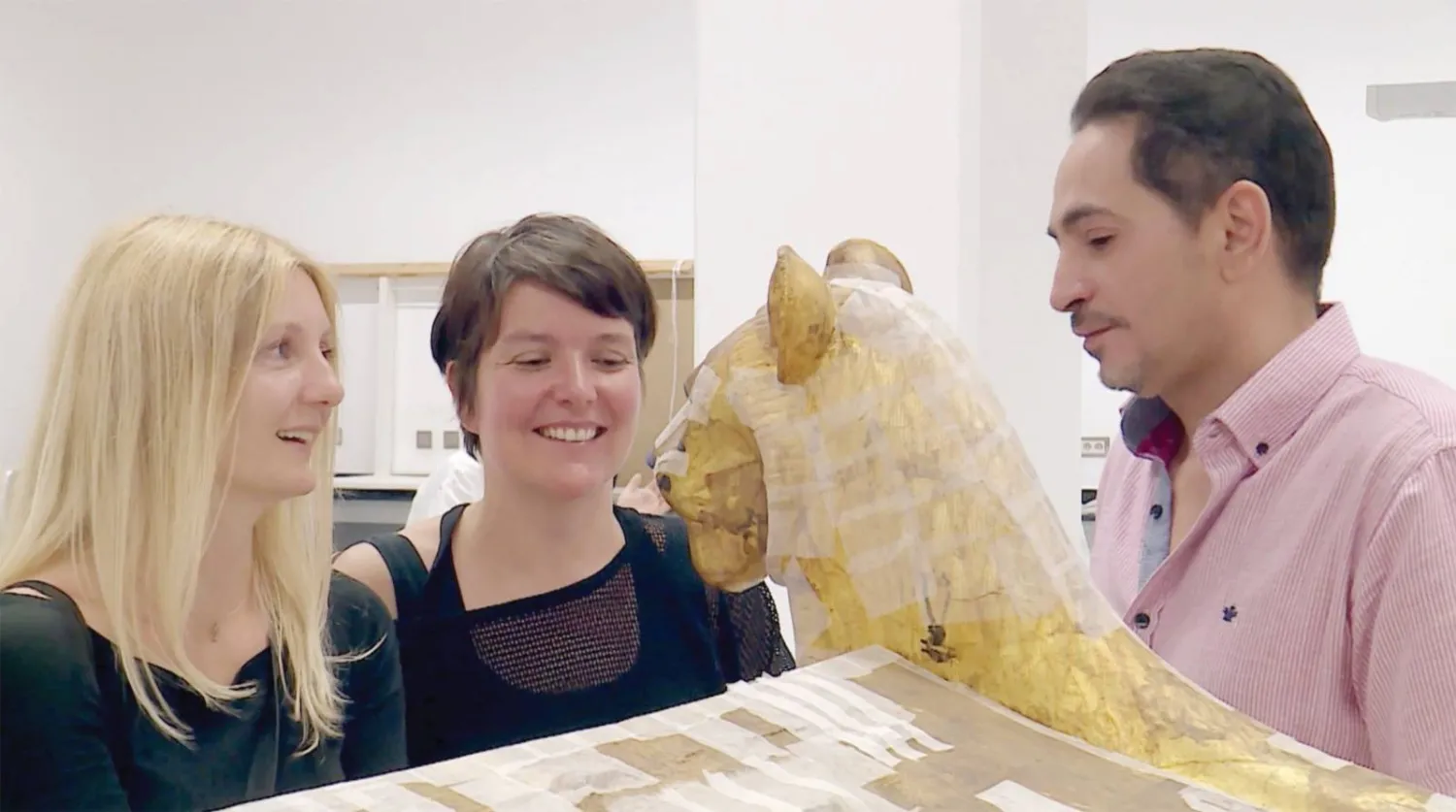
Tanya Zolner and experts at the Grand Egyptian Museum’s restoration center. (Atelier Brueckner)
TT

State-of-the-Art Home for an Ancient Pharaoh

Tanya Zolner and experts at the Grand Egyptian Museum’s restoration center. (Atelier Brueckner)

The world's eyes are turning once again towards the Giza Desert, where the pyramids and the Sphinx have long borne witness to the passage of the centuries and the massive efforts of our ancient forbears.

Now, another massive effort is underway, this time to complete the Grand Egyptian Museum, which will showcase the treasures of that ancient civilization. The museum is the largest ever devoted to archaeology. The antiquities it will house are priceless.

Despite an earlier opportunity for the public to visit its halls, a crucial part of the complex remained hidden from view: the Tutankhamun Gallery, which will contain previously unseen pieces from the young pharaoh's treasures, making it the crown jewel among the museum's departments.

A German studio called Atelier Brueckner designed key spaces in the museum, such as the atrium – which houses a statue of Ramses II that's over 11 meters high – and the stunning Grand Staircase. The Children's Museum, with 3,465 square meters of exhibition space, was also part of their commission.

They had to give security issues careful consideration. Every showcase had to be bullet proof, involving 40 milometer thick glass. And they were not allowed to touch the objects, only look at them, while they developed their ideas.
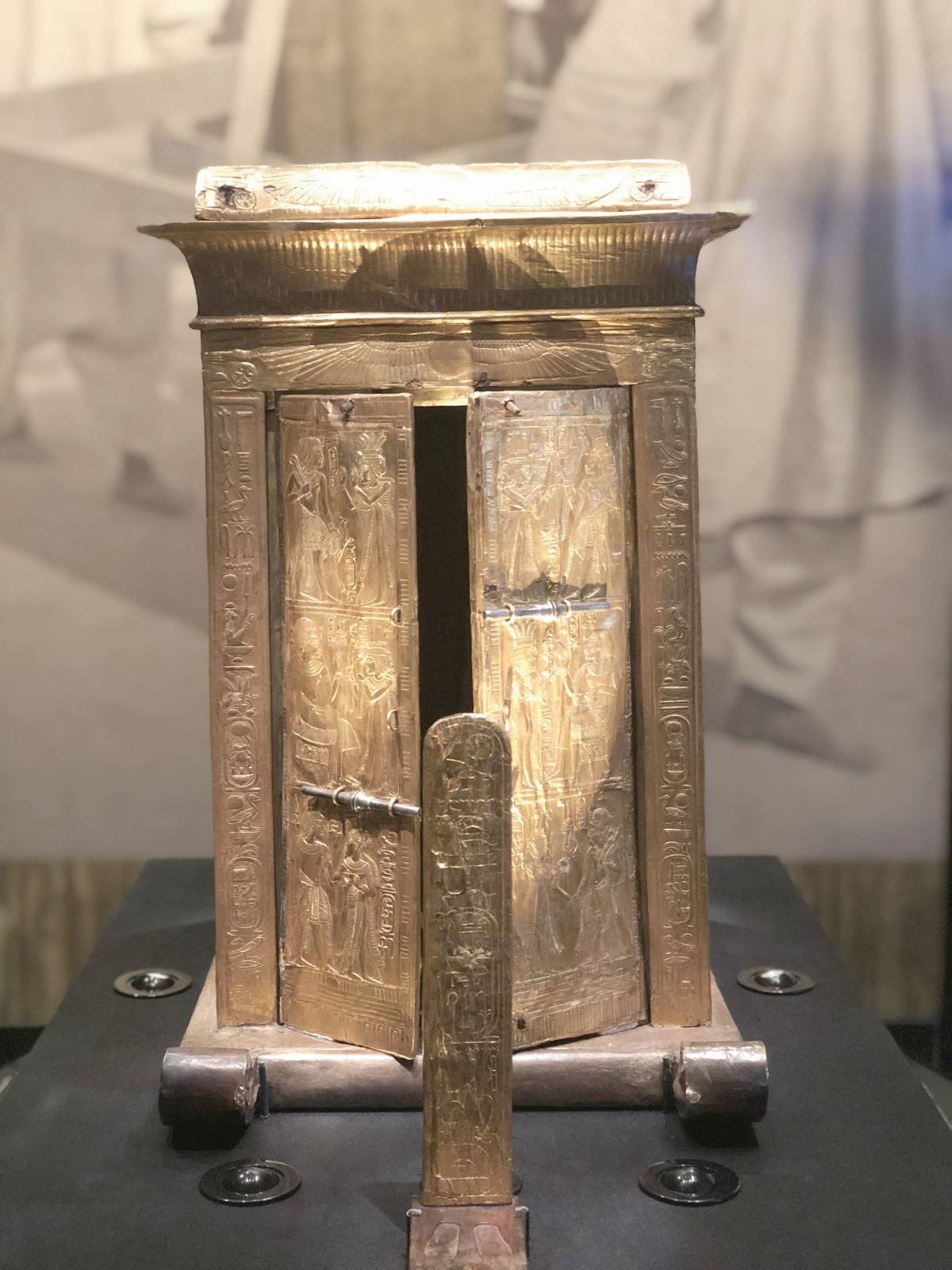
An artifact on display at the Tutankhamun exhibition in London in 2019. (Asharq Al-Awsat)

Asharq Al-Awsat was keen to speak to one of the people behind the Tutankhamun Gallery, which promises to be a wonder of the modern world. What could Tanya Zolner, associate partner of Atelier Brueckner and head of the design team, reveal about the gallery? And would it be possible to form a mental picture of the place before its unveiling?

The Visitor's Journey with the Golden Pharaoh

Zolner was clearly excited by the idea of discussing the project. She wanted to emphasize her team's approach: "Our work focused mostly on designing a storytelling experience related to the exhibits and a broader perspective on the story of ancient Egypt."

Obviously, she's immensely proud of the fact that the Atelier was chosen to design the new gallery, but it must have been a daunting responsibility, providing a new home for such beautiful and important pieces?

"I think the responsibility was twofold. On the one hand, we had to ensure the preservation, security, and safety of the exhibits so that people could enjoy them a hundred years from now. I also believe that our responsibility included providing an enjoyable experience for visitors," she said.

She added: "What I really liked was the museum director's conversation with us. He was keen to emphasize that the museum is for the Egyptian people and their 'guests', and that the display method must take this into account."

"He also wanted the artifacts to be shown in a new way. As you know, in international museums, such pieces are treated primarily as works of art [...] but without the necessary context. They may be separated [from each other], which removes them from their historical and thematic context. I think the choice fell on us because we care about telling the story behind the pieces," she explained.
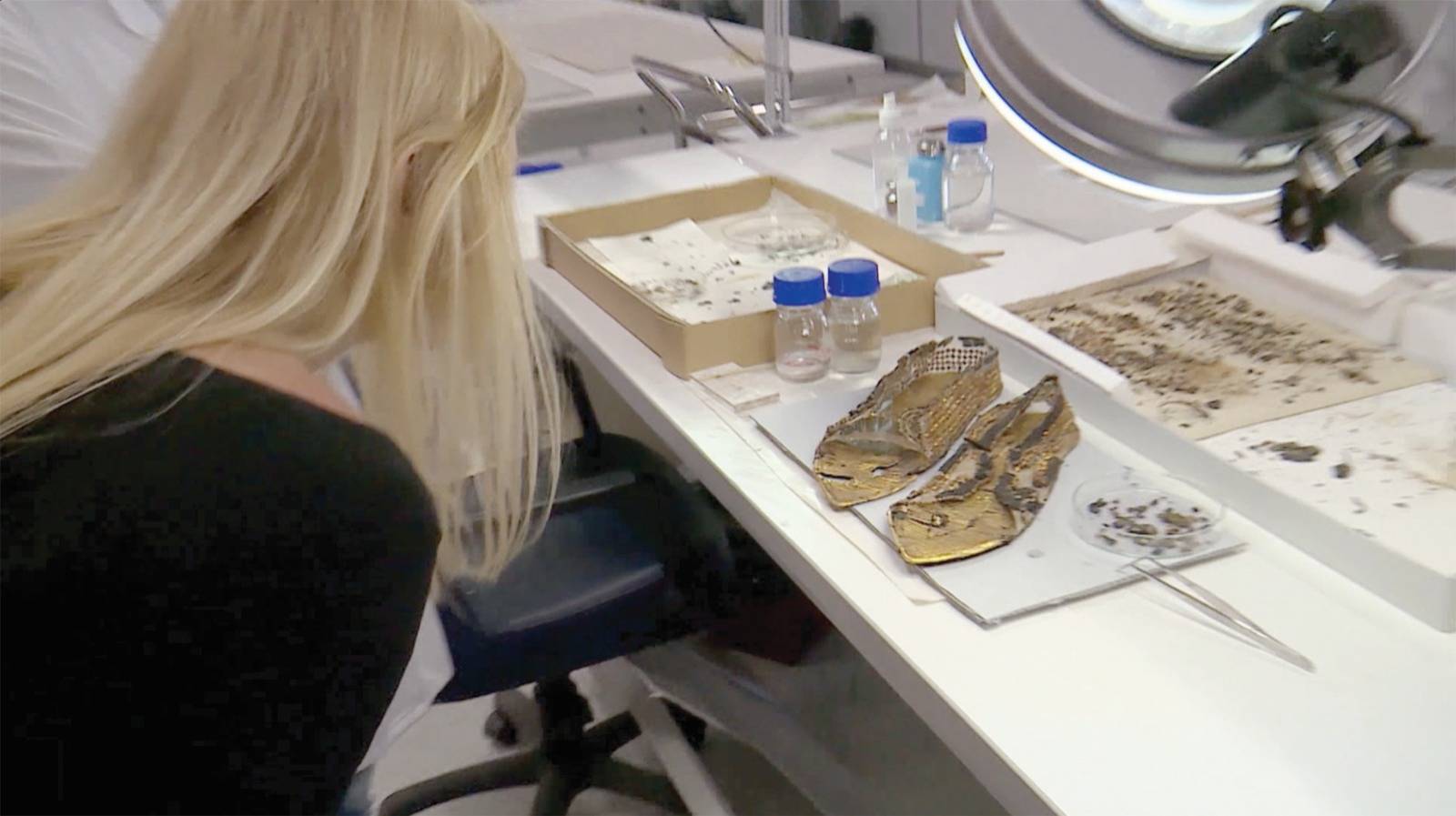
Tanya Zolner during the preparations for the Tutankhamun Gallery. (Atelier Brueckner)

Visiting Routes

The story in question, that of a young pharaoh's life, is almost unimaginably different from our lives today. How did her team go about reimagining the story of the Golden Pharaoh? Was chronology important to the museum's narrative?

"A visitor to the Tutankhamun Gallery has more than one way to begin their journey with the Golden Pharaoh," Zolner said.

With the museum expected to be visited by thousands of people every day – experts estimate 15,000 – the challenge was to create an intelligent visitor guidance system that organized the spaces and gave even the smallest objects a strong presence. In two parallel wings – each 180 meters long and 16 meters high – some 5,600 artifacts from the pharaoh's tomb are displayed, including nearly 3,000 pieces that have never been seen before.

The tour through the exhibition will offer a dramatic spatial journey through the god-king's life, coronation, death, and aftermath, climaxing with a full-scale immersive experience of the tomb itself. Here, lighting, materials, graphics, and interactive media will combine to create a breathtaking experience.

Clearly, the display here is unconventional. Is it entirely dependent on digital technology?

"There are some digital tools, but not many. The pieces here are beautiful in themselves. We are dealing with a lasting display, and technology has its weaknesses. But what really matters is how the pieces are arranged in the available spaces, and how the right piece is chosen for the right place," Zolner said.
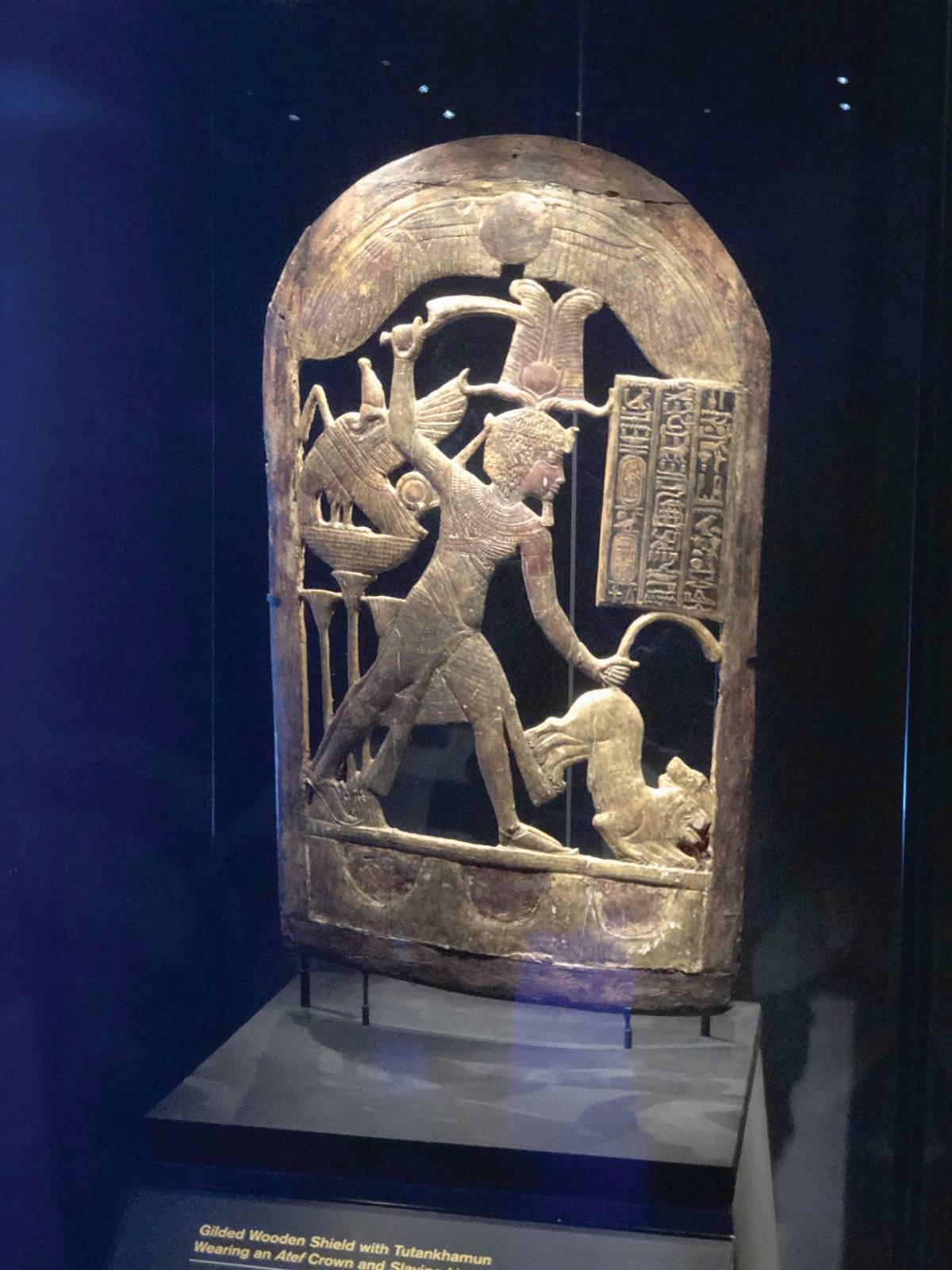
An artifact on display at the Tutankhamun exhibition in London in 2019. (Asharq Al-Awsat)

She offered the example of a section about the afterlife. The huge number of items found in the tomb included thirty shoes, and also provisions, such as bread, poultry and other meats, along with utensils and wine jars. The beauty of these items is that they bear drawings and inscriptions related to them, such as a box depicting the pharaoh on a hunting trip, with spears, arrows, and the chariots used in hunting. All of these items become elements of the narrative.

Zolner talked about the museum's staff and the discussions they had about display methods: "There are great experts in the museum who spoke with us about the various aspects of the exhibition, such as the need to include a narrative of the pharaoh's lifestyle and of his death."

They met every month to discuss the proposed locations.

"One of the things that made our work easier was knowing from the start that all the items associated with Tutankhamun would be in the exhibition, so we weren't faced with a difficult choice between the pieces."
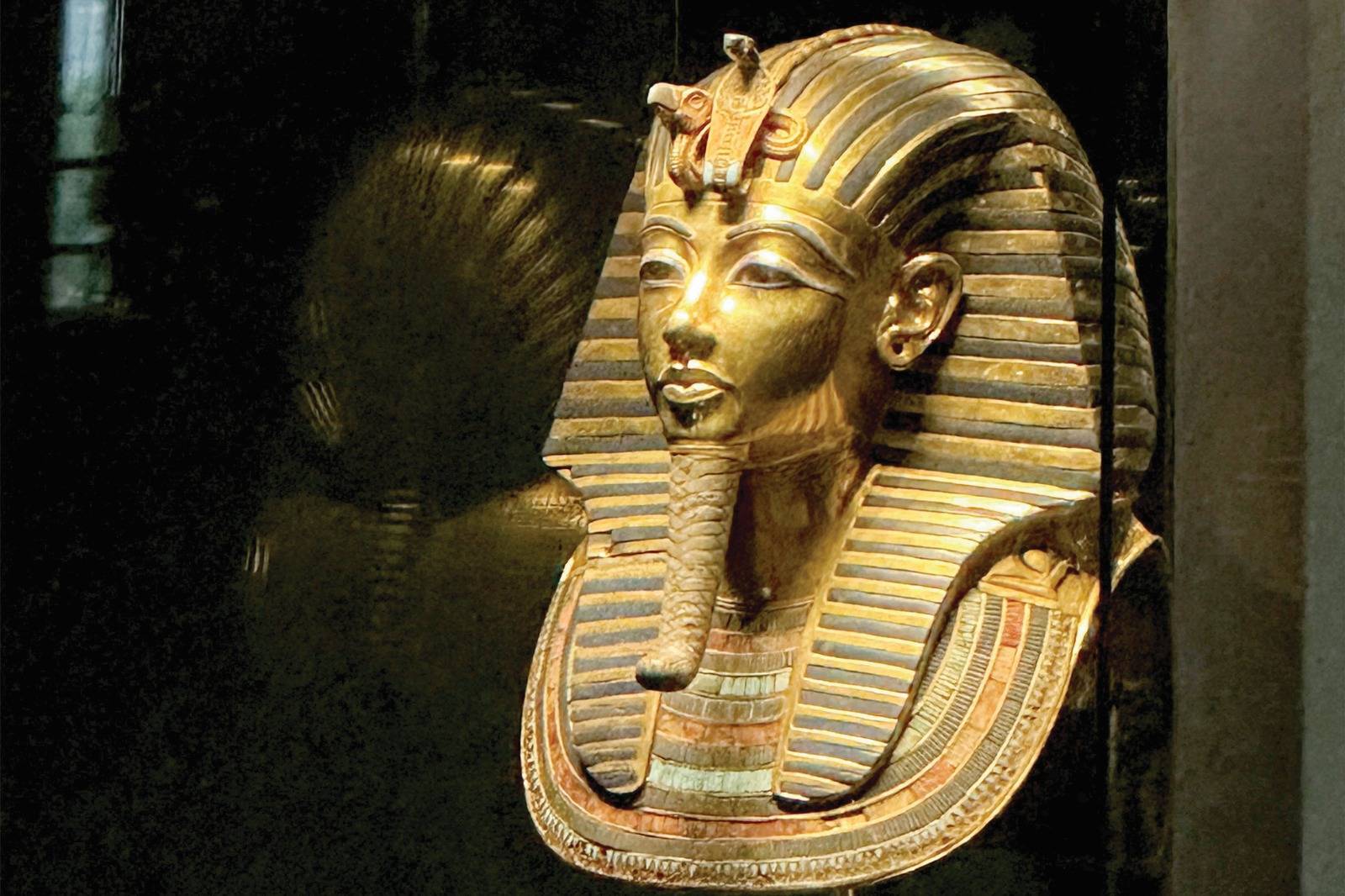
Tutankhamun’s golden mask. (AFP)

The Golden Mask

The phrase "all the items" implies a truly mind-boggling amount of stuff. Tutankhamun was buried with no less than 5,600 pieces. Zolner said that the process of preparing the display even revealed pieces that hadn't been accounted for. The number also changed slightly over time because some hadn't been removed from their boxes since they were found. Even the restoration team was sometimes surprised by the presence of a box hidden within another box.

"I believe visitors will also be in for a few surprises, considering that the treasures on display before now amounted to a third of the total discovered. When we had the opportunity to see the documentation detailing the pieces in full, we felt honored and humbled to be allowed to participate in telling the stories associated with them," Zolner said.

I conclude by asking: "What are the moments that stick in your memory? What are your favorite pieces?"

She replied without hesitation: "The golden mask, without a doubt! When we first visited Cairo, everyone was aware of the importance and uniqueness of the mask. I've never had a project where the curator said, before we started, 'unless we say otherwise, it's gold.' In other projects you might have a few golden things; here they're either gold or gold-plated."



Once a National Obsession, Traditional Korean Wrestling Fights for Survival 

An elderly spectator watches a ssireum match during a Lunar New Year Ssireum championship at the Taean Complex Indoor Gymnasium in Taean, South Korea, February 14, 2026. (Reuters)
TT

Once a National Obsession, Traditional Korean Wrestling Fights for Survival 

An elderly spectator watches a ssireum match during a Lunar New Year Ssireum championship at the Taean Complex Indoor Gymnasium in Taean, South Korea, February 14, 2026. (Reuters)

As South Korea's global cultural influence expands in areas such as music, film and television, one form of entertainment struggling to attract attention even at home is Korea's traditional style of wrestling, known as ssireum.

Ssireum - pronounced like "see room" - had its heyday in the 1980s and early 1990s, when there were as many as eight professional teams and the top wrestlers became household names. Since then, it has been squeezed by tighter budgets and a public quick to move on to new trends.

Twenty-year-old Lee Eun-soo, who began training at the age ‌of nine, is ‌taking part in this year's Lunar New Year ‌tournament, ⁠the showcase event ⁠for the more than 1,500-year-old sport.

Lee lamented that at his former high school, the ssireum team currently has no members and there is talk of disbanding it.

"I once tried to imagine my life if I hadn’t done ssireum," Lee said. "I don’t think I could live without it."

A ssireum match involves two wrestlers facing off in an ⁠eight-meter (26.25 ft) sandpit ring, gripping each other by a ‌cloth belt called a "satba" and using ‌strength, balance, timing and stamina to force the opponent to the ground.

Ssireum ‌was inscribed on UNESCO's Representative List of the Intangible Cultural Heritage ‌of Humanity in 2018, but that international recognition has not translated into commercial success. Its relative obscurity contrasts with the high profile of Japan's sumo, another centuries-old form of wrestling.

Unlike sumo, which is supported by ‌a centralized professional ranking system and six major annual tournaments - or Olympic wrestling, with its global reach - ⁠ssireum remains ⁠largely domestic.

"Sport is something people won't come to watch if they don’t know the wrestlers or even the sport itself," said Lee Tae-hyun, a former ssireum wrestler and Professor of Martial Arts at Yong In University, who has promoted the sport overseas and believes it has commercial potential with the right backing.

Lee Hye-soo, 25, a spectator at the Lunar New Year tournament, said many Koreans are now unfamiliar with ssireum.

"My grandfather liked watching ssireum, so I watched it with him a lot when I was young," she said.

"I like it now too, but I think it would be even better if it became more famous."


Saudi Arabia Concludes Guest of Honor Role at Damascus International Book Fair 2026

The Kingdom’s pavilion, led by the commission, attracted strong attendance and active engagement through its cultural activities - SPA
TT

Saudi Arabia Concludes Guest of Honor Role at Damascus International Book Fair 2026

The Kingdom’s pavilion, led by the commission, attracted strong attendance and active engagement through its cultural activities - SPA

The Literature, Publishing and Translation Commission concluded the Kingdom’s Guest of Honor participation at the Damascus International Book Fair 2026, held in the Syrian capital from February 6 to 16, drawing strong attendance and engagement from visitors and cultural enthusiasts.

The Kingdom's pavilion was highly praised for its rich cultural content and high-quality programs, reflecting the vitality and growth of the Kingdom’s literary and cultural scene, SPA reported.

Literature, Publishing and Translation Commission CEO Dr. Abdullatif Abdulaziz Al-Wasel stated that the Kingdom’s role as Guest of Honor at the Damascus International Book Fair 2026, represented by a high-level cultural delegation led by Minister of Culture Prince Bader bin Abdullah bin Farhan, highlights the depth of Saudi-Syrian cultural relations based on partnership and mutual respect.

He noted that the participation demonstrates the Kingdom’s commitment to enhancing cultural exchange, a key objective of the National Culture Strategy under Saudi Vision 2030. Through this strategy, the commission emphasizes fostering constructive dialogue among peoples, exchanging knowledge and expertise, and consolidating the Kingdom’s active role in the Arab and international cultural landscape.

The Kingdom’s pavilion, led by the commission, attracted strong attendance and active engagement through its cultural activities. It showcased the commission’s programs and initiatives in literature, publishing, and translation, and featured a comprehensive cultural program, including literary seminars, cultural discussions, and poetry evenings with prominent Saudi writers and intellectuals.

These efforts enriched cultural dialogue with fair visitors and strengthened the presence of Saudi literature in the Arab cultural scene.

This edition of the Damascus International Book Fair marks a significant cultural milestone, reaffirming the value of books as carriers of meaning, spaces for dialogue, and starting points for a cultural journey that reflects the aspirations of the Arab cultural landscape toward a more open and aware phase.


Qiddiya City Begins Construction of Landmark Performing Arts Center

The Qiddiya Performing Arts Center supports the city’s positioning as a destination for creativity and cultural expression - SPA
TT

Qiddiya City Begins Construction of Landmark Performing Arts Center

The Qiddiya Performing Arts Center supports the city’s positioning as a destination for creativity and cultural expression - SPA

Qiddiya Investment Company has announced the commencement of construction works for the Performing Arts Center in Qiddiya City, marking an important milestone in the development of Qiddiya City as a destination for entertainment, sports and culture.

The announcement coincided with the laying of the foundation stone, signaling the start of construction works to be carried out by Nesma and Partners.

During the ceremony, held at the project site perched on the edge of the Tuwaiq Mountains, Managing Director of Qiddiya Investment Company Abdullah Aldawood delivered a speech announcing the official start of construction. He highlighted the importance of the project as a transformative addition that strengthens Qiddiya City’s cultural offering.

The Qiddiya Performing Arts Center supports the city’s positioning as a destination for creativity and cultural expression, while contributing to the development of local talent and attracting international artistic experiences.

The Qiddiya Performing Arts Center has been designed by Tom Wiscombe Architecture, in collaboration with BSBG, and features a futuristic architectural style defined by monumental forms. The design comprises interlocking architectural panels and five illuminated blades that blend harmoniously with the desert landscape, forming a prominent cultural landmark within Qiddiya City.

The start of construction follows the launch of the first phase of Qiddiya City in December 2025, which included the opening of Six Flags Qiddiya City. It’s part of the company’s broader approach to developing integrated destinations that enhance quality of life and deliver distinctive experiences across entertainment, sports and culture.