


Tiny Carved Animals Found in Türkiye Tell Story of Prehistoric Myth Making

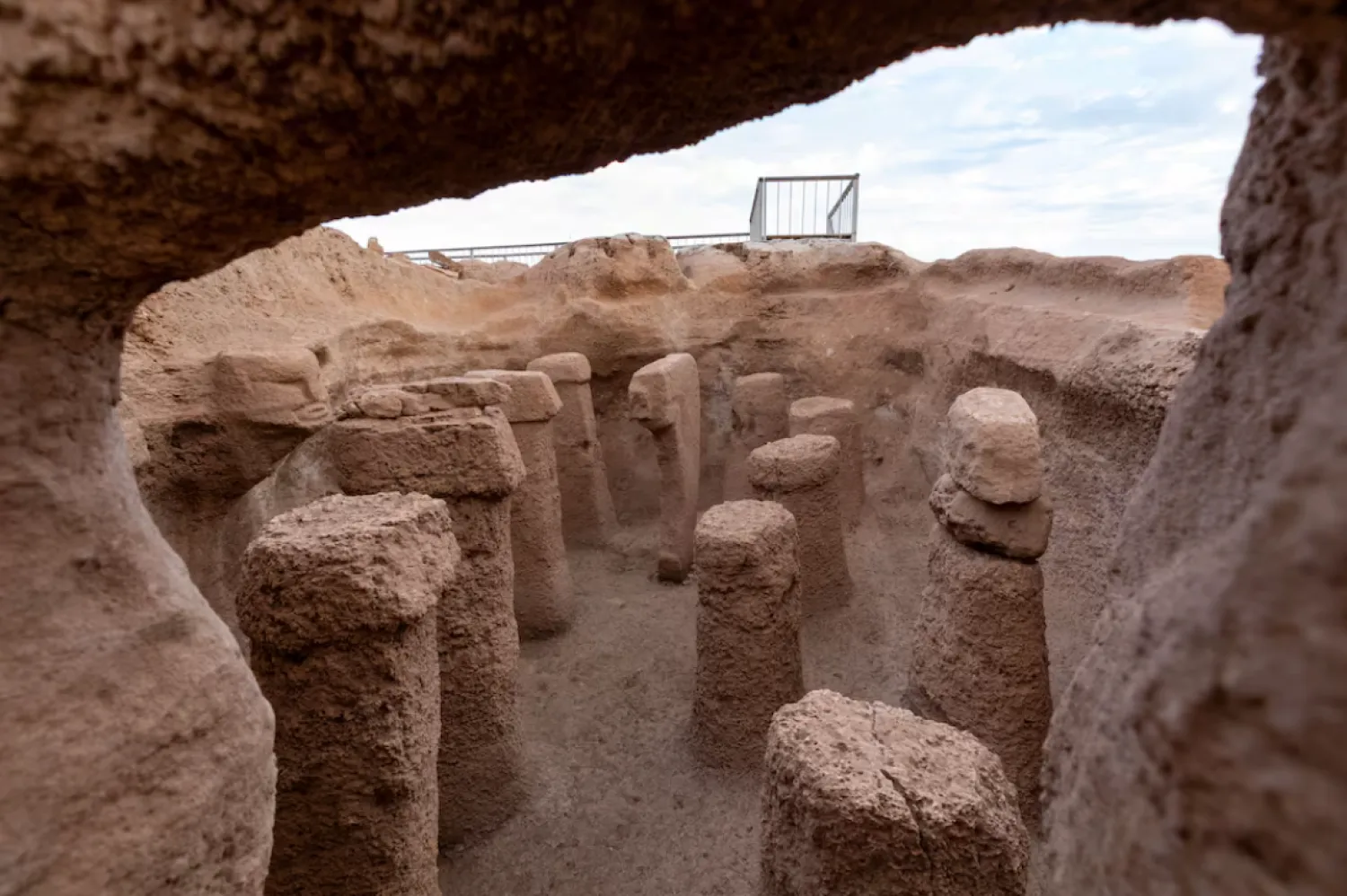
A view shows the archaeological site of Karahan Tepe, one of the world's oldest Neolithic settlements, is pictured in Sanliurfa, Türkiye, September 13, 2023. REUTERS/Tolga Ildun/File Photo
TT

Tiny Carved Animals Found in Türkiye Tell Story of Prehistoric Myth Making

A view shows the archaeological site of Karahan Tepe, one of the world's oldest Neolithic settlements, is pictured in Sanliurfa, Türkiye, September 13, 2023. REUTERS/Tolga Ildun/File Photo

A set of carved stone animals - a fox, a vulture and a wild boar - is shedding light on the way prehistoric people told stories after being unearthed by archaeologists in southeastern Türkiye.

Dating back some 11,500 years, the trio of figurines found at the Karahantepe archaeological site is the first known example of objects being arranged in a specific way to convey a narrative, archaeologists say.

"Telling a story undoubtedly brings storytellers to mind, and carving them into stone reveals the existence of artists. But it also proves that communities who know those stories share a common memory," Necmi Karul, head of the excavations at Karahantepe, one of the world's oldest Neolithic settlements, said, Reuters reported.

Unearthed late last year, the artefacts are now on display for the first time at the Presidential Complex in Türkiye's capital, Ankara, along with other items unearthed at Karahantepe, which dates back to 9,500 BC.

The set of animal figures - each one about 3.5 cm (1.38 inches) tall - was found in a small container, covered with a stone lid, and placed inside another, larger vessel. Each of the three figurines had its head placed into a limestone ring.

The intricacies of the arrangement reflect the figurines' use as part of a carefully prepared composition, Karul said, adding that previously only two-dimensional and often independent depictions had been found on immovable artefacts.

"With the Neolithic period and sedentism, we see a fundamental shift in narrative language," he said.

Sedentism, or living in one place for long periods, replaced millions of years of hunter-gatherer culture and gave rise to a new social order.

"These narratives must have been the social bonds that held this new order together," Karul said, describing the figurines as "one of the most important discoveries from a prehistoric perspective".

PREHISTORIC SUCCESS STORY

Karahantepe is one of the earliest settlements of the Neolithic period. Nearby Gobeklitepe, a UNESCO World Heritage Site, is believed to be the world's oldest.

Both sites are a part of a wider Neolithic research project called Tas Tepeler, or "Stone Hills", that includes various settlements dotted across the Turkish province of Sanliurfa and where excavations are ongoing.

Karahantepe covers 14 hectares (35 acres) but excavation work carried out there since 2019 has covered only a tiny fraction of the site, Karul said.

Pillars decorated with reliefs and a complex of circular communal buildings were also found there, with a human head carved into the bedrock on one of the walls.

Karul said he planned to seek different kinds of UNESCO recognition for the site as a way to increase global interest in his team's work.

"Modern people always place themselves at the pinnacle when compared to the past," he said. "Karahantepe shows us how successful people were in art and storytelling 11,000-12,000 years ago."



Olympic Visitors to Milan Get a Rare Chance to Glimpse Restoration of a Long-Hidden Leonardo Gem

Marina Vece works on restoring the Sala delle Asse, part of the newly created Leonardo da Vinci itineraries inside Milan's Sforza Castle, Italy, Tuesday, Jan. 20, 2026. (AP)
TT

Olympic Visitors to Milan Get a Rare Chance to Glimpse Restoration of a Long-Hidden Leonardo Gem

Marina Vece works on restoring the Sala delle Asse, part of the newly created Leonardo da Vinci itineraries inside Milan's Sforza Castle, Italy, Tuesday, Jan. 20, 2026. (AP)

In honor of the Milan Cortina Olympics, Milan cultural officials are for a brief time only allowing visitors access to a long-hidden wall and ceiling painting by Leonardo da Vinci while restoration work is underway.

The vast painting of a pergola covered with intertwined flowering branches inside Milan’s Sforza Castle is concealed behind a six-meter (nearly 20-foot) towering scaffolding in the Sala delle Asse. Letters establish that Leonardo started the work, but it's one he left unfinished.

“In 1498, he had to flee because the French arrived in Milan, and after that date it was covered over, hidden,” said Luca Tosi, heritage curator at Milan’s landmark Sforza Castle, which is in the same Sempione Park where the Olympic flame will burn during the Feb. 6-22 Winter Games.

In another sign of Leonardo's impact on Milan, the Olympic cauldron itself is inspired by the Renaissance genius' geometric studies, officials announced this week.

Under the French, the castle became a military barracks and the painting, which covers the ceiling and part of the wall, was covered with plaster. The work was only rediscovered early last century, when restorers removed the plaster and filled in color to match Leonardo’s work.

“As a result, Leonardo scholars no longer recognized them as a true Leonardo, but rather as a repainted Leonardo, somewhat a fake, to use a popular term,” Tosi added.

Visitors will be able to climb up the scaffolding and view the restorers at work during a brief window from Feb. 7-March 14, after which it will be closed to the public again for another 18 months to complete the work.

Restorers are using Japanese rice paper with demineralized water to remove salts that have seeped into the walls, gradually cleaning the surface of the painting.

“The hardest part is that Leonardo’s painting is very delicate, there are some liftings, there are more fragile parts and therefore the work must be done centimeter by centimeter, with the utmost attention and care,” Tosi said.

The painting is a study of leaves and plant species that provides yet more evidence of Leonardo’s infamous scientific inquiry, said Tomasso Sacchi, Milan’s top culture official.

“It’s a thrill to know another Leonardo and to experience this extraordinary dedication to various forms of knowledge by this fundamental figure in our history,” Sacchi said.


Italy Uncovers Basilica Designed by Vitruvius, the 'Father of Architecture'

A handout photo made available by Regione Marche press office shows the excavations in Piazza Andrea Costa from which large columns emerge, remains believed of the Basilica of Vitruvius, in Fano, Italy, 19 January 2026. (EPA/Regione Marche press office)
TT

Italy Uncovers Basilica Designed by Vitruvius, the 'Father of Architecture'

A handout photo made available by Regione Marche press office shows the excavations in Piazza Andrea Costa from which large columns emerge, remains believed of the Basilica of Vitruvius, in Fano, Italy, 19 January 2026. (EPA/Regione Marche press office)

Italian officials on Monday hailed the discovery of a more than 2,000-year-old public building attributed to Vitruvius, the ancient Roman architect and engineer known as the "father of architecture."

"It is a sensational finding ... something that our grandchildren will be talking about," Italian Culture Minister Alessandro Giuli told a press conference.

Vitruvius, who lived in the ‌1st century BC, ‌is celebrated for having written "De architectura," ‌or ⁠The Ten ‌Books on Architecture, the oldest surviving treatise on the subject.

His teachings on the classical proportions of buildings have inspired artists over centuries, including Leonardo da Vinci, whose famous drawing of the human body is known as the "Vitruvian Man."

Archaeologists believe they have found ⁠the remains of an ancient basilica, or public building, in the central ‌Italian city of Fano northeast of ‍Rome, that was created ‍by Vitruvius.

"I feel like this is the discovery ‍of the century, because scientists and researchers have been searching for this basilica for over 500 years," said the Mayor of Fano Luca Serfilippi.

"We have absolute match" between what was discovered and the descriptions given by Vitruvius in his books, regional archaeological superintendent Andrea Pessina told reporters.

The basilica had a rectangular layout, with 10 columns on the long side, and four on the short ones, Pessina said.

During excavation, when traces of four columns emerged, archaeologists used Vitruvius' descriptions to calculate where the top right column should be. When they started digging, they found it immediately, Pessina said.

"The are few certainties in archaeology ... but we were impressed by the precision" of the match, he added.

Further digging will determine whether more of the ‌basilica lies underground and if the site can be shown to the public, the superintendent said.


French TV Broadcasts Louvre Robbery Images

People wait for the Louvre museum to open as employees at the Louvre Museum vote to extend a strike that has disrupted operations at the world's most visited museum, Thursday, Dec. 18, 2025 in Paris. (AP)
TT

French TV Broadcasts Louvre Robbery Images

People wait for the Louvre museum to open as employees at the Louvre Museum vote to extend a strike that has disrupted operations at the world's most visited museum, Thursday, Dec. 18, 2025 in Paris. (AP)

Footage of the spectacular robbery at the Louvre Museum has been broadcast for the first time on French television, showing the brazen jewel thieves breaking into display cases.

The images, filmed by surveillance cameras, were shown by the TF1 and public France Televisions channels on Sunday evening, three months after the hugely embarrassing break-in in October.

They show the two burglars, one wearing a black balaclava and a yellow high-visibility jacket, the other dressed in black with a motorcycle helmet, as they force their way into the Apollo Gallery.

After breaking in through a reinforced window with a high-powered disk cutters, they begin slicing into display cases under the eyes of several staff members who do not intervene.

Managers at the Louvre have stressed that staff are not trained to confront thieves and are asked to prioritize the evacuation of visitors.

During the roughly four minutes that the two men were inside the gallery, one staff member can be seen holding a bollard used to orient visitor through the gallery, according to France Televisions.

The images form a key part of the ongoing criminal investigation into the October 19 heist.

Details of the footage have been reported in French newspapers, including Le Parisien.

Four suspects are in police custody, including the two suspected thieves, but the eight stolen items of French crown jewels worth an estimated $102 million have not been found.

The security failures highlighted by the break-in on a Sunday morning in broad daylight have lead to major pressure on director Laurence des Cars, who has apologized.

Metal bars have since been installed over the windows of the Apollo Gallery.