


Morocco High Atlas Whistle Language Strives for Survival

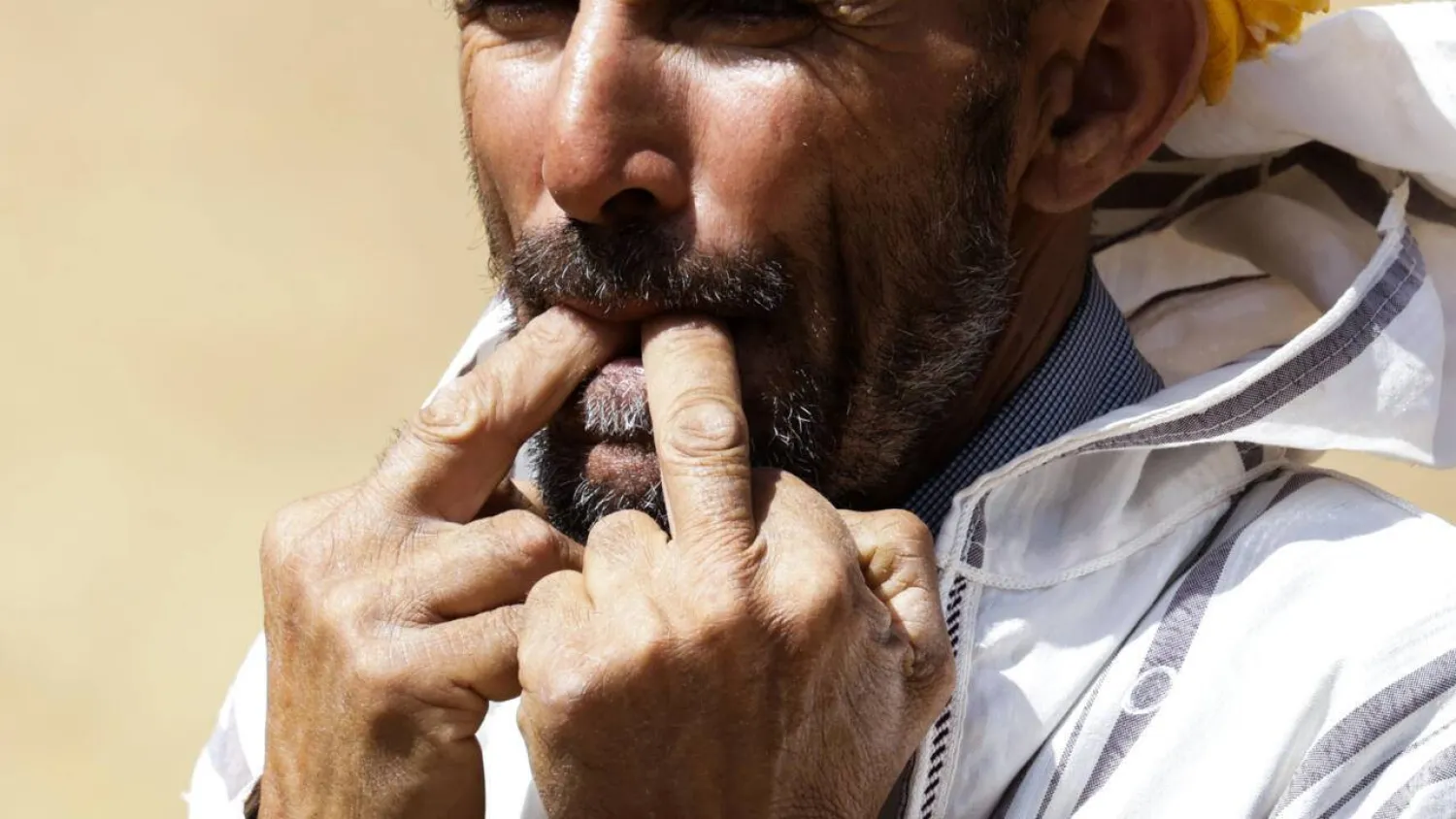
The Assinsg language replaces spoken words with sharp whistles that can carry for nearly three kilometers (two miles) in the mountains, according to researchers. Abdel Majid BZIOUAT / AFP
TT

Morocco High Atlas Whistle Language Strives for Survival

The Assinsg language replaces spoken words with sharp whistles that can carry for nearly three kilometers (two miles) in the mountains, according to researchers. Abdel Majid BZIOUAT / AFP

In Morocco's High Atlas mountains, shepherds Hammou Amraoui and his son hardly need words to speak. Across peaks, they whistle at each other in a centuries-old language, now jeopardized by rural flight.

"The whistle language is our telephone," joked Hammou, 59, the elder of a family known for the tradition in Imzerri, a hamlet in the remote commune of Tilouguit, about a two-hour drive from the nearest city.

In Tilouguit, Hammou said people learn it "like we learn to walk or to talk".

The Assinsg language replaces spoken words with sharp whistles that can carry for nearly three kilometers (two miles) in the mountains, according to researchers.

"The principle of the language is simple: the words are said in whistles and the key to understanding it is practice," said Hammou's 33-year-old son, Brahim.

"It makes it easier for us to communicate, especially when we're herding our livestock," he added.

Moroccan heritage researcher Fatima Zahra Salih described the whistle language as a cultural "treasure".

For five years, she has studied it to prepare a case for its recognition and protection by the UN's cultural agency UNESCO.

Whistle communication has been documented on nearly every continent, including the Spanish Canary Islands off Morocco's Atlantic coast.

"A little more than 90 languages have a whistled form, documented in scientific publications," said Julien Meyer, a linguist who specializes in the phenomenon.

In Morocco, it has so far only been documented in the Beni Mellal-Khenifra region of the central High Atlas mountain range, but Salih said she cannot rule out its existence elsewhere.

Moving away

Getting to Imzerri requires a climb along a dirt track winding through oak trees.

The village counts roughly 50 houses, none with running water or electricity.

Many families have moved away, threatening the survival of the whistle language.

"Our region is magnificent, but we live in isolation and difficult conditions," said Aicha Iken, 51, who learnt to whistle as a child while tending livestock. "Many of our neighbors have left."

Poverty in Azilal province, where Imzerri lies, has dropped in recent years, but was still double the national average in 2024, at 17 percent.

Yet some families are determined to hold onto their land -- and their whistling tradition.

Brahim Amraoui has made sure his 12-year-old son, Mohamed, was one of the few children in the hamlet who knows how to whistle.

"At first, it was very hard," said Mohamed, who dreams of becoming a pilot. "I could not understand everything, but after two years it's getting better."

His father said it was important to teach him the language, "even if he chooses a different profession".

"My goal is for the whistle language to be preserved," he added.

Since 2022, Brahim has led a small association dedicated to safeguarding the practice.

Whistle language 'disappearing'

It isn't just the villagers' migration to urban areas that has put the language at risk of vanishing.

"The whistle language is disappearing little by little because of environmental degradation," said Meyer.

Drought has gripped Morocco for seven straight years.

In November 2024, for the first time in their history, the Amraoui shepherds left their village to take their livestock on a nearly 350-kilometer journey east in search of pasture. They only came home seven months later.

"The move was painful, but we had no choice," Hammou recalled. "We had nothing left to feed our animals."

Salih said it was due to "climate change", which has "disrupted their pastoral way of life", where there used to be fixed seasonal pastures near their home they could travel between.

"For the first time, they had to practice nomadism," she said of the Amraouis.

The shepherd family has pinned its hopes on potential rainfall this fall, hoping they would not be forced to move again.

But while they wonder whether they will have to, Salih insists on the "urgent need to safeguard" the whistle language before more people leave it behind alongside rural life.



Once a National Obsession, Traditional Korean Wrestling Fights for Survival 

An elderly spectator watches a ssireum match during a Lunar New Year Ssireum championship at the Taean Complex Indoor Gymnasium in Taean, South Korea, February 14, 2026. (Reuters)
TT

Once a National Obsession, Traditional Korean Wrestling Fights for Survival 

An elderly spectator watches a ssireum match during a Lunar New Year Ssireum championship at the Taean Complex Indoor Gymnasium in Taean, South Korea, February 14, 2026. (Reuters)

As South Korea's global cultural influence expands in areas such as music, film and television, one form of entertainment struggling to attract attention even at home is Korea's traditional style of wrestling, known as ssireum.

Ssireum - pronounced like "see room" - had its heyday in the 1980s and early 1990s, when there were as many as eight professional teams and the top wrestlers became household names. Since then, it has been squeezed by tighter budgets and a public quick to move on to new trends.

Twenty-year-old Lee Eun-soo, who began training at the age ‌of nine, is ‌taking part in this year's Lunar New Year ‌tournament, ⁠the showcase event ⁠for the more than 1,500-year-old sport.

Lee lamented that at his former high school, the ssireum team currently has no members and there is talk of disbanding it.

"I once tried to imagine my life if I hadn’t done ssireum," Lee said. "I don’t think I could live without it."

A ssireum match involves two wrestlers facing off in an ⁠eight-meter (26.25 ft) sandpit ring, gripping each other by a ‌cloth belt called a "satba" and using ‌strength, balance, timing and stamina to force the opponent to the ground.

Ssireum ‌was inscribed on UNESCO's Representative List of the Intangible Cultural Heritage ‌of Humanity in 2018, but that international recognition has not translated into commercial success. Its relative obscurity contrasts with the high profile of Japan's sumo, another centuries-old form of wrestling.

Unlike sumo, which is supported by ‌a centralized professional ranking system and six major annual tournaments - or Olympic wrestling, with its global reach - ⁠ssireum remains ⁠largely domestic.

"Sport is something people won't come to watch if they don’t know the wrestlers or even the sport itself," said Lee Tae-hyun, a former ssireum wrestler and Professor of Martial Arts at Yong In University, who has promoted the sport overseas and believes it has commercial potential with the right backing.

Lee Hye-soo, 25, a spectator at the Lunar New Year tournament, said many Koreans are now unfamiliar with ssireum.

"My grandfather liked watching ssireum, so I watched it with him a lot when I was young," she said.

"I like it now too, but I think it would be even better if it became more famous."


Saudi Arabia Concludes Guest of Honor Role at Damascus International Book Fair 2026

The Kingdom’s pavilion, led by the commission, attracted strong attendance and active engagement through its cultural activities - SPA
TT

Saudi Arabia Concludes Guest of Honor Role at Damascus International Book Fair 2026

The Kingdom’s pavilion, led by the commission, attracted strong attendance and active engagement through its cultural activities - SPA

The Literature, Publishing and Translation Commission concluded the Kingdom’s Guest of Honor participation at the Damascus International Book Fair 2026, held in the Syrian capital from February 6 to 16, drawing strong attendance and engagement from visitors and cultural enthusiasts.

The Kingdom's pavilion was highly praised for its rich cultural content and high-quality programs, reflecting the vitality and growth of the Kingdom’s literary and cultural scene, SPA reported.

Literature, Publishing and Translation Commission CEO Dr. Abdullatif Abdulaziz Al-Wasel stated that the Kingdom’s role as Guest of Honor at the Damascus International Book Fair 2026, represented by a high-level cultural delegation led by Minister of Culture Prince Bader bin Abdullah bin Farhan, highlights the depth of Saudi-Syrian cultural relations based on partnership and mutual respect.

He noted that the participation demonstrates the Kingdom’s commitment to enhancing cultural exchange, a key objective of the National Culture Strategy under Saudi Vision 2030. Through this strategy, the commission emphasizes fostering constructive dialogue among peoples, exchanging knowledge and expertise, and consolidating the Kingdom’s active role in the Arab and international cultural landscape.

The Kingdom’s pavilion, led by the commission, attracted strong attendance and active engagement through its cultural activities. It showcased the commission’s programs and initiatives in literature, publishing, and translation, and featured a comprehensive cultural program, including literary seminars, cultural discussions, and poetry evenings with prominent Saudi writers and intellectuals.

These efforts enriched cultural dialogue with fair visitors and strengthened the presence of Saudi literature in the Arab cultural scene.

This edition of the Damascus International Book Fair marks a significant cultural milestone, reaffirming the value of books as carriers of meaning, spaces for dialogue, and starting points for a cultural journey that reflects the aspirations of the Arab cultural landscape toward a more open and aware phase.


Qiddiya City Begins Construction of Landmark Performing Arts Center

The Qiddiya Performing Arts Center supports the city’s positioning as a destination for creativity and cultural expression - SPA
TT

Qiddiya City Begins Construction of Landmark Performing Arts Center

The Qiddiya Performing Arts Center supports the city’s positioning as a destination for creativity and cultural expression - SPA

Qiddiya Investment Company has announced the commencement of construction works for the Performing Arts Center in Qiddiya City, marking an important milestone in the development of Qiddiya City as a destination for entertainment, sports and culture.

The announcement coincided with the laying of the foundation stone, signaling the start of construction works to be carried out by Nesma and Partners.

During the ceremony, held at the project site perched on the edge of the Tuwaiq Mountains, Managing Director of Qiddiya Investment Company Abdullah Aldawood delivered a speech announcing the official start of construction. He highlighted the importance of the project as a transformative addition that strengthens Qiddiya City’s cultural offering.

The Qiddiya Performing Arts Center supports the city’s positioning as a destination for creativity and cultural expression, while contributing to the development of local talent and attracting international artistic experiences.

The Qiddiya Performing Arts Center has been designed by Tom Wiscombe Architecture, in collaboration with BSBG, and features a futuristic architectural style defined by monumental forms. The design comprises interlocking architectural panels and five illuminated blades that blend harmoniously with the desert landscape, forming a prominent cultural landmark within Qiddiya City.

The start of construction follows the launch of the first phase of Qiddiya City in December 2025, which included the opening of Six Flags Qiddiya City. It’s part of the company’s broader approach to developing integrated destinations that enhance quality of life and deliver distinctive experiences across entertainment, sports and culture.