

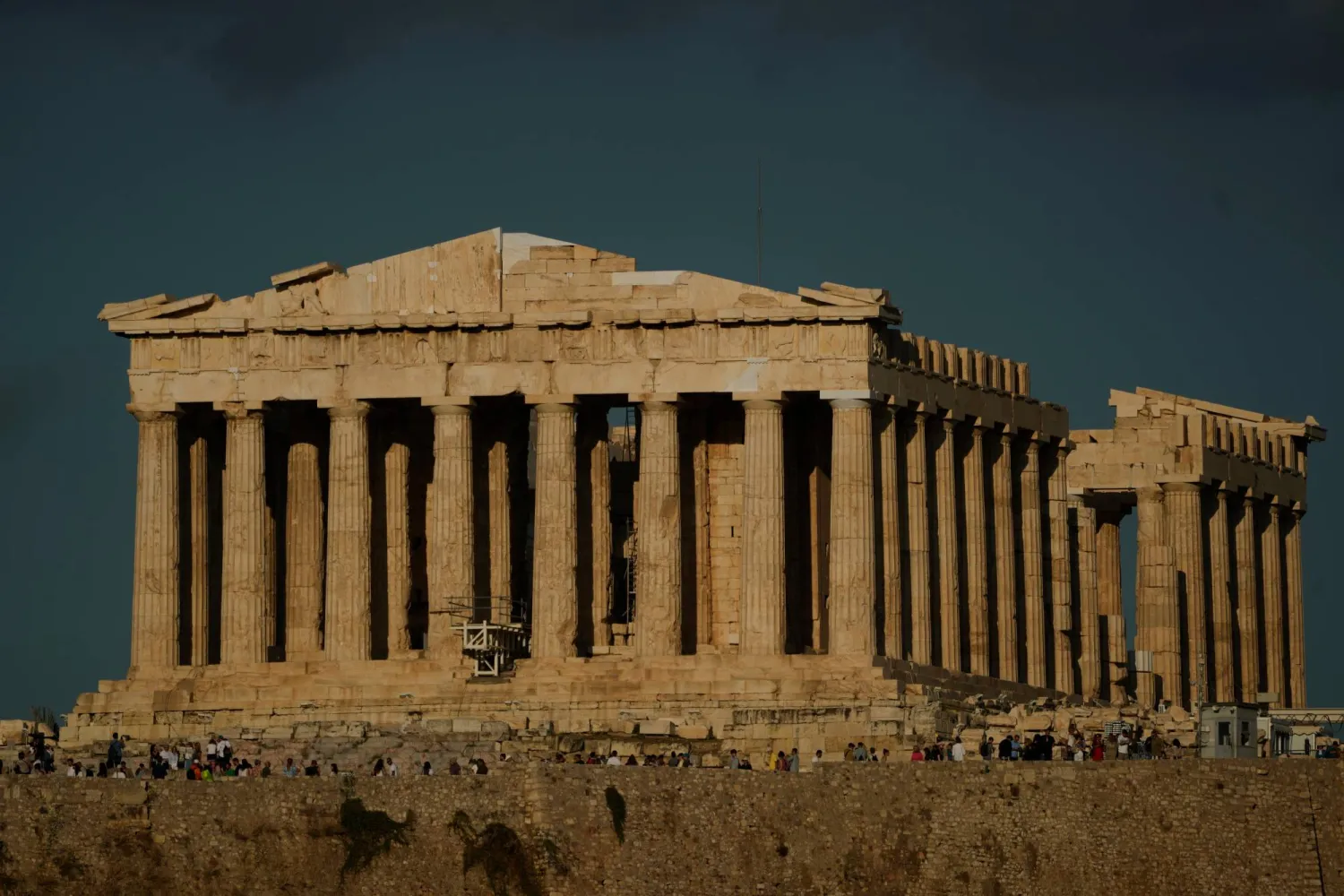

German Woman Returns Greek Relic Stolen Over 50 Years Ago

The 5th century B.C. Parthenon temple stands free of scaffolding on the Acropolis hill in Athens, Friday, Oct. 10, 2025, after the removal of restoration structures that had covered parts of the ancient monument for decades.(AP Photo/Petros Giannakouris)
TT

German Woman Returns Greek Relic Stolen Over 50 Years Ago

The 5th century B.C. Parthenon temple stands free of scaffolding on the Acropolis hill in Athens, Friday, Oct. 10, 2025, after the removal of restoration structures that had covered parts of the ancient monument for decades.(AP Photo/Petros Giannakouris)

A German woman who stole the top of an ancient column in Olympia over half a century ago has returned it to Greece, the Greek culture ministry said Saturday.

The capital of the column, made of limestone and measuring 24 cm (nine inches) high and 33.5 cm wide, was taken from the Leonidaion, a 4th-century BC guesthouse.

It is the third artifact returned by the University of Muenster in recent years. The handover took place on Friday.

"Motivated by the recent return of important antiquities from the University of Muenster to their countries of origin, she decided to hand it over to the university, with whose valuable contribution it returned to Greece and Ancient Olympia,” the ministry said, hailing the "sensitivity and courage" of the woman.

In 2019, the University of Muenster returned a twin-handled wine cup belonging to a champion from the first modern Olympic Games in Athens in 1896.

Then in 2024, it returned a Roman-era marble male head which came from a cemetery in Thessaloniki.

“This act proves that culture and history know no borders but require cooperation, responsibility, and mutual respect,” Giorgios Didaskalou, a senior culture ministry official said.

Torben Schreiber, curator of the University of Müenster’s archaeological museum, added that: “It is never too late to do the right thing, the moral and the just.”

Athens has been trying for years to broker deals for the repatriation of antiquities without resorting to legal action.

Its chief goal remains the return of the Parthenon Marbles, held by the British Museum since the 19th century.



Qasr Al-Shariah Mosque: An Architectural and Cultural Landmark

The Qasr Al-Shariah Mosque in Al-Haytham, Al-Kharj Governorate.(SPA)
TT

Qasr Al-Shariah Mosque: An Architectural and Cultural Landmark

The Qasr Al-Shariah Mosque in Al-Haytham, Al-Kharj Governorate.(SPA)

The Prince Mohammed bin Salman Project for Development of Historical Mosques focuses on preserving and restoring historical mosques across Saudi Arabia while enhancing their architectural integrity and highlighting their cultural and religious significance. The initiative aligns with Saudi Vision 2030 goals.

The Qasr Al-Shariah Mosque in Al-Haytham, Al-Kharj Governorate, exemplifies this effort. Closely tied to the governorate's history, it has served as a center for worship and community gatherings for decades, the Saudi Press Agency reported Sunday.

Built in 1338 AH during the reign of King Abdulaziz bin Abdulrahman, the mosque features traditional Najdi architecture, constructed from mud and stone with a roof made of tamarisk wood and palm fronds. Historically, it hosted Quranic classes and religious lessons.

Originally covering 314 square meters and accommodating around 90 worshippers, the mosque has been renovated to expand its area to 371 square meters and increase capacity to 150 worshippers, with the addition of essential facilities.

The project blends traditional building practices with modern techniques to ensure sustainability while preserving each mosque’s architectural identity. It also engages local heritage specialists under the supervision of Saudi engineers to achieve four key objectives: rehabilitating mosques for worship, restoring architectural authenticity, showcasing the Kingdom's civilizational heritage, and enhancing the cultural significance of historical mosques for future generations.


Royal Order Issued on Establishment of Riyadh University of Arts

Custodian of the Two Holy Mosques King Salman bin Abdulaziz. SPA
TT

Royal Order Issued on Establishment of Riyadh University of Arts

Custodian of the Two Holy Mosques King Salman bin Abdulaziz. SPA

A royal order has been issued approving the establishment of the Riyadh University of Arts, an independent educational institution headquartered in Riyadh under the supervision of the Ministry of Culture.

With legal personality and financial and administrative autonomy, the university is dedicated to specialized education in culture and the arts, aiming to cultivate national talent across creative disciplines through advanced academic programs aligned with global best practices and the objectives of Saudi Vision 2030.

The royal order authorizes the Minister of Culture to exercise the powers of the Board of Trustees until it is formally established, ensuring the swift completion of organizational procedures to begin operations.

To enhance its academic mission, the university will seek partnerships with prestigious international institutions to exchange expertise and develop high-level educational programs.

This initiative underscores the leadership's commitment to bolstering the Kingdom’s position as a regional cultural hub and fostering the growth of its creative industries.


Riyadh’s Markets Thrive as Men Prepare Traditional Attire for Eid Al-Fitr

Riyadh’s markets are experiencing a significant surge in activity - SPA
TT

Riyadh’s Markets Thrive as Men Prepare Traditional Attire for Eid Al-Fitr

Riyadh’s markets are experiencing a significant surge in activity - SPA

In preparation for Eid Al-Fitr, Riyadh’s markets are experiencing a significant surge in activity as men follow the Prophetic tradition of adorning themselves for the holiday, creating high demand for new thobes, bishts, and high-quality perfumes such as oud oil and incense, while tailoring shops and specialty retailers work at peak capacity to meet the community’s needs before the Eid morning celebrations, SPA reported.

The classic white thobe remains the most popular choice for Eid morning, often paired with a shemagh and a white bisht to symbolize cultural identity and elegance.

Beyond appearance, these preparations reflect deep-rooted social and religious values, emphasizing gratitude, family visits, and the strengthening of communal ties.