


Egypt Unveils the World's Largest Museum Dedicated to a Single Civilization

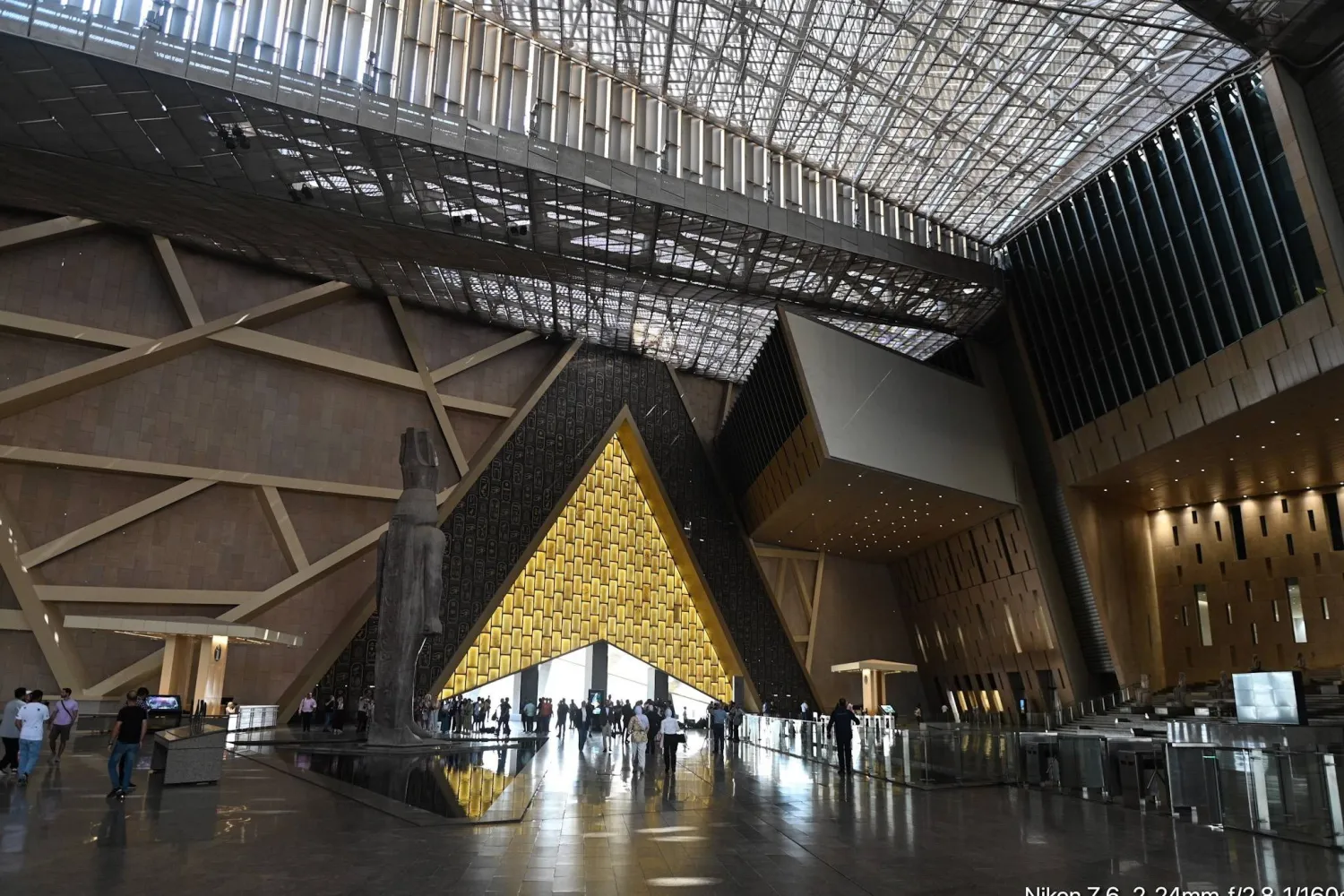
(FILE) - A view of the Grand Egyptian Museum during partial trial operation in Giza, Egypt, 15 October 2024 (reissued 31 October 2025). EPA/MOHAMED HOSSAM
TT

Egypt Unveils the World's Largest Museum Dedicated to a Single Civilization

(FILE) - A view of the Grand Egyptian Museum during partial trial operation in Giza, Egypt, 15 October 2024 (reissued 31 October 2025). EPA/MOHAMED HOSSAM

Egypt is inaugurating on Saturday the Grand Egyptian Museum, two decades in the making, with the aim of drawing more visitors to revitalize the country's tourist industry.

Located just outside Cairo on the Giza Plateau which also includes the three pyramids and the Sphinx, the museum will be the world’s largest dedicated to a single civilization. It will display over 50,000 artifacts detailing life in ancient Egypt.

World leaders, including monarchs, heads of states and governments, are set to attend the grand opening ceremony, according to the Egyptian presidency which touted the museum as “an exceptional event in the history of human culture and civilization.”

The museum is one of the megaprojects championed by President Abdel-Fattah al-Sisi since he took office in 2014. He has embarked on massive investments in infrastructure with the aim of reviving an economy weakened by decades of stagnation and battered by the unrest that followed the 2011 Arab Spring uprising.

Preparations for the grand reveal have been shrouded in secrecy. The museum, which was opened for limited visits in recent years, has been closed for the past two weeks.

The government has revamped the areas around the museum and the nearby Giza Pyramids. Roads were paved and a metro station is being constructed outside the museum gates to improve access. An airport, Sphinx International Airport, has also opened west of Cairo — 40 minutes from the museum.

The $1 billion facility had faced multiple delays, with construction beginning in 2005 but interrupted due to political instability.

The museum, known as GEM, boasts a towering, triangular glass façade imitating the nearby pyramids, with 24,000 square meters (258,000 square feet) of permanent exhibition space.

From the atrium, a grand six-story staircase lined with ancient statues leads up to the main galleries and a view of the nearby pyramids. A bridge links the museum to the pyramids, allowing tourists to move between them either on foot or via electric vehicles, according to museum officials.

The museum’s 12 main galleries, which opened last year, exhibit antiquities spanning from prehistoric times to the Roman era, organized by era and by themes.

Two halls are dedicated to the 5,000 artifacts from the collection of King Tutankhamun, which will be displayed in its entirely for the first time since British archaeologist Howard Carter discovered King Tut’s tomb in 1922 in the southern city of Luxor.

Zahi Hawass, Egypt’s most renowned archaeologist and former minister of antiquities, said the collection of Tutankhamun is the masterpiece of the museum.

“Why this museum is so important, and everyone is waiting for the opening?” he told The Associated Press. “Because of Tutankhamun.”

The collection includes the boy pharaoh’s three funeral beds and six chariots, his golden throne, his gold-covered sarcophagus and his burial mask, made of gold, quartzite, lapis lazuli and colored glass.

The government’s aim is that the museum will draw more tourists who will stay for a while and provide the foreign currency Egypt needs to shore up its economy.

The tourism sector has suffered during years of political turmoil and violence following the 2011 Arab Spring uprising. In recent years, the sector has started to recover from the coronavirus pandemic and the effects of Russia’s war on Ukraine — both countries are major sources of tourists visiting Egypt.

A record number of about 15.7 million tourists visited Egypt in 2024, contributing about 8% of the country's GDP, according to official figures. The government aims to attract 30 million visitors annually by 2032.

The museum will be open to the public starting Tuesday, authorities said.


Red Sea International Film Festival Held Amid Wide Participation from Film Stars, Creators

The festival runs until December 13 with the wide participation of local and international film stars and creators
TT

Red Sea International Film Festival Held Amid Wide Participation from Film Stars, Creators

The festival runs until December 13 with the wide participation of local and international film stars and creators

The fifth annual Red Sea International Film Festival is being held under the patronage of Minister of Culture Prince Bader bin Abdullah bin Farhan at Culture Square in Historic Jeddah under the theme "In Love with Cinema.”

It runs until December 13 with the wide participation of local and international film stars and creators.

In his opening speech, the minister welcomed the festival's guests, saying "Here in the beautiful city of Jeddah - alive with creativity, culture, and the arts - I am pleased to welcome those who have joined us in previous successful editions, as well as those attending for the first time to experience an event that reflects the energy of our youth and the richness of our culture.”

With the generous support of the Crown Prince and Prime Minister, the minister noted that the cultural sector has witnessed an unprecedented renaissance, positioning culture as a cornerstone of Saudi Arabia's future.

The minister pointed out that over the past seven years, the Ministry of Culture has worked to preserve the Kingdom's diverse heritage and build a thriving cultural landscape encompassing the arts, language, music, handicrafts, and the film sector, affirming that cinema is one of the most powerful tools of cultural influence globally and plays a pivotal role in strengthening understanding among peoples.

He added that the Red Sea Film Foundation embodies the Kingdom's vision of empowering youth, supporting creatives, and reinforcing Saudi Arabia's presence as a promising cinematic destination.

The festival opened with the film "Giant" in its Middle East and North Africa premiere.

Red Sea Film Foundation Chief Executive Officer Faisal Baltyuor explained that the choice of opening film reflects the festival's vision of supporting voices and stories from the Middle East, Asia, and Africa, and bringing them to global audiences.

Chairwoman of the Board of Trustees for Red Sea Film Foundation Jomana Alrashid stated that the foundation has, over five years, helped build an effective ecosystem that enables filmmakers from Arab, Asian, and African countries to lead their projects.

She noted that seven films supported by the "Red Sea Fund" were nominated for the Oscars, and that this year's edition features 111 films from more than 70 countries, highlighting 38 female directors.

This year, the festival offers a diverse cinematic program featuring selected global screenings and Arab works shown for the first time, in addition to an official competition that attracts films from five continents, and a series of panel discussions and talent-support programs designed to empower new voices and strengthen Arab presence in the international cinematic landscape.


‘Amazing’ Figurines Find in Egyptian Tomb Solves Mystery

This undated handout photograph released on November 25, 2025 by MFFT-EPHE/PSL shows funerary statuette, knonw as ouchbetis, found in the royal necropolis of Tanis (San el-Hagar). (Simone Nannucci / MFFT - EPHE/PSL / AFP)
TT

‘Amazing’ Figurines Find in Egyptian Tomb Solves Mystery

This undated handout photograph released on November 25, 2025 by MFFT-EPHE/PSL shows funerary statuette, knonw as ouchbetis, found in the royal necropolis of Tanis (San el-Hagar). (Simone Nannucci / MFFT - EPHE/PSL / AFP)

A treasure trove of 225 funerary figurines have been discovered inside a tomb in the ancient Egyptian capital of Tanis in the Nile Delta, a rare find that has also solved a long-running mystery.

"Finding figurines in place inside a royal tomb has not happened in the Tanis necropolis since 1946," French Egyptologist Frederic Payraudeau told reporters in Paris on Friday.

Such a find has also never happened before further south in Egypt's Valley of the Kings near modern Luxor -- apart from the tomb of the famous boy king Tutankhamun in 1922 -- because most such sites have been looted throughout history, he added.

Payraudeau, who leads the French Tanis excavation mission, said the remarkable discovery was made on the morning of October 9.

The team had already excavated the other three corners of a narrow tomb occupied by an imposing, unnamed sarcophagus.

"When we saw three or four figurines together, we knew right away it was going to be amazing," Payraudeau said.

"I ran out to tell my colleagues and the officials. After that it was a real struggle. It was the day before the weekend -- normally, we stop at 2 pm. We thought: 'This is not possible.'"

The team then set up lights to work through the night.

It took 10 days to carefully extract all of the 225 small green figurines.

They were "carefully arranged in a star shape around the sides of a trapezoidal pit and in horizontal rows at the bottom," Payraudeau said.

The funerary figurines, which are known as ushabti, were intended as servants to accompany the dead into the afterlife.

More than half the figurines are women, which is "quite exceptional", Payraudeau said.

Located in the Nile Delta, Tanis was founded around 1050 BC as the capital of the Egyptian kingdom during the 21st dynasty.

At the time, the Valley of the Kings -- which had been looted during the reign of pharaohs including Ramses -- was abandoned and the royal necropolis was moved to Tanis, Payraudeau said.

- One mystery leads to another -

The royal symbol on the newly discovered figurines also solves a long-standing mystery by identifying who was buried in the sarcophagus.

It was Pharaoh Shoshenq III, who reigned from 830 to 791 BC.

This was "astonishing" because the walls of a different tomb at the site -- and the largest sarcophagus there -- bear his name, Payraudeau said.

"Why isn't he buried in this tomb?" the expert asked.

"Obviously, for a pharaoh, building a tomb is a gamble because you can never be sure your successor will bury you there," he said.

"Clearly, we have new proof that these gambles are not always successful," Payraudeau said with a smile.

Shoshenq III's four-decade reign was turbulent, marred by a "very bloody civil war between upper and lower Egypt, with several pharaohs fighting for power," he said.

So it is possible that the royal succession did not go as planned and the pharaoh was not buried in his chosen tomb.

Another possibility is that his remains were moved later due to looting.

But it is "difficult to imagine that a 3.5 by 1.5-meter granite sarcophagus could have been reinstalled in such a small place," Payraudeau said.

After the figurines are studied, they will be displayed in an Egyptian museum, Payraudeau said.


Literature, Publishing and Translation Commission Launches Riyadh Int’l Philosophy Conference

The three-day event is organized by the Literature, Publishing and Translation Commission. SPA
TT

Literature, Publishing and Translation Commission Launches Riyadh Int’l Philosophy Conference

The three-day event is organized by the Literature, Publishing and Translation Commission. SPA

The fifth edition of the Riyadh International Philosophy Conference 2025 launched on Thursday at King Fahd National Library.

The three-day event is organized by the Literature, Publishing and Translation Commission under the theme “Philosophy Between East and West: Concepts, Origins, and Mutual Influences.”

This year’s conference continues the intellectual path it began five years ago, maintaining its role as a global platform that brings together thinkers, scholars, and experts from various countries and affirms the Kingdom’s position as an international center for knowledge production and cross-cultural dialogue.

The conference opened with remarks by CEO of the Literature, Publishing and Translation Commission Dr. Abdullatif Alwasel, who welcomed the guests and said the fifth edition builds on a project launched five years ago and has grown into a firmly established initiative that strengthens the presence of philosophy, enriches cultural dialogue, and reinforces the Kingdom’s standing as a global platform for knowledge and thought.

The conference features sixty speakers, including philosophers, thinkers, and researchers from different countries and philosophical traditions, giving the program intellectual diversity that strengthens its role as an international platform for dialogue and the exchange of expertise.

More than forty panel discussions will cover the foundations of Eastern and Western philosophy, modes of reasoning, and pathways of mutual influence between intellectual traditions. The sessions will also address contemporary issues related to human meaning, cultural shifts, and the role of philosophy in interpreting modern realities, offering varied perspectives and expanded approaches that deepen philosophical discussions.

The conference is expected to welcome around 7,000 visitors, reflecting the growing interest in philosophy and the humanities within the Kingdom.
