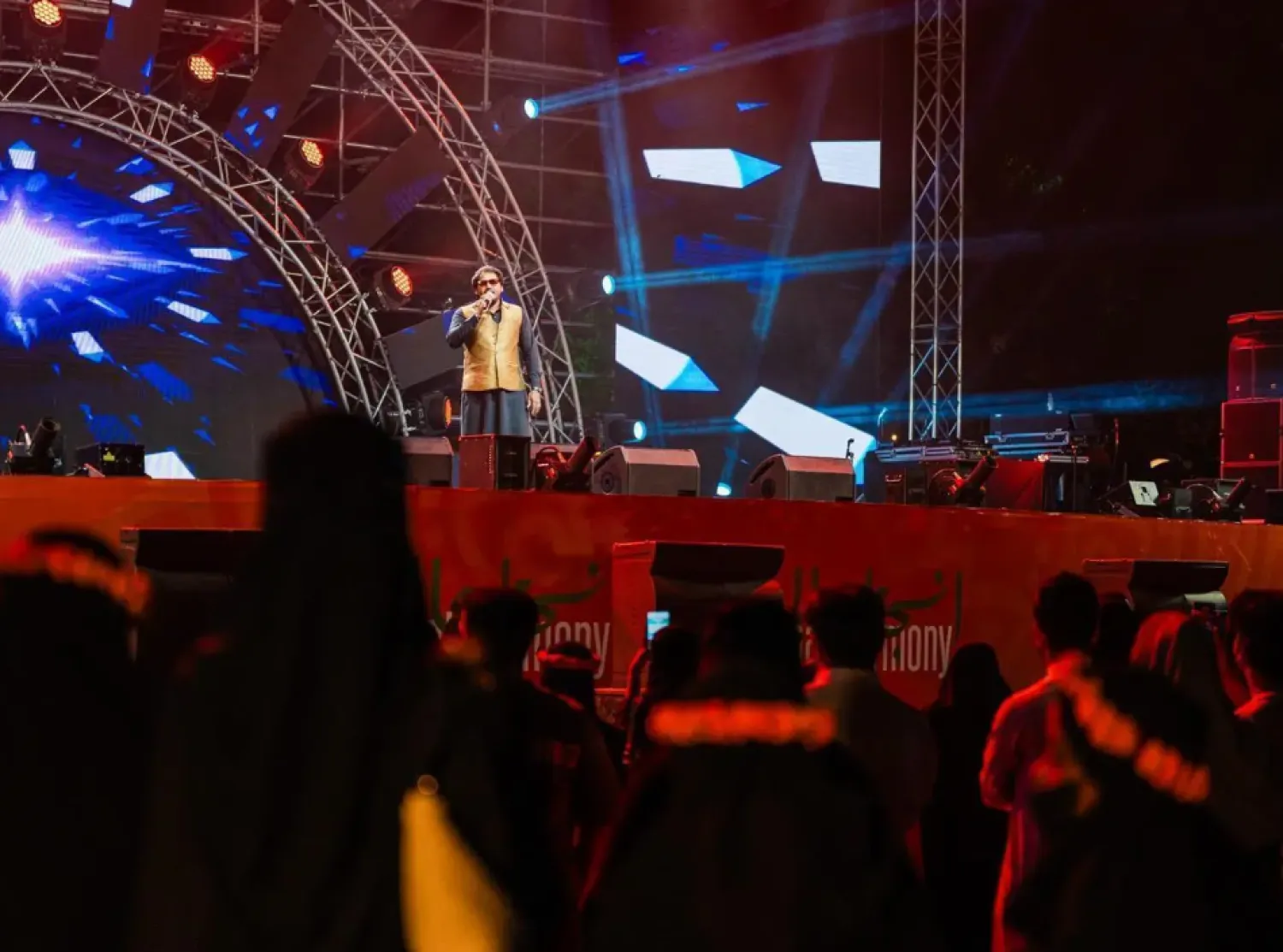
Indian Culture Week Brings Color, Celebration to Families at ‘Global Harmony 2’

Festivities opened with a performance by students of Dunes International School in Riyadh - SPA
TT

Indian Culture Week Brings Color, Celebration to Families at ‘Global Harmony 2’

Festivities opened with a performance by students of Dunes International School in Riyadh - SPA

The Global Harmony 2 initiative on Thursday welcomed thousands of visitors and families who gathered to enjoy a rich blend of cultural and entertainment activities presented during the Indian Culture Week.

The initiative is organized by the Ministry of Media in partnership with the General Entertainment Authority (GEA), SPA reported.

The event, one of the initiatives under the Quality of Life Program aimed at realizing Saudi Vision 2030, featured a diverse artistic lineup of live performances by Indian troupes as part of Indian Culture Week, drawing enthusiastic interaction from visitors and families alike.

Festivities opened with a performance by students of Dunes International School in Riyadh, followed by two shows highlighting traditional Indian heritage, a visually captivating circus filled with acrobatics and excitement, and a colorful carnival parade that filled the park with festive energy, traditional Indian costumes, and vibrant decorations.

A children’s stage also offered young visitors fun-filled entertainment areas featuring engaging games and lively performances.


Literature, Publishing and Translation Commission Launches Riyadh Int’l Philosophy Conference

The three-day event is organized by the Literature, Publishing and Translation Commission. SPA
TT

Literature, Publishing and Translation Commission Launches Riyadh Int’l Philosophy Conference

The three-day event is organized by the Literature, Publishing and Translation Commission. SPA

The fifth edition of the Riyadh International Philosophy Conference 2025 launched on Thursday at King Fahd National Library.

The three-day event is organized by the Literature, Publishing and Translation Commission under the theme “Philosophy Between East and West: Concepts, Origins, and Mutual Influences.”

This year’s conference continues the intellectual path it began five years ago, maintaining its role as a global platform that brings together thinkers, scholars, and experts from various countries and affirms the Kingdom’s position as an international center for knowledge production and cross-cultural dialogue.

The conference opened with remarks by CEO of the Literature, Publishing and Translation Commission Dr. Abdullatif Alwasel, who welcomed the guests and said the fifth edition builds on a project launched five years ago and has grown into a firmly established initiative that strengthens the presence of philosophy, enriches cultural dialogue, and reinforces the Kingdom’s standing as a global platform for knowledge and thought.

The conference features sixty speakers, including philosophers, thinkers, and researchers from different countries and philosophical traditions, giving the program intellectual diversity that strengthens its role as an international platform for dialogue and the exchange of expertise.

More than forty panel discussions will cover the foundations of Eastern and Western philosophy, modes of reasoning, and pathways of mutual influence between intellectual traditions. The sessions will also address contemporary issues related to human meaning, cultural shifts, and the role of philosophy in interpreting modern realities, offering varied perspectives and expanded approaches that deepen philosophical discussions.

The conference is expected to welcome around 7,000 visitors, reflecting the growing interest in philosophy and the humanities within the Kingdom.


New Exhibition in Saudi Arabia's AlUla Highlights Ancient City of Dadan

The new permanent exhibition, held at the Dadan archaeological site in AlUla, presents a wide collection of traditional crafts and customs, along with material evidence of cultural exchange between ancient civilizations. (SPA)
TT

New Exhibition in Saudi Arabia's AlUla Highlights Ancient City of Dadan

The new permanent exhibition, held at the Dadan archaeological site in AlUla, presents a wide collection of traditional crafts and customs, along with material evidence of cultural exchange between ancient civilizations. (SPA)

Saudi Arabia’s AlUla is preparing to open new chapters in the history of the ancient city of Dadan, the former capital of the Kingdoms of Dadan and Lihyan, through a new permanent exhibition titled “Illuminating Discoveries – Uncovering the Layers of Dadan’s History”, reported the Saudi Press Agency on Wednesday.

The exhibition offers an in-depth experience of the city’s archaeological heritage and its flourishing civilization across centuries. It guides visitors through the features of the past and demonstrates the importance of this historical site on regional and global heritage maps.

The new permanent exhibition, held at the Dadan archaeological site in AlUla, presents a wide collection of traditional crafts and customs, along with material evidence of cultural exchange between ancient civilizations. It highlights the historical role of Dadan as a political and commercial center on the Incense Road during the first millennium BCE and earlier.

The exhibition introduces a significant new chapter in the study of the Arabian Peninsula’s ancient history. It features more than one hundred artifacts carefully uncovered by international teams working at the Dadan site in AlUla and at the nearby mountain sanctuary of Umm Daraj over the past five years. These findings reveal the scale of ancient trade routes and confirm that AlUla once stood at the heart of a connected and sophisticated network.

Among the objects on display are small figurines linked to the Greek world, a bone hairpin from the Roman or Byzantine era, and rock inscriptions written in an ancient South Arabian script.

Dadan belongs to a line of advanced civilizations whose roots reach deep into the ancient world. Farming in the city is believed to date back to around the third millennium BCE, and archaeologists have found evidence of handcrafts from the second millennium BCE, long before the rise of the Roman Empire.

Material remains show that craftsmanship formed a central part of daily life and reflect the skill and ingenuity of the population. New discoveries include examples of complex metalwork and early evidence of textile production using weaving and spinning techniques. These traditional crafts, once essential to life in the city, are being revived today under the Royal Commission for AlUla’s cultural regeneration programs.

The exhibition also includes rare artifacts never before shown to the public. The material is organized into five main sections: Crafts and Daily Life in Ancient Dadan; Exchange and Trade; Ancient Beliefs and Rituals; Scripts in Stone; and Umm Daraj.

Among the findings is a copper-alloy spearhead dating to between 400 and 50 BCE. Field surveys along Dadan’s cliffs uncovered hundreds of inscriptions and striking rock art, including a battle scene showing four mounted warriors carrying long spears. Rock art in the nearby desert valley of Wadi Al-Naam depicts a rider using a spear to hunt an ostrich.

Another notable object is a terracotta head found in an urban neighborhood of Dadan and dating to the late fourth to first century BCE. Imported from the ancient Greek world, it is believed to have belonged to a Tanagra figurine, a type of small, finely crafted statue produced in central Greece and traded widely across the Mediterranean and as far as Babylon. The head reflects how Mediterranean artistic styles entered the region and circulated across northwest Arabia during the Lihyanite period.

Archaeologists also uncovered a striking statue from an ancient shrine at the foot of Dadan’s cliffs, dating to between 400 and 50 BCE, with one of its eye inlays still preserved. The statue reflects the high craftsmanship of symbolic objects produced during the Lihyanite period. Another figurine, marked by long hair and a belted garment, was found at the same site, with only one arm surviving. Its eyes were once inlaid with bone.

A unique part of the collection is a fragment of carved sandstone dating to the first millennium BCE. It preserves part of an inscription in the ancient South Arabian Minaic script. The relief carving likely came from a temple or public building. The preserved symbols probably refer to Wadd, the chief deity worshipped by the Minaean community at Dadan. Merchants from the Kingdom of Ma‘in established a trading presence in Dadan and left inscriptions documenting their cultural practices.

This inscription has a connection to the nearby “open-air library” at Jabal Ikmah. Inscribed on UNESCO’s Memory of the World Register, Jabal Ikmah contains nearly three hundred inscriptions, most dating to the Dadanite and Lihyanite periods.

The exhibition was organized through cooperation between the Royal Commission for AlUla, the French National Center for Scientific Research, and the French Agency for AlUla Development, which have jointly led recent Saudi-French archaeological missions in Dadan.

The launch of the 2025-2026 archaeological season in AlUla marks one of the region’s broadest heritage research efforts to date. More than one hundred archaeologists and specialists from leading Saudi and international institutions are participating across six major projects, ranging from new excavations at Hegra and Dadan to large-scale inscription surveys and environmental studies.

This program is the most ambitious undertaken in AlUla and contributes to advancing knowledge, developing national expertise, and strengthening the Kingdom’s position as a leader in cultural heritage research.


Gazans Race to Preserve Cultural Heritage Damaged in War

 Workers carry out restoration work at the historical Pasha's Palace, damaged during the war, in Gaza City, November 11, 2025. (Reuters)
Workers carry out restoration work at the historical Pasha's Palace, damaged during the war, in Gaza City, November 11, 2025. (Reuters)
TT

Gazans Race to Preserve Cultural Heritage Damaged in War

 Workers carry out restoration work at the historical Pasha's Palace, damaged during the war, in Gaza City, November 11, 2025. (Reuters)
Workers carry out restoration work at the historical Pasha's Palace, damaged during the war, in Gaza City, November 11, 2025. (Reuters)

With 70,000 dead, countless injured, hundreds of thousands of people homeless and whole districts laid to waste, the task of rebuilding Gaza is almost beyond comprehension.

But at a handful of sites where the enclave's most valuable historical monuments have been severely damaged, workers are already busy with shovels, trying to dig out the few surviving remnants of the past.

Those include Gaza's most important cultural site, the great Omari Mosque in Gaza's Old City, which Israeli forces struck during the war to destroy what they said was a tunnel under its grounds used by fighters.

Palestinians say there is no sign of such a tunnel there, and blame Israel for blasting apart the enclave's religious and cultural heritage.

"If the occupation (Israel) believes that by destroying these buildings it can erase the history of this people, it is mistaken," said Hamuda al-Dahdar, an architect and heritage expert at the Center for Cultural Preservation, which is based in the West Bank city of Bethlehem and is now working inside Gaza to try to rescue sites destroyed in the war.

"These buildings represent the collective memory of an ancient nation, one that must be preserved, and we must unite in our efforts to protect it,” he told Reuters in Gaza.

The Israeli military did not respond to a request for fresh comment on the destruction of Palestinian cultural sites in Gaza.

TIMELESS TALES

In an enclave where most residents are refugees from cities and villages in what is now Israel - and most districts were hastily built in recent decades to house them - the Omari Mosque was Gazans' main link to their own cultural heritage and the rich architectural historical legacy of the wider Middle East.

The site, said by local tradition to be where the biblical Samson brought down a temple on his Philistine captors, housed a Byzantine church before the seventh century Caliph Omar brought Islam to the Mediterranean and reconsecrated it as a mosque.

In the centuries since, it was embellished and restored countless times by Mamluks, Crusaders and Ottomans, renowned throughout the Middle Ages as the area's architectural marvel.

Its minaret was the main landmark of the Gaza skyline. Worshippers would pack its basilica, with vaulted ceilings and cool glazed tile floors, spilling out after prayers through the stately facade, the arched stone courtyard and the compound's gates into the surrounding market streets of the Old City.

The nearby Al Qaisariyya gold market was packed with shops whose owners and neighbors were known for recounting timeless legends of the wedding jewelry of doomed lovers and jealous mothers-in-law. Little is left.

Also lying in ruins is the Pasha's Palace, a landmark partly dating back to the 13th century, which housed a museum whose treasures are now gone.

"When we talk about heritage and culture, we are not merely talking about an old building or ancient stones. Every stone tells a story," said Dahdar.

Palestinian officials and UNESCO are preparing a three-phase recovery plan with initial costs of $133 million for historical sites, said Jehad Yasin, assistant deputy minister at the Palestinian Ministry of Tourism and Antiquities, based in the West Bank.

The first priority will be quickly intervening to support structures that could collapse without support. But there is a shortage of white cement and gypsum. Resources in Gaza are limited and the prices of excavation and restoration materials have skyrocketed, he said.

In Gaza, the loss of cultural landmarks still causes a particular ache, even among families who lost loved ones, homes and livelihoods.

Munzir Abu Assi said he had to comfort his daughter Kenzy after she heard the Great Omari Mosque was damaged.

"She’s really sad. When we heard that the mosque has been hit, we were surprised, why?" said Abu Assi.

"And when they also hit Pasha's Palace, we were certain that this occupation (Israel) wants to wipe out the Palestinian identity and to wipe out any Palestinian monument."