


Italian Cooking and Its Rituals Get UN Designation as World Heritage 

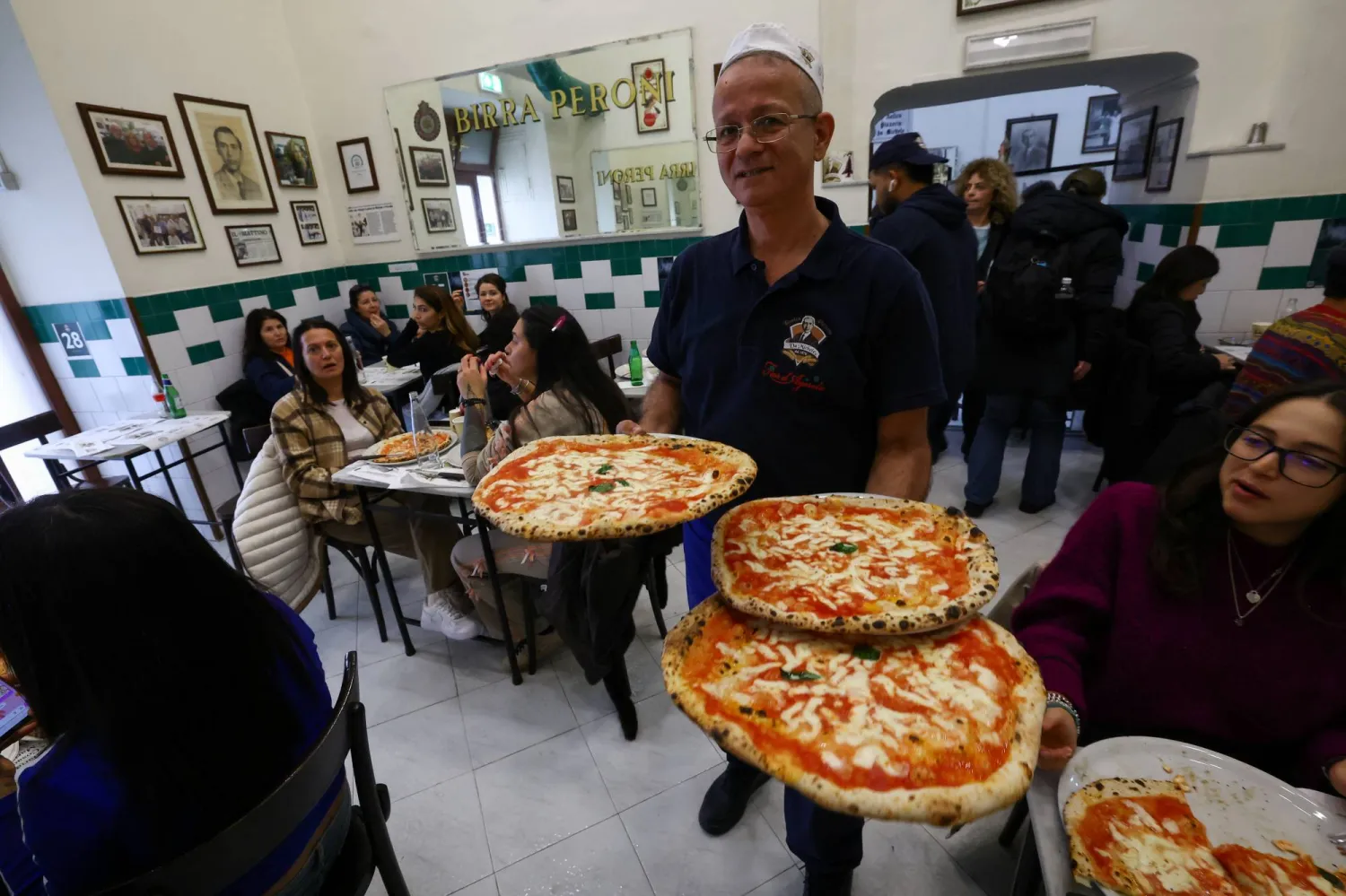
A waiter carries pizzas at L'antica Pizzeria da Michele as Italian cuisine awaits a crucial UNESCO decision that could recognize it as an Intangible Cultural Heritage of Humanity in Naples, Italy, December 5, 2025. (Reuters)
TT

Italian Cooking and Its Rituals Get UN Designation as World Heritage 

A waiter carries pizzas at L'antica Pizzeria da Michele as Italian cuisine awaits a crucial UNESCO decision that could recognize it as an Intangible Cultural Heritage of Humanity in Naples, Italy, December 5, 2025. (Reuters)

Italian food is known and loved around the world for its fresh ingredients and palate-pleasing tastes. On Wednesday, the UN's cultural agency gave foodies another reason to celebrate their pizza, pasta and tiramisu by listing Italian cooking as part of the world’s “intangible” cultural heritage.

UNESCO added the rituals surrounding Italian food preparation and consumption to its list of the world’s traditional practices and expressions. It's a designation celebrated alongside the more well-known UNESCO list of world heritage sites, on which Italy is well represented with locations like the Rome's Colosseum and the ancient city of Pompeii.

The citation didn’t mention specific dishes, recipes or regional specialties, but highlighted the cultural importance Italians place on the rituals of cooking and eating: the Sunday family lunch, the tradition of grandmothers teaching grandchildren how to fold tortellini dough just so, even the act of coming together to share a meal.

“Cooking is a gesture of love, a way in which we tell something about ourselves to others and how we take care of others,” said Pier Luigi Petrillo, a member of the Italian UNESCO campaign and professor of comparative law at Rome’s La Sapienza University.

“This tradition of being at the table, of stopping for a while at lunch, a bit longer at dinner, and even longer for big occasions, it’s not very common around the world,” he said.

Premier Giorgia Meloni celebrated the designation, which she said honored Italians and their national identity.

“Because for us Italians, cuisine is not just food or a collection of recipes. It is much more: it is culture, tradition, work, wealth,” she said in a statement.

Many gastronomic cultures get recognition It’s by no means the first time a country’s cuisine has been recognized as a cultural expression: In 2010, UNESCO listed the “gastronomic meal of the French” as part of the world’s intangible heritage, highlighting the French custom of celebrating important moments with food.

Other national cuisines and cultural practices surrounding them have also been added in recent years: the “cider culture” of Spain’s Asturian region, the Ceebu Jen culinary tradition of Senegal, the traditional way of making cheese in Minas Gerais, Brazil.

UNESCO meets every year to consider adding new cultural practices or expressions onto its lists of so-called “intangible heritage.” There are three types: One is a representative list, another is a list of practices that are in “urgent” need of safeguarding and the third is a list of good safeguarding practices.

This year, the committee meeting in New Delhi considered 53 nominations for the representative list, which already had 788 items. Other nominees included the Swiss yodelling, the handloom weaving technique used to make Bangladesh’s Tangail sarees, and Chile’s family circuses.

In its submission, Italy emphasized the “sustainability and biocultural diversity” of its food. Its campaign noted how Italy’s simple cuisine valued seasonality, fresh produce and limiting waste, while its variety highlighted its regional culinary differences and influences from migrants and others.

“For me, Italian cuisine is the best, top of the range. Number one. Nothing comes close,” said Francesco Lenzi, a pasta maker at Rome’s Osteria da Fortunata restaurant, near the Piazza Navona. “There are people who say ‘No, spaghetti comes from China.’ Okay, fine, but here we have turned noodles into a global phenomenon. Today, wherever you go in the world, everyone knows the word spaghetti. Everyone knows pizza.”

Lenzi credited his passion to his grandmother, the “queen of this big house by the sea” in Camogli, a small village on the Ligurian coast where he grew up. “I remember that on Sundays she would make ravioli with a rolling pin.”

“This stayed with me for many years,” he said in the restaurant's kitchen.

Mirella Pozzoli, a tourist visiting Rome’s Pantheon from the Lombardy region in northern Italy, said the mere act of dining together was special to Italians:

“Sitting at the table with family or friends is something that we Italians cherish and care about deeply. It’s a tradition of conviviality that you won’t find anywhere else in the world.”

Italy already well-represented on list Italy already has 13 other cultural items on the UNESCO intangible list, including Sicilian puppet theater, Cremona’s violin craftsmanship and the practice moving of livestock along seasonal migratory routes known as transhumance.

Italy appeared in two previous food-related listings: a 2013 citation for the “Mediterranean diet” that included Italy and half a dozen other countries, and the 2017 recognition of Naples’ pizza makers.

Petrillo, the Italian campaign member, said after 2017, the number of accredited schools to train Neapolitan pizza makers increased by more than 400%.

“After the UNESCO recognition, there were significant economic effects, both on tourism and the sales of products and on education and training,” he said.



Koshary, Egypt's Spicy Staple, Wins UNESCO Recognition 

Koshary, an Egyptian vegan dish recognized by UNESCO as part of its Intangible Cultural Heritage, is plated in Cairo, Egypt, on December 9, 2025. (Reuters)
TT

Koshary, Egypt's Spicy Staple, Wins UNESCO Recognition 

Koshary, an Egyptian vegan dish recognized by UNESCO as part of its Intangible Cultural Heritage, is plated in Cairo, Egypt, on December 9, 2025. (Reuters)

Koshary – a spicy dish of lentils, rice and pasta available at countless Egyptian food stalls – won recognition as a cultural treasure from the UN's cultural agency on Wednesday, as Cairo makes a broad push to promote its cultural and historical identity abroad.

Egypt's nomination of koshary for UNESCO's "Intangible Cultural Heritage" list comes a little over a month after its opening of a sprawling new antiquities museum – another move officials hope will highlight the country's rich history and lure more tourists.

One popular legend claims koshary originated in northern India and was brought to Egypt by soldiers during the British occupation. But the dish's origins can in fact be traced through a farther-flung, millennia-old lineage of migration, trade and conquest, food researcher and archaeobotanist Hala Barakat said.

EGYPTIAN DISH, WITH GLOBAL INFLUENCES

Lentils arrived from the Fertile Crescent more than 5,800 years ago, and rice was introduced from East Asia. Tomatoes and chili peppers were brought from the Americas centuries later, while pasta noodles were a more modern addition.

"These components came together over thousands of years," Barakat said. "Its name may be Indian, but the Egyptian dish has its own form – and even that varies from Alexandria to Aswan."

"Koshary in its current form is the koshary Egyptians made their own," she added.

Egypt's nomination makes note of this diversity, highlighting the fact that yellow lentils are used on the coast, compared with black lentils in Cairo and Upper Egypt. Some households add boiled eggs, while in Sinai a similar dish called ma'dous is common.

Each of these variations is united by "the special flavor provided by condiments such as vinegar, garlic, and hot sauce, which are added according to preference," the nomination says.

COUSCOUS, CEVICHE ALSO ON LIST

Making the intangible heritage list is mostly symbolic, and does not bring any direct financial benefit. Other dishes such as couscous – common across the Maghreb region – and the South American dish ceviche are on the list. Italian cuisine was also set to be inscribed this year.

Koshary's popularity surged in the 20th century as restaurants and brightly decorated street carts proliferated near schools and stations. The absence of animal products has also made it a staple among fasting Coptic Christians and younger Egyptians who are going vegetarian.

Today, the dish is one of Egypt's most recognizable features, according to Ahmed Shaker, the public relations officer at Abou Tarek Koshary, a popular Cairo restaurant that dates back to 1963.

"Any foreigner or visitor who comes to Egypt visits the Pyramids, visits the museum, and comes to Abou Tarek to eat koshary," Shaker said.

The dish joins Egypt's 10 previous "inscriptions", which include tahteeb, an ancient martial art using sticks, and the Sirat Bani Hilal, an epic oral poem.

UNESCO’s new director-general, Khaled El-Enany, previously served as Egypt's minister of tourism and antiquities, and has vowed to use his tenure to safeguard cultural traditions.


More Glittering Royal Jewels Displayed While Paris Is Still Uneasy Over the Louvre Robbery 

The Queen Victoria's emerald tiara, designed by Prince Albert and crafted by Joseph Kitching, London, 1845, emeralds and diamonds set in gold and silver, displayed at the exhibition "Dynastic Jewels" organized by The Al Thani Collection Foundation at the Hôtel de la Marine museum in Paris, France, Monday, Dec. 8, 2025. (AP) 
TT

More Glittering Royal Jewels Displayed While Paris Is Still Uneasy Over the Louvre Robbery 

The Queen Victoria's emerald tiara, designed by Prince Albert and crafted by Joseph Kitching, London, 1845, emeralds and diamonds set in gold and silver, displayed at the exhibition "Dynastic Jewels" organized by The Al Thani Collection Foundation at the Hôtel de la Marine museum in Paris, France, Monday, Dec. 8, 2025. (AP) 

A glittering exhibition of royal jewels is opening Wednesday in Paris even as the city still reels from the brazen crown-jewel heist at the nearby Louvre Museum.

The four-minute operation in October emptied cases in the Louvre's Apollo Gallery, forced its closure and rattled public confidence in France’s cultural security.

With the plundered gallery still sealed off, another museum nearby is showcasing diamonds and tiaras that endured revolutions, exile and empire: treasures that have managed to escape the type of plunder now afflicting the Louvre’s own jewels.

A loaded location The "Dynastic Jewels" exhibition at the Hôtel de la Marine — itself the site of an infamous 1792 crown-jewel theft — opens at a moment of national sensitivity.

Spread across four galleries, the exhibit unfurls more than a hundred pieces that dazzle in both sparkle and scale. Its objects are drawn from the Al Thani Collection, the Victoria and Albert Museum, and major lenders including King Charles III, the Duke of Fife, Cartier, Chaumet and France’s own national collections.

Some of the most striking loans include the giant 57-carat Star of Golconda diamond; a sapphire coronet and emerald tiara designed by Prince Albert for Queen Victoria, reunited here for the first time in more than 150 years; and Catherine the Great’s diamond-encrusted dress ornaments. A Cartier necklace created for an Indian ruler blends European platinum-age design with centuries-old gems.

Curators didn’t comment on details of operational security. But the Hôtel de la Marine stresses that it was rebuilt with modern, high-grade security when it reopened in 2021, and that its galleries were conceived with robust protections in mind. The museum did not say whether any measures had been strengthened in response to the Louvre heist.

Still, the latest exhibition unfolds at a moment when Paris is urgently tightening museum protections.

Last month, Louvre director Laurence des Cars announced that roughly 100 new surveillance cameras and upgraded anti-intrusion systems will be installed, with the first measures rolled out in weeks and the full network expected by the end of next year. The Louvre investigation remains active; meanwhile, none of the stolen pieces have been recovered.

Arthur Brand, an Amsterdam-based art detective, said the Louvre heist will have sharpened vigilance at institutions like the Hôtel de la Marine.

"Authorities have learned from the Louvre’s lacking security," he said. "The thieves know that the security people here aren’t going to be sloppy. They will have learned their lesson. It’s a good thing this exhibit is going on. Life goes on. You should not give in to thieves. Show these precious items!"

With the Apollo Gallery closed, the Hôtel de la Marine is suddenly poised to become a prime stop for jewel-lovers — an unfortunate coincidence, or unexpected advantage — a place where visitors shut out of the Louvre’s Crown Jewels displays may naturally gravitate.

"We show how great gemstones, tiaras and objects of virtuosity reflected identity in the 18th, 19th and 20th centuries," said Amin Jaffer, director of the Al Thani Collection and one of the exhibition’s curators. "They were expressions of power, reflections of prestige and markers of passion."

Before the Revolution, what was then known as the Hôtel du Garde-Meuble housed the Crown Jewels and royal collections — a history the exhibition directly invokes. That the building’s 18th-century jewels were stolen in 1792 only deepens the irony: this stretch of Paris has witnessed such crimes before.

Despite the charged backdrop, curators say they want visitors to marvel, to dream and to explore the layers of "affection, love, relationships, gift-giving" embedded in the objects.

"Every object here tells a story," Jaffer told AP. "They’ve changed hands ever since they were made, and they continue to survive."


Scientists Discover Secrets of Ancient Roman Concrete at Pompeii

The archaeological site of the ancient Roman city of Pompeii is seen in Pompeii, Italy, May 26, 2020. (Reuters)
TT

Scientists Discover Secrets of Ancient Roman Concrete at Pompeii

The archaeological site of the ancient Roman city of Pompeii is seen in Pompeii, Italy, May 26, 2020. (Reuters)

Scientists excavating the ruins of Pompeii have discovered a construction site left frozen in time by the eruption of Italy's Mount Vesuvius volcano in 79 AD, clarifying the ingredients and methods behind the durable self-healing concrete the ancient Romans used to revolutionize architecture.

The site represents a building project that was underway when the eruption buried Pompeii under volcanic ash and rock. The researchers came across rooms where the walls were unfinished and piles of premixed dry material and tools for weighing and measuring were in place for preparing concrete.

"Studying it truly felt as if I had traveled back in time and was standing beside the workers as they mixed and placed their concrete," said Admir Masic, a Massachusetts Institute of Technology professor of civil and environmental engineering and leader of the study published on Tuesday in the journal Nature Communications.

An indispensable building material, concrete helped the Romans erect structures including stadiums like the Colosseum, domed temples like the Pantheon, public baths and other big buildings, aqueducts and bridges unlike any fashioned to that point in history. Because the concrete could harden underwater, it also was vital for constructing harbors and breakwaters.

The precise method they used to make their concrete has been a matter of debate, with recent archaeological discoveries appearing to contradict accounts given in a 1st century BC treatise by Roman architect and engineer Vitruvius.

The Pompeii discovery showed the Romans used a technique called "hot mixing" in which a material called quicklime - dry limestone that was previously heated - is combined directly with water and a blend of volcanic rock and ash, producing a chemical reaction that naturally heats the mixture. That differs from the method described by Vitruvius, who wrote about a century earlier.

"Pompeii preserves buildings, materials and even work in progress in the precise state they were in when the eruption occurred. Unlike finished structures that have undergone centuries of repair or weathering, this site captures construction processes as they happened," Masic said.

"For studying ancient technologies, there is simply no parallel," Masic said. "Its exceptional preservation offers a true 'snapshot' of Roman building practice in action."

The building under construction combined domestic rooms with a working bakery with ovens, grain-washing basins and storage. The evidence there indicated that the technique outlined by Vitruvius, known as slaked lime, was not used for building walls.

That method may have been outdated by the time of the project in Pompeii.

"Imagine what 100 years of difference could mean for the building technology. A good analogy could be the early telephones. In the 1920s-30s: rotary dialing, long-distance copper lines. In the 2020s: smartphones using packet-switched digital signals and wireless networks," Masic said.

The hot-mixing technique contributed to the self-healing properties of the concrete, chemically repairing cracks. The concrete contains white remnants of the lime used to make it, called "lime clasts," which can dissolve and recrystallize, healing cracks that may form with the infiltration of water.

The Romans industrialized concrete, beginning in the 1st centuries BC and AD.

"This allowed builders to construct massive monolithic structures, complex vaults and domes, and harbors with concrete that cured underwater. Concrete fundamentally expanded what could be built and how cities and infrastructures were conceived," Masic said.

The new understanding of Roman concrete may have relevance for modern architects.

"Modern concretes generally lack intrinsic self-healing capability, which is increasingly important as we seek longer-lasting, lower-maintenance infrastructure," Masic said. "So while the ancient process itself is not a direct replacement for modern standards, the principles revealed can inform the design of next-generation durable, low-carbon concretes."