

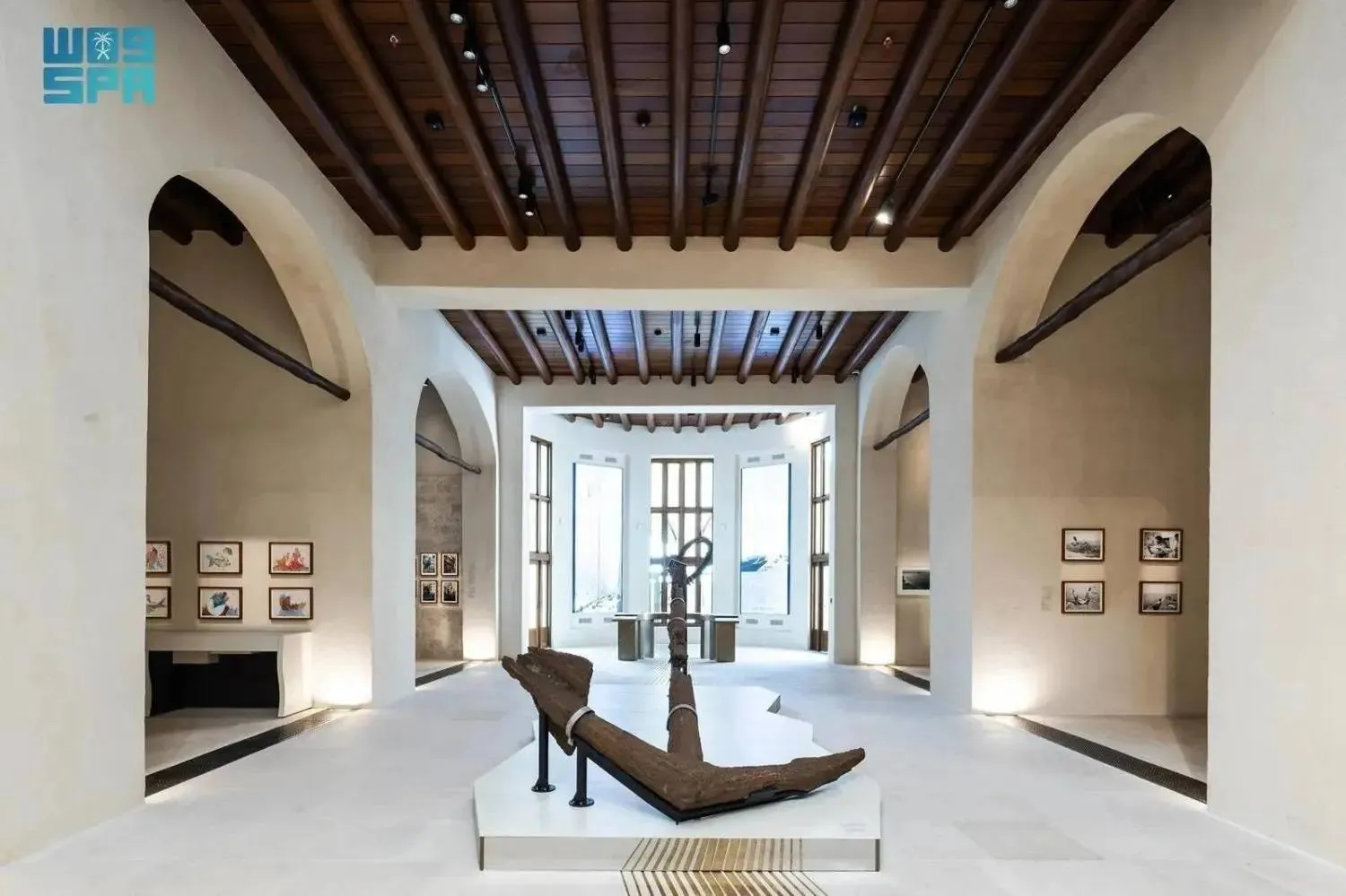

'Sunken Treasures' Exhibition on Exploring Maritime Heritage to Be Held at Red Sea Museum

"Sunken Treasures: The Maritime Heritage of the Red Sea" runs from February 25 to May 29. (SPA file photo)
TT

'Sunken Treasures' Exhibition on Exploring Maritime Heritage to Be Held at Red Sea Museum

"Sunken Treasures: The Maritime Heritage of the Red Sea" runs from February 25 to May 29. (SPA file photo)

The Red Sea Museum, under the Museums Commission, announced the opening of "Sunken Treasures: The Maritime Heritage of the Red Sea", running from February 25 to May 29.

The exhibition presents archaeological discoveries from the Red Sea as witnesses to human journeys, cultural exchange, and the enduring relationship between maritime heritage and environmental conservation, said the Museum Commission in a statement on Sunday.

"Sunken Treasures" invites visitors to discover how shipwrecks became archives of history and eventually transformed into living coral reefs. Through archaeological artifacts, immersive visual experiences, and interactive technologies, the exhibition reveals the Red Sea coast as a cultural corridor upon which layers of history have accumulated over millennia.

Curated by Director of the Red Sea Museum Eman Zidan and Chief of the French-Saudi Archeological Mission in Farasân Islands Dr. Solène Marion de Procé, the exhibition unfolds across four thematic sections that together tell the story of maritime life, risk, and discovery in the Red Sea. The journey begins with "The Red Sea Passage", exploring how seasonal winds and navigation patterns shaped trade routes connecting the Mediterranean, southern Arabia, East Africa, and the Indian Ocean.

"Life Aboard the Ship" transports visitors into the world of historic seafarers, presenting the ship not just as a means of transport, but an integrated world of maritime voyages, where crew, cargo, and navigation tools reveal the accumulated expertise of reading the sea and sky. Pottery, coins, glass, and ceramic objects preserve stories of movement, connection, and communication across the Red Sea.

"Shipwrecks: From a Voyage to a Memory" explores the dramatic moment when journeys are cut short. Through storms, waves, or collision with coral reefs, vessels shift from means of crossing into silent traces.

"Exploring for Tomorrow" traces the transformation of shipwrecks from discovery to interpretation as scientific sources of knowledge. The section highlights conservation and restoration efforts carried out by the Heritage Commission and archaeological missions working on the Saudi coast of the Red Sea, following guidelines and frameworks that ensure protection for future generations.

"Sunken Treasures" demonstrates the Red Sea Museum's commitment to preserving the tangible, intangible, and natural heritage of the Red Sea while creating opportunities for cultural exchange, education, and sustainable development.

The exhibition is enriched through collaboration with key institutional partners, including the Heritage Commission and Historic Jeddah Program, who have loaned objects that strengthen the presentation of authentic material evidence of maritime and coastal heritage, reflecting a shared commitment to safeguarding the Maritime Heritage of Saudi Arabia.

The exhibition showcases the Red Sea Museum as a platform for knowledge creation and scientific research. It highlights how submerged cultural heritage is transformed into valuable historical knowledge through research-driven storytelling, while fostering collaboration between marine specialists, scientists, conservators, and the wider community.



Royal Order Issued on Establishment of Riyadh University of Arts

Custodian of the Two Holy Mosques King Salman bin Abdulaziz. SPA
TT

Royal Order Issued on Establishment of Riyadh University of Arts

Custodian of the Two Holy Mosques King Salman bin Abdulaziz. SPA

A royal order has been issued approving the establishment of the Riyadh University of Arts, an independent educational institution headquartered in Riyadh under the supervision of the Ministry of Culture.

With legal personality and financial and administrative autonomy, the university is dedicated to specialized education in culture and the arts, aiming to cultivate national talent across creative disciplines through advanced academic programs aligned with global best practices and the objectives of Saudi Vision 2030.

The royal order authorizes the Minister of Culture to exercise the powers of the Board of Trustees until it is formally established, ensuring the swift completion of organizational procedures to begin operations.

To enhance its academic mission, the university will seek partnerships with prestigious international institutions to exchange expertise and develop high-level educational programs.

This initiative underscores the leadership's commitment to bolstering the Kingdom’s position as a regional cultural hub and fostering the growth of its creative industries.


Riyadh’s Markets Thrive as Men Prepare Traditional Attire for Eid Al-Fitr

Riyadh’s markets are experiencing a significant surge in activity - SPA
TT

Riyadh’s Markets Thrive as Men Prepare Traditional Attire for Eid Al-Fitr

Riyadh’s markets are experiencing a significant surge in activity - SPA

In preparation for Eid Al-Fitr, Riyadh’s markets are experiencing a significant surge in activity as men follow the Prophetic tradition of adorning themselves for the holiday, creating high demand for new thobes, bishts, and high-quality perfumes such as oud oil and incense, while tailoring shops and specialty retailers work at peak capacity to meet the community’s needs before the Eid morning celebrations, SPA reported.

The classic white thobe remains the most popular choice for Eid morning, often paired with a shemagh and a white bisht to symbolize cultural identity and elegance.

Beyond appearance, these preparations reflect deep-rooted social and religious values, emphasizing gratitude, family visits, and the strengthening of communal ties.


Prince Mohammed bin Salman Project Restores Al-Fuwaihi Mosque in Sakaka

The restoration expanded the mosque’s area from 72.33 to 93.98 square meters - SPA
TT

Prince Mohammed bin Salman Project Restores Al-Fuwaihi Mosque in Sakaka

The restoration expanded the mosque’s area from 72.33 to 93.98 square meters - SPA

As part of the Prince Mohammed bin Salman Project for the Development of Historical Mosques, Al-Fuwaihi Mosque in Sakaka, originally built in 1380 AH (1960) and commissioned by Shaman Al-Fuwaihi, has undergone a comprehensive restoration to preserve its architectural and cultural identity while serving as a vital link to the urban and social history of Al-Jouf Region, SPA reported.

The restoration expanded the mosque’s area from 72.33 to 93.98 square meters, yet maintained its original capacity of 28 worshippers.

Supervised by Saudi engineers and executed by specialized heritage firms, the project successfully balanced traditional standards with modern technology.

This initiative aligns with Vision 2030 by rehabilitating historic sites for prayer, highlighting the Kingdom’s cultural heritage, and ensuring the long-term sustainability of these religious landmarks.