


Before Dawn, Ancient Drum Rite Wakes Istanbul Faithful to Fast

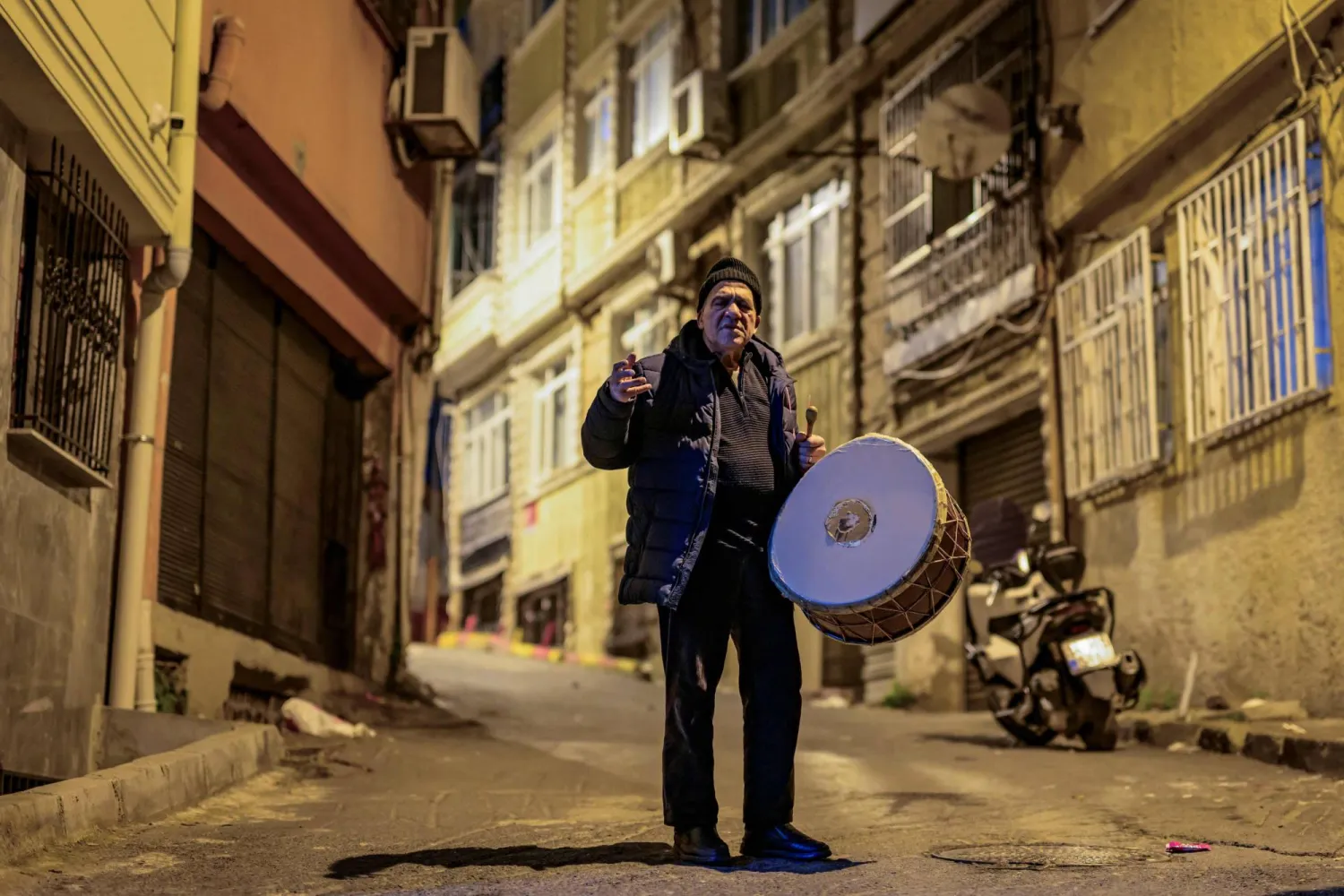
Turkish drummer Hakan Ozbingol plays drum and sings traditional songs in the streets of Istanbul, to wake Muslims up for the suhour, the Ramadan meal eaten at night, on February 24, 2026. (AFP)
TT

Before Dawn, Ancient Drum Rite Wakes Istanbul Faithful to Fast

Turkish drummer Hakan Ozbingol plays drum and sings traditional songs in the streets of Istanbul, to wake Muslims up for the suhour, the Ramadan meal eaten at night, on February 24, 2026. (AFP)

It's 3:30 am and lights are slowly coming on in the homes lining a narrow Istanbul street as people are woken up by the rhythmic thump of a drum.

Emerging onto a balcony, Sibel Savas and her grandson look down as the drummer -- or davulcu in Turkish -- wanders through the Ayvansaray neighborhood, his drumbeat waking the faithful for a last meal before the daily Ramadan fast begins at sunrise.

For the past 55 years, Hakan Ozbingol has got up at 3:00 am every day during Ramadan to play his davul, a large double-headed drum carried with a strap and played while walking through the streets.

He inherited the role from his father, with whom he started venturing out when he was 10.

Although their nightly sortie is purely voluntary, local residents traditionally give a tip at the end of the month, says Ozbingol, who is now 65.

If once this amounted to enough to buy the children a nice gift, these days it's barely enough "to buy them clothes or to cover the bills", he sighs, as people struggle to cope with Türkiye's bitter economic crisis.

But for him, it's not a job but more of a sacred duty.

"As long as it's to do with Allah, this drum will never fall silent. We're doing Allah's work, it's our duty," he said hoarsely, trudging with bent back through the winding streets.

- Ottoman roots -

According to Harun Korkmaz, a music historian at Istanbul University, the Ramadan drum rite "dates back to the end of the 19th century" when the Ottoman military bands, or mehters, performed several times a day, setting the pace of daily life.

"The davulcu are continuing this tradition," he told AFP of a tradition that began in Istanbul and spread to the rest of the country.

As well as drumming, "real" davulcu will also chant "mani", or short rhythmic poems, under people's windows to flatter a sleepy audience, Ozbingol explained.

"In Türkiye, there are few davulcus who know how to sing mani. It's not enough to pick up the drum and bang on it while walking around," he said, proudly tapping his temple to show where he keeps this knowledge.

The tradition began in the Fatih district near Istanbul's historic peninsula, and most of today's Ramadan drummers come from Türkiye's Roma community, who today number around 2.7 million, research figures show.

As the davulcu walks the street where washing lines vie for space with Turkish flags draped from the high facades of the buildings, he is warmly greeted by a pensioner called Zafer, who is also a musician.

"If the Roma weren't here there would be nothing. They are the musicians and Istanbul's Ramadan drummers," the 71-year-old told AFP.

- 'A tradition that must not die' -

Still holding her grandson, Sibal Savas says she has no alarm clock and relies on the early-morning drum rite to wake her up.

"This tradition is important to us this. It comes from our ancestors," she told AFP.

In a nearby street, another drummer, 58-year-old Yurdaer, is trying to play a little more quietly as he passes the home of an elderly neighbor who has heart problems.

Across Istanbul, Türkiye's largest city, there are a total of 3,000 davulcu who go out nightly to wake the faithful in 961 neighborhoods, explains Selami Aykut, who heads an organization representing the megacity's local mayors.

Since the pandemic, when the nightly rite was briefly halted, the authorities doubled the number of accredited drummers.

"We have increased the number we work with in order to better pass on our Ottoman traditions to young people, so that they can feel the excitement of Ramadan," Aykut told AFP.

With street vendors hawking traditional foods increasingly scarce across the city's streets, their services replaced by supermarkets, the davulcu is one rare tradition not at risk of disappearing due to his unique role at Ramadan.

"There are no more people selling boza (a fermented cereal-based drink), no more yoghurt sellers, nor other street vendors -- they've almost all disappeared," said Ozbingol.

"Only the davulcu are left," he murmurs, wandering off up the street.



Prince Mohammed bin Salman Project Restores Historical Al-Jaloud Mosque in Hail

​​​​​​​The recent renovation by specialized Saudi firms increased the mosque's capacity from 80 to 129 worshippers and its area to 250 square meters - SPA
TT

Prince Mohammed bin Salman Project Restores Historical Al-Jaloud Mosque in Hail

​​​​​​​The recent renovation by specialized Saudi firms increased the mosque's capacity from 80 to 129 worshippers and its area to 250 square meters - SPA

The Prince Mohammed bin Salman Project for the Development of Historical Mosques has completed the comprehensive restoration of Al-Jaloud Mosque in Hail Region as part of its first phase.

Dating back to 1761 (1175 AH), this 265-year-old landmark in Samira Governorate served as a vital stop on the ancient pilgrimage route between Makkah and Kufa, SPA reported.

Originally constructed from mud, stone, and tamarisk wood, the mosque has undergone several expansions, including a notable 1371 AH project funded by King Saud bin Abdulaziz.

The recent renovation by specialized Saudi firms increased the mosque's capacity from 80 to 129 worshippers and its area to 250 square meters.

By integrating modern building standards with traditional architectural identity, the project fulfills the Saudi Vision 2030 objective of preserving the Kingdom's urban heritage while rehabilitating historical sites for worship.


Saudi Coffee Remains Key Crop and Cultural Treasure during Ramadan

The ministry encourages consumers to choose national coffee products for their nutritional value - SPA
TT

Saudi Coffee Remains Key Crop and Cultural Treasure during Ramadan

The ministry encourages consumers to choose national coffee products for their nutritional value - SPA

The Saudi Ministry of Environment, Water and Agriculture has confirmed that Saudi coffee is a key national agricultural crop and an important cultural legacy, especially during Ramadan.

Coffee cultivation thrives in the southwestern and southern highlands, benefiting from a favorable climate and fertile soil.

Regions such as Jazan, Aseer, Al-Baha, Makkah, and Najran host over 1.3 million productive coffee trees, yielding more than 870 tons of coffee annually, according to SPA.

Jazan leads with over 966,000 trees producing more than 642 tons. Aseer has more than 243,000 trees yielding around 175 tons.

Al-Baha boasts about 72,000 trees; Makkah has over 12,000 trees yielding more than 10 tons; and Najran has over 9,000 trees producing over seven tons.

The ministry encourages consumers to choose national coffee products for their nutritional value, emphasizing that supporting local agriculture promotes farmer livelihoods and enhances food security in line with Saudi Vision 2030 goals.


Red Sea Museum Opens 'Sunken Treasures' Exhibition to Highlight Maritime Heritage

Saudi Arabia, under Vision 2030, is investing in world-class cultural infrastructure that serves both local communities and international visitors. SPA
TT

Red Sea Museum Opens 'Sunken Treasures' Exhibition to Highlight Maritime Heritage

Saudi Arabia, under Vision 2030, is investing in world-class cultural infrastructure that serves both local communities and international visitors. SPA

The Red Sea Museum celebrated the opening of 'Sunken Treasures: The Maritime Heritage of the Red Sea' exhibition on Wednesday in an event that brought together cultural leaders, researchers, and community partners in Historic Jeddah.

The exhibition is now open to the public through May 29.

The opening ceremony featured a panel discussion on maritime heritage and underwater archaeology, bringing together leading experts. The discussion explored the critical processes of discovery, documentation, and conservation that transform submerged cultural heritage into valuable historical knowledge, highlighting collaborative efforts between the Heritage Commission, Historic Jeddah Program, and various archaeological missions working along the Saudi coast of the Red Sea to safeguard this vital heritage for future generations.

Guests then embarked on an exclusive curator-led tour with Director of the Red Sea Museum Eman Zidan, and Co-Director, Saudi-French Archaeological Mission in Farasan Dr. Solène Marion de Procé, who guided visitors through the exhibition's thematic sections exploring how shipwrecks became archives of history and eventually transformed into living coral reefs.

The museum exemplifies how historic artifacts and contemporary cultural conservation work hand in hand. SPA

The evening concluded with a Ramadan reception, reflecting the museum's commitment to creating cultural programming that honors the spirit of the holy month while celebrating the launch of this significant exhibition.

The opening of Sunken Treasures represents a significant moment for the Red Sea Museum as Saudi Arabia's first institution dedicated specifically to the Red Sea's maritime history, cultural heritage, and biodiversity.

Housed in the restored Bab Al Bunt building, a structure that has welcomed travelers arriving by sea for generations, the museum exemplifies how historic artifacts and contemporary cultural conservation work hand in hand.

Saudi Arabia, under Vision 2030, is investing in world-class cultural infrastructure that serves both local communities and international visitors while positioning the Kingdom as a global leader in museum innovation, research, and public engagement.