
Türkiye in Cultural Diplomacy Push to Bring History Home

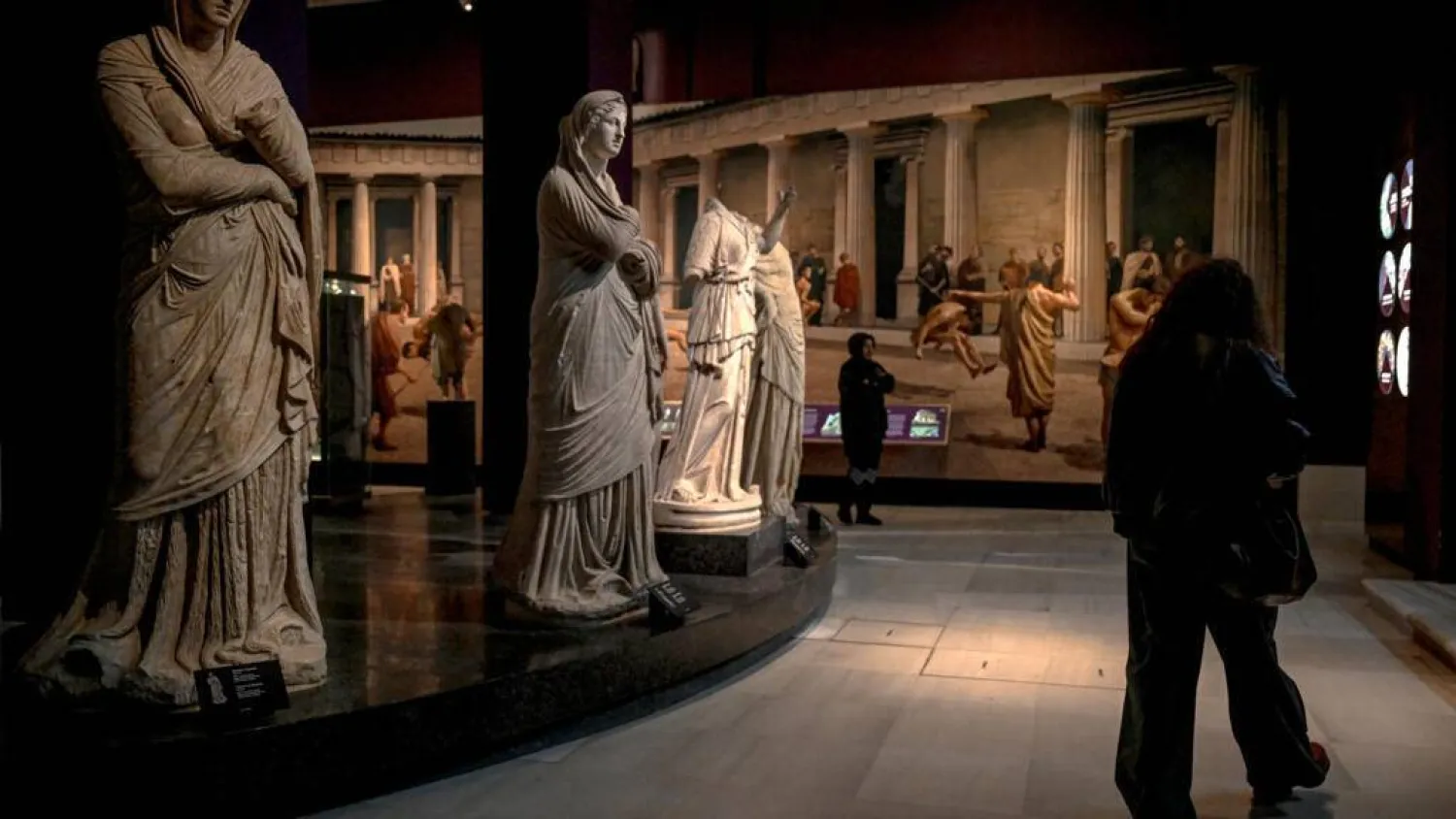
Türkiye's is waging an increasingly assertive campaign to recover antiquities illegally taken abroad. Ozan KOSE / AFP
TT

Türkiye in Cultural Diplomacy Push to Bring History Home

Türkiye's is waging an increasingly assertive campaign to recover antiquities illegally taken abroad. Ozan KOSE / AFP

When an ancient bronze statue of Roman Emperor Marcus Aurelius landed back on Turkish soil after decades abroad, it was more than a symbolic homecoming.

It marked the latest victory in Türkiye's increasingly assertive push to recover antiquities illegally taken abroad -- a campaign supported by a newly-developed AI tool for identifying cultural assets of Turkish origin.

The life-sized bronze, which dates back to the second- or third-century, was taken in the 1960s from the ancient city of Bubon near Türkiye's southwestern Antalya resort.

After a years-long investigation involving research, scientific testing and statements from now elderly witnesses, the headless statue arrived back in Türkiye last year.

Its repatriation from an Ohio museum involved cooperation with the US Department of Homeland Security and the Manhattan District Attorney's Office.

For Zeynep Boz, director of Türkiye's department for combating the illicit trafficking of cultural property, one moment stands out.

"I clearly remember when the computer finally processed the data and we saw the match come together. It was an exciting moment," she told AFP at Istanbul's archaeology museum.

That the statue survived at all is exceptional: in antiquity, bronze was a valuable raw material routinely melted down for weapons, coins or everyday objects.

"For this reason, bronze statues of this scale have rarely been preserved until today," she said.

For years, Cleveland's Museum of Art had dragged its feet, claiming there was insufficient evidence to prove where it came from, Boz said.

But that changed after archaeometry expert Professor Ernst Pernicka concluded there was "no doubt whatsoever" the statue came from Bubon, where an imperial shrine housed bronze sculptures of Roman emperors.

Soil and lead samples provided crucial scientific evidence which convinced the museum, Boz said.

"It was a long struggle. We were determined and patient and we won," Culture Minister Mehmet Nuri Ersoy said when the statue returned in July.

Türkiye has stepped up efforts to combat illicit antiquities trading and in 2025 alone secured the repatriation of 180 cultural artefacts.

- AI to identify trafficked objects -

Although its newly-developed AI-powered "TraceART" system was not involved in recovering the Marcus Aurelius statue, the tool helped identify two 16th-century Iznik tiles that were recovered from Britain this month.

Developed by the culture ministry, it scans images on sales platforms, auctions and social media to identify any cultural assets of Turkish origin that may have been trafficked, with flagged items sent for expert assessment.

TraceART went operational in 2025 and has since identified hundreds of objects for review, Boz said.

In January, Türkiye recovered an Anatolian-style marble head from Denver Art Museum in Colorado, said Burcu Ozdemir of the antiquities trafficking unit.

The museum contacted Ankara because the piece "had been donated by the wife of a US consul general who served in Istanbul in the 1940s", she said.

Türkiye's campaign also involves returning items to countries like Iran, China and Egypt.

"We returned two of the artefacts stolen from temples in China," Boz told AFP.

Türkiye also returned "a key of the Kaaba to Egypt" after realizing it had ended up in Türkiye illegally, she said of the cube-shaped stone structure at Makkah’s Grand Mosque.

- Ottoman tiles at the Louvre -

Türkiye is now seeking the repatriation of other antiquities taken during the Ottoman era: an ancient marble torso called the "Old Fisherman" from Berlin, and dozens of Iznik tiles held at France's Louvre museum.

"There's an assumption that artefacts taken in the 18th-19th centuries were acquired legally. We don't share that view," Boz said.

The illegal tile swap came to light in 2003 when one fell from the wall of an Ottoman-era library and on the back was the French manufacturer's mark.

The original and others were taken in the late 1800s by a Frenchman who claimed to be restoring them, then replaced them with fakes.

"We have repeatedly shared evidence with France and talked with the Louvre but no resolution has been reached," she said.

The tiles were on a panel by the tomb of Ottoman Sultan Selim II in the garden of the Hagia Sophia.

Today it bears a plaque in English, French and Turkish reading: "The tiles before us are replicas."

The originals are currently on display at a branch of the Louvre in Lens, 200 kilometers north of Paris, which says they were "bought in 1895".

The museum did not respond to several requests for comment from AFP.


Saudi Culture Ministry Launches UK-KSA Arabian Peninsula Cultural Research Fellowships

The Saudi flag. Asharq Al-Awsat
TT

Saudi Culture Ministry Launches UK-KSA Arabian Peninsula Cultural Research Fellowships

The Saudi flag. Asharq Al-Awsat

The Ministry of Culture has launched the UK-KSA Arabian Peninsula Cultural Research Fellowships in partnership with Effat University and the National Archives of the United Kingdom, to support archival-based research, advance cultural inquiry on the Arabian Peninsula, and strengthen collaboration between researchers and institutions in Saudi Arabia and the United Kingdom.

The program includes a 10-week research residency at the National Archives of the United Kingdom, where participants receive hands-on training in archival methods and gain access to a wide range of archival collections and cultural institutions across the UK. It supports diverse areas of cultural research related to the Arabian Peninsula.

This initiative aligns with the Ministry of Culture’s strategic vision for advancing cultural research, reflecting its commitment to fostering both local and international collaboration and promoting meaningful cultural exchange.

The fellowship is open to researchers and cultural heritage specialists capable of conducting independent research in English, regardless of their professional level.


Culture Ministry Signs Partnership with Guildhall School of Music & Drama for Riyadh University of Arts

Culture Ministry Signs Partnership with Guildhall School of Music & Drama for Riyadh University of Arts
TT

Culture Ministry Signs Partnership with Guildhall School of Music & Drama for Riyadh University of Arts

Culture Ministry Signs Partnership with Guildhall School of Music & Drama for Riyadh University of Arts

The Ministry of Culture signed on Thursday a partnership with Guildhall School of Music & Drama for Riyadh University of Arts (RUA)’s College of Music. The partnership aims to further develop cultural and artistic talent and drive cultural exchange.

Under the terms of the partnership, Guildhall School will work with RUA to co-design undergraduate, postgraduate and research programs spanning music performance, production and education, in addition to training and capability development opportunities for RUA’s faculty body.

The programs will help cultivate and support Saudi talent across a wide range of musical disciplines, as well as provide students with a firm understanding of creative processes, research pathways and professional skills.

Founded in 1880, Guildhall School is a vibrant, international community of musicians, actors and production artists. Ranked as number one in Arts, Drama and Music by the Complete University Guide 2025, and in the top three in the world for Music by the QS World University Rankings 2025, Guildhall delivers world-class professional training in partnership with distinguished artists, companies and ensembles, SPA reported.

The partnership with Guildhall School sits within a series of partnerships for the Riyadh University of Arts and its colleges with leading international institutions to co-design academic programs, collaborate in research, and offer enriching programs in cultural education and development.

In December 2025, RUA announced partnerships between their College of Film and the University of Southern California’s (USC) School of Cinematic Arts (SCA); between SOAS University of London and their College of Heritage and Civilization Studies; AMDA College of the Performing Art and RUA’s College of Theater and Performing Art; and between ESSEC Business School and RUA’s College of Cultural Management. A further agreement was signed with the Royal College of Art (RCA) and RUA’s College of Architecture and Design and College of Visual Arts and Photography in January 2026.

Riyadh University of Arts was established by royal decree and is headquartered in Riyadh. Its Board of Trustees is chaired by Minister of Culture Prince Bader bin Abdullah bin Farhan. The university is dedicated to advancing education in the fields of culture and the arts, serving as a cornerstone for creative learning and cultural innovation. It aims to empower students with the knowledge, skills, and vision needed to shape the future of Saudi Arabia’s creative economy.

The university will launch its programs in phases, gradually expanding to cover a wide range of fields and specialized disciplines. It will offer a comprehensive academic portfolio that supports continuous education across the arts and culture sectors, including short courses, diplomas, bachelor’s degrees, higher diplomas, master’s degrees, and PhDs.


Czech ‘Arks’ Help Preserve Ukraine’s Cultural Heritage

A photo taken in Prague's National Museum shows a 3D scanner in the Archa III (Ark Project) truck on March 24, 2026 in Prague, Czech Republic. (AFP)
TT

Czech ‘Arks’ Help Preserve Ukraine’s Cultural Heritage

A photo taken in Prague's National Museum shows a 3D scanner in the Archa III (Ark Project) truck on March 24, 2026 in Prague, Czech Republic. (AFP)

The National Museum in Prague on Tuesday unveiled a van containing a 3D scanning device that will soon travel to war-ravaged Ukraine to help preserve its cultural artifacts.

The Archa (Ark) III is a Volkswagen van comprising a studio equipped with a robot and three cameras to create precise models of endangered historic items in Ukraine, which has been battling a full-scale Russian invasion since 2022.

"Archa III is a unique mobile digitization device enabling us to create high-quality 3D images of endangered artifacts and collection items out in the field," National Museum director Michal Lukes told reporters.

He added the scanners could handle both tiny objects and more sizeable items even inside museums.

"In this way, we can create precise digital copies of items that can then serve for documentation and research purposes, but also for restoration, potential reconstruction, or the production of copies," he added.

Museum staff will drive the van to Kyiv in early April and hand it over to Ukrainian partners under the project carried out in cooperation with the foundation of Czech billionaire Karel Komarek.

It follows an Archa I container equipped to conserve and restore books and an Archa II van digitizing two-dimensional items, which Prague sent to Ukraine earlier.

The foundation, which worked on the first two "Arks" with other institutions, said they have so far handled almost 40,000 pages of documents, such as historic newspapers retrieved from the Regional Scientific Library in Kherson.

"The van comprises an autonomous robotic system designed for photogrammetry and 3D output," said the museum's IT director Martin Soucek.

Speed is crucial, and the robot moving along three axes can generate thousands of high-quality photographs within minutes.

"It then uses the photographs to create a hyper-realistic model with high detail, a so-called digital twin," Soucek added.

The project also involves expert training and a website on which the scanned artifacts will be exhibited.

Vitalii Usatyi, the charge d'affaires at the Ukrainian embassy in Prague, hailed the van for being able to work across Ukraine, "including regions exposed to risks related to the Russian aggression".

"This is crucial for preserving cultural heritage," he added.

A recent UNESCO report said that 523 cultural sites had been verified as damaged as of March 11, including 153 religious sites, 273 buildings of historical or artistic interest, 39 museums, 33 monuments, 20 libraries, four archaeological sites and one archive.