


Clooney and Netflix Team Up for Venice Festival Spotlight

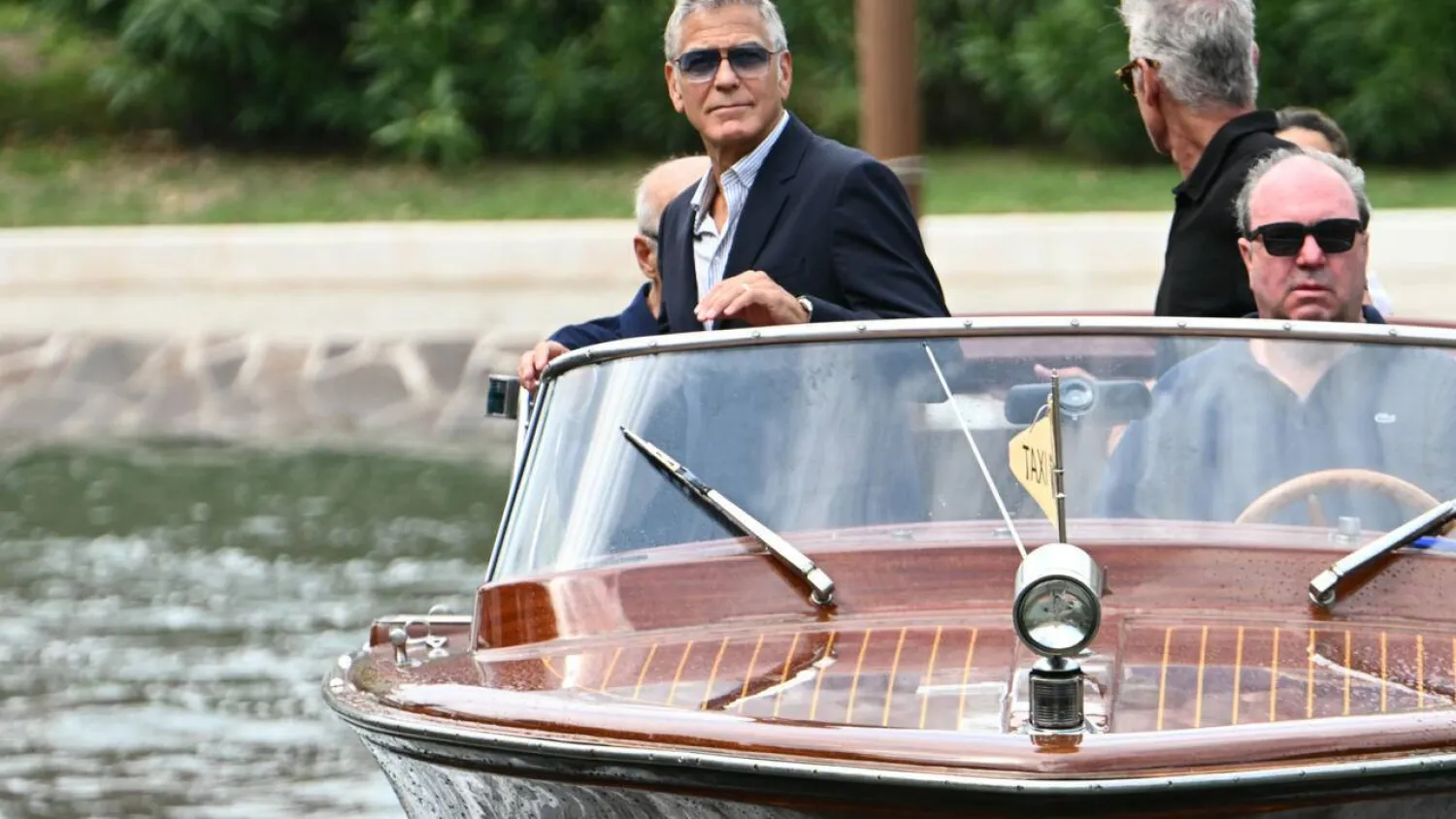
George Clooney travelling in style on Wednesday in Venice. Stefano RELLANDINI / AFP
TT

Clooney and Netflix Team Up for Venice Festival Spotlight

George Clooney travelling in style on Wednesday in Venice. Stefano RELLANDINI / AFP

Hollywood stars and Netflix are set to take the spotlight Thursday on the second day of the prestigious Venice film festival, with George Clooney, Adam Sandler and Emma Stone preparing for high-profile premieres.

The rainy skies that dampened the red carpet at Wednesday's opening night of the 11-day festival are forecast to continue, but they aren't likely to put off eager fans willing to brave the weather for a glimpse of charismatic leading man Clooney, AFP said.

The actor -- who entertained crowds in Venice alongside co-star Brad Pitt at the premiere of "Wolfs" last year -- returns to the watery city for the unveiling of the comedy "Jay Kelly" from director Noah Baumbach.

Clooney had little research to do for the role which sees him play a famous Hollywood actor, albeit one going through an identity crisis, with Sandler playing his manager.

The film is the first of three Netflix-produced features at the festival, with the heavy-hitting US streaming giant seen as desperate to find a strong contender for a first Best Picture award at the next Oscars.

Its big hope at this year's ceremony -- "Emilia Perez" -- saw its campaign for Academy Award glory derailed by a racism scandal involving leading actor Karla Sofia Gascon.

Having sat out Venice in 2024, the platform has two other productions in the 21-film top competition, "A House of Dynamite" by Oscar-winning thriller specialist Kathryn Bigelow and a star-studded remake of "Frankenstein" by Guillermo del Toro.

Adding to the Tinseltown firepower on Thursday will be "Bugonia" by Greek director Yorgos Lanthimos who has teamed up again with Stone, hoping to repeat the successful formula from 2023 when they landed Venice's top prize for "Poor Things".

In their latest collaboration, Stone plays a high-powered pharmaceutical executive kidnapped by a pair of conspiracy theorists convinced she is an alien in the zany remake of the South Korean film "Save the Green Planet!" from 2003.

Anti-war

Alongside the glitz came protest on the festival's opening day, with demonstrators near the red carpet unfurling a "Free Palestine" and "Stop the Genocide" banner to denounce Israel's war in Gaza.

A group of Italian film professionals have also called on festival organizers to openly condemn Israel's bombardment and siege of Gaza, while a larger protest is scheduled for Saturday.

The festival's artistic director, Alberto Barbera, has called the movie showcase a place of "dialogue", but has ruled out rescinding invitations to pro-Israel actors.

The festival has selected a film about the war for its main competition -- "The Voice of Hind Rajab" by Tunisian director Kaouther Ben Hania, which has the backing of Hollywood A-listers from Pitt to Joaquin Phoenix.

It will premiere next Wednesday.

Jury president Alexander Payne ("Sideways") dodged questions on Wednesday about his personal views on the war in Gaza and he questioned aloud whether films could really "change society or culture".

"I don't know. Doubtful. At least though, when we make films which are relevant to the times, we leave a document that someone was thinking about it," he said.

Elephants

German arthouse giant Werner Herzog spoke passionately about his search for "truth in unusual ways" as the acclaimed documentary maker received a lifetime achievement award during Wednesday night's opening ceremony.

"I have always tried to strive for something that goes deeper beyond what you normally see in movie theatres, a deep form of poetry that is possible in cinema," the 82-year-old told the star-studded audience in an acceptance speech.

Oscar-Winning ‘Star Wars’ Editor Marcia Lucas Dies at 80

Marcia Lucas, wife of director George Lucas, right, carries her Oscar statuette as they arrive at a post Academy Awards party at the Beverly Hilton Hotel in Los Angeles, April 4, 1978. (AP)
TT

Oscar-Winning ‘Star Wars’ Editor Marcia Lucas Dies at 80

Marcia Lucas, wife of director George Lucas, right, carries her Oscar statuette as they arrive at a post Academy Awards party at the Beverly Hilton Hotel in Los Angeles, April 4, 1978. (AP)

Marcia Lucas, who won an Oscar as editor of the original 1977 “Star Wars" and was part of a group of women whose editing was essential to film's New Hollywood era, has died, a lawyer for her family said Friday. She was 80.

Lucas, who was married to “Star Wars” creator George Lucas from 1969 to 1983, died Wednesday from metastatic cancer, attorney Deidre Von Rock said in an email to The Associated Press. She died in Rancho Mirage, California, surrounded by loved ones, Von Rock said.

Marcia Lucas was the editor on 1983's “Return of the Jedi” and the pre-“Star Wars” George Lucas-directed films “THX 1138” and “American Graffiti.”

She was also part of the editing team for director Martin Scorsese's 1970s films “Taxi Driver,” “Alice Doesn't Live Here Anymore” and “New York, New York.”

Editor was a rare senior creative position where a woman could find a foothold in Hollywood. Marcia Lucas became one of several women whose work in the editing chair made sense of the work of the overwhelmingly male directors of the New Hollywood of the late 1960s through the early 1980s, including Dede Allen, editor of “Bonnie and Clyde” and “Dog Day Afternoon”; Verna Fields, editor of “Paper Moon” and “Jaws"; and Thelma Schoonmaker, editor of most of Scorsese's films starting with 1980's “Raging Bull.”

Lucas was often called the unsung hero of “Star Wars,” the original film that after sequels, prequels and spinoffs has come to be known by its subtitle, “A New Hope.”

She convinced her then-husband that he should have Obi-Wan Kenobi, played by Alec Guinness, die in his lightsaber battle with Darth Vader and become a spirit guide to Mark Hamill's Luke Skywalker.

And she had to make sense of raw footage that could have been a mess in the wrong hands, including the climactic rebel attack on the Death Star.

“It was extremely complex and we had 40,000 feet of dialogue footage of pilots saying this and that. And she had to cull through all that, and put in all the fighting as well,” George Lucas told Rolling Stone in an interview a few months after the film came out. “Nobody really has ever tried to interweave an actual plot story into a dogfight, and we were trying to do that."

Lucas was born Marcia Griffin in Modesto, California shortly after the end of World War II. She moved to Los Angeles with her mother after her parents divorced when she was a small child.

She began working as a film librarian and moved into working as an editor on commercials, trailers and promotional films. She was an assistant editor on the documentary “Journey to the Pacific” for Fields, who also hired George Lucas, then a film student at the University of Southern California.

The couple became engaged soon after. Their marriage would essentially end in 1982, but they kept their divorce under wraps until after the release of “Return of the Jedi” in 1983. Marcia Lucas was then married to Tom Rodrigues, a production manager at the Skywalker Ranch production center, from 1983 to 1993.

She is survived by her daughters, Amanda Lucas and Amy Soper, and grandchildren Felix Hallikainen, Aeliana Hallikainen and Knox Soper.

"Her influence on film is indelible, but those who knew her best will remember the way she made life feel more vivid, more beautiful, more fun, and more full of love,” a family statement said. “Her work was known for its emotional intelligence, rhythm, and humanity — a rare ability to find the truth of a scene and bring heart, momentum, and clarity to the screen.”


The Golden Trailer Awards: Hollywood’s ‘Oscars’ for Movie Previews

The gala started in 1999 when co-founders Monica Brady and Evelyn Watters were looking for a team to produce a trailer. (Getty Images/AFP)
TT

The Golden Trailer Awards: Hollywood’s ‘Oscars’ for Movie Previews

The gala started in 1999 when co-founders Monica Brady and Evelyn Watters were looking for a team to produce a trailer. (Getty Images/AFP)

The Golden Trailer Awards, which recognize the people behind Hollywood's best-made movie previews, returned for its 26th edition Thursday.

The gala started in 1999 when co-founders Monica Brady and Evelyn Watters were looking for a team to produce a trailer, only to find that those who worked in the field were practically anonymous.

"Trailer editors, the people creating some of the most memorable moments of the moviegoing experience, were completely unrecognized," Brady told AFP.

"They weren't credited on trailers, they weren't credited in films, and there wasn't even a directory to find them."

The pair, who remain as executive producers on the award show, oversaw 19 prizes given out during the inaugural ceremony in New York.

The ceremony was held in Los Angeles and recognized achievements in more than 100 categories.

The night's most coveted statuette for Best of Show went to the trailer for sci-fi movie "Project Hail Mary", starring Ryan Gosling, which was created by Wild Card Creative Group.

But what makes one movie trailer stand out from the rest?

"What makes a great trailer, first and foremost, is a great hook," Watters said.

- 'A tempting appetizer' -

An honoree will likely have "a fresh storyline, compelling characters, an emotional moment, and something audiences haven't seen before," she explained ahead of the ceremony.

"A winning trailer is a tempting appetizer, it is not the whole meal."

Taylor Engel, a creative director at Create Advertising Group -- which received 16 nominations this year for the company's work on trailers for "Sinners,Tron: Ares" and "Only Murders in the Building" -- said editing a trailer is like putting together pieces of a puzzle.

"We get materials at the beginning of the project, and it could be anything. Sometimes you get the movie, sometimes you get just dailies, you know, just the scenes that they shot," Engel said.

The challenge lies in combining the audio, video and editing effects to "tell maybe a different story or showcase the movie in some way."

Like film editing, movie trailers have evolved over the decades in Hollywood, and the crowded marketplace for attention has led to fierce competition.

Sometimes, the trailer ends up being better than the movie itself -- something that has become its own category in the Golden Trailer Awards.

Dubbed the "Golden Fleece," this year's nominees include trailers for the horror film "Shell" starring Elisabeth Moss and "The Strangers: Chapter 3."

- No AI used -

Despite the intense competition and demand, Engel said that the work in making movie trailers is not under the same pressure to utilize artificial intelligence as other sectors of Hollywood.

"Every cut is very specific in why you pair a shot with a certain piece of music," Engel said.

AI tools "may get better at recreating what's been done in the past, but what's exciting about trailers is when you see something that you've never seen before, you see it done in a different way," the creative director said.


In ‘Pressure,’ the Story of the Meteorologist Who Helped Save D-Day

 Anthony Maras, left, director/co-writer of the film "Pressure," poses with cast members Brendan Fraser, center, and Andrew Scott on Tuesday, May 12, 2026, in Los Angeles. (AP Photo/Chris Pizzello)
Anthony Maras, left, director/co-writer of the film "Pressure," poses with cast members Brendan Fraser, center, and Andrew Scott on Tuesday, May 12, 2026, in Los Angeles. (AP Photo/Chris Pizzello)
TT

In ‘Pressure,’ the Story of the Meteorologist Who Helped Save D-Day

 Anthony Maras, left, director/co-writer of the film "Pressure," poses with cast members Brendan Fraser, center, and Andrew Scott on Tuesday, May 12, 2026, in Los Angeles. (AP Photo/Chris Pizzello)
Anthony Maras, left, director/co-writer of the film "Pressure," poses with cast members Brendan Fraser, center, and Andrew Scott on Tuesday, May 12, 2026, in Los Angeles. (AP Photo/Chris Pizzello)

D-Day was supposed to happen on June 5, 1944. The story of why it ultimately took place on June 6 is one that has been a bit lost to history, consumed by the larger events surrounding it.

One day might not seem like much in the grand scheme, but it was a seismic delay in plans for the unprecedented and daring invasion, which would deploy nearly 160,000 Allied troops in Normandy.

Ultimately it came down to a recommendation from a shrewd Scottish meteorologist, Group Capt. James Stagg, who had to tell everyone, including Gen. Dwight D. Eisenhower and the Allied leadership, something they didn’t want to hear: The weather was going to be catastrophically bad. And no, he wasn’t certain about it.

The tense 72 hours before the invasion are brought to life in "Pressure," in theaters May 29, on the eve of the operation’s 82nd anniversary. An adaptation of David Haig’s acclaimed stage play, the film sheds light on this bit of history that would effectively change the course of the second World War.

Filmmaker Anthony Maras assembled a unique group of actors for the task at hand, calling on Brendan Fraser to play Eisenhower and Andrew Scott to play Stagg.

"I didn’t think I was an Ike Eisenhower when Anthony Maras sent me the script," Fraser said. "I got on a Zoom call and he said, ‘You gotta do this man.’ Me? Why? ‘It’s because he’s you, he’s like you. He’s just a regular guy.’ Really? I mean, I thought Eisenhower was this, you know, stern, staunch, something on coin."

Fraser went deep in his preparation, reading and listening to everything he could get his hands on to help him understand the man who would ultimately have to make the decision. The research even continued on set. Maras laughed that right before they shot Eisenhower’s famous "soldiers, sailors and airmen" speech, something that they’d rehearsed many, many times, he looked up and saw Fraser reading yet another biography. But he appreciated that the Oscar-winner was passionate about knowing everything he possibly could to get it right.

"He cared intensely for his troops," Fraser said. "It was my responsibility to honor their memory and to comport myself in a way that puts a human face on the seemingly academic decisions that go into an operation as massive as this."

Scott was the opposite in terms of how he approached his role. Yes, he read Stagg’s book and wanted to have a working understanding of the metrological jargon he’d have to be spouting. While history was important, for him, character was king. And he liked that Stagg is not the most immediately likable person, but he has integrity.

"The thing with Stagg is that he’s just not interested in charm ... or being liked at all," Scott said. "I think that’s to be admired actually, because he’s just there to do a job. So I like the fact that at the beginning of the movie, you’re like, whoa, this guy is not pleasant."

Maras said that for Scott, it was all about the inner, emotional life of the character, which was essential for a part that would require so much internal conflict.

"With Andrew, he has a quality to him where he can seemingly be doing very little — he’s sitting down, rearranging his tie, he can be reading a phone book — and you can’t look away," Maras said.

In the shadow of ‘Saving Private Ryan’

The actors weren’t the only ones feeling pressure of the assignment: Maras also had a behemoth looming in attempting to stage, however briefly, the D-Day invasion.

"You’ve kind of got to be crazy maybe to attempt it, given that Spielberg did it so masterfully," Maras said.

But unlike "Saving Private Ryan," which focused on the men storming the beach, "Pressure" is about the ones making the decisions. It’s a different perspective. Still, once they make the call to go, there would have to be at least some of the operation shown to juxtapose with the "bloody tense, wire-type atmosphere of the control room," Maras said.

Inspired by Peter Jackson’s World War I documentary "They Shall Not Grow Old," and the existence of dozens of hours of pristine 35 mm black and white film from the event, Maras decided that perhaps archival footage, colorized, would be the way to go. It was a different way to present D-Day that gave it immediacy, he said, as opposed to looking like history.

Ultimately, "Pressure" isn’t just a history lesson, or even a character drama with big personalities and even bigger stakes: It’s a portrait of leadership and ego clashing with facts and science. And its relevance to the present day is the reason Maras wanted to make the film in the first place.

"How do you bring your best self to the table to make the decision? How do you have the humility to acknowledge when you don’t know something? And how do you have the wisdom to determine who to trust? ... Eisenhower in the end showed that he was a maestro at that," Maras said.

"What I love about the Stagg character is he’s someone who feels compelled to tell someone something that they don’t want to hear, that they violently don’t want to but they need to hear. The world needs more of that."

Years later, John F. Kennedy, on the way to his own inauguration, asked Eisenhower what gave them the edge on D-Day. His response? "We had better meteorologists than the Germans."

"When life or death depends on you understanding the facts, it probably has a way of like cutting up the BS and getting to it," Maras said. "It’s a very clear example of a time where the Allied worlds’ future was at stake and they listened to someone who knew what he was talking about and they did all right."