

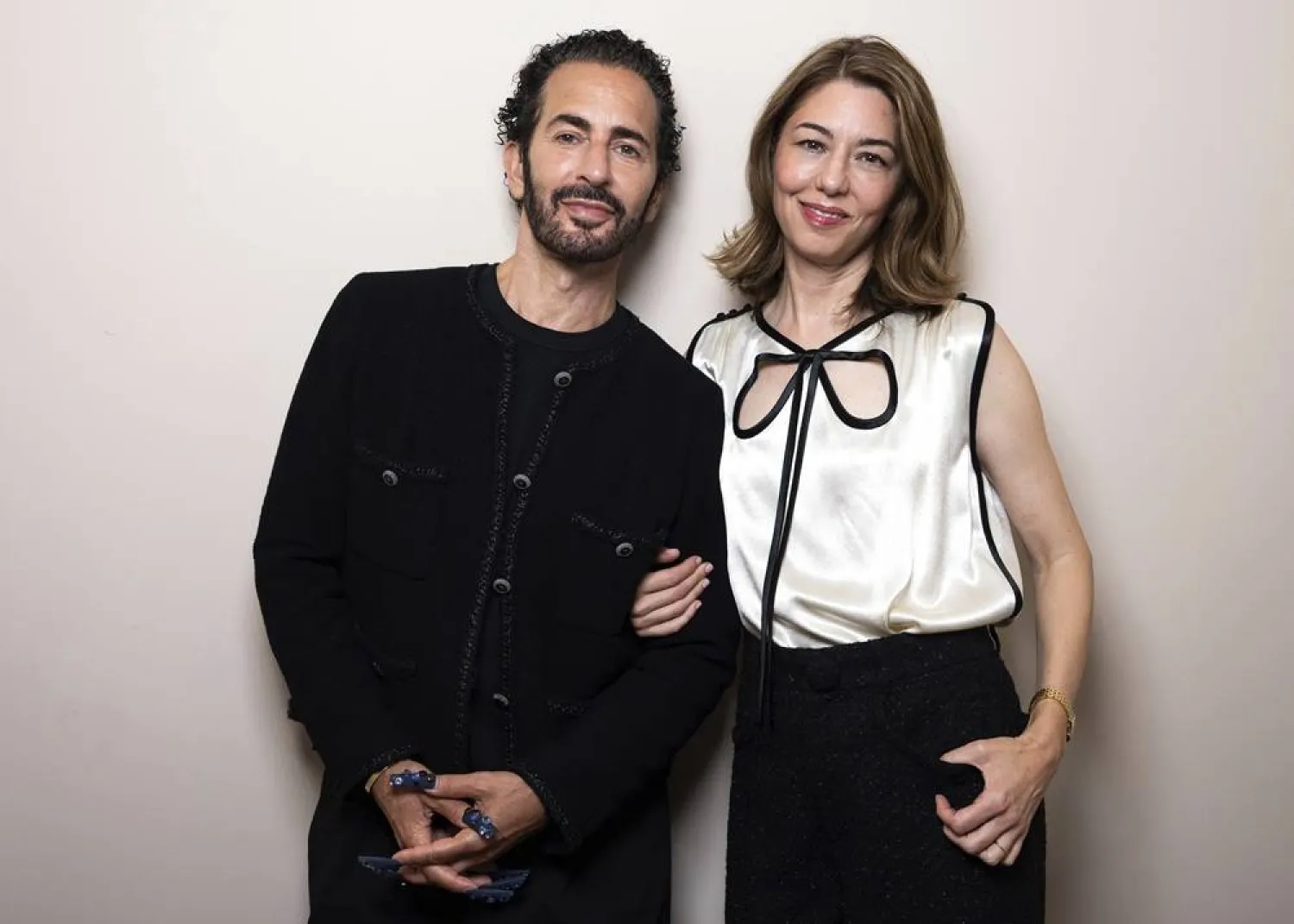

In ‘Marc, by Sofia,’ an Intimate Portrait of Fashion Luminary and Friendship

 Marc Jacobs, left, and Sofia Coppola pose for a portrait photograph for the film "Marc by Sofia" during the 82nd edition of the Venice Film Festival in Venice, Italy, on Tuesday, Sept. 2, 2025. (AP)
Marc Jacobs, left, and Sofia Coppola pose for a portrait photograph for the film "Marc by Sofia" during the 82nd edition of the Venice Film Festival in Venice, Italy, on Tuesday, Sept. 2, 2025. (AP)
TT

In ‘Marc, by Sofia,’ an Intimate Portrait of Fashion Luminary and Friendship

 Marc Jacobs, left, and Sofia Coppola pose for a portrait photograph for the film "Marc by Sofia" during the 82nd edition of the Venice Film Festival in Venice, Italy, on Tuesday, Sept. 2, 2025. (AP)
Marc Jacobs, left, and Sofia Coppola pose for a portrait photograph for the film "Marc by Sofia" during the 82nd edition of the Venice Film Festival in Venice, Italy, on Tuesday, Sept. 2, 2025. (AP)

Neither Sofia Coppola nor Marc Jacobs were convinced a documentary was a good idea. Jacobs wasn’t sure he wanted to be the subject of one and Coppola wasn’t sure she wanted the pressure of being the person behind the camera. This was her friend of over 30 years, after all. What if the film wasn’t good?

Yet the idea, which they credit to producers R.J. and Jane Cha Cutler, started to take hold. Coppola has always been interested in fashion and the creative process. Jacobs knew that if anyone could make him feel less self-conscious, it would be her. And they decided to jump into the unknown. At least it would be together.

“There was no off limits,” Jacobs said in a recent interview, alongside Coppola, with The Associated Press. “It was just like come as you are and you get what you get and that’s the way it’s going to be.”

“Marc, by Sofia,” which had its world premiere Tuesday at the Venice Film Festival, is an evocative, and very Coppola, collage of Jacobs' influences, his biography and his team at work putting together a ready-to-wear collection.

“I’ve never done anything like this where there isn’t a plan or a script,” Coppola said. “What I was trying to do is show his creative process around this one collection and then interweave inspiration and references and artists who collaborated with him to have this full portrait.”

It was a very lo-fi production, they said. Sometimes it would just be Coppola coming into the office with her own handheld camera. Sometimes her brother Roman Coppola would come to help. Coppola had never done a feature length documentary before and found the process exciting, though she said it’s not signaling a new phase or director for her as a filmmaker.

She also got to see some of the behind-the-scenes things she’s rarely privy to, including being backstage at a runway show.

“I had total freedom, which was great. I was just filming what interested me,” she said. “It was really the same as like taking snapshots, which wasn’t unfamiliar to me.”

The two met in the early 1990s in New York, when Coppola asked her mother if she could go see the Perry Ellis show that Jacobs was working on. They quickly hit it off, bonding over shared loves of art, music, fashion and movies, and have collaborated many times, on handbags, dresses, commercials and more. Jacobs has visited her film sets and even provided clothes for some of her characters, including some of the coats Scarlett Johansson wore in “Lost in Translation.”

While Coppola wanted to acknowledge their friendship, even making a little cameo in her film, she also didn’t want it to be about her or even them, necessarily. The focus would remain on Jacobs.

“I didn’t want it to be too much about me,” Coppola said. “But I wanted it to feel that it’s personal and made by me and that I’m part of it and in that way it’s not just a generic interview or portrait.”

In addition to the behind the scenes of designing the Spring 2024 ready-to-wear collection, “Marc by Sofia” is full of film and art references, with clips from “Hello, Dolly!” “All that Jazz,” “Sweet Charity” and many more of Jacobs' most beloved films. He was particularly blown away that she was able to get the rights to use the clips.

“It made me feel very special. And I couldn’t imagine all those things coming through for just anyone,” Jacobs said. “I felt like it was OK because it was for Sofia. That may not be the truth, but that’s the way I like to think of it.”

It also includes some biography, big career moments, and some rare glimpses of Jacobs’ grandmother, an influential figure in his life who he lived with as a teen in New York and who instilled in him the importance of caring for beautiful clothes.

After the runway show, Coppola and her brother visit Jacobs at his home where, in his silk pajamas, he discusses his comedown. He likes to borrow a phrase coined by his friend, filmmaker Lana Wachowski, to describe the feeling: Post-art-um.

“I just sort of just felt like it could have been any conversation,” Jacobs said. “Nothing felt like director and subject. It just felt completely easy.”

Still, Jacobs was nervous the first time she screened it for him. He worried about what he was going to look like, and sound like, and what it was going to be.

“In very typical me fashion, when it was over I said I don’t hate myself after seeing it,” Jacobs laughed. “I just thought it all felt natural. I wasn’t pretending. There was just nothing synthetic or false or anything. So whether people like it or not, I know that I just felt good about me being me and Sofia, you know, sort of seeing that her way.”



Italy's Agnona Brand: Lamb among the Fashion Wolves

Italy's Agnona Brand: Lamb among the Fashion Wolves
TT

Italy's Agnona Brand: Lamb among the Fashion Wolves

Italy's Agnona Brand: Lamb among the Fashion Wolves

At Milan Fashion Week, headlines go to splashy names, over-the-top fashions and celebrities posing by catwalks.

But behind the scenes, Italy's smaller and medium-sized brands, the often family-owned lifeblood of the industry, are doggedly defending their craft, striving to keep alive long traditions of excellence.

One of them, Agnona, began in 1953 as a wool mill in Italy's northern Piedmont region, producing luxurious textiles in natural fabrics like cashmere, lambswool and angora that supplied top haute couture houses in Paris, from Christian Dior to Givenchy to Yves Saint Laurent.

Acquired in 1999 by the Ermengildo Zegna Group, Agnona switched from textiles to apparel and was sold in 2020 to Zegna family members Stefano Aimone, the chief executive and creative director, and his father Roberto.

Agnona, which is opening its first flagship store in Milan next month, envisions a global network of owned and franchised stores in future.

Stefano Aimone sat down with AFP to explain the challenges facing smaller names amid competition from the big fashion conglomerates, changes in consumer habits and the race towards retail.

- 'Overwhelmed by demand' -

"If you want to aim for quality and certain types of craftsmanship you have to stay here in our Italian boot. But many companies have closed. Many closed because of Covid, post-Covid they were absorbed into larger groups because costs went up, prices fluctuated, they had periods of no sales -- no work at all -- followed by excess work. Financially they didn't have the reserves.

"The businesses that remain are now extremely overwhelmed by demand from the big French groups and the Italian brands.

"The problem isn't just cut-and-sew, it's also the production of materials, because everything cascades down... the dye houses that are still around are clogged up, which creates delays, and delays weaken the quality of the entire industrial process."

- 'Made in Italy' -

"I'd say 'Made in Italy' is becoming relatively less important to them (customers); the customer now identifies more with the brand itself, with its values, with what the brand represents...

"Made in Türkiye, Made in Italy, Made in France -- it can be important, but it's definitely not as important as it once was, because brands have been very active in communicating many other values they embody, which provide justification beyond geography.

"And in a way that's right, because a brand isn't just its product -- it's also what it stands for and what it does beyond the product itself."

- 'Sowing seeds' -

"We're just under 15 million euros in revenue but we expect to reach 20 million and beyond within three years.

"We still have many markets that we haven't even started talking to, for example, all of China, the entire Middle East, all of Latin America, the whole APAC region including Australia.

"Since we took over the brand, there have been years of rebuilding: not only rebuilding our premises -- the industrial site and the headquarters -- but working on the collection.

"We introduced menswear, so we focused heavily on internal work, and we didn't necessarily want to push revenue right away. Because if you go out to market without a solid product, you risk ruining everything you're trying to achieve -- it can be counterproductive.

"So those were years of sowing seeds, and now that we're ready, we're beginning to address the global market."


Stella McCartney Marks Year of the Horse with Equestrian Paris Fashion Week Show

 Models present a creation by Stella McCartney for the Women's Ready to Wear Fall/Winter 2026-2027 collection fashion show as part of the Paris Women Fashion Week, in Paris, on March 4, 2026. (AFP)
Models present a creation by Stella McCartney for the Women's Ready to Wear Fall/Winter 2026-2027 collection fashion show as part of the Paris Women Fashion Week, in Paris, on March 4, 2026. (AFP)
TT

Stella McCartney Marks Year of the Horse with Equestrian Paris Fashion Week Show

 Models present a creation by Stella McCartney for the Women's Ready to Wear Fall/Winter 2026-2027 collection fashion show as part of the Paris Women Fashion Week, in Paris, on March 4, 2026. (AFP)
Models present a creation by Stella McCartney for the Women's Ready to Wear Fall/Winter 2026-2027 collection fashion show as part of the Paris Women Fashion Week, in Paris, on March 4, 2026. (AFP)

Stella McCartney, known for her commitment to animal rights and sustainability, put horses at the center of her eponymous brand's Paris Fashion Week show set in a riding hall in Paris' Bois de Boulogne.

Five black horses and five white horses charged in and began performing an intricate equestrian choreography, walking in circles and weaving around each other, before the first ‌models emerged on ‌an oval catwalk surrounding the ‌sandy ⁠ring.

The winter 2026 ⁠collection continued the equestrian theme, with thigh-high riding boots, and suit trousers or jeans fashioned into stirrup pants and paired with bright preppy sweatshirts.

"There's a lot of new innovations in the show," McCartney told Reuters in an ⁠interview after the show. "Everything's plant-based, vegan, so ‌there are no ‌animal glues, there's no dead animals.

"That's why I always ‌like to sort of remind people and celebrate ‌and bring animals into the conversation," she added, saying the show also honored the Lunar New Year of the Horse.

Dresses and skirts covered ‌in plastic-free sequins featured hip bustles, pleats and bows, while multicolored crochet scarves ⁠provided a ⁠pop of color to tailored suits.

Stella McCartney, founded 25 years ago, became fully independent once more last year after McCartney bought the minority stake held by LVMH back from the luxury group.

A few seats down from Stella's father, former Beatle Paul McCartney, LVMH heir Antoine Arnault was among the front row guests at the show, seated next to his wife, model Natalia Vodianova.


Adidas Expects Operating Profit to Rise to 2.3 Bln Euros in 2026

An Adidas logo is seen at the new Futurecraft shoe unveiling event in New York City, New York, US, April 6, 2017. (Reuters)
TT

Adidas Expects Operating Profit to Rise to 2.3 Bln Euros in 2026

An Adidas logo is seen at the new Futurecraft shoe unveiling event in New York City, New York, US, April 6, 2017. (Reuters)

German sportswear maker Adidas on Wednesday said it expected its operating profit to increase to around 2.3 billion euros ($2.7 billion) this year, despite around a 400-million-euro impact from US tariffs and unfavorable currency developments.

Currency-neutral revenues were expected to ‌increase at ‌a high-single-digit rate in ‌2026, ⁠adding another 2 ⁠billion euros in revenue, it said in a statement, as it forecast to grow at a low-double-digit rate in North America and Greater China, among others.

It added ⁠it expected currency-neutral net ‌sales to ‌keep growing at a high-single-digit rate in ‌both 2027 and 2028, with operating ‌profit rising a mid-teens compound annual growth rate over the three-year period from 2026 to 2028.

In 2025, ‌it reported sales of 24.8 billion euros and operating profit ⁠of ⁠2.06 billion.

Management proposed a dividend increase of 40% to 2.80 euros per share for 2025.

In a separate release, Adidas proposed Nassef Sawiris as its new chairman and extended the contract of CEO Bjorn Gulden to 2030.