


Pakistan and Afghanistan Announce Eid ‘Pause’ in Hostilities

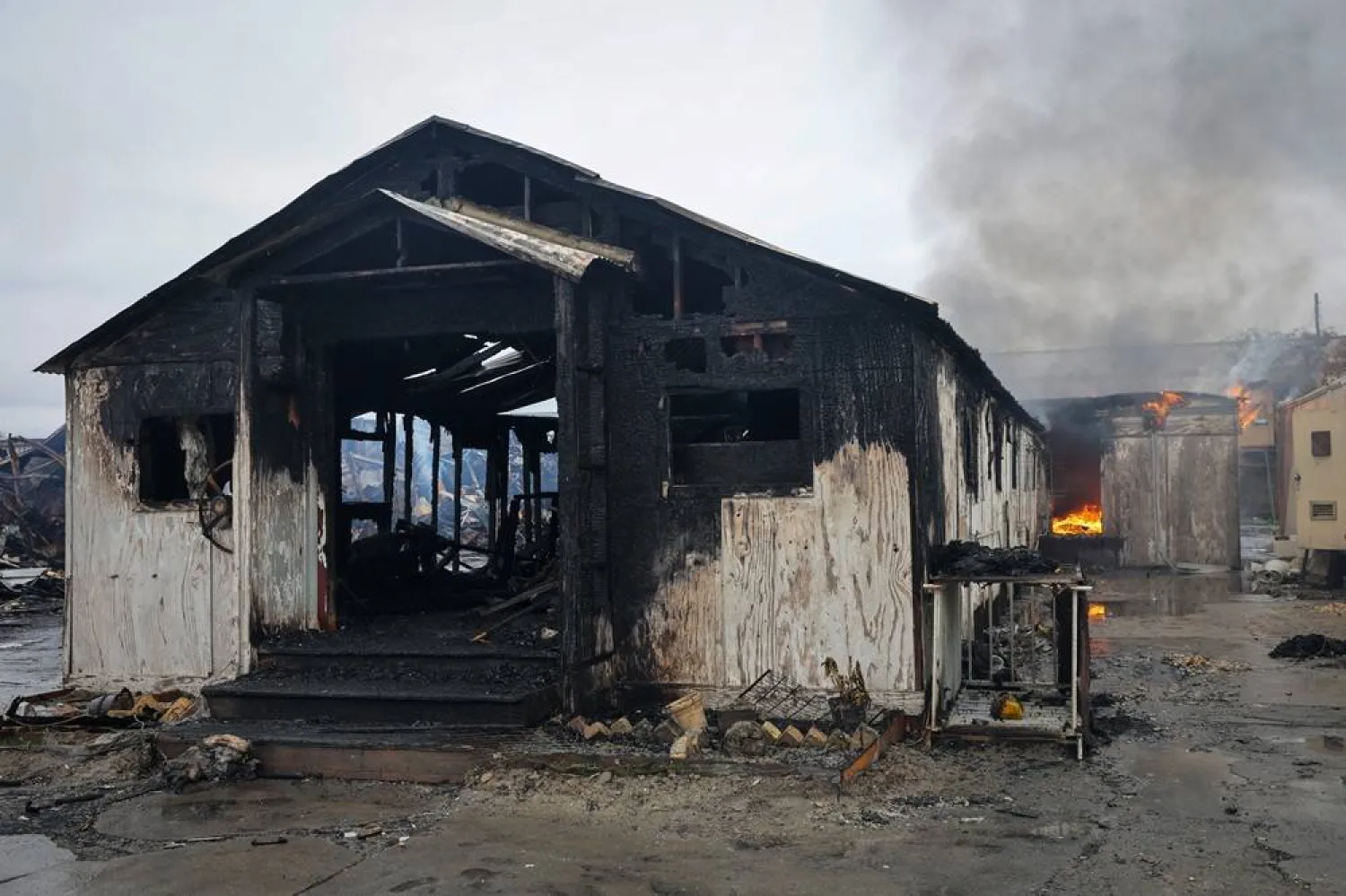
 A part of a drug rehabilitation center destroyed in what the Taliban said was a Pakistani air strike burns, in Kabul, Afghanistan, March 18, 2026. (Reuters)
A part of a drug rehabilitation center destroyed in what the Taliban said was a Pakistani air strike burns, in Kabul, Afghanistan, March 18, 2026. (Reuters)
TT

Pakistan and Afghanistan Announce Eid ‘Pause’ in Hostilities

 A part of a drug rehabilitation center destroyed in what the Taliban said was a Pakistani air strike burns, in Kabul, Afghanistan, March 18, 2026. (Reuters)
A part of a drug rehabilitation center destroyed in what the Taliban said was a Pakistani air strike burns, in Kabul, Afghanistan, March 18, 2026. (Reuters)

Pakistan and Afghanistan on Wednesday announced a halt in fighting during celebrations for the end of Ramadan, after the deadliest strike in their escalating conflict killed hundreds in Kabul earlier this week.

The governments in Islamabad and Kabul said in separate statements that Saudi Arabia, Qatar and Türkiye had requested a pause in fighting over Eid al-Fitr and both agreed.

Cross-border attacks have intensified since last month and Pakistan accuses the Taliban authorities of shielding extremists behind attacks on its territory. Afghanistan denies doing so.

On Monday night, Pakistani jets struck a drug rehabilitation center in the Afghan capital, prompting fresh calls for an immediate end to attacks and talks to end the bloodshed.

Pakistan's information minister, Attaullah Tarar, said the government agreed to a halt to its operations from Thursday to Monday "in good faith and in keeping with the Islamic norms".

Taliban government spokesman Zabiullah Mujahid said defending Afghanistan was "a national and religious obligation" and they would respond to any aggression or threat.

Tarar said: "In case of any cross-border attack, drone attack or any terrorist incident inside Pakistan, (operations) shall immediately resume with renewed intensity."

- Mass funeral -

The Taliban authorities have said that around 400 people were killed and more than 200 wounded in Monday's strike and a mass funeral was held for some of the victims on Wednesday.

Afghan Red Crescent Society volunteers carried dozens of simple wooden coffins from a fleet of ambulances to a mass grave in Kabul, dug in the rocky ground of a rainswept hillside by giant excavators.

At the graveside, Interior Minister Sirajuddin Haqqani said they were innocent victims targeted by "criminals", days before the end of the Muslim holy month.

"We will take revenge," he added and warned those behind Monday night's bombing: "We are not weak and helpless. You will see the consequences of your crimes."

But Haqqani, who until last year had a $10-million US bounty on his head, also suggested that talks were the government's preferred option to halt the fighting.

"We do not want war but the situation has come to this," he said. "So, we are trying to solve the problems through diplomacy."

Interior ministry spokesman Abdul Mateen Qani said the ceremony was for identified victims. Some had been sent back to their home provinces for burial.

Identification of other victims was still ongoing, he added.

Health ministry spokesperson Sharafat Zaman told AFP that 50 coffins had been brought to the Kabul site on Wednesday.

- Identification -

Obtaining immediate independent confirmation of exact death tolls is difficult in Afghanistan and Pakistan, with attacks often in hard-to-reach places and with conflicting information.

AFP journalists at the scene on Monday evening and Tuesday morning saw at least 95 bodies extracted from the rubble at the devastated center.

Jacopo Caridi, the Afghanistan country director for the Norwegian Refugee Council, a humanitarian NGO, said they also had teams on the ground.

"From what we saw and what we discussed with the others involved in the (emergency) response, we can say that there were hundreds of killed and wounded," he told AFP.

Recovery of bodies has proven difficult because of the debris and collapsed structures, and Caridi described the scene as "shocking", which would make identification more difficult.

"I saw a finger in one place, a foot in another place, a hand in one location. It was really horrific," said Caridi.

- Mediation stalled -

Afghanistan and Pakistan have faced calls for an immediate end to the conflict, with the overall civilian death toll mounting and concern about those displaced.

The UN said before Monday's strike that at least 76 Afghan civilians had been killed in the fighting since February 26, and that more than 115,000 people had been forced from their homes.

Mediation efforts, however, have so far proved fruitless.

China has sent a special envoy to mediate and pledged to play a "constructive role in de-escalating tensions".

Russia's special representative for Afghanistan, Zamir Kabulov, said Moscow "will be ready" to help broker talks if both sides request it.

"So far, this has not happened," he told pro-Kremlin outlet Izvestia.


Pentagon Reaches Deals with Defense Firms to Expand Munitions Production

A general view of the Pentagon in Washington, DC (AP) 
TT

Pentagon Reaches Deals with Defense Firms to Expand Munitions Production

A general view of the Pentagon in Washington, DC (AP) 

The Pentagon said on Wednesday it had reached framework agreements with BAE Systems, Lockheed and Honeywell to boost production of defense systems munitions as part of a push to put the US military on a “wartime footing.”

The ‌announcements come more than three weeks after US President Donald Trump and Israel launched a war on Iran. They also follow Trump's meeting earlier this month with executives from seven defense contractors as the Pentagon sought to replenish weapons stocks depleted by US strikes on Iran and other recent military operations.

The Pentagon also plans to send thousands of airborne troops to ⁠the Gulf to give Trump more options to order a ground assault, Reuters reported on Tuesday.

Under the agreements, Honeywell Aerospace will “surge production of critical components for America's munitions stockpile,” as part of a $500 million multi-year investment, the Pentagon said.

BAE Systems and Lockheed Martin will also quadruple production of seekers for the Terminal High Altitude Area Defense (THAAD) interceptor, while a new framework agreement with Lockheed will accelerate production of its Precision Strike Missile, the Pentagon added.

Honeywell said the agreement would support increased output of navigation systems, missile steering actuators and electronic warfare products used ‌across ⁠US military platforms.

Honeywell Aerospace CEO Jim Currier said the company was ready to help meet the urgent demand.

Lockheed Martin CEO Jim Taiclet also said the company was “working closely with the Department of War and the US Army to scale production to meet operational demand.”

Trump in January signed an executive order directing ⁠officials to identify contractors deemed to be underperforming on government contracts while continuing to return profits to shareholders. His administration has also stepped up pressure on defense companies to prioritize production over shareholder payouts.

“We discussed ⁠production and production schedules,” Trump said of the earlier meeting, which included executives from Lockheed Martin, RTX, BAE Systems, Boeing, Honeywell Aerospace, L3Harris Technologies and Northrop Grumman.

The United States has drawn ⁠down billions of dollars worth of weapons from its stockpiles since Russia invaded Ukraine in 2022, and during Israel's military operations in Gaza, including artillery systems, ammunition and anti-tank missiles.


Strikes Near Iran, Israel Nuclear Sites Risk ‘Unmitigated Catastrophe’, Says UN

 A drone view shows a damage in a residential neighborhood, following a night of Iranian missile strikes which injured dozens of Israelis, amid the US-Israel conflict with Iran, in Dimona, southern Israel March 22, 2026. (Reuters)
A drone view shows a damage in a residential neighborhood, following a night of Iranian missile strikes which injured dozens of Israelis, amid the US-Israel conflict with Iran, in Dimona, southern Israel March 22, 2026. (Reuters)
TT

Strikes Near Iran, Israel Nuclear Sites Risk ‘Unmitigated Catastrophe’, Says UN

 A drone view shows a damage in a residential neighborhood, following a night of Iranian missile strikes which injured dozens of Israelis, amid the US-Israel conflict with Iran, in Dimona, southern Israel March 22, 2026. (Reuters)
A drone view shows a damage in a residential neighborhood, following a night of Iranian missile strikes which injured dozens of Israelis, amid the US-Israel conflict with Iran, in Dimona, southern Israel March 22, 2026. (Reuters)

Strikes around Iran and Israel's nuclear sites risk unleashing an "unmitigated catastrophe", the United Nations rights chief said Wednesday, warning that the Middle East war had created an "extremely dangerous" situation.

Speaking before the UN Human Rights Council, where countries were holding an urgent debate on Tehran's attacks across the Gulf, Volker Turk warned that many of the strikes in the weeks-long war "raise serious concerns under international law".

In particular, Turk cautioned that "recent missile strikes near nuclear sites in both Israel and Iran underscore the immense danger of further escalation".

"States are flirting with unmitigated catastrophe."

His comments came after the UN nuclear watchdog said Iran had informed it that "another projectile hit the premises" of the Bushehr nuclear power plant on Tuesday, without damaging it.

Over the weekend, an Iranian strike hit the southern Israeli town of Dimona, home to a nuclear facility, in what Tehran said was in response to an earlier attack on its nuclear site at Natanz.

"The situation is extremely dangerous and unpredictable, and has created chaos across the region," Turk said, insisting that "we cannot go back to war as a tool of international relations".

The UN rights chief also warned that "this conflict has an unprecedented power to ensnare countries across borders and around the world".

"The complex dynamics could ignite further national, regional or global crises at any moment, with an appalling impact on civilians and people everywhere."


Hungary Says Will Phase Out Gas Deliveries to Ukraine

Hungarian Prime Minister Viktor Orban speaks during an assembly of European far-right parties with Orban’s Patriots for Europe group, in Budapest, Hungary, Monday, March 23, 2026. (AP)
TT

Hungary Says Will Phase Out Gas Deliveries to Ukraine

Hungarian Prime Minister Viktor Orban speaks during an assembly of European far-right parties with Orban’s Patriots for Europe group, in Budapest, Hungary, Monday, March 23, 2026. (AP)

Hungary's prime minister said on Wednesday that Budapest would phase out gas deliveries to Ukraine, the latest salvo in a bitter feud between the two countries over a damaged pipeline transporting Russian oil. 

Hungarian Prime Minister Viktor Orban, whose country is a major gas supplier to Ukraine, has accused Kyiv of delaying repairs on the pipeline, effectively stopping the flow of Russian oil to Hungary and its neighbor Slovakia. 

"To break the oil blockade and guarantee the security of Hungary's energy supply, new measures are now necessary," Orban said in a video posted on Facebook. 

"We are gradually halting gas shipments from Hungary to Ukraine and storing the gas that remains here domestically. Until Ukraine supplies oil, it will receive no gas from Hungary," he added. 

Ukrainian authorities have said that the Druzhba (Friendship) pipeline, which crosses its territory, was damaged by Russian airstrikes on January 27. 

Hungary and Slovakia, which have obtained exemptions from the European Union to continue purchasing Russian oil, accuse Kyiv of dragging their feet to repair it. 

In retaliation, Orban -- who is facing crucial parliamentary elections next month -- is blocking a European loan of 90 billion euros ($104 billion) to Ukraine. 

Last week, European Commission President Ursula von der Leyen announced that the EU would help reopen the Druzhba pipeline. 

Budapest and Bratislava are also blocking the official adoption of new economic sanctions against Russia, endorsed by other EU countries. 

According to analysts at the pro-government Hungarian Economic Research Foundation (Oeconomus), Hungary has become one of Ukraine's main gas suppliers. 

Ukraine imported 2.94 billion cubic meters of gas from Hungary in 2025, the top source for Ukrainian imports, accounting for 45.5 percent of all Ukrainian imports, Ukrainian consultancy ExPro said in a report. 

ExPro said separately that Ukraine's imports from Hungary were already slightly dropping as a share in 2026, down to 34 percent of Ukraine's import mix in March 2026. 

Ukraine's total gas consumption in 2025 was 21 billion cubic meters, the Dixi group consultancy said in a report in March, meaning Hungary accounted for 14 percent of Ukraine's total gas use in 2025.
