
Former Spy Chief and Assad’s Cousin Plot Syrian Uprisings from Russia

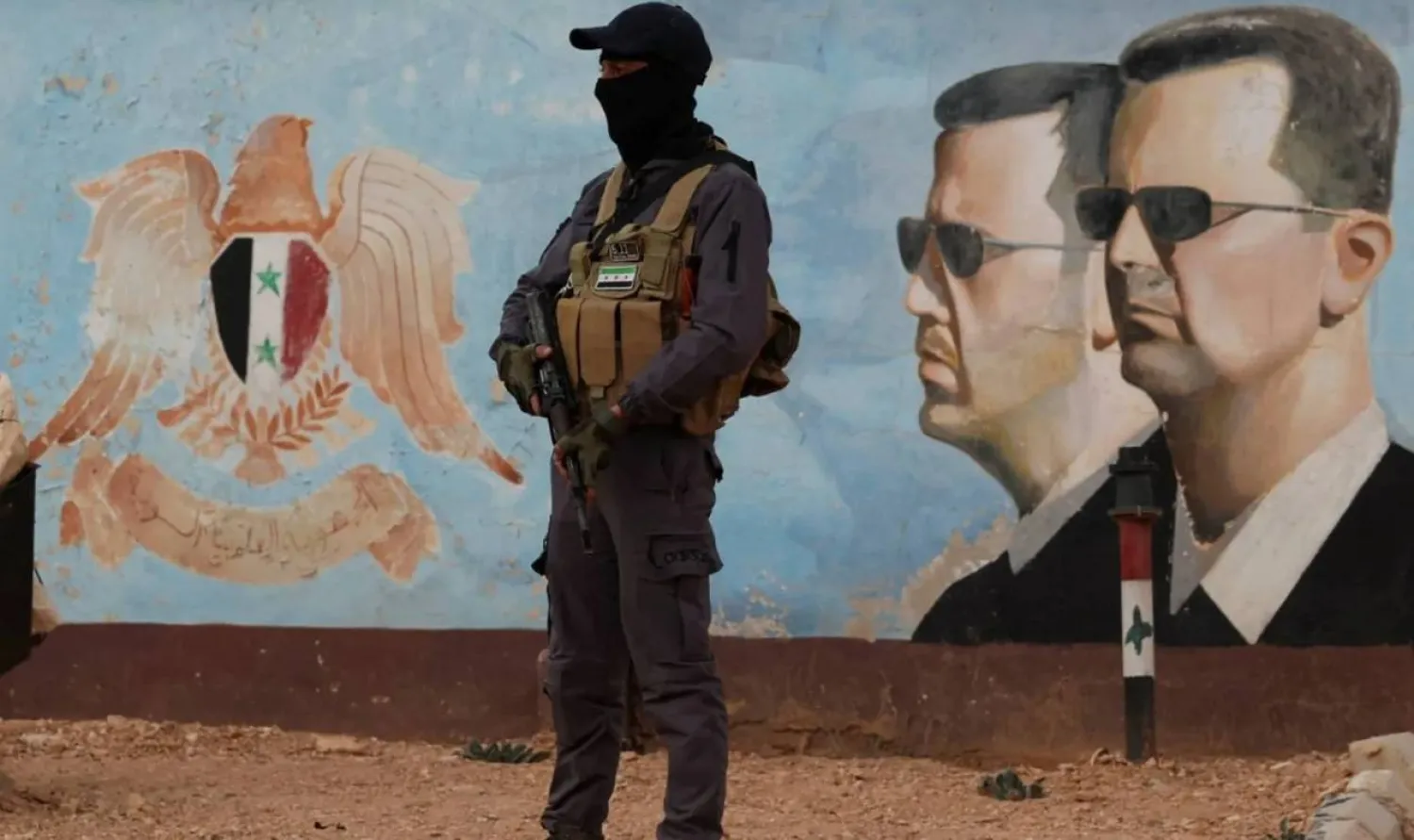
A member of Hayat Tahrir al-Sham stands guard near an image of Syria's Bashar al-Assad at the fourth division headquarters in Damascus, Syria, January 23, 2025 (Reuters)
TT

Former Spy Chief and Assad’s Cousin Plot Syrian Uprisings from Russia

A member of Hayat Tahrir al-Sham stands guard near an image of Syria's Bashar al-Assad at the fourth division headquarters in Damascus, Syria, January 23, 2025 (Reuters)

Two former loyalists to Bashar al-Assad who fled Syria after his fall are funneling millions of dollars to tens of thousands of potential fighters, hoping to stir uprisings against the new government and reclaim some of their lost influence, a Reuters investigation has found.

Assad, who escaped to Russia last December, is largely resigned to exile in Moscow, say four people close to the family. But other senior figures from his inner circle, including his brother, have not come to terms with losing power.

Reuters found that two of the men once closest to Assad, Maj. Gen. Kamal Hassan and billionaire Rami Makhlouf, are competing to form militias in coastal Syria and Lebanon made up of members of their minority Alawite sect, long associated with the Assad family.

All told, the two men and other factions jostling for power are financing more than 50,000 fighters in hope of winning their loyalty.

Assad’s brother, Maher, who is also in Moscow and still controls thousands of former soldiers, has yet to give money or orders, said the four people close to the Assads.

One prize for Hassan and Makhlouf is control of a network of 14 underground command rooms built around coastal Syria toward the end of Assad’s rule, as well as weapons caches.

Two officers and a Syrian regional governor confirmed the existence of these concealed rooms, details of which appear in photos seen by Reuters.

Hassan, who was Bashar’s military intelligence chief, has been tirelessly making calls and sending voice messages to commanders and advisors. In them, he seethes about his lost influence and outlines grandiose visions of how he would rule coastal Syria, home to the majority of Syria’s Alawite population and Assad’s former powerbase.

Makhlouf, a cousin of the Assads, once used his business empire to fund the ousted President during the civil war, only to run afoul of his more powerful relatives and wind up under years of house arrest. He now portrays himself in conversations and messages as a messianic figure who will return to power after ushering in an apocalyptic final battle.

Hassan and Makhlouf did not respond to requests for comment for this report. Bashar and Maher Assad couldn’t be reached. Reuters also sought comment from the Assad brothers through intermediaries, who didn’t reply.

From their exiles in Moscow, Hassan and Makhlouf envision a fractured Syria, and each wants control of the Alawite-majority areas.

Both have spent millions of dollars in competing efforts to build forces, Reuters found. Their deputies are located in several countries.

To counter the plotters, Syria’s new government is deploying another former Assad loyalist – a childhood friend of new President Ahmed al-Sharaa who became a paramilitary leader for Assad and then switched sides mid-war after the ousted President turned against him. The task of that man, Khaled al-Ahmad, is to persuade Alawite ex-soldiers and civilians that their future lies with the new Syria.

Details of the scheming are based on interviews with 48 people with direct knowledge of the competing plans. All spoke on condition of anonymity.

Reuters also reviewed financial records, operational documents, and exchanges of voice and text messages.

The governor of the coastal region of Tartous, Ahmed al-Shami, said Syrian authorities are aware of the outlines of the plans and ready to combat them. He confirmed the existence of the command-room network as well, but said it has been weakened.

“We are certain they cannot do anything effective, given their lack of strong tools on the ground and their weak capabilities,” al-Shami told Reuters in response to questions about the plotting.

The Lebanese Interior Ministry and the Russian Foreign Ministry did not respond to requests for comment. A UAE official said its government is committed to preventing the use of its territory for “all forms of illicit financial flows.”

For now, the prospects of a successful uprising seem low.

Chief plotters Hassan and Makhlouf are virulently at odds with one another.

Their hopes are fading to win backing from Russia, once Assad’s most powerful political and military supporter. Many Alawites in Syria, who also suffered under Assad, mistrust the pair. And the new government is working to stymie their plans.

In a brief statement in response to the Reuters findings, the government’s Alawite point man al-Ahmad said the “work of healing – of uprooting sectarian hatred and honoring the dead – remains the only path toward a Syria that can live with itself again.”

Hassan claims control of 12,000 fighters, while Makhlouf claims control of at least 54,000, according to their factions’ internal documents. Commanders on the ground said fighters are paid a pittance and taking money from both sides.

The exiles don't appear to have mobilized any forces yet. Reuters could not confirm the fighter figures or determine specific action plans. Tartous governor Al-Shami said potential fighters numbered in the tens of thousands.

In interviews, the people closest to the plotters said they’re aware that tens of thousands of Syrian Alawites could face violent retribution if they implement their plans against the new leadership.

In March, nearly 1,500 civilians were killed across the Mediterranean coast by government-affiliated forces after a failed uprising in an Alawite town.

Both Hassan and Makhlouf promise to protect Syria’s Alawites from the insecurity that has continued since March, including near-daily killings and kidnappings.

Neither Makhlouf nor Hassan were behind the protests, but rather a cleric who opposes both men and publicly called on people to demonstrate peacefully.

Makhlouf attacked the cleric the next day in a social media post, saying, “all these movements will only bring calamity, for the time is not yet right.”
One of Hassan’s top military coordinators told Reuters that fighting is the only way to restore Alawite dignity.

“We are lucky that only this number of our people have died so far,” said the coordinator, a former Assad-era military intelligence officer who is now in Lebanon. “Perhaps thousands more will die, but the sect must offer up sacrificial lambs” to defend the community.

According to January 2025 documents seen by Reuters, Assadist forces drew up initial plans to build a paramilitary force of 5,780 fighters and supply them from the subterranean command rooms. These are essentially large storerooms equipped with arms, solar power, internet, GPS units and walkie-talkies.

Nothing came of that early plan, and the command rooms – along a spine in coastal Syria about 180 kilometers from north to south – remain operational but essentially idle, according to two people with knowledge of them and photos seen by Reuters.

One photo showed a room with five stacked crates, three of which were open to reveal a collection of AK-47s, ammunition and hand grenades. The room also held three desktop computers, two tablets, a set of walkie-talkies, and a power bank. In the center was a wooden table topped with a large map.

For the plotters, “this network is Treasure Island, and they are all boats trying to reach it,” said one of the people, a commander who monitors the readiness of the rooms.

Al-Shami, the Tartous governor, said the network is real but poses little danger.

As senior military officials and ranking government figures escaped abroad in December 2024, many mid-level commanders remained in Syria. Most fled to the coastal regions dominated by Alawites, a Muslim minority that makes up a little over 10% of Syria’s population.

Those officers started recruiting fighters, according to a retired commander involved in the effort.

“The most fertile ground was the military,” the retired commander said. “Thousands of young men from the sect had been conscripted into the army, which was dissolved in December, and they suddenly found themselves exposed.”

Then came the failed uprising on March 6. An Alawite unit operating independently ambushed security forces from the new Syrian government in rural Latakia, killing 12 men and capturing more than 150, according to a brigadier general who was involved with the ambush and has since left for Lebanon.

The new Syrian government says hundreds of its security forces died in the fighting that followed – a claim largely echoed by the pro-Assad fighters.

The brigadier general said 128 pro-Assad forces died in the uprising, which was quelled by the new government. The insurgency sparked reprisals that killed nearly 1,500 Alawites.

The Assadist exiles neither started nor commanded the uprising, according to the officers who were there, but those days marked a turning point. They began to organize.

An Assad Family Feud
It was on March 9 that Makhlouf started calling himself “The Coast Boy,” declaring in a statement that he had been entrusted with a divine mission to help Alawites. “I’m back, and blessed be the return,” the statement read. It did not mention that he was in Moscow.

Makhlouf dominated Syria’s economy for more than two decades, with holdings estimated by the British government at well over a billion dollars in industries as varied as telecoms, construction and tourism. He used his money to fund Syrian army units and allied militias during the civil war, which broke out in 2011.

When Assad’s victory seemed assured in 2019, Makhlouf publicly claimed credit. Soon after, Assad seized Makhlouf’s businesses, ostensibly because they were indebted to the state, and put him under years of house arrest.

Makhlouf escaped to Lebanon in an ambulance the night of December 8, 2024, as Damascus fell to Sharaa’s rebels.

Makhlouf’s brother Ehab also tried to flee that night in his Maserati, but was shot to death near the border and robbed of millions of dollars he was carrying in cash, according to four close associates of the family and a customs officer with direct knowledge of the events. Reuters could not independently verify the events of that night.

Makhlouf now lives on a private floor in a luxurious Radisson hotel in Moscow under tight security, according to nine aides and relatives.

The Radisson in Moscow and group headquarters in Brussels did not respond to a request for comment.

According to Makhlouf’s Facebook posts and WhatsApp messages to associates, he believes God gave him money and influence so he can play a messianic role in a prophecy involving the battle of Armageddon in Damascus.
In his interpretation, the apocalypse will arrive after the end of US President Donald Trump’s term.

Using trusted business administrators three countries, Makhlouf is transferring money to Alawite officers for salaries and equipment, according to a financial manager and receipts and payroll tables seen by Reuters.

The documents show the money is funneled through two prominent Syrian officers who reunited with Makhlouf in Moscow: Suhail Hassan and Qahtan Khalil, who both held the rank of major general. Hassan and Khalil claimed to have created a force for Makhlouf totaling what they said were 54,053 willing fighters, including 18,000 officers, organized into 80 battalions and groups in and around the cities of Homs, Hama, Tartous and Latakia.

Many rank-and-file soldiers conscripted under Assad, however, gave up fighting when his government fell.

Hassan and Khalil didn’t reply to requests for comment about their role in transferring money.

An UAE official said the government maintains strict oversight over its economic sectors and fully “supports Syria’s efforts to safeguard its security, stability, and sovereignty over all territories.’

One of his financial managers told Reuters that Makhlouf has spent at least $6 million on salaries. Payroll tables and salary receipts created by financial aides to Makhlouf in Lebanon claimed he spent $976,705 in May, and that one group of 5,000 fighters received $150,000 in August.

The total force numbers are real, according to five leaders of military groups in Syria who are on Makhlouf’s payroll and lead about a fifth of his following. But Makhlouf’s funding falls short of their needs, amounting to just $20 to $30 a month per fighter.

In addition, Makhlouf’s staff has sought to provide weapons. They have mapped the possible location of dozens of caches hidden during the Assad era totaling a few thousand firearms, according to schematics Reuters viewed.

These stockpiles are separate from the hidden command rooms.

They have also been in discussions with smugglers in Syria for new weapons.

People familiar with the discussions said they didn’t know if new weapons were actually purchased or delivered.

Altogether, the five local military leaders said they command about 12,000 men in various stages of readiness. One of them told Reuters the time wasn’t yet right for action.

Another of the five commanders derided Makhlouf as trying to buy loyalty with “crumbs of money.”

All five said they had accepted money from both Makhlouf and Hassan, the spy chief. They saw no issue with overlapping paymasters.

Mass Grave and Hiding Atrocities
Hassan ran the Assad dictatorship’s military detention system, which was notorious for extorting money at scale from prisoners’ families, according to a 2024 United Nations report about the system.

A Reuters investigation this year found it was Hassan who proposed moving a mass grave containing thousands of bodies in 2018 to the Dhumair desert outside Damascus to hide the scope of the Assad government atrocities.

With Assad’s fall, Hassan took refuge in the Russian embassy in December 2024 for nearly two weeks.

He was infuriated at what he perceived as ill-treatment by his hosts, who provided a single room with just one hard chair to sit on, according to two people close to him.

“Kamal Hassan is not one to sit on a wooden chair for days!” he said in one WhatsApp voice message to his inner circle from this spring, reviewed by Reuters.

Hassan ultimately took up residence in a three-story villa in suburban Moscow, according to an officer who met him over the summer.

Since then, he has seen Maher al-Assad once and maintains close ties with Bashar’s Russian protectors, according to the two people aware of Hassan’s movements.

According to Hassan’s operations coordinator in Lebanon, Hassan has spent $1.5 million since March on 12,000 fighters in Syria and Lebanon.

“Be patient, my people, and don’t surrender your arms. I am the one who will restore your dignity,” he said in another WhatsApp voice message from April that appeared aimed at commanders. Two recipients confirmed the message was from him.

In mid-year, a charity called the “Development of Western Syria” announced its creation and said it was funded by “the Syrian citizen Maj. Gen. Kamal Hassan,” according to one of its initial Facebook posts.

Three officers linked to Hassan and a manager in the organization described it as a humanitarian cover so Hassan could build influence among Alawites.

In August, the charity paid $80,000 to shelter 40 Syrian Alawite families, according to an announcement of its first action. That same month, Hassan sent $200,000 in cash to 80 officers in Lebanon, according to a payroll document seen by Reuters.


What Safe Havens Remain for the Islamic Jihad?

The late Iranian Supreme Leader Ali Khamenei receives the late «Hamas» leader Ismail Haniyeh and the leader of the «Jihad» movement, Ziad al-Nakhala, in Tehran, July 2024 (AFP)
TT

What Safe Havens Remain for the Islamic Jihad?

The late Iranian Supreme Leader Ali Khamenei receives the late «Hamas» leader Ismail Haniyeh and the leader of the «Jihad» movement, Ziad al-Nakhala, in Tehran, July 2024 (AFP)

The US-Israeli war against Iran has reshaped the landscape for Palestinian factions aligned with Tehran, with the Palestinian Islamic Jihad among the most affected. The group has faced financial and security setbacks in both Syria and Lebanon, even as fighting continues in the Gaza Strip.

Sources in the movement told Asharq Al-Awsat that the regional security changes and the war against Iran have further complicated the organization’s remaining safe havens.

While Hamas maintains close ties with Tehran, Islamic Jihad’s relationship with Iran runs deeper. The connection dates back to the group’s founding in the 1980s by Fathi Shaqaqi.

For decades, Islamic Jihad maintained a military and human presence in both Syria and Lebanon, gaining additional protection as Iranian influence expanded in the two countries over the past ten years.

However, the assassination of Ismail Haniyeh, the head of Hamas’ political bureau, in Tehran in July 2024, followed by an attempted attack on Hamas leaders in Doha in September, served as a major warning to Palestinian faction leaders, particularly Islamic Jihad.

Three countries

According to sources in the group, Secretary-General Ziad al-Nakhalah has sharply reduced his visits to Iran, traveling there only three times since Haniyeh’s assassination. One visit involved a joint delegation from Islamic Jihad and Hamas and lasted several days, while the other two were brief.

Previously, Nakhalah and several senior figures — particularly Akram al-Ajouri, who oversees the group’s armed wing, the Al-Quds Brigades — considered Iran a key safe haven, along with other capitals, such as Beirut. In recent years, however, the group has also expanded its contacts with Qatar and strengthened ties with Egypt.

A source close to Nakhalah said the leader has recently been moving between Doha and Cairo, staying for extended periods, especially in Doha, where his deputy Mohammed al-Hindi is based almost permanently.

Hindi also travels between Qatar, Egypt and Türkiye, with his role in Egypt largely focused on Gaza-related discussions with Egyptian intelligence officials.

Sources declined to confirm whether Ajouri, who had been based in Beirut’s southern suburbs in recent years, has left the area because of security concerns.

Israel recently killed Adham al-Othman, a commander in the Al-Quds Brigades in Lebanon, in a strike on an apartment used by Hezbollah in Beirut’s southern suburbs. He was known to be close to Ajouri.

Pressure in Syria

Israel had already tightened pressure on the Islamic Jihad in Syria before the fall of Bashar al-Assad’s government. A November 2024 airstrike on a group facility in Damascus killed senior figures Abdul Aziz al-Minawi and Rasmi Abu Issa, along with other members.

After the regime’s collapse in December 2024, the pressure intensified. Syria’s new authorities arrested the Islamic Jihad’s representative in the country, Khaled Khaled, and his deputy Abu Ali Yasser in April 2025, holding them for several months.

Movement sources say many of its members in Syria were detained and later released, with interrogations focusing on their weapons and where they were stored.

Some Israeli strikes in recent months have also targeted senior operatives, including field commanders in the Al-Quds Brigades who had previously been wounded in Gaza and remained in Damascus for treatment.

Facing continued Israeli pressure, some Islamic Jihad activists have relocated from Syria to Lebanon or Türkiye. Others have joined Hezbollah fighters in southern Lebanon.

All of this comes as the Islamic Jihad faces a severe financial crisis. Iranian support has largely stopped, affecting salary payments for fighters and limiting the group’s operational budgets both inside Gaza and abroad.


Syrians on Alert to Prevent Accommodation of Displaced Hezbollah Supporters from Lebanon

 Syrians living in Lebanon wait outside the Ministry of Interior Immigration and Passports Department, at the Syrian-Lebanese border, as they return to Syria due to ongoing hostilities between Hezbollah and Israeli forces, amid the US-Israeli conflict with Iran, in Jdaydet Yabous, Syria, March 3, 2026. (Reuters)
Syrians living in Lebanon wait outside the Ministry of Interior Immigration and Passports Department, at the Syrian-Lebanese border, as they return to Syria due to ongoing hostilities between Hezbollah and Israeli forces, amid the US-Israeli conflict with Iran, in Jdaydet Yabous, Syria, March 3, 2026. (Reuters)
TT

Syrians on Alert to Prevent Accommodation of Displaced Hezbollah Supporters from Lebanon

 Syrians living in Lebanon wait outside the Ministry of Interior Immigration and Passports Department, at the Syrian-Lebanese border, as they return to Syria due to ongoing hostilities between Hezbollah and Israeli forces, amid the US-Israeli conflict with Iran, in Jdaydet Yabous, Syria, March 3, 2026. (Reuters)
Syrians living in Lebanon wait outside the Ministry of Interior Immigration and Passports Department, at the Syrian-Lebanese border, as they return to Syria due to ongoing hostilities between Hezbollah and Israeli forces, amid the US-Israeli conflict with Iran, in Jdaydet Yabous, Syria, March 3, 2026. (Reuters)

Syrians in Damascus, its countryside, and western Homs countryside are on alert to prevent displaced Lebanese supporters of Hezbollah from entering Syrian territory or being hosted by locals.

The stance marks a sharp departure from previous Israeli wars on Lebanon, when Syrian cities received tens of thousands of Lebanese fleeing the fighting.

As Israel broadened its strikes in the region to include Hezbollah, not just Iran, displacement from southern Lebanon and Beirut's southern suburbs has resumed. This time, however, those fleeing include not only Lebanese but also Syrians who had been living as refugees in Lebanon.

The scene in and around Damascus appears markedly different from past years. No private cars carrying Lebanese displaced people have been seen in the capital Damascus and its outskirts, unlike during earlier Israeli wars on southern Lebanon under the rule of ousted leader Bashar al-Assad.

In previous waves of displacement, tens of thousands of Lebanese fled to Damascus. Some stayed in hotels, others rented apartments, while a small number were housed in shelters.

The same pattern now applies to Eastern Ghouta. Hezbollah and Iran had turned the area into a strategic rear base while fighting alongside Assad's government during the years of the Syrian uprising.

Hezbollah also housed large numbers of fighters' families there during its war with Israel.

Omar Mohammad Safi, known as Abu Firas, from the town of Beit Sahm in Eastern Ghouta, said the town has not seen the arrival of any Lebanese during the current war, whether Hezbollah supporters or others.

“When Israel attacked Hezbollah the last time, large numbers of fighters' families came and stayed in homes the party had seized in Ghouta, Sayeda Zeinab and elsewhere, but in this war, we have not seen any of them at all in any town,” he told Asharq al-Awsat.

Over the past two days, activists circulated a statement purportedly issued by residents of Damascus and its countryside, especially Eastern Ghouta, warning against renting property to or hosting strangers from southern Lebanon, or Lebanese individuals or families, particularly those linked to Hezbollah.

The statement said Hezbollah, during its support for the former regime, had “committed crimes and massacres,” adding: “We will not forget the massacres of Eastern Ghouta and the chemical massacre.

“Whoever dared to kill us and gloat over us will have no place among us, and we will expel him from the area immediately, along with anyone who shelters him, by all means,” it warned.

During the war in Syria, Hezbollah turned the western Qalamoun area in the Damascus countryside, adjacent to Lebanon's Bekaa region, into a strategic regional rear base.

During the previous war with Israel, the area also hosted tens of thousands of displaced people from Beirut's southern suburbs and southern Lebanon, with facilitation from Assad's government.

But Mahmoud Qusaibiya, known as Abu Alaa, from the town of Jarjir in western Qalamoun, said the town has not seen the arrival of any displaced Lebanese Hezbollah supporters.

“A warning was circulated by elders and prominent figures telling residents not to receive anyone from Hezbollah or their families, because we supported the revolution and they stood with the former government and its remnants,” he told Asharq al-Awsat.

The clearest development has been in the city of Qusayr in western Homs countryside, which Hezbollah seized during the Syrina war.

Rashid Jammoul, known as Abu Mohammad, who comes from the city, said Syrians at the border with Lebanon around Qusayr were on high alert to prevent Hezbollah members, their families, or people linked to them from entering Syrian territory.

“There have been some attempts, but there is an alert by the army and by residents at all legal and illegal crossings,” the man in his sixties told Asharq al-Awsat.

“We will not allow any of them or anyone linked to them to enter or be received after they committed massacres against us, destroyed our villages, and burned our homes.”

Since Israel launched its new war on southern Lebanon, more than 25,000 Syrians have returned to their country.

Syria’s General Authority for Ports and Customs denied that families of Hezbollah members were among those arriving from Lebanon.

Mazen Alloush, director of relations at the authority, said two days ago that since the first day families began fleeing from Lebanon to Syria, social media had been flooded with rumors claiming that families of Hezbollah fighters and supporters were entering Syrian territory through border crossings.

As the rumors spread, some buses leaving the Jousieh border crossing were stopped by young men in the city of Qusayr and attacked on that pretext.

Seeking to clarify the situation, Alloush said all the passengers on those buses were Syrians who had been living in Lebanon and who came from different Syrian provinces.

He said they had entered the country legally.


This Is How Ukraine Has Countered Russia’s Iran-Designed Drones

An Iranian Shahed exploding drone launched by Russia flies through the sky seconds before it struck buildings in Kyiv, Ukraine, on Oct. 17, 2022. (AP)
TT

This Is How Ukraine Has Countered Russia’s Iran-Designed Drones

An Iranian Shahed exploding drone launched by Russia flies through the sky seconds before it struck buildings in Kyiv, Ukraine, on Oct. 17, 2022. (AP)

Ukraine is preparing to dispatch military drone specialists to Gulf states to help them fend off Iranian-designed drones -- something the Ukrainian army has been doing since the start of Russia's invasion.

The military assault launched in February 2022 spawned a cat-and-mouse game of aerial drone warfare that has forced both sides to constantly innovate -- or perish.

Moscow has dramatically scaled-up the production and sophistication of its drones, based on Iranian-designed Shaheds drones that Tehran has launched at Israel and Gulf states over the last week.

That has forced Ukraine to develop cheap and versatile defense systems that allows it to down hundreds of drones in a single barrage -- experience Kyiv says is unmatched anywhere in the world.

- Interceptors vs Shaheds -

Private Ukrainian arms companies have spearheaded the development of drone interceptors -- cheap, light single-use drones that are designed to knock Russian unmanned aerial vehicles out of the sky.

The interceptors -- usually winged or propeller-like helicopters -- are mainly controlled with inbuilt cameras that beam real-time images to pilots on the ground.

Late last year, President Volodymyr Zelensky released grainy, black-and-white images recorded from interceptors as they crashed into Shaheds. He has instructed manufacturers to produce up to 1,000 a day.

This method of air defense is becoming increasingly prevalent: Ukraine's commander-in-chief Oleksandr Syrsky said this week that some 70 percent of all drones launched by Russia at Kyiv and its surrounding region in February were downed by interceptors.

Individual interceptors can cost around as little as $700 or as much as $12,000. But even the most expensive varieties are a fraction of the price of a single missile fired from US Patriot air defense batteries, which are estimated to cost more than $1 million.

"The warfare shifted a lot. First it was drones against humans, soldiers and tanks. Now it's mostly drones against drones," Konstantyn, a deputy commander of an anti-aerial unit deployed in eastern Ukraine recently explained to AFP.

- Anti-aircraft guns, pick-ups -

Ukrainian air defense units also deploy traditional, tried-and-tested weapons: anti-aircraft guns.

These come both in the form of heavy machine guns set on wheels, and make-shift solutions, where troops attach any high-caliber weapon they have onto the back of a pick-up truck.

AFP journalists in Kyiv have seen -- and heard -- these air defense units work during nighttime Russian attacks.

Ukrainian troops also deploy man-portable air-defense systems: guided surface-to-air missiles that are shoulder-launched and originally designed to take down low flying aerial targets.

These portable weapons are used alongside tracking and radar systems.

- F-16s, choppers, Yaks -

Ukraine lobbied its Western allies for supplies of advanced fighter jets for months before finally receiving its first batch of F-16s in mid-2024.

Kyiv has not received many F-16s and there have been reports of issues in training Ukrainian pilots but they are among the aerial arsenal that Ukraine uses to down Shaheds.

The Ukrainian air force also deploys ageing Soviet-era aircraft to down Russian drones, including helicopters like the Mi-24 and Mi-8 or the Yak-52 plane.

- Electronic jamming -

Ukraine has for years deployed a variety of electronic systems that disorientate the navigation systems used by Shaheds to lock onto and fly towards their targets.

By scrambling the networks used by Shaheds inside Ukraine's borders, these means of electronic warfare force Moscow's drones to alter their course and fly back towards Russia.

According to Ukraine air force data, the military has been consistently intercepting or shooting down more than 80 percent of all incoming Russian drones -- hundreds of which are fired every night.