
NATO's Ability to Deter Russia Has Taken a Hit with Trans-Atlantic Infighting

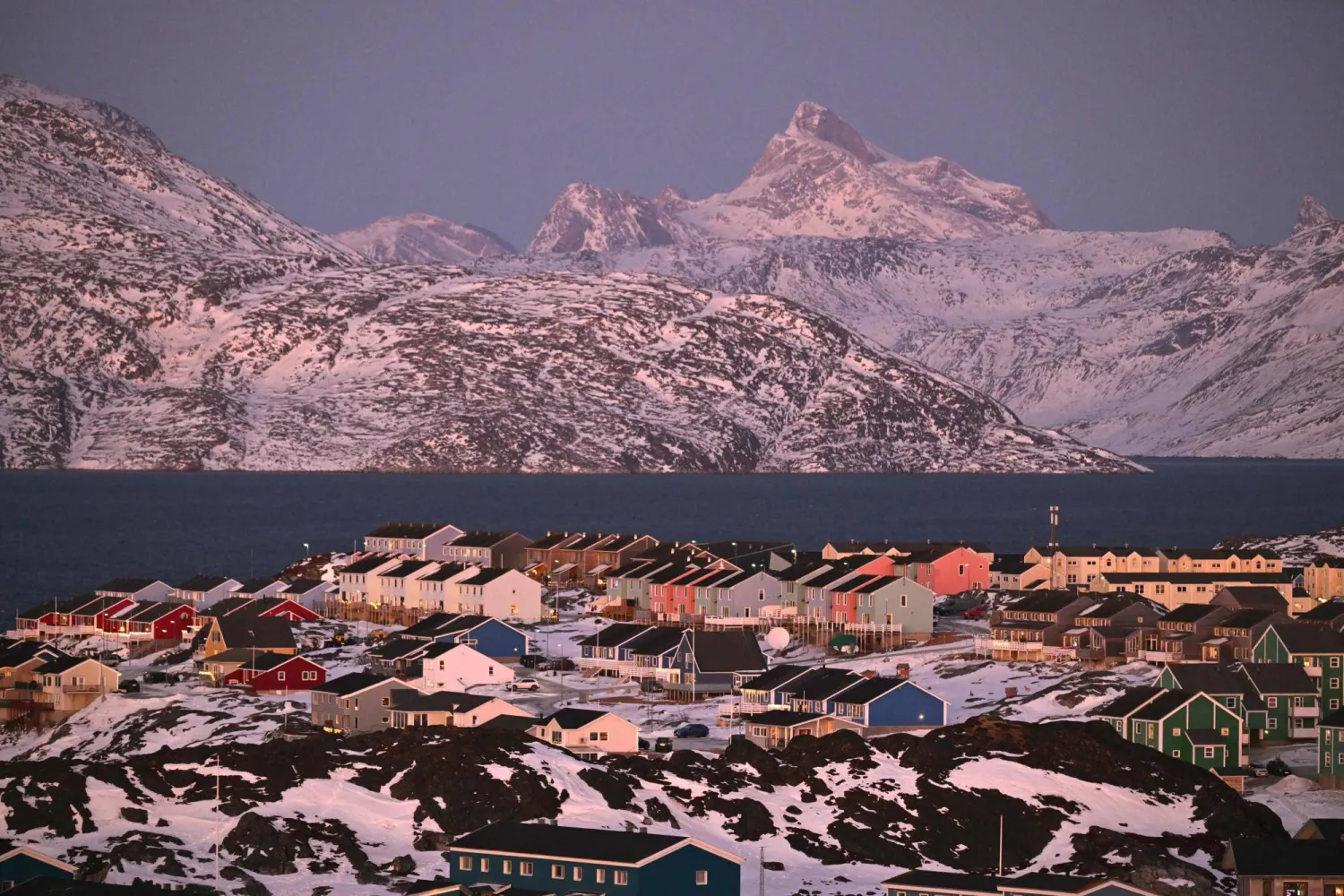
A photo shows a residential area near the airport at the city of Nuuk, western Greenland, with a slightly snow covered mountain in the background, on January 28, 2026. (AFP)
TT

NATO's Ability to Deter Russia Has Taken a Hit with Trans-Atlantic Infighting

A photo shows a residential area near the airport at the city of Nuuk, western Greenland, with a slightly snow covered mountain in the background, on January 28, 2026. (AFP)

European allies and Canada are pouring billions of dollars into helping Ukraine, and they have pledged to massively boost their budgets to defend their territories.

But despite those efforts, NATO’s credibility as a unified force under US leadership has taken a huge hit over the past year as trust within the 32-nation military organization dissolved.

The rift has been most glaring over U.S. President Donald Trump's repeated threats to seize Greenland, a semiautonomous territory of NATO ally Denmark. More recently, Trump's disparaging remarks about his NATO allies' troops in Afghanistan drew another outcry.

While the heat on Greenland has subsided for now, the infighting has seriously undercut the ability of the world’s biggest security alliance to deter adversaries, analysts say.

“The episode matters because it crossed a line that cannot be uncrossed,” Sophia Besch from the Carnegie Europe think tank said in a report on the Greenland crisis. “Even without force or sanctions, that breach weakens the alliance in a lasting way.”

The tensions haven’t gone unnoticed in Russia, NATO’s biggest threat.

Any deterrence of Russia relies on ensuring that President Vladimir Putin is convinced that NATO will retaliate should he expand his war beyond Ukraine. Right now, that does not seem to be the case.

“It’s a major upheaval for Europe, and we are watching it,” Russian Foreign Minister Sergey Lavrov noted last week.

Filling up the bucket

Criticized by US leaders for decades over low defense spending, and lashed relentlessly under Trump, European allies and Canada agreed in July to significantly up their game and start investing 5% of their gross domestic product on defense.

The pledge was aimed at taking the whip out of Trump's hand. The allies would spend as much of their economic output on core defense as the United States — around 3.5% of GDP — by 2035, plus a further 1.5% on security-related projects like upgrading bridges, air and seaports.

NATO Secretary-General Mark Rutte has hailed those pledges as a sign of NATO’s robust health and military might. He recently said that “fundamentally thanks to Donald J. Trump, NATO is stronger than it ever was.”

Though a big part of his job is to ensure that Trump does not pull the US out of NATO, as Trump has occasionally threatened, his flattery of the American leader has sometimes raised concern. Rutte has pointedly refused to speak about the rift over Greenland.

Article 5 at stake

The North Atlantic Treaty Organization was formed in 1949 to counter the security threat posed by the Soviet Union during the Cold War, and its deterrence is underpinned by a strong American troop presence in Europe.

The alliance is built on the political pledge that an attack on one ally must be met with a response from them all — the collective security guarantee enshrined in Article 5 of its rule book.

It hinges on the belief that the territories of all 32 allies must remain inviolate. Trump’s designs on Greenland attack that very principle, even though Article 5 does not apply in internal disputes because it can only be triggered unanimously.

“Instead of strengthening our alliances, threats against Greenland and NATO are undermining America’s own interests,” two US senators, Democrat Jeanne Shaheen and Republican Lisa Murkowski, wrote in a New York Times op-ed.

“Suggestions that the United States would seize or coerce allies to sell territory do not project strength. They signal unpredictability, weaken deterrence and hand our adversaries exactly what they want: proof that democratic alliances are fragile and unreliable,” they said.

Even before Trump escalated his threats to seize control of Greenland, his European allies were never entirely convinced that he would defend them should they come under attack.

Trump has said that he doesn’t believe the allies would help him either, and he recently drew more anger when he questioned the role of European and Canadian troops who fought and died alongside Americans in Afghanistan. The president later partially reversed his remarks.

In testimony to the Senate Foreign Relations Committee, US Secretary of State Marco Rubio dismissed criticism that Trump has undermined the alliance.

“The stronger our partners are in NATO, the more flexibility the United States will have to secure our interests in different parts of the world,” he said. “That’s not an abandonment of NATO. That is a reality of the 21st century and a world that’s changing now.”

A Russia not easily deterred

Despite NATO’s talk of increased spending, Moscow seems undeterred. The EU's foreign policy chief, Kaja Kallas, said this week that “it has become painfully clear that Russia will remain a major security threat for the long term.”

“We are fending off cyberattacks, sabotage against critical infrastructure, foreign interference and information manipulation, military intimidation, territorial threats and political meddling,” she said Wednesday.

Officials across Europe have reported acts of sabotage and mysterious drone flights over airports and military bases. Identifying the culprits is difficult, and Russia denies responsibility.

In a year-end address, Rutte warned that Europe is at imminent risk.

“Russia has brought war back to Europe, and we must be prepared for the scale of war our grandparents or great-grandparents endured,” he said.

Meanwhile in Russia, Lavrov said the dispute over Greenland heralded a “deep crisis” for NATO.

“It was hard to imagine before that such a thing could happen,” Lavrov told reporters, as he contemplated the possibility that “one NATO member is going to attack another NATO member.”

Russian state media mocked Europe's “impotent rage” over Trump's designs on Greenland, and Putin's presidential envoy declared that “trans-Atlantic unity is over.”

Doubt about US troops

US Defense Secretary Pete Hegseth is due to meet with his counterparts at NATO on Feb. 12. A year ago, he startled the allies by warning that America’s security priorities lie elsewhere and that Europe must look after itself now.

Security in the Arctic region, where Greenland lies, will be high on the agenda. It’s unclear whether Hegseth will announce a new drawdown of US troops in Europe, who are central to NATO’s deterrence.

Lack of clarity about this has also fueled doubt about the US commitment to its allies. In October, NATO learned that up to 1,500 American troops would be withdrawn from an area bordering Ukraine, angering ally Romania.

A report from the European Union Institute for Security Studies warned last week that although US troops are unlikely to vanish overnight, doubts about US commitment to European security means “the deterrence edifice becomes shakier.”

“Europe is being forced to confront a harsher reality,” wrote the authors, Veronica Anghel and Giuseppe Spatafora. “Adversaries start believing they can probe, sabotage and escalate without triggering a unified response.”

A Bullet Shattered Her Knee. Now a Gaza Teen's Chances of Walking Depend on Rafah Border Crossing

Islam Saleh, who was injured in her left leg in an Israeli strike on a school shelter in Jabalia in 2024, sits in a wheelchair inside her family’s tent in Zawaida, Gaza Strip, Tuesday, Jan. 27, 2026, as she awaits permission to travel outside Gaza for treatment. (AP Photo/Abdel Kareem Hana)
TT

A Bullet Shattered Her Knee. Now a Gaza Teen's Chances of Walking Depend on Rafah Border Crossing

Islam Saleh, who was injured in her left leg in an Israeli strike on a school shelter in Jabalia in 2024, sits in a wheelchair inside her family’s tent in Zawaida, Gaza Strip, Tuesday, Jan. 27, 2026, as she awaits permission to travel outside Gaza for treatment. (AP Photo/Abdel Kareem Hana)

Rimas Abu Lehia was wounded five months ago when Israeli troops opened fired toward a crowd of hungry people mobbing an aid truck for food in Gaza and a bullet shattered the 15-year-old Palestinian girl's left knee.

Now her best chance of walking again is surgery abroad. She is on a long list of more than 20,000 Palestinians, including 4,500 children, who have been waiting — some more than a year — for evacuation to get treatment for war wounds or chronic medical conditions, according to the Gaza Health Ministry, The AP news reported.

Their hopes hinge on the reopening of the crucial Rafah border crossing between Gaza and Egypt, a key point under the nearly 4-month-old ceasefire between Israel and Hamas. Israel has announced the crossing would open in both directions on Sunday.

The Israeli military body in charge of coordinating aid to Gaza said Friday that “limited movement of people only” would be allowed. Earlier, Prime Minister Benjamin Netanyahu had said Israel will allow 50 patients a day to leave; others have spoken of up to 150 a day.

That's a large jump from about 25 patients a week allowed to leave since the ceasefire began, according to UN figures. But it would still take anywhere from 130 to 400 days of crossings to get everyone in need out.

Abu Lehia said her life depends on the crossing opening.

“I wish I didn’t have to sit in this chair,” she said, crying as she pointed at the wheelchair she relies on to move. “I need help to stand, to dress, to go to the bathroom.”

Evacuations are critical as Gaza hospitals are decimated Israel’s campaign in Gaza after the Hamas October 2023 attack on southern Israel that triggered the war has decimated the territory’s health sector — the few hospitals still working were overwhelmed by casualties. There are shortages of medical supplies and Israel has restricted aid entry.

Hospitals are unable to perform complicated surgeries for many of the wounded, including thousands of amputees, or treat many chronic conditions. Gaza’s single specialized cancer hospital shut down early in the war, and Israeli troops blew it up in early 2025. Without giving evidence, the military said Hamas militants were using it, though it was located in an area under Israeli control for most of the war.

More than 10,000 patients have left Gaza for treatment abroad since the war began, according to the World Health Organization.

After Israeli troops seized and closed the Rafah crossing in May 2024 and until the ceasefire, only around 17 patients a week were evacuated from Gaza, except for a brief surge of more than 200 patients a week during a two-month ceasefire in early 2025, according to WHO figures.

About 440 of those seeking evacuation have life-threatening injuries or diseases, according to the Health Ministry. More than 1,200 patients have died while waiting for evacuation, the ministry said Tuesday.

A UN official said one reason for the slow pace of evacuations has been that many countries are reluctant to accept the patients because Israel would not guarantee they would be allowed to return to the Gaza Strip. The official spoke on condition of anonymity because he was not authorized to discuss the issue. The majority of evacuees have gone to Egypt, the United Arab Emirates, Qatar and Türkiye.

He said it wasn't clear if that would change with Rafah's opening. Even with "daily or almost daily evacuations,” he said, the number is not very high. Also, Israel has said it will only allow around 50 Palestinians a day to enter Gaza while tens of thousands of Palestinians hope to go back.

Israel has also banned sending patients to hospitals in the Israeli-occupied West Bank and east Jerusalem since the war began, the official said — a move that cut off what was previously the main outlet for Palestinians needing treatment unavailable in Gaza.

Five human rights groups have petitioned Israel’s High Court of Justice to remove the ban. The court has not ruled. Still, one cancer patient in Gaza was allowed to travel to the West Bank for treatment on Jan. 11, after the Jerusalem District Court accepted a petition in his case by the Israeli rights group Gisha.

Thousands of cancer patients need evacuation Gaza has more than 11,000 cancer patients and some 75% of the necessary chemotherapy drugs are not available, the Health Ministry said. At least 4,000 cancer patients need urgent treatment abroad, it added.

Ahmed Barham, a 22-year-old university student, has been battling leukemia. He underwent two lymph node removal surgeries in June but the disease is continuing to spread “at an alarming rate,” his father, Mohamed Barham, said.

“There is no treatment available here," the elder Barham said.

His son, who has lost 35 kilograms (77 pounds), got on the urgent list for referral abroad this past week but still doesn’t have a confirmation of travel.

“My son is dying before my eyes,” the father said.

Desperate for Rafah to open Mahmoud Abu Ishaq, a 14-year-old, has been waiting for more than a year on the referral list for treatment abroad.

The roof of his family home collapsed when an Israeli strike hit nearby in the southern town of Beni Suhaila. The boy was injured and suffered a retinal detachment.

“Now he is completely blind,” his father, Fawaz Abu Ishaq said. “We are waiting for the crossing to open.”

Abu Lehia was wounded in August, when she went out from her family tent in the southern city of Khan Younis, looking for her younger brother, Muhannad, she told The Associated Press. The boy had gone out earlier that morning, hoping to get some food off entering aid trucks.

At the time, when Gaza was near famine, large crowds regularly waited for trucks and pulled food boxes off them, and Israeli troops often opened fire on the crowds. The Israeli military said its forces were firing warning shots, but hundreds were killed over the course of several months, according to Gaza health officials.

When Abu Lehia arrived at the edge of a military-held zone from which the trucks were passing, dozens of people were fleeing as Israeli troops fired. A bullet hit Abu Lehia in the knee, and she fell to the ground screaming, she said.

At the nearby Nasser Hospital, she underwent multiple surgeries, but they were unable to repair her knee. Doctors told her she needs knee replacement surgery outside Gaza.

Officials told the family last month that she would be evacuated in January. But so far nothing has happened, said her father, Sarhan Abu Lehia.

“Her condition is getting worse day by day,” he said. “She sits alone and cries.”


How Far Will He Go? Trump’s Options for US Action Against Iran

An Iranian woman walks next to an anti-US mural in Tehran, Iran, 29 January 2026. (EPA)
TT

How Far Will He Go? Trump’s Options for US Action Against Iran

An Iranian woman walks next to an anti-US mural in Tehran, Iran, 29 January 2026. (EPA)

US President Donald Trump has threatened military action against Iran over its crackdown on protesters, while still for now appearing to leave the door open for negotiations over the country’s controversial nuclear program.

But should Trump, after weeks of American threats and counter-threats from Tehran, finally decide to order military action after already sending a US aircraft carrier to the region, he faces another dilemma over what form the intervention should take.

Such action could replicate American strikes during Israel's June war against the country, enforce economic strangulation by targeting the energy sector or amount to a bid to replace the theocratic system under supreme leader Ali Khamenei.

- Venezuela economic pressure scenario

Trump's relatively cautious stance so far has sparked speculation he could target Iranian energy infrastructure and squeeze its oil exports, mimicking a strategy Washington used over Venezuela.

This policy earlier this month led to the capture of Venezuelan leader Nicolas Maduro, with Trump then working with the remnants of his former administration.

The US naval group in Middle East waters could look to block "dark fleet vessels" carrying Iranian oil and put pressure on Iran's oil exports, said Farzan Sabet, managing researcher of the Sanctions and Sustainable Peace Hub at the Geneva Graduate Institute.

"And that pressure can be gradual, similar to what we saw in Venezuela. It could play out over days, weeks, months, it's hard to foresee, but possibly longer," he said, while acknowledging that Trump was playing "his cards very close to his chest".

The naval group, repeatedly described as an "armada" by Trump, consists of the aircraft carrier USS Abraham Lincoln and its more than 80 aircraft, as well as its escort of three destroyers, equipped with anti-missile capabilities and Tomahawk cruise missiles.

- Strikes on military and IRGC targets

If Trump decides on a course of military action, prime targets would be bases of the Iranian Revolutionary Guards Corps (IRGC) and its youth militia, the Basij, which are accused by rights groups of taking a frontline role in the deadly crackdown on the protests that according to rights groups left thousands dead.

Using Tomahawk missiles and combat aircraft, the United States could strike positions of the Basij and the IRGC forces, "particularly those forces that participated and continue to participate in targeting Iranian protesters", said independent military researcher Eva J. Koulouriotis.

She said US intelligence, helped by Israel's Mossad spy agency, has "a clear picture" of those forces and their location nationwide.

"Such a strike would serve as a direct warning to the Iranian regime," she said.

During its June war against Tehran, Israel showed its deep intelligence penetration of Iran by killing senior security officials including the IRGC's chief and the armed forces chief of staff in targeted strikes based on location intelligence.

In a "harsh but measured strike", the United States could target "operations command and senior officers involved in mass killings carried out by the Iranian regime", she said.

- Massive strikes and regime change bid -

Iran's theocratic system has been in place since the 1979 revolution led by Khomeini that ousted the largely pro-Western shah.

Relations with the United States were cut in the wake of the hostage siege of the US embassy in Tehran that began that year and have remained severed ever since.

Under Khomeini, the revolution survived the war with Iraq in the 1980s. Since Khamenei took over in 1989, he has managed to keep the system in place despite economic sanctions and repeated protests.

As well as the so-called "armada", Washington already has a heavy deployment of military resources in the region with dozens of aircraft deployed at the air bases of Al Udeid in Qatar and Al Dhafra in the United Arab Emirates.

"The American objective is to destabilize the regime," said David Khalfa, co-founder of the Atlantic Middle East Forum (AMEF) think-tank.

"So there is really a strategy that will aim to paralyze it, to disrupt the chain of command" marked by the physical "elimination" of Khamenei, his close advisors and senior IRGC generals, he added.

But he said: "The regime is still relatively solid and resilient, it will not be an easy task", especially as "the Guards have anticipated this scenario".

Sabet said it would appear for now that Washington "would prefer something limited, where they can continue the process of weakening the system while minimizing the country's desire -- and to some extent its ability, but mostly its desire -- to carry out larger-scale retaliation".


Deal or Strike: Is Military Action Against Iran Drawing Closer?

Military equipment, including helicopters, on board the aircraft carrier Abraham Lincoln (AP)
TT

Deal or Strike: Is Military Action Against Iran Drawing Closer?

Military equipment, including helicopters, on board the aircraft carrier Abraham Lincoln (AP)

Despite reports of mediation and back-channel exchanges between Washington and Tehran, what is being described as “negotiations” so far looks more like a bid to keep tensions from boiling over than a diplomatic process.

Signals emerging from Western officials and media indicate the two sides have yet to engage in direct, substantive talks, with the dispute over the very terms of entry itself carrying a political message.

US President Donald Trump’s administration is pressing for an agreement that encompasses Iran’s nuclear program, ballistic missiles, and regional influence. At the same time, Tehran insists that any dialogue be confined strictly to the nuclear file.

That gap has reinforced suspicions in Tehran that Trump’s offer of a deal is little more than a tactical feint, masking serious preparations for military action. This scenario would echo the US strikes on Iranian nuclear facilities in June 2025.

As Trump sharpens his rhetoric, the stalemate revives a central question: Is diplomacy becoming a pretext for war, or a narrowing window to avert it?

A different escalation

The key difference this time lies in the scale and nature of the military posture.

It is not a mere show of force, but a combined offensive-defensive package signaling readiness for multiple scenarios, following the arrival of the aircraft carrier Abraham Lincoln and its strike group in the US Central Command area of operations, enabling support for strikes or protection of allies against retaliatory attacks.

This has been accompanied by strengthened air defenses, including Patriot and THAAD systems, as well as air drills focused on deployment, operations, and sortie generation under challenging conditions, according to US Central Command.

Such a pattern is typically associated with raising readiness for potential reciprocal responses.

At the same time, Washington is aware that any operation against Iran would not be a “precision operation” like what occurred in Venezuela, where the US previously amassed large forces in the Caribbean in a campaign that ended with the arrest of President Nicolas Maduro in early January 2026.

Iran’s geography is more complex, and its missile capabilities and layered defenses make a “decisive strike” more complicated, even if the US enjoys overwhelming superiority.

Trump’s options

Earlier leaks pointed to the end of this month as a possible date for a US strike, though this remains unconfirmed publicly.

The danger in circulating such reports lies in the political-military dynamic they create. When a force of this size is mobilized, internal and external pressure on the White House grows to justify the cost by achieving some result, even if limited.

At the same time, the leaks may be part of psychological warfare aimed at forcing Tehran to make concessions before the window for de-escalation “closes.”

Accordingly, the practical rule is that absent a clear political decision, the scenario remains open to three graduated possibilities: a limited strike to impose new rules of engagement; a broader campaign targeting nuclear and missile infrastructure and security nodes; or continued military pressure as a negotiating lever without opening fire.

According to the Financial Times, Trump’s options, should he decide to carry out military action, range from a limited punitive strike targeting missile sites, drones, or facilities linked to the Revolutionary Guard, aimed at raising the cost of Iranian refusal without seeking regime change.

Another option would expand the target bank to include nuclear facilities that are being hardened and rebuilt, particularly after Western talk of Iranian attempts to resume work at deeper underground sites.

There is also a set of non-traditional pressure options, such as tightening a maritime blockade or striking state infrastructure as a political message.

These options carry higher risks, as they raise the likelihood of retaliation outside established rules of engagement.

The decisive issue, however, is the “endgame.”

The US administration itself implicitly acknowledges that removing the regime's head does not guarantee its collapse, and that the question of “who comes next” has no ready answer.

This explains repeated warnings in assessments leaked to the media and in statements by US officials that the regime is weaker than ever, but that a decisive blow is not guaranteed.

How might Iran respond?

Tehran has warned in advance that any attack would mark the start of a war, and that retaliation could extend to Israel, particularly Tel Aviv, as well as anyone who supports the aggressor.

Operationally, Iran has a ladder of response, starting with strikes on US bases in the region using missiles or drones, moving through the activation of regional proxies, and culminating in threats to shipping in the Strait of Hormuz, the scenario with the most severe global impact.

The latter possibility may be among the main reasons regional states have sought to avoid war and continue diplomatic efforts while stressing neutrality.

This stance could increase US logistical demands in any large-scale operation and heighten reliance on distant naval platforms.

Markets, however, have already issued an early warning. Oil prices have risen for three consecutive sessions amid fears of supply disruptions, with Brent crude nearing the $ 70-a-barrel threshold and a rise in the geopolitical risk premium, while gold has climbed as a safe-haven asset.

If a strike does occur, the potential fallout would be threefold. Economically, a spike in oil prices, pressure on shipping and insurance, and volatility in Gulf markets. Security-wise, an expansion of theaters of engagement to include Iraq, Syria, the Gulf, and Israel, with heightened risks of miscalculation.

Politically, a narrowing of prospects for any near-term negotiations, or conversely, a limited strike used to force talks under harsher terms.