
Mines ‘Draining Türkiye's Water Sources’, Environmentalists Warn

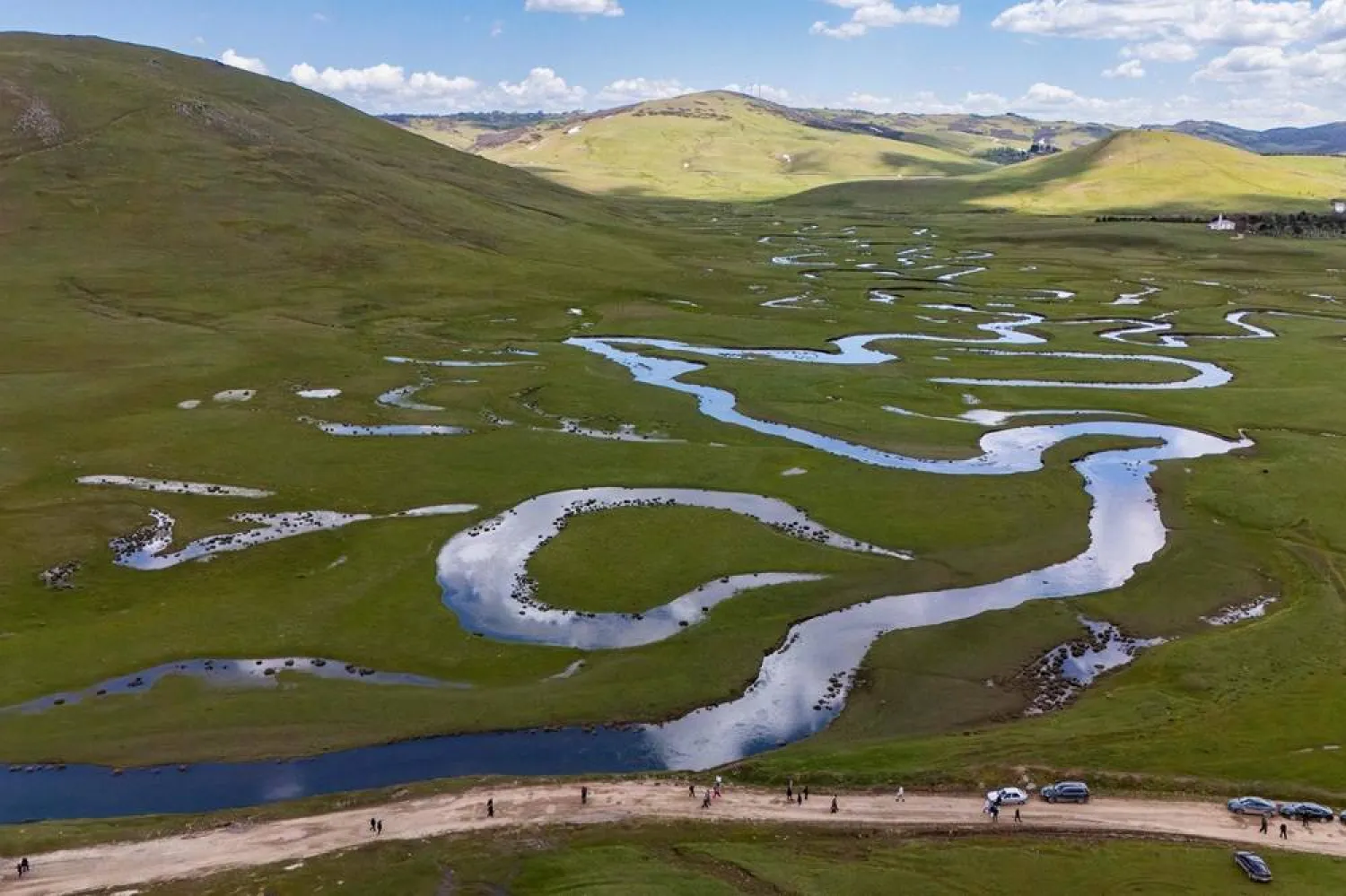
This aerial view shows protesters during a protest march against mining at the Aybasti Plateau in Ordu Province, northeastern Türkiye, on May 8, 2026. (AFP)
TT

Mines ‘Draining Türkiye's Water Sources’, Environmentalists Warn

This aerial view shows protesters during a protest march against mining at the Aybasti Plateau in Ordu Province, northeastern Türkiye, on May 8, 2026. (AFP)

Guney was once a water-rich village fed by 50 springs in Türkiye's western Usak province, but since a gold mine opened 20 years ago, they have all dried up.

"Before, you only had to drill 60 meters to find water," said Ugur Sumer, environmental activist and resident of Guney, which is about 170 kilometers (100 miles) east of the resort city of Izmir.

"Today, even drilling 400 meters yields nothing. The mine has used all our water."

With Türkiye hosting COP31 in November, its own environmental record is being scrutinized, and activists have warned about the growing number of water-intensive mining projects as resources dry up.

Since 2000, Türkiye has rapidly expanded the number of drilling and mining permits granted, notably for gold and coal. The number reached 410,000 last year after the procedures were streamlined by a new law adopted in July.

"I am convinced this law will speed up the arrival of foreign investment in Türkiye," Energy Minister Alparslan Bayraktar said in March while visiting Canada.

While there, he met officials from the Tuprag gold mine in Usak, which is owned by Vancouver-based Eldorado Gold.

Türkiye is hoping to hike its gold production from 28 tons to 100 tons per year "without compromising human health and the environment", Bayraktar said. It also wants to be a major player in global rare earths.

But experts and environmentalists warn this explosion in mining permits is endangering water resources and the economies of rural areas.

Not only does the extraction of metals like gold involve large amounts of water, but it also uses cyanide and releases other pollutants, posing major environmental and health risks.

According to official data, in 2024 mining used 5.8 percent of Türkiye's 20.3 billion cubic meters of water consumption -- four times the amount used in 2016.

This photograph shows harvested hazelnuts in the province of Ordu, in northeast Türkiye on May 7, 2026. (AFP)

- Farmers' protest -

On the Aybasti plateau in the northeastern Ordu province, villagers turned out en masse earlier this month to protest plans to mine an area they use for farming.

"Our pastures have been closed off because of an exploratory drilling plan for a gold mine," said Nuriye Dilek, a 48-year-old livestock farmer.

"What are we supposed to do if we can no longer raise livestock? Are we supposed to abandon our land and leave?"

Farming and animal husbandry are the main sources of income for locals in this region known for its hazelnuts, which are exported across the world.

"Once the gold mine opens, we won't be able to grow hazelnuts here anymore," says Omer Aydin, a nut producer and exporter.

"What's above ground here is more valuable than what's underground. The real gold is the hazelnuts this country produces," he said.

"We are hearing that 80 percent of Ordu's land has been declared a mining site," he told AFP.

"We're extremely concerned."

Last month, the government's anti-disinformation unit Center for Combating Disinformation denied claims "a large portion of land" was being actively used for mining.

It said the total area corresponded to "only 0.18 percent of Türkiye's surface area", denouncing efforts to "tarnish the mining sector".

- 'Excessive use of water, chemicals' -

But the increase in mining permits has infuriated environmentalists, including Ozer Akdemir, who says investment in the sector is being prioritized at the expense of pollution risks and harm to local economies.

"Mining uses excessive water and chemicals. The water isn't just used, it's also polluted," explained hydrologist Erol Kesici.

"The whole world is experiencing a prolonged drought, but Türkiye is also facing a severe hydrological drought," he said of a phenomenon where rainfall shortages hit the wider water system, depleting water bodies and groundwater.

"Our lakes, rivers and groundwater reserves have dried up as a direct consequence of poor water management," said Kesici.

He recently resigned from Türkiye's National Water Council over its "inaction".
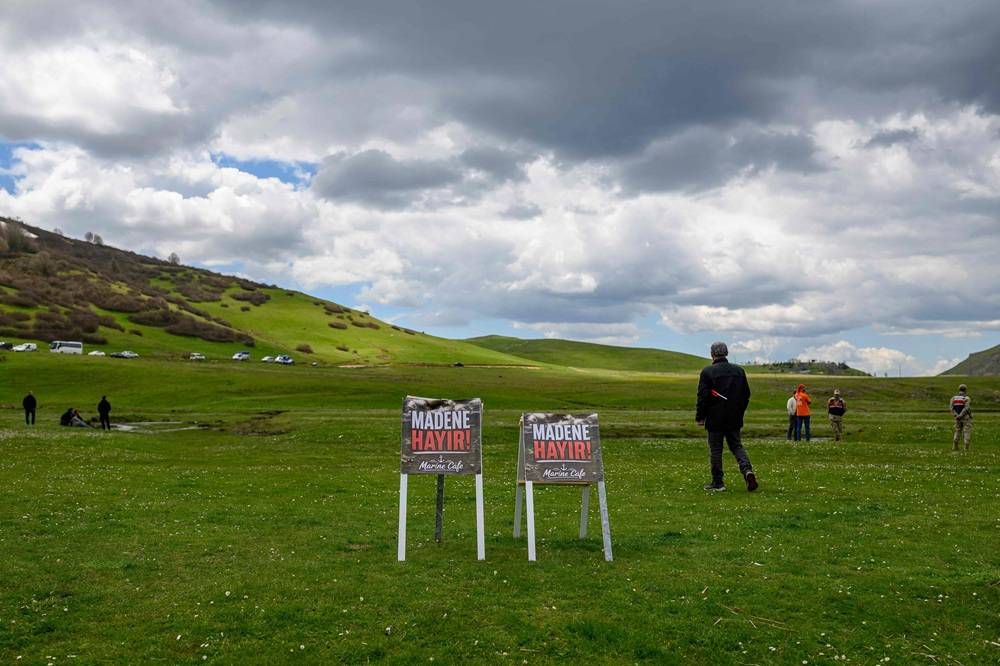
Protesters stand next to placards reading “No to the mine” during a protest march against mining at the Aybasti Plateau in Ordu Province, northeastern Türkiye, on May 8, 2026. (AFP)

"When mountains are levelled to dig mines, the ecosystem is destroyed. Heat islands form, reducing rainfall and consequently groundwater levels," he explained.

"How is it possible to grant so many mining permits? Türkiye is suffering from over-exploitation," he said.

For lawyer and activist Arif Ali Cangi, the legislation approved in July, which allows companies to expropriate or rezone agricultural land for mining, will only aggravate the situation.

"Environmental impact assessments and oversight mechanisms are now completely ineffective," he told AFP.

"There are now no longer any obstacles to mining operations being set up anywhere."

- 'Pollution is killing farming' -

Using emergency procedures, mining permit requests can be fast-tracked so companies can immediately seize land, a move that seeks to hobble the growing protest movement across Türkiye, Cangi said.

Among them are villagers from Ikizkoy in the Mugla region, who have mobilized to protect their olive groves from plans to expand a nearby brown coal lignite mine.

Back in Guney, local resident Sumer said the issue of protecting water sources from overexploitation or pollution was ultimately a matter of survival.

"In 2006, nearly 2,000 residents suffered from vertigo, sight problems and nausea after it rained in Guney, with blood tests showing cyanide in their blood," he said.

"Pollution is killing livestock farming and grape harvests, once the backbone of the local economy," he said.

"We wonder how we're going to survive."


Hantavirus Outbreak Tests Post-COVID Health Communications Playbook

The cruise ship MV Hondius, affected by a hantavirus outbreak, leaves the port of Granadilla de Abona, Tenerife, Spain on May 11. (Reuters)
TT

Hantavirus Outbreak Tests Post-COVID Health Communications Playbook

The cruise ship MV Hondius, affected by a hantavirus outbreak, leaves the port of Granadilla de Abona, Tenerife, Spain on May 11. (Reuters)

A rodent-borne virus with a scary name. A mid-ocean cruise ship in quarantine. Several people dead and more falling sick.

It is no wonder that an outbreak of the Andes strain of hantavirus on a luxury liner in the Atlantic has revived some COVID-era trauma and panic online.

That has presented a dilemma to health officials: how to communicate quickly and clearly about a virus which is not new and unlikely to cause a pandemic, but where knowledge gaps remain - without inadvertently fomenting fear.

"Hantavirus thread incoming," posted the health department of Illinois state in the US earlier this week about a risk-free case unrelated to the MV Hondius cruise ship outbreak.

"But you have to promise to read this whole thread before panic-texting your group chat. Deal?"

In interviews with Reuters, half a dozen health officials said they were trying to learn from mistakes around COVID, providing information on hantavirus with more empathy while addressing uncertainties and tackling falsehoods.

"We spend half of our time discussing how we will communicate," said Gianfranco Spiteri, emergencies lead at the EU's European Center for Disease Prevention and Control.

During COVID, many governments were slow to react or in denial, public messaging was sometimes confusing and contradictory, restrictions and vaccine rollouts were applied differently round the world, and misinformation and politicization proliferated.

That helped fuel modern mistrust of institutions. For example, faith in public health institutions declined in 20 of 27 EU countries ‌between 2020 and ‌2022, one study showed.

JUGGLING THE COMMUNICATIONS

Spiteri and others at the forefront of the hantavirus response spoke about the need ‌to balance ⁠explanations of why ⁠it is a serious global health event with reassurances that risks to the public are low and honesty over the open questions about a virus that has rarely spread among humans before.

"There are people who say we are overdoing it, and on the other extreme, that we’re not doing enough," he said. "We always base our messages on the evidence we have."

From a look at social media, their efforts are still a work in progress, with many people needlessly fretting about a return to lockdowns, social distancing and masks.

"We have kind of lost perspective," said Gustavo Palacios, a professor at Icahn School of Medicine at Mount Sinai in the US who is originally from Argentina and a hantavirus expert.

An outbreak can be a major public health event deserving attention and action but without becoming a pandemic, he noted.

Some posts online falsely present hantavirus as a bigger existential threat than COVID, or promote ⁠protections like the ivermectin anti-parasite drug, vitamin D and zinc without scientific evidence.

False conspiracy theories are popping up too - that it ‌is a side effect of the Pfizer vaccine or a hoax to boost pharmaceutical profits.

Sander van der Linden, ‌a psychology professor at England's University of Cambridge and misinformation expert, said the public needed more support in how to interpret information, including potentially showing them conspiracy theories they may face in ‌the event of an outbreak.

"We need to do more preparatory work to create resilience in the population," he said.

As of Thursday, there had been three deaths ‌from 11 reported hantavirus cases in the outbreak, all people who had been on board the Hondius. Dozens of other passengers are being monitored as they return to around 20 countries.

Unlike COVID, there are established measures to control hantavirus' spread, officials said. The strain has circulated in parts of Argentina and Chile for decades and the ship samples show no meaningful variation from that virus.

"I'm definitely seeing improvements," said Gabby Stern, former head of communications at the World Health Organization until September last year, referring particularly to sharing what you know when you know it.

"It seems like ‌the public health community has absorbed crucial lessons, although not all of them."

'EMOTIONAL REACTION' TO CRUISE SHIP

The WHO was quick to reassure the public, holding regular press conferences, issuing alerts and tackling misinformation in social media Q&As since the ⁠outbreak was disclosed on May 3.

WHO chief ⁠Dr. Tedros Adhanom Ghebreyesus even took the unusual step of an open letter to the people of Tenerife, where the Hondius docked on Sunday.

"But I need you to hear me clearly: this is not another COVID," he wrote. "The current public health risk from hantavirus remains low. My colleagues and I have said this unequivocally, and I will say it again to you now."

Some started more slowly: in the US, the Centers for Disease Control and Prevention put out its first information on May 8, five days after the news broke, but has since increased the pace of communications.

"One of the things this is teaching us is a lesson we should have learned from COVID: What we say is really important," said Michael Osterholm, an infectious diseases expert at the University of Minnesota.

The cruise ship hantavirus narrative has not helped, echoing the infamous outbreak on the Diamond Princess docked off Japan early in the COVID pandemic in 2020 where 14 people died and nearly a quarter of the 3,000 passengers and crew became infected.

"The whole cruise ship thing ... is a very significant memory from the beginning of COVID," said Krutika Kuppalli, associate professor of medicine at the University of Texas Southwestern Medical Center.

"There’s an emotional reaction that is stirring people."

The resemblance was not lost on Laura Millán, 40, in Tenerife, as passengers began to disembark at the beginning of this week under strict infection-control measures.

Seeing WHO boss Tedros arrive on the island with Spanish officials to help oversee the hantavirus response took her back.

"It gave me the impression that this isn’t just the flu – otherwise all these people wouldn’t be coming," she said at a playground, adding that overall she understood their involvement helped ensure the right measures.


Syrian Hospitals Turned Into Torture Chambers, with Tishreen Military Hospital as a Model

Reception sign at the entrance to Mezzeh Military Hospital 601 in Damascus, where torture and killings took place and where Caesar photos were taken (Asharq Al-Awsat)
TT

Syrian Hospitals Turned Into Torture Chambers, with Tishreen Military Hospital as a Model

Reception sign at the entrance to Mezzeh Military Hospital 601 in Damascus, where torture and killings took place and where Caesar photos were taken (Asharq Al-Awsat)

Asharq Al-Awsat collected harrowing testimonies from survivors of “deliberate liquidation” operations carried out against detained opponents at Tishreen Military Hospital in Damascus and other military hospitals during the years of the Syrian revolution.

They described torture methods and killing techniques, most notably “breaking the neck.”

Syrian security authorities have detained dozens of people for questioning over those crimes, while most of those responsible and those who carried them out remain at large.

The Syrian Network for Human Rights said the data it had collected indicated the existence of organized networks of doctors, nurses, and security personnel involved in the crimes, including organ removal and direct killings.

This comes amid continuing shock among most Syrians since the beginning of this month, after videos and leaked images documenting the torture of detainees inside several sites, including Tishreen Hospital, were published.

The largest medical complex

Tishreen Military Hospital, located in the Barzeh neighborhood northeast of Damascus, opened in 1982 as the largest medical complex in Syria. It included modern buildings and received civilians as well as military personnel.

The hospital became one of the country’s leading specialized centers, with more than 36 specialized medical departments and divisions, modern equipment, especially for kidney dialysis, and a staff of nearly 1,600 doctors, nurses, administrators and guards.

The hospital’s administrative structure consisted of a director general, an officer with the rank of brigadier general, and two deputies, usually with the rank of brigadier general or colonel, one for technical and medical affairs and the other for administrative affairs.

It also included a security officer, whose rank ranged from captain to colonel; heads of divisions and departments, with ranks from lieutenant colonel to brigadier general; specialists and resident doctors, with ranks from first lieutenant to colonel; nursing staff, who were noncommissioned officers; and conscripts and corporals.

The number of military hospitals and clinics under the former regime reached about 30. They were affiliated with the Military Medical Services Directorate and distributed across 14 provinces.

The most prominent included Tishreen, 601 and Harasta hospitals in Damascus and its countryside, as well as hospitals in Aleppo, Homs and Latakia.

Since the leak of old videos and images showing that military hospitals, including Tishreen, had turned into “human slaughterhouses” under the former regime, families have demanded that those who committed the crimes be identified, arrested and held accountable, and that the fate of their loved ones be disclosed.

Asharq Al-Awsat learned that about 40 doctors had been detained for questioning, including three heads of medical departments and divisions.

However, the defense and interior ministries did not respond to Asharq Al-Awsat’s questions about the medical staff involved and the number of those detained.

The liquidation section

Doctor Mahmoud Rahban was a colonel in the former Military Medical Services Directorate. A resident of Damascus, he served in several medical centers and military hospitals, the last of which was Aleppo Hospital.

Rahban told Asharq Al-Awsat that buildings inside military hospitals, including Tishreen, had, over the years of the revolution, turned into mini security branches that were not affiliated with the hospital administration but were overseen by military police personnel.

The small building in Tishreen Hospital, as in Aleppo Hospital, was completely separate from the main building where doctors worked and where ordinary citizens came for treatment.

During the first years of the revolution, Rahban worked with a group of activists to bring medicines and medical supplies into the Barzeh and Qaboun neighborhoods. He was active within the Barzeh Housing Coordination Committee for the Syrian Revolution and the Union of Damascus Coordination Committees.

Rahban was arrested on charges of “financing terrorist acts,” referred to the “terrorism court,” and then sent to the notorious Sednaya prison.

After 75 days in detention, he was released under a decision to “bar prosecution for lack of evidence,” after paying large bribes to investigators and the investigating judge to secure his release.

Rahban said that when detainees became ill, most of them were referred to the “special section” at Tishreen Hospital.

“The treatment was very bad. We were beaten severely and described as terrorists and traitors by doctors and medical staff, whose main concern at the beginning of the revolution was to demonstrate absolute loyalty to the regime,” he said.

Liquidation by breaking necks

Despite the severity of torture in those hospitals, especially Tishreen, some people managed to survive, including Brigadier General Mohammed Mansour Ammar, who was serving at al-Seen Military Airport in the Damascus countryside when the revolution began in 2011.

He was detained in Sednaya between 2014 and 2022 on charges of “providing terrorists with information.”

Ammar told Asharq Al-Awsat that he was transferred to Tishreen Hospital six times during those years. “Each time, the number of those transferred was about 20 detainees, but no more than three of us would return,” he said.

Ammar described how the killings took place.

“All the members of the military police detachment were thugs. Every day, they would choose 10 detainees and order them to lie on their backs. Then one of the members would come and step forcefully on the detainee’s neck, killing him within minutes, while those still alive were forced to collect the bodies at the door of the detachment,” he said.

He pointed to the forensic doctor’s indifference. “He would not enter the detachment or examine the patients. He would simply ask the assistant from the doorway, with disgust, about the number of bodies so he could record them,” Ammar said. He added that during four visits to Tishreen Hospital, he witnessed “the liquidation of about 45 detainees by breaking their necks.”

Among the survivors was also Ibrahim Ali al-Hamdan, who held the rank of conscripted first lieutenant in the former regime’s army in Daraa. He defected in mid-2012 and was arrested in Damascus in August 2012.

Hamdan spoke bitterly to Asharq Al-Awsat about the severe torture he endured for a month and a half at Harasta Hospital.

“My body was exhausted from torture for three weeks. An assistant named Abu al-Layth told me, ‘There is a recommendation from the head of the branch to slaughter you because you are an informant for the Free Syrian Army.’”

He added: “A medical committee came to the section. When the doctor examined me, he found that my feet were infected because of the severe beatings. He cut open the swelling with a scalpel, without any anesthesia or disinfectant, and began pressing on it.”

According to Hamdan, Abu al-Layth once brought in a detainee, accompanied by a doctor and two members of the security forces. They tortured him severely for hours. After resting briefly, they resumed torturing him until midnight, and he died at dawn.

In July 2013, Hamdan was transferred to Sednaya prison. During his detention, he was referred 47 times to Tishreen Hospital, where on one occasion he stayed for about four months while suffering from several illnesses.

“They gave me an IV drip, and I developed a severe fever. I felt I was dying, and I vomited blood, while the doctors were saying that I might die,” Hamdan said.

Because of his condition, a doctor requested that Hamdan be transferred to the intensive care unit. But the director of the medical section replied: “He will remain in the holding cell until he dies. Intensive care is for war wounded, not traitors.”

Hamdan, who was released from Sednaya in late 2020 after serving his sentence, said “the hospital was a place to finish off detainees, not treat them. During four months, I recited the shahada for 40 people before they died.”

Diab Serrih, executive director of the Association of Detainees and the Missing in Sednaya Prison, said: “It is not possible, given the current data and circumstances, to verify any figures for the number of victims at Tishreen Military Hospital. But we estimate that about 39,000 detainees entered Sednaya prison between 2011 and 2021, of whom about 6,000 remained alive.”

Serrih said in a report published in 2023 that a significant number of those who lost their lives were transferred alive to Tishreen Military Hospital, then died there. He added: “We were able to document only 80 cases of people who returned alive from the hospital to Sednaya prison, out of 1,160 documented cases inside the prison.”

The fate of the perpetrators

In this context, Rahban said the old Military Medical Services Directorate had been “completely dissolved, and most of those involved in those crimes are believed to have fled the country.”

He said Major General Dr. Ammar Suleiman, the former director of the Military Medical Services Directorate, who had close ties with Bashar al-Assad, was chiefly responsible for the liquidation operations carried out in those hospitals.

Rahban said Suleiman was believed to have “fled the country, while Brigadier General Dr. Nizar Ismail was arrested two or three months after liberation.” Ismail had held the posts of deputy director of the directorate, head of the supply branch and head of its therapeutic branch.

“Information indicates that the head of the officers’ department in the directorate, Colonel Lubna Ali, fled on the night of liberation from her office to her hometown, then abroad. As for the directorate’s security officer, Brigadier General Mazen Iskandar, there is no information about him,” Rahban said.

According to Rahban, Major General Dr. Mufid Darwish, who served as hospital director until the fall of the regime, knew all the details of what was happening in the hospital, whether in the main building or in the isolated building for sick detainees.

But his treatment was extremely harsh even toward the medical staff working in the main civilian building.

Darwish remained in the country for a short period after liberation, then left for the United Arab Emirates. Some doctors were detained and later released, including the security officer at Tishreen Hospital, Brigadier General Dr. Hani Salloum.

As for the heads of medical departments and divisions in the main building, Rahban said they “had no connection to what was happening in the isolated building.”

He said most of them had regularized their status and were granted settlement documents after it was confirmed that they were not involved in bloodshed and that no personal claims had been filed against them.

Travel ban notices were placed on their names at land, air, and sea crossings. Anyone wishing to travel must submit a request to the Ministry of Defense and may be allowed to do so once for a period of three months after a security review.

Distribution of roles and tasks

The role of the forensic medicine division in the hospital was to document the deaths of detainees and issue death certificates.

But its head would state in the death certificate that the death resulted from “cardiac and respiratory arrest” or “cardiovascular collapse,” even though detainees had in fact died under torture.

From 2011 until liberation in December 2024, Brigadier General Dr. Akram Fares al-Shaar, from the Hama countryside, headed the forensic medicine division at Tishreen Hospital.

The division also included his deputy, Brigadier General Ismail Kiwan from the city of Sweida; Lieutenant Colonel Ayman Khalo; Lieutenant Munqith Shammut; and seven noncommissioned officers who served as nurses and administrators.

Rahban said Shaar had been detained, and noted that Ayman Khalo had been detained for some time over a criminal case unrelated to Tishreen Hospital. Ismail Kiwan fled to areas controlled by Druze cleric Hikmat al-Hijri in Sweida province in southern Syria.

With the dissolution of the old Military Medical Services Directorate, Asharq Al-Awsat’s information indicates that the number of former medical staff members who returned, including doctors and nurses, “can be counted on one hand.”

A number of doctors who were not involved in crimes are practicing in private clinics, while others have left for Western, regional, and Arab countries.

An accelerated process is currently underway to evacuate and hand over the ready housing units affiliated with Tishreen Hospital. The move implements a decision issued by the Ministry of Defense at the beginning of this May, which set a one-month deadline from the date of issuance.

An organized network of killing and torture

The Syrian Network for Human Rights does not yet have a fully documented figure for the number of doctors and medical personnel involved in liquidation operations specifically inside Tishreen Hospital.

What can be confirmed, according to the network’s documentation methodology, is that the hospital included an organized network of doctors, nurses, and security officers who cooperated in killings and torture, and that the violations were not committed by isolated individuals.

Its director, Fadel Abdul Ghany, told Asharq Al-Awsat that “the data collected by the network indicate the existence of networks of doctors, nurses, and security personnel involved in these crimes, including organ removal in addition to direct killings.”

The available data point to three categories. The first includes detainees whom the new security authorities managed to arrest. The second includes those who fled Syria. The third includes those who remained inside the country with unresolved legal status.

Abdul Ghany said some medical staff members were still in the hospital housing units or in different parts of Syria, as revealed by the recent security operation conducted in the nurses’ housing units affiliated with the hospital.

Abdul Ghany said the escape of some of those individuals posed a serious challenge to accountability efforts, requiring immediate international coordination to issue Interpol notices and international arrest warrants against suspects.

Abdul Ghany noted that some suspects had been arrested, but said their number remained limited compared with the scale of documented crimes.

Among the most prominent cases documented by official Syrian sources was the Interior Ministry’s announcement in late 2025 that five former members of the medical, judicial, military, and security cadres had been arrested in the nurses’ housing units in early May 2026, while a number of former workers were detained.

A German court issued its ruling on June 16, 2025, sentencing Syrian doctor Alaa Mousa to life in prison on charges of committing crimes against humanity, including torturing detainees in military hospitals in Syria.


From Black Death to Covid, Ships Have Long Hosted Outbreaks

Passengers stand aboard the Bahamas-registered cruise ship Ambition after they were confined following the outbreak of a gastrointestinal illness onboard, at the Bordeaux port in Bordeaux, southwestern France on May 13, 2026. (AFP)
TT

From Black Death to Covid, Ships Have Long Hosted Outbreaks

Passengers stand aboard the Bahamas-registered cruise ship Ambition after they were confined following the outbreak of a gastrointestinal illness onboard, at the Bordeaux port in Bordeaux, southwestern France on May 13, 2026. (AFP)

A deadly outbreak on a cruise liner is just the latest in a long history of infectious diseases spreading rapidly in the cramped confines of ships, from the Black Death to Covid.

People around the world remain in quarantine or self-isolation after a rare outbreak of hantavirus on a cruise ship left three dead and infected at least seven more.

Another scare came on Wednesday, when more than 1,700 passengers were confined to a cruise ship docked in the French city of Bordeaux after an elderly passenger man died of a heart attack.

Dozens of passengers showed symptoms of a stomach bug, however initial tests ruled out norovirus -- a common infection on cruises -- and officials said there was no connection to hantavirus.

The latest incidents shone a light on how ships -- whether they are cruise liners, aircraft carriers or old wooden boats -- can be the ideal environment for viruses to spread.

"The worst place to have an epidemic, like a fire, is in close quarters far from help, such as a ship on the high seas," US historian Alfred Crosby once wrote about the Spanish influenza pandemic of 1918.

Jean-Pierre Auffray, the honorary president of the French Society of Maritime Medicine, told AFP that "the risk is twofold".

There is the danger that passengers and crew transmit the disease to each other on the ship -- and then the risk they transport their illness across the land, he explained.

"Ships remain enclosed environments where there is prolonged, repeated and close contact, which facilitates the spread of some outbreaks," he said.

This is particularly the case for viruses "transmitted through the air, such as influenza and Covid-19, and those transmitted through contact or food, such as norovirus," added Auffray, whose book about seafaring infections will be published next month.

The Andes strain of hantavirus, which spread onboard the MV Hondius cruise ship, can be spread via aerosols, research has suggested.

The World Health Organization has warned that more hantavirus cases could yet emerge, but also stressed there "is no sign that we are seeing the start of a larger outbreak".

- Sailors or retirees? -

At the height of the pandemic in 2020, Covid tore through many vessels.

The luxury cruise ship Zaandam and its many sick passengers were turned away by numerous Latin American countries before finally docking in the US state of Florida.

Hundreds of sailors onboard the French aircraft carrier Charles de Gaulle also contracted Covid.

While sailors on military ships are often young and fit, cruise ship passengers tend to be more elderly and vulnerable.

However the viruses spread in the same way: in close quarters where people regularly share equipment.

"We learned from the Covid pandemic, and there have been improvements on cruise ships," Auffray said.

"We've improved the ventilation systems, which allow us to better combat aerosol transmission."

"There is better training for the ship's doctors," Auffray added.

- 'Woe to us' -

The other threat comes when infected passengers disembark.

Before the MV Hondius docked in the Canary Islands on the weekend, the local government had initially opposed taking it in.

In previous centuries, quarantined ships were kept away from ports, sometimes forced to dock at tiny islands called lazarettos.

"The ethics were not the same. Quarantine meant: 'You'll die on your ship -- don't come and infect us'," Auffray said.

Now, the passengers of outbreak ships like the MV Hondius can be tracked, to ensure they do not spread disease to their home countries.

People who merely came in contact with passengers are currently being isolated and checked for hantavirus in several countries.

While diseases can now hop continents on airplanes, for most of human history they crossed seas on boats.

This was how the Black Death -- the most devastating pandemic in human history -- arrived on Europe's shores back in the 1340s.

Sailors from Genoa were laying siege to the ancient Crimean trading hub of Caffa when they became infected by plague-ridden corpses catapulted over the walls by the Mongol Golden Horde.

When the sailors journeyed back across the Mediterranean, they brought with them a plague that wiped out up to 60 percent of the population in parts of Europe.

"Woe to us for we cast at them the darts of death!" Italian notary Gabriel de Mussis wrote at the time.

"Whilst we spoke to them, whilst they embraced us and kissed us, we scattered the poison from our lips."