


Manama Summit Seeks to Bolster Joint Gulf Work, Int’l Partnerships

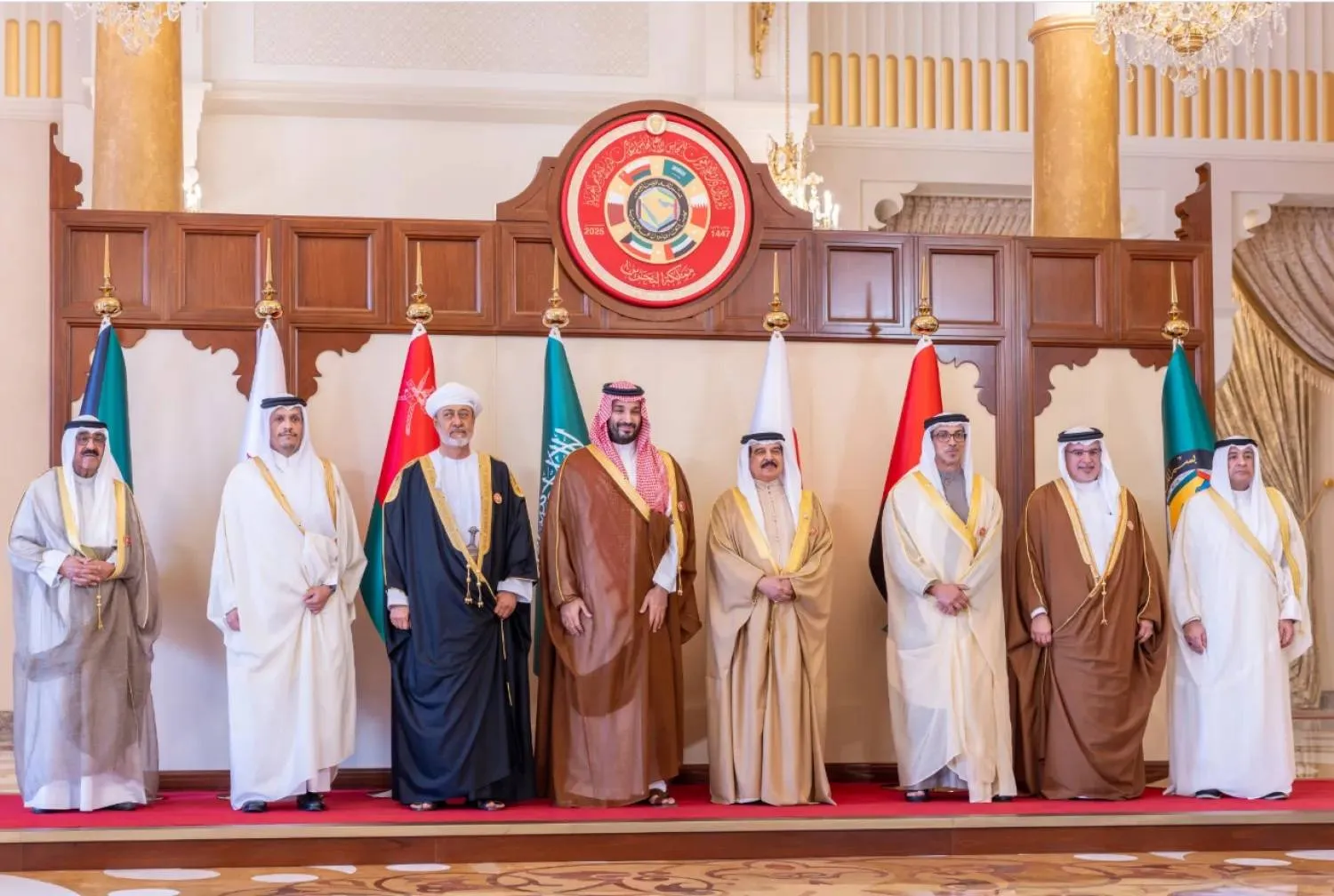
Leaders and representatives of Gulf countries pose for a family photo at the 46th session of the Supreme Council in Al Sakhir. (BNA)
TT

Manama Summit Seeks to Bolster Joint Gulf Work, Int’l Partnerships

Leaders and representatives of Gulf countries pose for a family photo at the 46th session of the Supreme Council in Al Sakhir. (BNA)

Leaders of the Gulf Cooperation Council (GCC) countries convened in Al Sakhir, Bahrain, on Wednesday to underscore the “solid bonds and integration among the members.”

“The leaders underlined their determination to continue advancing coordination and integration among the GCC states across all political, security, economic and social fields, towards the aspired unity that serves their shared fraternal interests and contributes to establishing the foundations of security, peace and prosperity in the region and the world,” said a statement.

“The leaders expressed satisfaction with the achievements made in the course of joint GCC action, including integration milestones realized under a cohesive defense and security system, balanced and prudent diplomatic positions, and sustainable development and economic projects,” it added.

“These achievements reflect the Council’s political cohesion and alignment in vision, objectives and positions on regional and international issues. They also stressed the importance of continuing efforts at an accelerated pace to achieve further gains for the GCC states and their peoples.”

Regional affairs

They underscored respect for the sovereignty of GCC states and all countries of the region, non-interference in their internal affairs, and rejecting the use of force or threats. They stressed that the security and stability of GCC states “are indivisible, and that any infringement upon the sovereignty of a member state constitutes a direct threat to their collective security.”

The leaders welcomed the outcomes of the Sharm el-Sheikh Peace Summit, held in October, and underlined their support for regional and international efforts aimed at ensuring full adherence to the agreement to end the war in Gaza, facilitating the delivery of humanitarian aid and reconstruction.

They expressed full support to “advancing efforts to establish an independent, sovereign Palestinian state on the June 4, 1967, borders with East Jerusalem as its capital in line with the two-state solution, the Arab Peace Initiative, and international resolutions, in a manner that fulfills the aspirations of the Palestinian people and all peoples of the region to live in security and peace.”

Economic affairs

The leaders stressed the importance of completing the requirements of the GCC Common Market and the Customs Union, enhancing trade and tourism, and encouraging investment in strategic projects, particularly in infrastructure, transport, energy, communications, water, and food.

They emphasized boosting digital infrastructure integration, facilitating e-commerce, and supporting the development of shared systems for digital payments and cloud services, contributing to full economic citizenship and comprehensive, sustainable development.

The leaders underscored the significance of continuing economic diversification pathways and strengthening innovation and sustainability-based economies to ensure long-term prosperity for GCC states and their peoples.

They stressed the importance of bolstering cooperation in technology, artificial intelligence, and cybersecurity within the framework of a joint GCC strategy that strengthens knowledge integration, supports the exchange of expertise in digital transformation, combats cybercrime, ensures a secure digital environment for societies, and promotes the effective participation of youth and women in the development process, while emphasizing the role of think tanks and research centers in anticipating the future and formulating public policies that support sustainable development.

Int’l cooperation

The leaders highlighted the importance of strengthening international cooperation to safeguard regional security, deepening political, security, and economic partnerships with friendly countries, international organizations, and economic blocs.

They stressed the need to deepen collaboration in areas of sustainable development, combating extremism and terrorism in all its forms, countering hate speech and incitement, tackling transnational organized crime, and supporting the efforts of joint naval forces headquartered in Bahrain to enhance energy security, protect maritime navigation, and safeguard international trade.

The leaders further stressed working towards making the Middle East a region free of nuclear weapons and weapons of mass destruction, and averting arms races, to reinforce regional security and stability.

The leaders expressed their appreciation for the participation of Italian Prime Minister Giorgia Meloni in bilateral discussions in Bahrain, which focused on strengthening the deep-rooted historical relations. They agreed to establish a joint action plan to elevate relations to a comprehensive strategic partnership aimed at boosting their shared interests, reflecting the GCC states’ openness to building broad partnerships with friendly nations.

The leaders of the GCC states underscored “the need to develop institutional cooperation mechanisms to expand horizons of fraternal solidarity and strategic integration to achieve sustainable security and prosperity for the GCC states and their peoples, within a safe and stable region, and to contribute to building a world that is more just and prosperous.”



Saudi Arabia: High-Level Readiness for Hajj Season

Prince Saud bin Mishaal chairs Hajj and Umrah committee meeting in Makkah
TT

Saudi Arabia: High-Level Readiness for Hajj Season

Prince Saud bin Mishaal chairs Hajj and Umrah committee meeting in Makkah

Saudi authorities on Wednesday reviewed preparedness for this year’s Hajj season, assessing operational plans and readiness indicators as officials called for intensified coordination ahead of the annual pilgrimage.

The permanent Hajj and Umrah committee, chaired by Prince Saud bin Mishaal bin Abdulaziz, examined scenarios already implemented and others planned to ensure full readiness, in a meeting held under directives from Prince Khalid bin Faisal bin Abdulaziz.

Prince Saud bin Mishaal thanked agencies involved in the Ramadan Umrah season, citing extensive logistical and human support from the Saudi leadership that helped deliver smooth operations for visitors to the Grand Mosque.

Officials reviewed Ramadan performance across transport, ambulance and healthcare services, reporting no epidemics or incidents.

The meeting also covered the departure phase of Umrah performers via King Abdulaziz International Airport, and progress on upgrading the Hajj and Umrah terminal complex, with its first and second phases completed.

In Madinah, Prince Salman bin Sultan bin Abdulaziz chaired a parallel meeting of the regional Hajj and Umrah committee, attended by his deputy, Prince Saud bin Nahar bin Saud bin Abdulaziz, to review government preparations for the upcoming season.

Prince Salman congratulated agencies on the success of Ramadan operations, saying coordinated plans enabled visitors to perform rituals in a calm and secure environment.

He said the results reflect sustained leadership support for the Two Holy Mosques and their visitors, highlighting oversight by Prince Abdulaziz bin Saud bin Naif bin Abdulaziz to enhance services and ensure safety.

He stressed the need for full readiness across government, service and volunteer sectors, calling for proactive planning and stronger coordination to reinforce facilities and services in line with the care provided to pilgrims.

The Madinah meeting issued recommendations to support relevant entities and ensure high-quality services for visitors to the Prophet’s Mosque during Hajj.

Prince Salman was also briefed by the Minister of Hajj and Umrah Tawfiq al-Rabiah, accompanied by Pilgrim Experience Program CEO Mohammed Ismail, on a digital dashboard designed to track the readiness of Hajj projects and improve coordination.

Al-Rabiah said the platform enables continuous monitoring through daily updates, including readiness plans and performance indicators, project progress in the holy sites, alignment of operational plans, and integration with a central database.

Prince Salman also reviewed the Hajj and Umrah sector’s indicators platform, which presents real-time data and analysis on services provided to pilgrims. The platform supports decision-making by delivering timely, precise data, enhancing monitoring efficiency and strengthening system-wide readiness within an integrated institutional framework.


UAE Air Defenses Intercept 5 Ballistic Missiles, 35 UAVs

UAE air defenses on Wednesday engaged 5 ballistic missiles and 35 UAVs launched from Iran (AFP).
TT

UAE Air Defenses Intercept 5 Ballistic Missiles, 35 UAVs

UAE air defenses on Wednesday engaged 5 ballistic missiles and 35 UAVs launched from Iran (AFP).

The UAE air defenses on Wednesday intercepted 5 ballistic missiles and 35 UAVs launched from Iran, according to the Emirates News Agency (WAM).

The agency said that, since the start of the Iranian attacks, UAE air defenses have engaged 438 ballistic missiles, 19 cruise missiles and 2,012 UAVs.

A WAM statement said the attacks resulted in the martyrdom of two members of the armed forces while performing their national duty, in addition to the death of a Moroccan civilian contracted by the Armed Forces, as well as nine civilian fatalities of Pakistani, Nepali, Bangladeshi, Palestinian and Indian nationalities.

A total of 190 people were also injured, with injuries ranging from minor to moderate and severe, from various nationalities including Emirati, Egyptian, Sudanese, Ethiopian, Filipino, Pakistani, Iranian and Indian.

The Ministry of Defense affirmed that it remains fully prepared and ready to deal with any threats and will firmly confront anything that aims to undermine the country’s security, in a manner that preserves its sovereignty and stability and protects its interests and national capabilities.


Kuwaiti Foreign Minister Arrives in Riyadh on Official Visit

Photo by SPA
Photo by SPA
TT

Kuwaiti Foreign Minister Arrives in Riyadh on Official Visit

Photo by SPA
Photo by SPA

Kuwaiti Minister of Foreign Affairs Sheikh Jarrah Jaber Al-Ahmad Al-Sabah arrived Wednesday in Riyadh on an official visit to Saudi Arabia.

He was received by Saudi Vice Minister of Foreign Affairs Waleed Elkhereiji at King Khalid International Airport.