


Saudi Arabia Becomes Region’s Key Transit Hub as War Disrupts Gulf Airspace

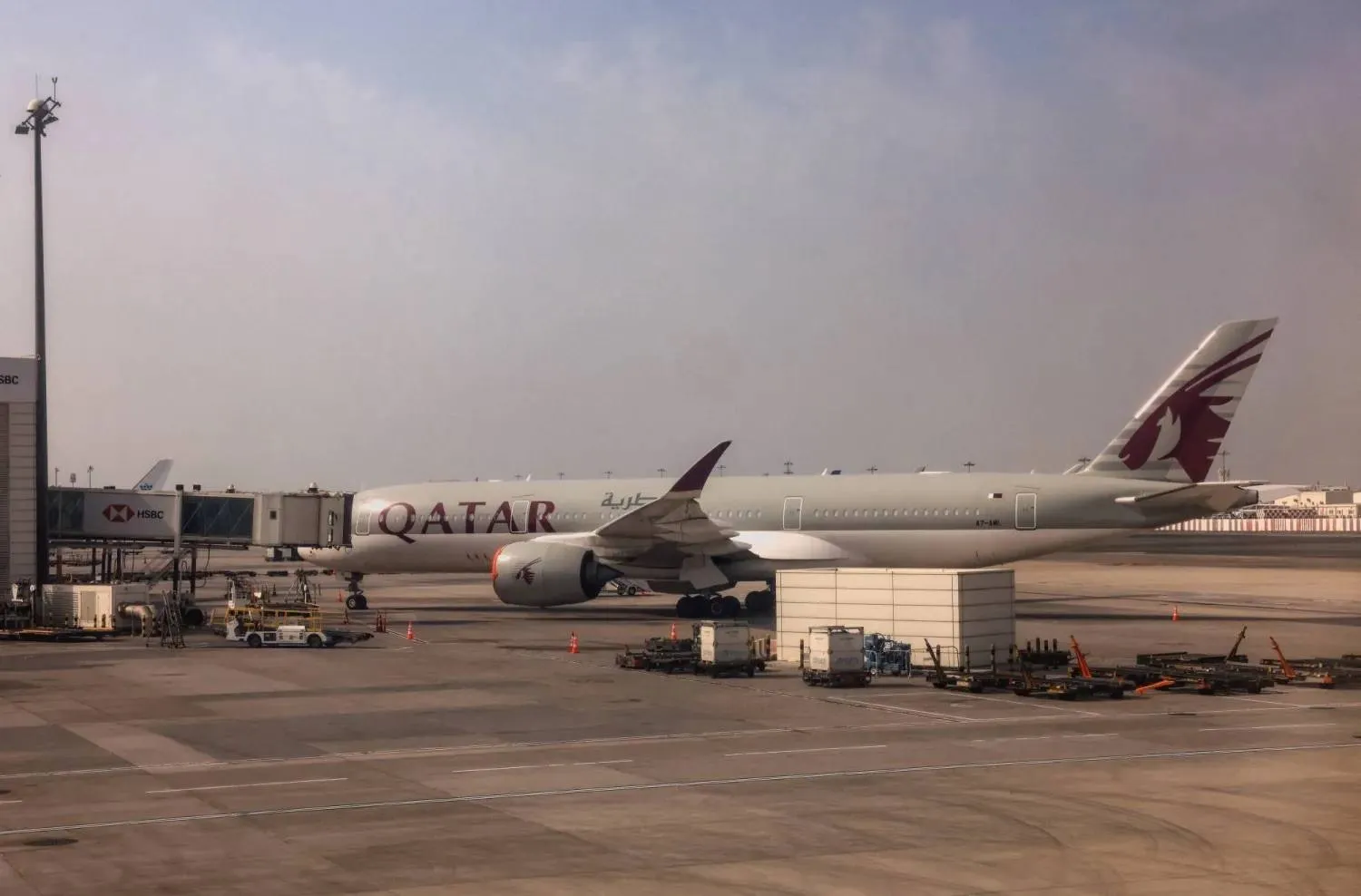
Qatar Airways announces the continued temporary suspension of its flights as airspace closures persist (dpa). 
TT

Saudi Arabia Becomes Region’s Key Transit Hub as War Disrupts Gulf Airspace

Qatar Airways announces the continued temporary suspension of its flights as airspace closures persist (dpa). 

As the war between Iran on one side and the United States and Israel on the other enters its third week, mounting military tensions and disruptions to regional air and maritime routes have pushed Saudi Arabia to the forefront as a critical transit hub.

The Kingdom has become a vital artery for travel and logistics across the Gulf and parts of the Arab world after allowing several Gulf carriers to use its airports and airspace to facilitate incoming and outgoing flights.

Iraq expressed gratitude to Saudi Arabia for facilitating the transit and reception of Iraqi citizens through land and air crossings after Iraqi Airways was permitted to operate flights through Arar Airport in northern Saudi Arabia.

Saudi airports have recorded a noticeable surge in air traffic in recent days as airlines rerouted flights to avoid areas of conflict. On Sunday, Bahrain’s Gulf Air announced it was expanding operations through King Fahd International Airport in Dammam. Earlier, Kuwait’s Jazeera Airways said it would operate through Al-Qaisumah Airport in Hafar Al-Batin in the Kingdom’s Eastern Province.

Meanwhile, air defense systems across Gulf states have intercepted dozens of Iranian missile and drone attacks targeting civilian sites and private property, actions officials say violate international humanitarian law and the United Nations Charter.

Saudi Arabia

Saudi Arabia’s Ministry of Defense spokesperson, Major General Turki Al-Maliki, said air defenses intercepted and destroyed six ballistic missiles and 36 drones targeting Riyadh, the Eastern Province, Al-Kharj and the Empty Quarter within the past 24 hours.

The projectiles were reportedly headed toward the Shaybah oil field in southeastern Saudi Arabia.

Kuwait

Kuwait’s General Directorate of Civil Aviation said Kuwait International Airport was targeted by several drones that struck the airport’s radar system. Authorities said no casualties were reported and that emergency procedures activated since the start of the crisis were implemented in full coordination with relevant agencies.

The Kuwaiti National Guard said its forces shot down five drones in areas under its protection during the same period.

Bahrain

Bahrain’s Defense Force said its air defense systems have intercepted and destroyed 125 missiles and 211 drones since the start of the Iranian attacks.

Separately, Bahrain’s Interior Ministry announced the arrest of five individuals and identified a sixth suspect who fled the country. Authorities said the suspects were involved in gathering and transmitting sensitive information to Iran’s Revolutionary Guard Corps through operatives in Iran and recruiting individuals for terrorist plots targeting Bahrain.

Gulf Air also confirmed it would temporarily expand operations through King Fahd International Airport in Dammam, allowing passengers to book flights through its usual commercial channels. The airline had already operated several repatriation and limited flights through Dammam in recent days to maintain air connectivity while Bahrain’s airspace remains temporarily closed.

United Arab Emirates

The UAE Ministry of Defense said its forces intercepted four ballistic missiles and six drones launched from Iran, adding that the country remains on high alert to confront any threats.

Since the start of the attacks, UAE air defenses have intercepted 298 ballistic missiles, 15 cruise missiles and 1,606 drones, according to the ministry. Six people of various nationalities have been killed.

Authorities also said a fire that broke out at an oil facility in Al-Ruwais in Abu Dhabi after a drone strike last week had been fully contained.

UAE Attorney General Hamad Saif Al-Shamsi ordered the arrest of 25 individuals of various nationalities accused of spreading misleading digital content online that could undermine public security and stability.

Qatar

In Doha, Qatari air defenses said they repelled new Iranian drone attacks. Official figures indicate around 170 missile strikes and 78 drone attacks have been recorded, in addition to an attack by two fighter jets.

Qatar’s Ministry of Defense said Saturday that it intercepted four ballistic missiles and several drones launched from Iran.

Qatar Airways confirmed it will continue temporary suspending flights while the country’s airspace remains closed.

During a visit to the Abu Samra border crossing with Saudi Arabia, Qatar’s Minister of Municipality described the crossing as a vital gateway for goods entering the country and a key pillar for ensuring the steady flow of supplies under all circumstances.


Albudaiwi: Regional Arrangements Excluding Gulf States Are Rejected

Albudaiwi affirmed that Gulf states had long been a pillar of regional and global stability (GCC)
TT

Albudaiwi: Regional Arrangements Excluding Gulf States Are Rejected

Albudaiwi affirmed that Gulf states had long been a pillar of regional and global stability (GCC)

Secretary-General of the Gulf Cooperation Council (GCC) Jasem Albudaiwi on Thursday called for Gulf states to be included in talks or agreements to resolve the crisis between Iran and the US and Israel.

“We stress the importance of involving GCC countries in any talks or agreements to resolve this crisis, in a way that contributes to strengthening their security and stability,” said Albudaiwi.

He added that the bloc rejected “any arrangements intended to redraw the map of the Middle East after the conflict ends.”

He said the GCC’s first choice was a diplomatic and political solution, describing it as “the wisest and most successful option,” while noting that Gulf states were reviewing all options in line with international law and the UN Charter.

Speaking in Riyadh to Arab and foreign ambassadors, Albudaiwi urged partners to send a unified international message to Iran demanding an immediate and unconditional halt to attacks on GCC states.

He said the Gulf’s goal “has never been to destroy Iran or weaken it, but to reach a normal relationship based on mutual respect, non-interference and non-aggression.”

He rejected framing the situation as part of “Middle East complexities,” calling it “a blatant violation of international law” and “a systematic targeting” of states not involved in any conflict.

Albudaiwi said Gulf states would not accept becoming targets of aggression (GCC)

Albudaiwi said GCC states had long been a pillar of regional and global stability, a reliable energy source, and a responsible economic partner. But he said they would not accept becoming targets of aggression, arenas for regional rivalries, or seeing their citizens killed without accountability.

He said Iranian attacks over 25 days had exceeded 5,000 ballistic missiles and drones targeting GCC states.

Albudaiwi revealed that 85% of Iranian missiles launched in the war were aimed at Gulf states.

He praised Gulf air defenses for limiting the impact of the attacks, but said that this does not diminish the scale of the aggression or absolve Iran of full responsibility.

He said Iran had “crossed every line” by closing the Strait of Hormuz, blocking commercial ships and oil tankers, and imposing transit fees, in violation of international law.

He also cited repeated ship hijackings and attacks carried out through Iran’s regional proxies.

He warned that disruption to shipping would hit not only Gulf states but the global economy, especially as some countries face oil and gas shortages.

Albudaiwi explained that maritime passages are governed by international agreements, and no party can obstruct them or impose conditions.

The impact of closing the Strait of Hormuz may begin with higher energy prices, but its cumulative repercussions on the global economy, energy markets, marine insurance, and civil aviation would be catastrophic.

“What happens in the Strait of Hormuz does not stay in the Strait of Hormuz,” he added.

Albudaiwi said Gulf states were surprised by US and Israeli strikes on Iran, stressing they had made clear they would not take part in military action or allow their territory to be used against Iran, and had informed Tehran of that.

“Yet this position did not prevent it from attacking GCC states,” he said.

He said GCC states had shown restraint and chosen not to respond to avoid widening the conflict, and in the hope that Iran would come to its senses and stop these attacks.

He said Gulf states produce about 16 million barrels per day of crude oil, or 22% of global output, and account for 27% of global oil exports, or 11.5 million barrels per day.

They also hold 33% of global oil reserves and 21% of natural gas reserves.

These figures make the Gulf an indispensable pillar of the global economy, Albudaiwi affirmed, warning that any disruption would directly affect energy security and global economic stability.


Zelenskyy Arrives in Jeddah

Ukrainian President Volodymyr Zelenskyy in Kyiv (AFP)
TT

Zelenskyy Arrives in Jeddah

Ukrainian President Volodymyr Zelenskyy in Kyiv (AFP)

President Volodymyr Zelenskyy of Ukraine arrived in Jeddah Thursday. At King Abdulaziz International Airport, he was welcomed by Deputy Governor of Makkah Region Prince Saud bin Mishaal bin Abdulaziz and several other officials.

Zelenskiy said he would hold "important meetings" in the Kingdom as part of an effort to bolster ties with Middle East countries amid the Iran war.

"Arrived in Saudi Arabia. Important meetings are scheduled. We appreciate ⁠the support and support ‌those who ‌are ready to work ​with us ‌to ensure security," Zelenskyy wrote ‌on X.

Rustem Umerov, the head of Ukraine's National Security and Defense Council, accompanied Zelenskiy on the ‌visit.


Saudi FM Discusses Regional Developments with his French, Canadian Counterparts

Saudi Foreign Minister Prince Faisal bin Farhan (Asharq Al-Awsat)
TT

Saudi FM Discusses Regional Developments with his French, Canadian Counterparts

Saudi Foreign Minister Prince Faisal bin Farhan (Asharq Al-Awsat)

Saudi Minister of Foreign Affairs Prince Faisal bin Farhan bin Abdullah met on Thursday with France's Minister for Europe and Foreign Affairs Jean-Noël Barrot on the sidelines of his participation in the Group of Seven (G7) ministerial meeting held France.

During the meeting, they reviewed relations between the two countries, along with ways to strengthen and develop them.

They also discussed the latest developments in the region and ongoing efforts in this regard.

According to SPA, the Saudi minister also met with Canadian Minister of Foreign Affairs Anita Anand.

During their meeting they reviewed cooperation between the two countries in various fields, in addition to discussing the latest developments and issues of common interest.
