


Andrés Iniesta Begins Glorious Goodbye as an Era Draws to a Close

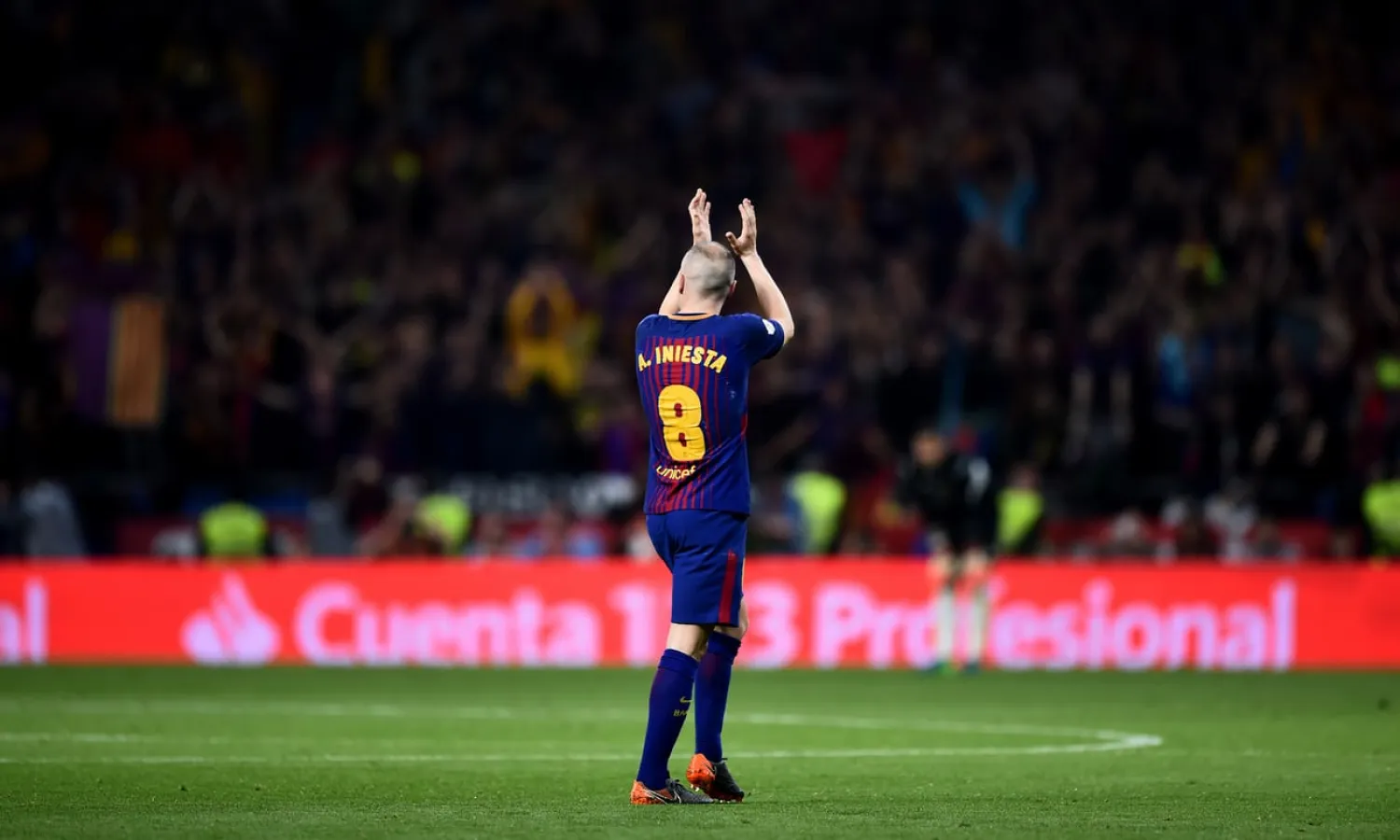
 Andrés Iniesta is given a standing ovation in Madrid after starring in Barcelona’s 5-0 Copa del Rey final victory over Sevilla. Photograph: Denis Doyle/Getty Images
Andrés Iniesta is given a standing ovation in Madrid after starring in Barcelona’s 5-0 Copa del Rey final victory over Sevilla. Photograph: Denis Doyle/Getty Images
TT

Andrés Iniesta Begins Glorious Goodbye as an Era Draws to a Close

 Andrés Iniesta is given a standing ovation in Madrid after starring in Barcelona’s 5-0 Copa del Rey final victory over Sevilla. Photograph: Denis Doyle/Getty Images
Andrés Iniesta is given a standing ovation in Madrid after starring in Barcelona’s 5-0 Copa del Rey final victory over Sevilla. Photograph: Denis Doyle/Getty Images

There were two minutes to go in the final, his final, when Andrés Iniesta began the long walk goodbye.

Slowly, swallowing hard, eyes red, he made his way across the pitch, team-mates coming to embrace him as he went, and all around the Metropolitano supporters got to their feet, applauding. They stood in the Barcelona end and they stood in the Sevilla end too. Iniesta’s name rolled around, accompanying him until he ducked out of sight, taking a seat on the bench. He sat there for a little while, tears forcing their way through, and then he got up again and went to collect the Copa del Rey, alone.

It was the 34th title of his career and a 35th will follow, but it was this one that felt like it marked the end: the last waltz. As he climbed up to collect the trophy, down on the grass Barcelona’s players waited for him, much as they had waited for him when, 51 minutes into his 670th game for Barcelona, he scored the fourth goal, ensuring this would always be his night: the Iniesta Final.

Collecting Lionel Messi’s pass, with a gentle shift of the hips, just a hint of a pause, he stepped past David Soria and rolled the ball in. He jumped into the air and at some point in that leap, sadness crept into the celebration, nostalgia flooding the stadium. They knew what this meant.

Any doubt disappeared when they saw the Barcelona’s players’ reaction, more eloquent than anything they could have said. “There were a lot of emotions in that goal,” Iniesta admitted. “Lots of emotions, lots of feelings, lots of years. I really wanted this final to go well and I’m happy.” The normal huddle broke up and then, almost one by one, they waited for Iniesta, a moment each. Eyes closed, Messi held him in an embrace that may become the image of the final, maybe even a generation; he held on just that little bit longer, like he didn’t want to let go.

There was something in that. In good times and bad Messi looks for Iniesta, and in bad times above all. It is in those moments when he seeks security, assurance, that he most wants the Spaniard at his side. “I know how difficult it is to do what he does,” Messi says in Iniesta’s book, The Artist.

“On the pitch I like him to be near me, especially when the game takes a turn for the worse, when things are difficult. That’s when I say to him: ‘Come closer.’ He takes control and responsibility.”It is a simple solution, successful for well over a decade and expressed on Saturday night, like a portrait of their era, Barcelona producing a performance that may have been as good as any since Wembley 2011. And yet time waits for no man, not even the man who sometimes seemed able to control it. You can slow the clock, but not stop it and when Messi looks for Iniesta next season, he will no longer be there … he’ll be 5,000 miles away; 22 years after arriving, 18 after meeting Messi, 16 since his debut, Iniesta is leaving Barcelona for China. An announcement is expected this week.

At 33, a starter in 24 of 33 league games and eight of 10 in the Champions League, on course to win a league and cup double, it may have come too soon. That, certainly, was the conclusion drawn after Saturday. China looks incongruous. The headline on the front of Sunday’s AS said it all: “Iniesta, don’t go!” But the appeals for him to stay will also reinforce his belief this is the right time to go. The right way, too: remember me like this.

Although Iniesta wouldn’t say so, something broke last year, and while a momentary fix was found, a “lifetime” contract signed and his role renewed, he didn’t want to leave too late, a long goodbye from the bench. Nor did he ever want to face the club he joined aged 12.

Iniesta described that day in September 1996 when he arrived at La Masia as the worst of his life. José Bermúdez, another resident, remembered him as “pale, tiny and sad, delicate and sensitive”. Iniesta couldn’t stop crying. A few hundred metres away in the Hotel Rallye, nor could his parents. His father, José Antonio, couldn’t sleep and the same went for Andrés’s grandfather. Together, they planned to go and get him, take him home. Mari, Iniesta’s mum, stopped them. “Let him try,” she insisted. So, they did.

They took him to school the next morning and then headed home to La Mancha. Iniesta felt abandoned when they weren’t there to pick him up that afternoon. Victor Valdés was there at the start. “His success was forged through silent tears,” Valdés says. It is some success. There have been two trebles as well, and the World Cup and the European Championship, twice in a row. Which makes it sound almost as easy as his football makes it look, but it hasn’t been.

Iniesta does not use the word depression but he has spoken eloquently about the “dark place” he was in before the 2010 World Cup, how he felt in “freefall”. He went into the 2009 Champions League final with a hole in his thigh, ordered not to shoot. He reached the World Cup struggling with injury, running around hotel corridors in the middle of the night, unseen by team-mates, trying to prove his fitness to himself. It says something that Vicente Del Bosque said he would wait for him, as long as it took; it says something too that when he suffered an injury 17 days before the 2009 final, Pep Guardiola insisted: “He plays.”

He played, the way only Iniesta could, the way that became symbolic of a generation: arguably the best that football in Spain, maybe anywhere, has seen. “An era departs with him,” said AS’s match report. “A style, too. A way of playing and a way of life.” After Rome, Alex Ferguson talked about how “he and Xavi get you on that carousel” and he experienced that again at Wembley in 2011, an era-defining display revived on Saturday.

In South Africa, he scored the winning goal, 116 minutes into the final, peeling off his shirt to reveal a vest underneath. “Dani Jarque, always with us,” it said, written by the physio Hugo before kick-off for Iniestain honour of the Espanyol captain, his friend, who had passed away after a sudden unexpected heart attack. Jarque’s wife Jessica watched the match on TV, her first in a year since his death. “Seconds before the goal, I knew it was coming. I started to cry before you scored,” she told Iniesta. As the ball sat up, he said he heard “the silence”.

And then he scored. The goal.

“Iniesta is leaving us,” ran one headline last week; the key word was “us”.

Iniesta is applauded at every stadium in Spain, but not just because of that goal and it is not just Spain. It happened in Turin and Lisbon too, and at the Bernabéu. On Saturday, it happened again; it was not the first time but it felt like the last, a touch of melancholy. “The last emperor,” Marca called him. “How happy he made us. Something in your soul dies when a friend goes; nothing will ever be the same,” one editorial read last week – and that too was in Madrid.

Iniesta belongs to everybody, like some shared treasure, held close but enjoyed together. Luis Enrique called him “world heritage”. When the goal went in on Saturday, on Cadena Ser radio the commentator joined those chanting his name. “The scriptwriter has done it; this final needed this moment,” Lluis Flaquer said. “Iniesta! Iniesta! Iniesta! We can’t leave here without joining in the chant, which is the chant of all football lovers, dedicated to a universal manchego.”

It is the player and the person, the way he is, that helps explain that. He is every man’s in part because he is everyman: there’s a normality about him which is not entirely normal in football, and he is universally admired. “He’s an amazingly good person; someone kicks him and he’s the one who says sorry,” Samuel Eto’o insists. Sergio Ramos disagrees: “You can’t kick him; it’s Andrés,” he says.

After Spain defeated Croatia at Euro 2012, Ivan Rakitic, still not the club-mate he would become said: “We can play against all of them, but against Iniesta it is different. He is another level again. He has everything: he’s so fast, he thinks so quickly, he’s in control.” That day, Fernando Torres noted: “When he has the ball, it’s like everything else stops. I’ve known him for 15 years and he’s never, ever had a bad game.” On Saturday, Vicenzo Montella described him as an “extra-terrestrial”.

Sometimes, though, it’s more than words. Some years ago now, Iniesta was recording a video, explaining to the camera as he walked through the move where he shifts the ball from one foot to another and back. He came to the defender, a fellow Barcelona player, and went past him. Swish, swish, and he was gone. He was “walking” everyone through it but it still happened so fast as to be almost imperceptible. There was something of that in Saturday’s goal; the ball doesn’t even change direction much; the defender does, as if Iniesta is controlling him too. That day, there were only five or six people there but there was an audible gasp – from professional players.

“Bloody hell,” one spat out.

There is work behind it but Iniesta believes it’s intuitive. “What I did at 12, I still do now,” he says. What he does delights; it also creates a sense of quiet awe, even among those for whom football holds fewer secrets. Del Bosque says it is like he is watching the game from the stands while still on the pitch, a player of “uncommon intelligence and awareness”. Paco Seirulo, fitness coach at Barcelona, talked about his “mastery of the relationship between space and time”.

The day that Iniesta was first invited to train, Luis Enrique was sent to pick him up at the gate because otherwise the security guard, Antonio, wouldn’t have let him past. Luis Enrique later called him “Harry Potter” but doesn’t recall it, despite Guardiola urging team-mates: “Remember this day, the day you first played with Andrés.” Guardiola knew; he’d been encouraged by his brother Pere to see Iniesta a few years before. As he left, he came across a friend. “I’ve just seen something incredible,” he said. That day, Guardiola also famously told Xavi: “You’re going to retire me. This lad is going to retire us all.” Now, after 670 games, Iniesta is going too. He goes like this, playing his way.

“He’s a phenomenon, a force of nature: no one plays like him and no one can compare to him,” wrote Xavi, the man who was closer to him than any other, who with Iniesta defined a generation. “Sometimes I get the feeling Andrés doesn’t realise how important he is: one day he’ll retire and we’ll see the magnitude of what he has done.” He surely knows now, as that day draws closer: he saw it on Saturday. “It’s emotional to see the affection and respect people have for me,” he said.

There is not long left, they know. Soon, maybe too soon, Messi will look across and see an empty space. They all will.

The Guardian Sport


Rodrygo Scrapes Real Madrid Win at Alaves

Real Madrid's Brazilian forward Rodrygo secured the visitors a much-needed victory at Alaves. ANDER GILLENEA / AFP
TT

Rodrygo Scrapes Real Madrid Win at Alaves

Real Madrid's Brazilian forward Rodrygo secured the visitors a much-needed victory at Alaves. ANDER GILLENEA / AFP

Kylian Mbappe and Rodrygo Goes's goals earned Real Madrid a tense 2-1 win at Alaves in La Liga on Sunday to potentially keep coach Xabi Alonso in his job.

Second-placed Madrid trimmed league leaders Barcelona's advantage back to four points and recorded only their third victory in the last nine games across all competitions.

After a home defeat by Manchester City in the Champions League on Wednesday, Spanish media reported that anything but a victory would cost Alonso his position, AFP said.

After Mbappe's superb opener, Carlos Vicente pulled Alaves level in the second half, but Rodrygo secured the visitors a much-needed victory at Mendizorroza stadium.

"It was a hard-fought game, we competed well, got in front and then lost a bit of control," Alonso told reporters.

"Alaves play with a lot of intensity, it's hard to dominate throughout. We came here to win and we got the three points."

The coach said, as he did after the City game, that he has the support of his squad.

"We're all together in this. One game isn't enough to change the dynamic," he said.

"Now before the winter break we have a cup game on Wednesday, and a game at home (in La Liga to come)."

Alonso was able to bring his key player, Mbappe, back into the side after he could only watch the defeat by City from the bench because of a painful knee.

The coach also handed a debut to Victor Valdepenas at left-back, with both Alvaro Carreras and Fran Garcia suspended, and Ferland Mendy one of several players out injured.

Mbappe appeared to be feeling his knee and also hobbling in the first few minutes but, despite that, was the game's most influential player.

The forward had a shot deflected wide and then fired narrowly over as Alaves sat deep and tried to keep the 15-time European champions at bay.

By the time Mbappe opened the scoring in the 25th minute, his discomfort seemed to have cleared up.

Released by Jude Bellingham, Mbappe drove towards goal at full tilt and whipped a shot into the top right corner for his 17th league goal of the campaign.

England international Bellingham then blasted home from close range but his strike was ruled out for handball.

Needing to fight back, Alaves moved on to the front foot and took control of the game before the break, almost pulling level.

Madrid goalkeeper Thibaut Courtois made a fine save with his head, even if he knew little about it, to deny Pablo Ibanez from close range.

Tight battle

Los Blancos were dangerous again soon after the interval, with Alaves goalkeeper Antonio Sivera saving well from Mbappe and then Vinicius Junior.

Real came to rue those misses when Vicente pulled Alaves level after 68 minutes.

The forward got in behind Antonio Rudiger, controlled former Madrid midfielder Antonio Blanco's chipped pass and whipped a shot past Courtois.

Eduardo Coudet's side almost took the lead when Vicente's low cross from the right was nudged wide by Toni Martinez, who was nudged off-balance by Raul Asencio's pressure.

Instead, Madrid pulled back in front, with Vinicius breaking in down the left and crossing for Rodrygo to finish from six yards out.

It was the Brazilian's second goal in two games after going the previous 32 matches without finding the net, and a tense Alonso celebrated wildly, knowing that his future could depend on it.

Vinicius had appeals for a penalty turned down as he fell under a challenge from Nahuel Tenaglia, and Bellingham came close in stoppage time as Madrid tried in vain to ease their nerves by putting the game to bed.

"I thought it was a clear penalty, Vini was going very fast, there was contact... it surprises me that it didn't go to VAR," said Alonso.

Third-place Villarreal's visit to Levante was postponed because of a weather warning in the Valencia region.

Real Oviedo, 19th, sacked coach Luis Carrion after a 4-0 hammering at Sevilla.

On Saturday, champions Barcelona beat Osasuna 2-0 to win a seventh straight La Liga game and ensure that they will lead the table into 2026, regardless of what happens in the final round of fixtures before the winter break.


Bayern Goalkeeper Neuer Set to Miss Last Game of Year with Hamstring Injury 

14 December 2025, Bavaria, Munich: Bayern Munich goalkeeper Manuel Neuer warms up ahead of the German Bundesliga soccer match between Bayern Munich and FSV Mainz 05 at the Allianz Arena. (dpa)
TT

Bayern Goalkeeper Neuer Set to Miss Last Game of Year with Hamstring Injury 

14 December 2025, Bavaria, Munich: Bayern Munich goalkeeper Manuel Neuer warms up ahead of the German Bundesliga soccer match between Bayern Munich and FSV Mainz 05 at the Allianz Arena. (dpa)

Bayern Munich goalkeeper Manuel Neuer could miss his team's last game of the year because of a hamstring tear.

The club said on Monday that the injury to Neuer's right hamstring was confirmed by a medical examination after the 39-year-old club captain played the entirety of Sunday's 2-2 draw with Mainz. That was a rare case of the unbeaten Bundesliga leader Bayern dropping points.

Bayern said Neuer would be unavailable “for the time being,” without giving further information on the severity of the injury.

The visit to Heidenheim in the Bundesliga on Sunday is the club's last before the winter break.

The German champion is next in action on Jan. 11 against Wolfsburg.


Mbeumo Faces Double Cameroon Challenge at AFCON 

Football - Premier League - Wolverhampton Wanderers v Manchester United - Molineux Stadium, Wolverhampton, Britain - December 8, 2025 Manchester United's Bryan Mbeumo reacts. (Action Images via Reuters)
TT

Mbeumo Faces Double Cameroon Challenge at AFCON 

Football - Premier League - Wolverhampton Wanderers v Manchester United - Molineux Stadium, Wolverhampton, Britain - December 8, 2025 Manchester United's Bryan Mbeumo reacts. (Action Images via Reuters)

Manchester United star Bryan Mbeumo must handle the twin challenges of scoring and captaincy when playing for Cameroon at the 2025 Africa Cup of Nations in Morocco this month.

With veteran striker Vincent Aboubakar surprisingly axed, the responsibility for scoring falls heavily on the 26-year-old who moved to Old Trafford from Brentford last July.

Goals have been hard to come by for the Indomitable Lions lately as they failed to find the net in two crucial 2026 World Cup qualifiers.

Needing maximum points at home against Angola two months ago to have any hope of automatic qualification, Cameroon managed only a 0-0 draw.

Given a second chance to qualify a month later as one of the best four African group runners-up, Cameroon fell 1-0 to the Democratic Republic of Congo in a play-off and were eliminated.

For Cameroon supporters, recalling the past exploits of star strikers like Roger Milla, Patrick Mboma and Samuel Eto'o, consecutive blanks were difficult to accept.

Mbeumo started in both matches, but poor service from midfield and tight marking meant scoring opportunities were scarce.

Aboubakar was the eight-goal leading scorer in the 2022 AFCON as hosts Cameroon finished third behind Senegal and Egypt.

It was an outstanding performance in the modern era of the premier African football tournament, finishing just one goal shy of matching the 1974 record of Congolese Ndaye Mulamba.

But Mbeumo was left without a potentially key partner in attack when new Cameroon coach David Pagou omitted Aboubakar from the Morocco-bound squad.

- Low morale -

"We wanted to do things differently. They are good players, but we set our sights on others to create a different mindset," said Pagou, referring to Aboubakar and goalkeeper Andre Onana.

While Mbeumo seeks goals in Group F against Gabon, title-holders Ivory Coast and Mozambique, he must also shoulder the additional responsibility of succeeding Aboubakar as captain.

He must lift a team whose morale is low after their failure to qualify for the World Cup in the United States, Canada and Mexico.

Cameroon hold the African record for World Cup appearances with eight. Losing out to Group D winners Cape Verde, a west African archipelago with a population of just 525,000, was a bitter blow.

Mbeumo was born in eastern France to a Cameroonian father and a French mother, making him eligible to represent either country.

He played underage football for France before switching his international allegiance to Cameroon. His highlight so far with the Indomitable Lions was competing at the 2022 World Cup in Qatar.

At club level, he spent one season with Troyes in France, then six with Brentford, helping the London club gain promotion to the Premier League.

He formed a dynamic attacking partnership with Democratic Republic of Congo winger Yoane Wissa at the Bees -- both scored in the same match six times last season.

It was a feat matched only by Liverpool pair Mohamed Salah and Cody Gakpo in the 2024-25 Premier League.

His six goals this season for United include a brace in a 4-2 home victory over Brighton.
