


South America’s World Cup Is Over but Uruguay Are an Example to Everyone

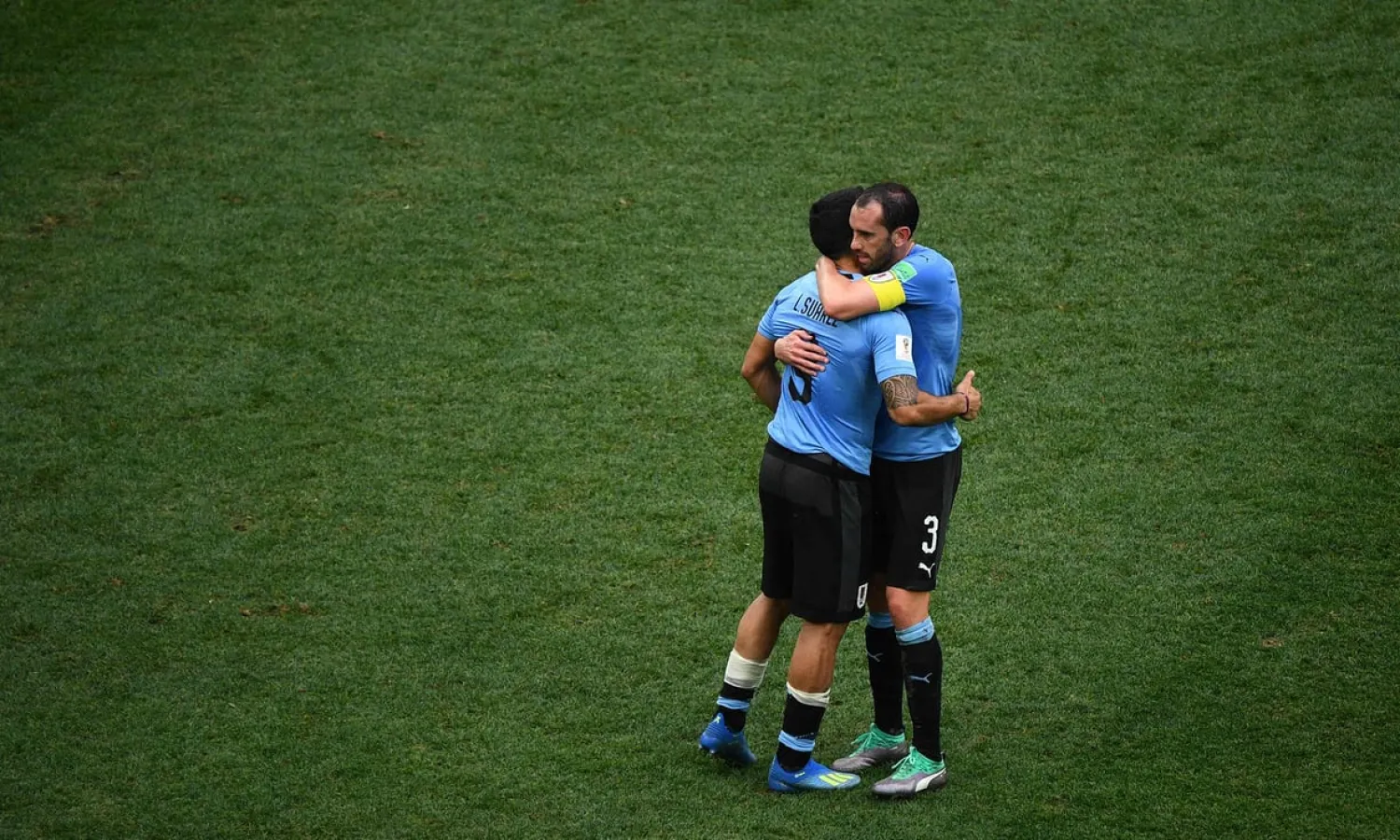
Luis Suárez, left, and Diego Godín react embrace after the defeat to France in the World Cup quarter-final. Photograph: Johannes Eisele/AFP/Getty Images
TT

South America’s World Cup Is Over but Uruguay Are an Example to Everyone

Luis Suárez, left, and Diego Godín react embrace after the defeat to France in the World Cup quarter-final. Photograph: Johannes Eisele/AFP/Getty Images

It was Italia 90 and I was in Milan for the World Cup. I had been there for three weeks and my head was full of football. I needed a moment’s peace and a double espresso, so I ducked into a small café. There were few customers and, at one end, a television showing football in black and white. I turned my back on it all and waited for my coffee in silence, thinking about nothing in particular. Suddenly, a piercing scream scared the life out of me. Something had happened. I turned around and realized that the noise was the most decontextualized goal celebration I had heard in my life. Still in shock, I saw him shouting – the “goal” not yet over. It had to be some madman. Only, it wasn’t … or perhaps it was.

A Uruguayan was cheering Alcides Ghiggia’s goal from the 1950 World Cup final on the television. When he had finally finished, he approached with that Uruguayan austerity I admire so much and said to me: “Sorry, it’s just that every time I see a Uruguay goal I celebrate as if it was the first.” His name was Mario, I never forgot that half an hour we spent together and I remember him every time Uruguay score a goal on the television. He came to mind again this weekend, watching Uruguay get knocked out by France. Perhaps more importantly, he came to mind watching Brazil get beaten too.

I adore Uruguayan football and those expressions of love for a game that always feels like an amateur pursuit with them, even if they’re lifting the World Cup. The achievements of Uruguayan football take on a glorious dimension. The names of the stages on which they wrote their history echo in the memory like a drum on a battlefield: “Colombes”, “Centenario”, “Maracanã”. Just recalling the names of heroes such as José Nasazzi and Obdulio Varela builds statutes in shorts.

But let’s bring Obdulio down from his plinth so that we can see what these heroes are made of.

When the most epic moment of Uruguayan football came, the famous Maracanazo, his figure took on heroic proportions. “There are 11 of them and 11 of us too” he told his teammates in the tunnel, adding: “they’re made of wood”. Outside were 200,000 Brazilians who had no doubt that glory awaited them that day. But glory awaits no one. You have to go and find it. Legend has it that in the silence after Uruguay scored, Obdulio could be heard asking for “more blood”. Given that every time we talk about Uruguay we talk about Garra Charrúa, that warrior spirit, it is appropriate to clarify here that the blood he demanded was that of his team-mates, not his opponents.

In the midst of that surreal atmosphere, described as the “Waterloo of the tropics”, Ghiggia scored the goal that my friend Mario celebrated, for the umpteenth time. Obdulio was the incarnation of a great player. To define what it is that makes a great team, you need only hear the story of Jorge Fucile during the 2010 quarter-final when Uruguay played Ghana. Fucile offered to sacrifice himself, volunteering to take the place of condemned man and cause celebre Luis Suárez. You will remember it: in the last second of the game, Suárez reached out with his hand to make a save on the goalline. Penalty, red card. With swift reflexes sharpened over thousands of games on the street, Fucile approached the referee and said: “You’re right, sir. It was me: send me off.” It didn’t work but that’s not really the point. The theory says that to be a true team-mate, you have to be prepared to subsume your individuality into that of the group, to put yourself at the service of the collective. Fucile did something that goes well beyond that: he was prepared to sacrifice the natural desire for glory that every footballer feels at a World Cup because he understood that Suárez was more necessary than he was in that battle and, if it came to it, in the next battle too. Ghana missed the penalty and Uruguay went through.

In 2018, Uruguay are still Uruguay. At this World Cup, they were the same collective they always were, a lesson in life and in defeat too. They appeared at the team hotel in shorts and flip flops, drinks of mate in hand. I feel admiration every time I see the first team to encounter footballing glory living with such extraordinary normality. Extraordinary and normality might seem mutually contradictory terms, but in this case and in these times they go together because remaining so normal having reached a footballing level this high is an almost heroic feat. And this is a subject worth pursuing. Given that more than one team departed the World Cup because of the sin of frivolity, afflicted by something approaching vanity, Uruguay pose a question: could it be that humility is more important than we think?

They have departed now, it is true. But they did so on the same day as Brazil – a nation of three million against a country of 208 million. None of the countries in the Americas that dwarf them outlasted them. This is a loss, yes. But it is a lesson too. Uruguay are different, unique. They may lack the resources that others on the continent have in abundance, but they have something that those nations do not, that the rest could benefit from embracing. That allows Uruguay to compete, yet it goes beyond the pitch. It is lasting.

The first person raising the flag of normality is Maestro Tabárez, a likable leader. When he finds himself before a group of players, rather than an exhibition of power, the only means of leadership acceptable to him is one founded upon knowledge and a strict sense of justice. And justice can only be imparted through meritocracy. Tabárez is the embodiment of the typical Uruguayan and he knows the human and professional qualities of his players like no one else after 12 years in charge. Tabárez is as concerned with educating the man as he is with educating the player. He never over-acts, never seeks to create a scene: the best example of that are his words after defeat to France: “this dream is over, others will come.” Football in its rightful place in society.

This Uruguay is the proud daughter of its footballing history and its way of understanding the game. They departed having given everything: that may not be enough to win, but it is enough to know that there is no regret and no reproach. They fought for every centimeter of turf; killed for every ball; never felt like visitors anywhere.A real team, with class and spirit, which showed a superior talent and warrior’s ambition in both areas. In their own, Diego Godín and José María Giménez defended as if the area was sacred territory; in the opposition’s, Suárez and Edinson Cavani invaded as if conquered territory was the gateway to paradise.

Cavani’s absence in the quarter-final left them blind in one eye but there was not one complaint, not a single lament. I have named two centre-backs and two centre forwards but the bad news, the very bad news, for their opponents is that the other seven players are also Uruguayan. And when they went, Uruguay left something. A lesson. They are footballers and they are people and they got there with their play and their personality too, the history and character that built them. The identity that Mario celebrated that day and every day. If England had made the grand final against Uruguay, I have no idea what the score would have been, but I know one thing: at the end of the game they would have regretted teaching that lot how to play football.

(The Guardian)


FIFA Launches $60 Ticket Tier amid Criticism of 2026 World Cup Pricing 

13 December 2024, Switzerland, Zurich: The FIFA logo is seen on the façade of FIFA headquarters before the draw ceremony for the 2026 FIFA World Cup qualifiers. (dpa)
TT

FIFA Launches $60 Ticket Tier amid Criticism of 2026 World Cup Pricing 

13 December 2024, Switzerland, Zurich: The FIFA logo is seen on the façade of FIFA headquarters before the draw ceremony for the 2026 FIFA World Cup qualifiers. (dpa)

FIFA introduced on Tuesday a small number of $60 "Supporter Entry Tier" tickets, aiming to make next year's World Cup more affordable for fans of qualified teams.

Football's governing body said that the discounted tickets would cover all 104 matches of the tournament, including the final.

The cheaper tickets will make up 10% of Participating Member Associations' (PMAs) allocations.

The PMAs, which represent competing national teams and manage dedicated fan ticket programs, will handle the ticket allocation process.

They will also define their own criteria to prioritize tickets for "loyal fans" closely connected to their national teams.

"In total, half of each PMA's ticket allocation will fall within the most affordable categories: 40% under the Supporter Value Tier and 10% under the new Supporter Entry Tier," FIFA said in a statement.

"The remaining allocation will be split evenly between the Supporter Standard Tier and the Supporter Premier Tier," it added.

Fans who apply through PMA ticketing programs and whose teams fail to progress to the knockout stage will have administrative fees waived for refund requests.

The announcement comes amid growing scrutiny of ticket pricing ahead of the 2026 tournament, set to take place from June 11 to July 19 across Canada, Mexico, and the United States. Last week, Football Supporters Europe (FSE) accused FIFA of imposing "extortionate" ticket prices that could prevent average fans from attending the event.

'STEP IN THE RIGHT DIRECTION'

FSE director Ronan Evain told Reuters on Tuesday that while the new pricing was a step in the right direction, it was "clearly not sufficient".

He noted that following a team to the final would cost $480 under category four, but jumps to $6,900 for category three, meaning one fan "sitting in the same section" as another could pay 15 times more.

Evain also said there was a lack of transparency around ticket distribution.

"FIFA doesn't provide any guidelines or obligations for the PMAs. They have the freedom to choose how they distribute the tickets," he said.

According to the BBC, this will mean about 400 of the cheaper tickets will be available for England and Scotland in their group games, yet Evain said that most PMAs don't disclose the number of tickets.

FIFA said in its statement on Tuesday that PMAs were requested to ensure that these cheaper tickets were "specifically allocated to loyal fans who are closely connected to their national teams".

Evain also raised concerns about accessibility for fans with disabilities. "The cheapest they can get all the way to the final is $7,000 and they also must pay full price for companion seats, meaning that following a team to the final could cost $14,000," he said.

Reuters has put Evain's points to FIFA for comment.

Despite the backlash, FIFA reported strong interest in the sale's third phase draw, which began on December 11 and will remain open until January 13, driven by the release of match schedules, venues and kick-off times.


Norris Steps up as a Fresh Champion for Formula One’s New Era 

Formula One F1 - Abu Dhabi Grand Prix - Yas Marina Circuit, Abu Dhabi, United Arab Emirates - December 7, 2025 McLaren's Lando Norris celebrates after becoming the 2025 Formula One World Champion (Reuters)
TT

Norris Steps up as a Fresh Champion for Formula One’s New Era 

Formula One F1 - Abu Dhabi Grand Prix - Yas Marina Circuit, Abu Dhabi, United Arab Emirates - December 7, 2025 McLaren's Lando Norris celebrates after becoming the 2025 Formula One World Champion (Reuters)

Lando Norris stepped up as a first-time world champion in 2025 to end Max Verstappen's four-year reign and lead Formula One into a new era.

Whether the McLaren driver can do it again remains a big question.

The title did not come easy to the 26-year-old as he made a dream come true in a rollercoaster season of highs and lows, the wins accompanied also by mistakes and misfortune in a three-way battle.

Even as the Briton celebrated beating Red Bull's Verstappen by two points, and Australian teammate Oscar Piastri by 13, Norris recognized it could be a one-off.

Formula One, set to expand to 11 teams with the arrival of Cadillac, is facing a major reset next year with a new generation of engines and the biggest technical upheaval in decades.

The usual suspects are likely to stay competitive, but nobody really knows who will be ahead in 2026.

MCLAREN'S FIRST TITLE DOUBLE SINCE 1998

"It could be my only opportunity in my life that I get to do such a thing," Norris said of putting the champion's number one on his car next season.

"I have a lot of faith in my team and we've achieved a lot in the last few years together. And I'm confident we will achieve a lot more together. But Formula One is unpredictable. You never know how much things can change. You never know what can happen."

McLaren have won two constructors' crowns on the trot and this year sealed the team and driver's title double for the first time since 1998.

While Norris and Piastri were the only ones to lead the standings, and the Briton was a deserving champion, Verstappen provided some of the standout moments with one of the great comebacks in the sport's 75-year history.

"Championships are important, but they do not tell the whole story. Sometimes the best driver does not win the title," observed Damon Hill, who dethroned Ferrari great Michael Schumacher to take the 1996 crown.

Verstappen was at times in a league of his own against a backdrop of upheaval at Red Bull, who fired team principal Christian Horner in July and said farewell to consultant Helmut Marko in December.

The Dutch driver went from 104 points behind Piastri at the end of August to 11 ahead at the final flag and said it was probably the best he had driven in Formula One -- quite a statement from someone who won a record 19 of 22 races in 2023.

VERSTAPPEN WON MORE, PIASTRI LED LONGER

Norris did not win the most races or lead the championship longest, with Verstappen taking eight wins -- including the last three of the campaign -- to the McLaren drivers' seven apiece.

Piastri topped the leaderboard from April to the end of October.

The Australian will be even more determined in 2026, after a massive learning year that at one point looked sure to crown him Australia's first champion in 45 years.

Mercedes, who power McLaren and whose factory team finished runners-up with two wins from George Russell, could also provide far stiffer opposition.

The last time the sport had a major engine change, in 2014, Mercedes went on a dominant run of eight successive constructors' titles.

Winless Ferrari, without a title since 2008, will be under pressure to deliver with seven-times world champion Lewis Hamilton absent even from the podium in a disappointing first year at Maranello.

Next year also sees the first Adrian Newey-designed Aston Martin, Verstappen racing a Red Bull powered by the energy drink company's own engine in partnership with Ford while Audi replaces Sauber.

Frenchman Isack Hadjar joins Verstappen at Red Bull after an excellent rookie season at Racing Bulls, with a first podium at the Dutch Grand Prix.

How the 21-year-old matches up, as Verstappen's fourth teammate since the end of 2024, will be another fascinating storyline when the season starts in Australia on March 8.


Maresca Says he is Happy at Chelsea After 3-1 Win at Cardiff

Football - Carabao Cup - Quarter Final - Cardiff City v Chelsea - Cardiff City Stadium, Cardiff, Wales, Britain - December 16, 2025 Chelsea manager Enzo Maresca celebrates after the match. (Action Images via Reuters/Andrew Couldridge)
TT

Maresca Says he is Happy at Chelsea After 3-1 Win at Cardiff

Football - Carabao Cup - Quarter Final - Cardiff City v Chelsea - Cardiff City Stadium, Cardiff, Wales, Britain - December 16, 2025 Chelsea manager Enzo Maresca celebrates after the match. (Action Images via Reuters/Andrew Couldridge)

Chelsea manager Enzo Maresca said he is happy at the club after they booked a spot in the League Cup semi-finals with a 3-1 win at Cardiff City on Tuesday, just days after he had voiced his frustrations over behind-the-scenes issues at the club.

Maresca had said after Saturday's 2-0 Premier League home win over Everton, which ended a run of four games without a win, that he had been through "the worst 48 hours" of his time at the club and complained about a lack of support.

At the final whistle on Tuesday, however, Maresca was celebrating with the crowd as they chanted his name after a brace from Alejandro Garnacho and a goal from Pedro Neto put his side into the last four.

"I'm just happy, we're going to play another semi-final and I think it's what the fans deserve," he told reporters, according to Reuters.

"It was a great moment. In some moments when you don't win games, they have been not happy, but it's normal. But overall, the fans have always been there.

"These are the kind of games that I fall in love even more with the players because you cannot imagine how easy it is to slip, to slide, because they are tricky games," added Maresca, who declined to elaborate on his comments from the weekend.

"I didn't speak with anyone. I didn't speak, no it's OK," Maresca said. "I always said that I've been happy since day one. So it's not that tonight I'm not happy." Chelsea, who are fourth in Premier League and eight points behind leaders Arsenal, will next travel to Newcastle United on Saturday.
