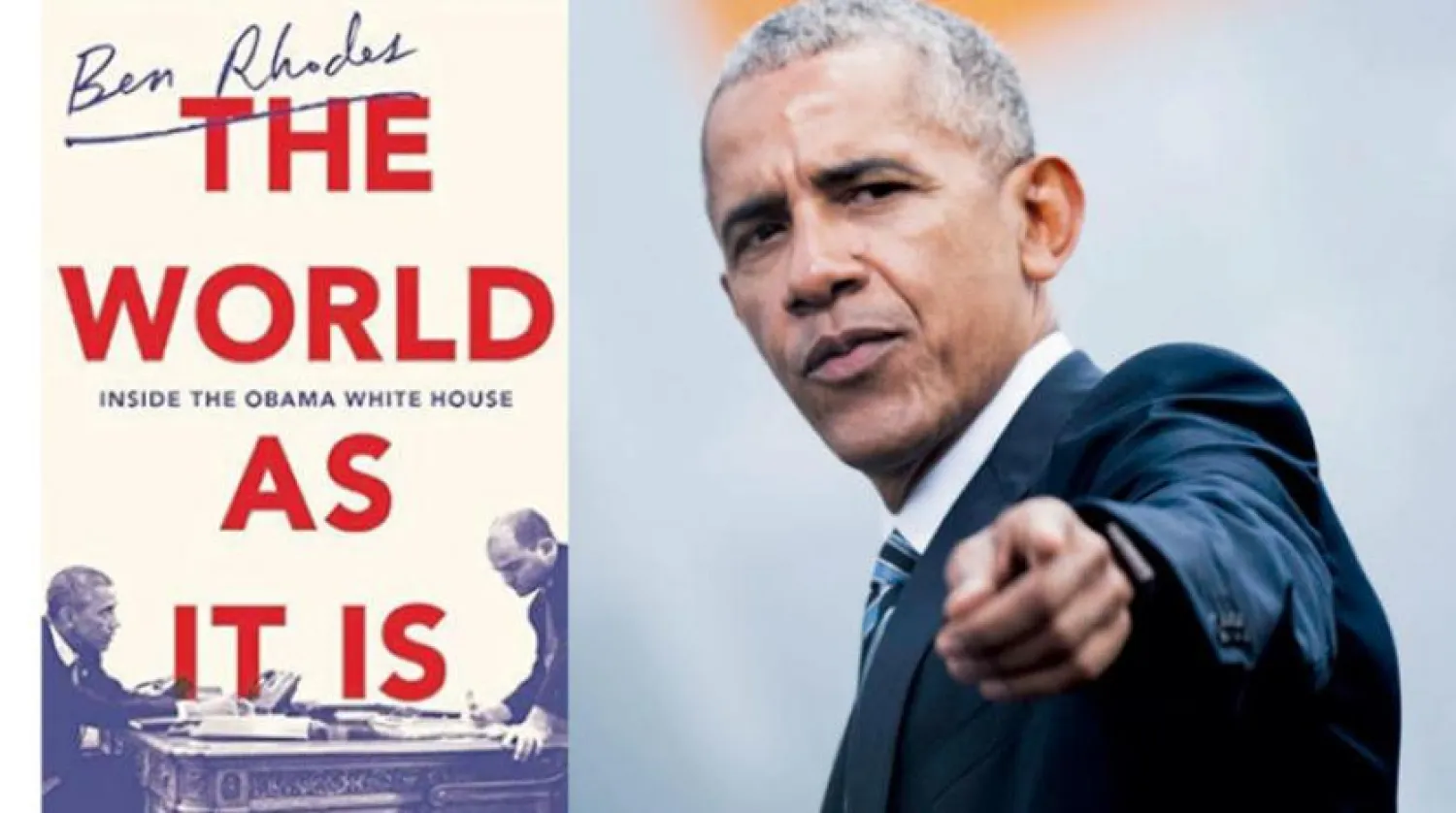

THE WORLD AS IT IS
By Ben Rhodes
Publisher: Bodley Head
480 pages
Ben Rhodes’ semi-memoirs starts with a quotation from Ernest Hemingway’s “The Old Man and the Sea”, stating that no man is ever alone in the sea. Rhodes then takes 480 pages to introduce us to a young man who is all at sea. The young man in question, well sort of young, is Barack Hussein Obama who was Rhodes’ boss for almost a decade, first as a junior Senator from Illinois and then as President of the United States. Rhodes initially served as a jack-of-all trades in Obama’s first presidential campaign but rose to become the president’s chief speech-writer and then as Deputy National Security Adviser, a position that gave him a rare spot at the White House coalface.
Despite his penchant for self-aggrandizement, an affliction of many Americans in public service, Rhodes’ narrative is interesting precisely because he was mostly a bit-player with no prospects for an independent career of his own in American politics. That enabled him to cast himself as an observer of the circus of which Obama was the ring master.
It took Rhodes little time to understand Obama, the real Obama, a synthetic product of American contradictions who knows how to survive and even prosper in a political system in which perception is often more important than reality. It didn’t matter who you were and what you believed in, if anything; what mattered was how you were seen and what you could market as your beliefs. Rhodes writes “Obama’s language sounded authentic” and that “his politics seemed moral.” The key words here are “sounded” and “seemed.”
Rhodes recalls a chat with one of Obama’s senior advisers who is concerned about the candidate’s lack of any knowledge of foreign policy and dismisses his youthful entourage as equally ignorant. “No one out there knows anything about foreign policy,” the adviser laments to Rhodes.
Rhodes, however, isn’t concerned. He writes: “We wanted a hero”, at a time that the US needed a leader and the American voters believed they were choosing a president.
Because Obama had little of substance to offer, except his synthetic charm, Rhodes tries to exploit his idol’s “complexity” as a factor that attenuates his intellectual shallowness. We are reminded that Obama was born in Hawaii, which had once been a US colony and thus still nursing the wounds of Imperialism, and that his father had been a Muslim from the Luo tribe in Kenya, a tribe that had suffered at the hands of British colonialism and, after Kenya’s independence, humiliated by the bigger tribe of the Kikuyus. Further, Obama’s step-father had been a Muslim from Indonesia, a country that had suffered from Dutch Imperialism and where Obama spent his boyhood and early youth. According to Rhodes, Obama’s multiple identities gave him “a different world view.”
Different from what? You might ask. Here is Rhodes’ answer “His views did not necessarily reflect those of the US government.”
In other words, the man chosen to represent the US government didn’t share that government’s views. He was his own man, a free spirit who could do what he liked. Only, we know that he couldn’t do what he liked because the US Government, notably the House of Representatives and the Senate, wouldn’t let him.
So what did he do? Rhodes says: “He turned to speeches to reorient American foreign policy.” Hillary Clinton, the erstwhile rival who became Obama’s Secretary of State, put it more starkly: “Whenever there was a crisis, Obama made a speech.” Rhodes wrote most of those speeches without having a clue about the subjects covered, mostly by googling things on the Internet.
Rhodes reveals that Obama and his entourage knew almost nothing about the Middle East, beyond a few quotations from” Lawrence of Arabia”, the David Lean film not the writings of the British agent who had been a master of self-promotion.
Early in his presidency, Obama told Rhodes that “the problems are in the Arab world” and decided to do something about it. That “something” was a grand visit to Cairo, the Egyptian capital, to deliver a speech aimed at flattering Muslims but asking them to adopt the Greater Middle East agenda worked under President George W Bush after the “liberation of Iraq”. The difference, however, was that Bush had preached the gospel of Jeffersonian democracy while Obama, who didn’t share such “American prejudices”, believed that the corrupt West wasn’t a model and that Muslims should do their own Islamic thing, whatever that meant.
In his Cairo speech, Obama condemned the Western model in these terms: “In the West there is a mindless violence, a crude sexuality, a lack of reverence for life, a glorification of materialism”. Worse still, according to Obama, the West, and the US in particular, had been guilty of trying to dictate to others and intervene in their affairs, a claim he repeated in his epistolary attempt at wooing Ayatollah Ali Khamenei the Islamic Republic’s “Supreme Guide.”
Later, Obama told Rhodes that “if democracy comes to Egypt, the Muslim Brotherhood will win.” We now know that his prediction wasn’t exact. In the first post-Mubarak presidential election, Mohammad Morsi the Muslim Brotherhood’s candidate, attracted the votes of fewer than 10 per cent of the Egyptian electorate. Morsi won in the second round by attracting most of the protest vote against a background of strong support from Washington.
Obama played a key role in forcing President Hosni Mubarak out of office, triggering the Egyptian crisis. Rhodes shows how Obama sent a special emissary, the seasoned diplomat Frank Wisner, to Cairo to persuade Mubarak to prepare for a transition of unspecified length instead of trying to crush the protesters. Thinking that he was now leading a strategy backed by the US, Mubarak complied until it was too late for a shift to containment of the crowds. At that time, Obama phoned Mubarak and openly asked him to step down as president. His claim that the US shouldn’t intervene in the affairs of others was thrown into the dustbin. Interestingly, Rhodes tells us that the hapless emissary, Wisner, hadn’t been told of the president’s shenanigans. That was no surprise as Wisner represented the “US Government” which Obama regarded as a negative force in world politics.
When news comes that Mubarak is out, Obama says “I feel good, I didn’t know him”, as if foreign leaders should be judged on the basis of their intimacy with him. Obama then adds: “If it had been King Abdullah of Jordan, I don’t know if I would have done the same thing.”
Obama’s sympathy for the Muslim Brotherhood and his own Muslim background didn’t necessarily make him sympathetic to Islam and Muslims; Sympathy came because he thought them to be anti-American.
Rhodes recalls an anecdote that Obama liked to repeat about the time that, as a child, he had spent in Pakistan with his “white” American mother. He recalls that his mother had entered a lift wearing cool clothing and no hijab. A young Pakistani man had entered the lift on one of the floors and, seeing that a woman, though of a certain age, was scantily clad had started to sweat so hard that he had been obliged to step out at the next floor.
In Obama’s view, Muslim men were obsessed with sex.
Rhodes claims that “Hezbollah” and Palestinians, especially “Hamas” supporters, loved Obama but, he notes, that “He didn’t do anything tangible for the Palestinians.” In fact, Obama had appointed the Democrat, former Senator George Mitchell, as his special envoy for Middle East with a brief to help create a Palestinian state within a year. However, Obama had soon forgotten the whole thing and never gave Mitchell access even to report on what was going on. Not surprisingly, Mitchel isn’t mentioned at all in Rhodes’ tome.
Rhodes shows that two things mattered most to Obama.
The first was what advantage he could claim by doing anything. Although he is of mixed black-and-white ethnicity, sometimes in his 30s he decided to cast himself as completely black to secure the votes of African-Americans as a bloc. He didn’t realize that he had been a victim of the cult of appearance, and that ”whiteness” and “blackness” were not matters solely of the color of your skin. You could be black in appearance but “white” in culture, taste, body-language and even beliefs and prejudices. In contrast you could have a dark skin and be whiter-than-white in character. To reduce a man, or a woman, to skin color, is simply idiotic.
The second stratagem that Obama adopted followed the first. He wanted to appear as a champion of “victims” real or imagined, a target he tried to hit with a series of symbolic gestures, including a bizarre tour of cities in Laos, Vietnam and Japan that the US had bombed during various wars. At each stop he made a speech, apologizing for what the US had done, much to the amazement of the ”natives” who knew that no war is one sided and that their nations too, were not as snow-white as Obama pretended.
It was also Obama’s belief that Iran had been a victim of American bullying that persuaded him to trample US and international law by pushing through his “nuclear deal”, certain to become a classical example of diplomatic subterfuge.
Obama’s embrace of the Venezuelan “strongman” Hugo Chavez, at a time that the latter was uprooting his nation’s democratic institutions, and the pas-de-deux to woo Cuba’s Raoul Castro, presiding over the biggest political prison in Latin America, were also prompted by the same “sympathy for the victims” of American Imperialism.
However, he never forgot the need to win votes. Before his second-term election, Obama secured a state visit to the United Kingdom to be received by the Queen.
According to Rhodes Obama believed that an audience with by the Queen, with full genuflections and hand-kissing, was “perfect, and will be a great validator for us with the White people.”
During Obama’s stay at Buckingham Palace, the US security found out that mice were roaming in the suite assigned to the President and his wife Michelle.
Rhodes quips “May be this is a dying Empire!” Obama replies “Just don’t tell the First Lady!”
Obama emerges from Rhodes’ portrayal as a reluctant, if not actually self-loathing, American. At one time, Obama compared the United Sates with the Mongol chief Chengiz Khan who conquered a big chunk of the world thanks to overwhelming violence.
“The difference is that the Mongols didn’t have our bombs,” Obama quipped. “But they had good horsemanship.”
Rhodes implies that he understands Obama’s dislike of America by saying the he himself is “a self-loathing Jew, maybe half self-loathing.”
Towards the end of his presidency Obama is asked by Rhodes and others in the entourage to define “The Obama Doctrine”, something that his admirers in the American media had invented.
“What is the Obama Doctrine?” he repeats the question. The answer is: ”Don’t do stupid shit!” Does this mean that he did “intelligent shit”?
According to Rhodes, Obama told him: “Our job is to tell a really good story about who we are.”
Well, Rhodes, who seems to have the talents of a writer of fiction, has taken the advice of his master and mentor; and the story he tells is a good one. It is also a sobering reminder of how vulnerable even a mature a democracy is.