

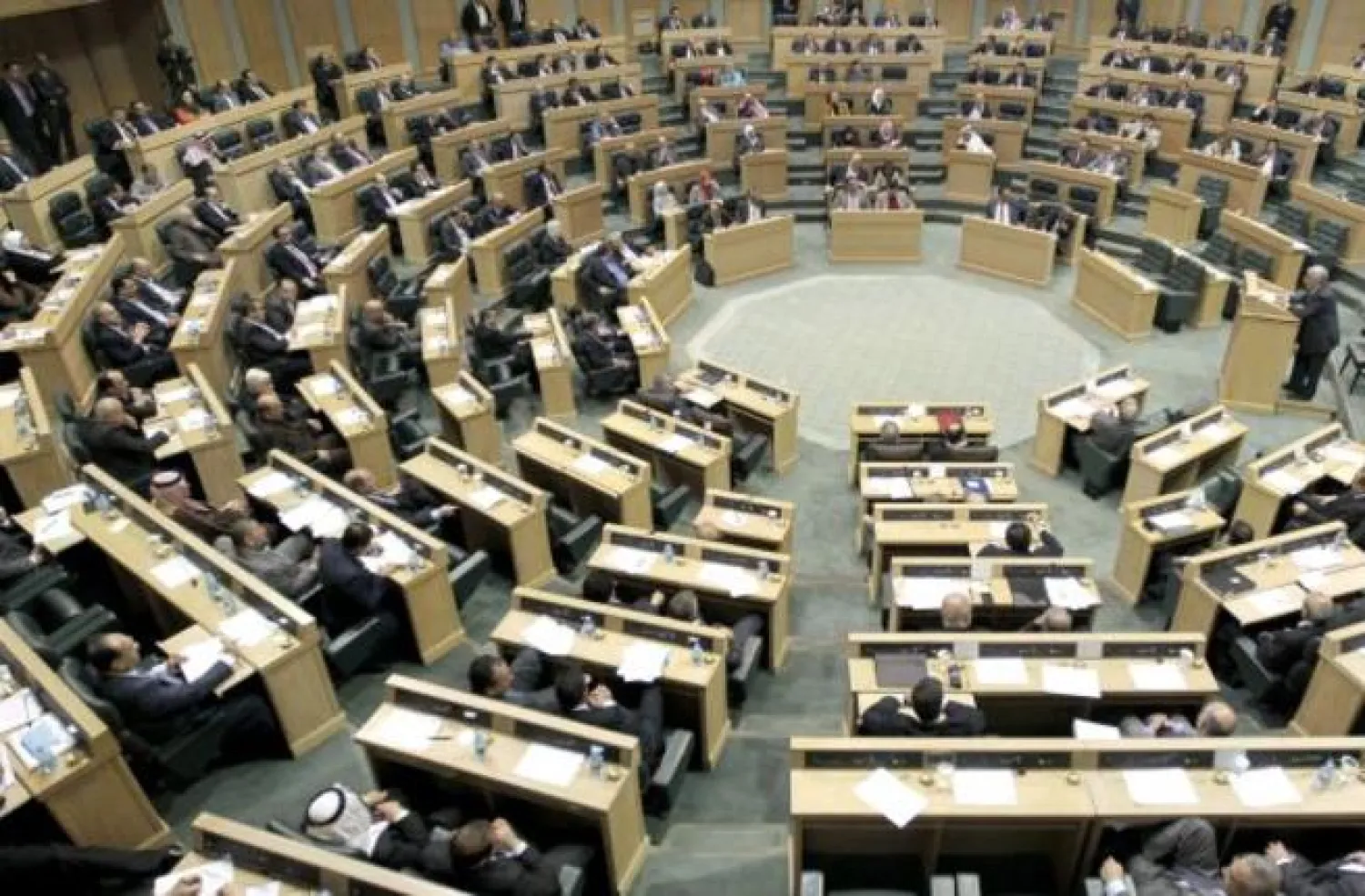

Jordan: Government Approves Amendments to Income Tax Law

Jordanian parliament (File Photo: AFP/Khalil Mazaawri)
TT

Jordan: Government Approves Amendments to Income Tax Law

Jordanian parliament (File Photo: AFP/Khalil Mazaawri)

The Jordanian government approved the final version of a draft law amending the Income Tax Law before sending it to the Lower House for endorsement. A Royal Decree was issued, adding the bill and three others to the list to be debated by the House in the second extraordinary session this summer, due to start on Wednesday.

The government said it has introduced 7 amendments to the law, "in accordance with the dialogues with the concerned unions, political parties and other institutions of civil society, chambers of industry, trade, agriculture, and all other sectors and provincial meetings.”

The discussions witnessed intense debates where several members withdrew from the session, and in some provinces, residents left the room while others were expelled.

Despite the criticism, the government discussed with all parties, but it had little room to maneuver the amendments, as it could not adjust further due to World Bank requirements and foreign pressures.

The most important amendments to the draft law included raising the threshold of taxable income for households by JD1,000 that should be covered by bills for health, education, loan interests, murabaha (an Islamic finance and investment instrument), and residential rent in 2020.

Subsequently, the tax exemptions for families in this year will amount to JD18,000 instead of JD17, 000, according to the draft law text announced by the Prime Ministry.

In the latest draft, income tax on banks was raised from 35 percent to 37 percent and the threshold of taxable income for retirees was lowered from JD3,500 per month to JD2,500 per month.

The income tax on manufacturing industries in developmental zones will start as of next year at 1 percent to rise to a maximum of 8 percent, instead of 20 percent in the older version.

For establishments based in free zones, they will be subject to 6 percent instead of 20 percent, according to the draft law.

President of the Jordan Dental Association, Ibrahim Tarawneh, stated that the government responded to some of the unions’ demands.

Tarawneh called on the parliament to further pressure for introducing amendments that benefit the poor and middle classes. He said he would invite heads of unions and associations to a meeting to discuss the government's final amendments to the law.

Meanwhile, Finance Minister Ezzeddine Kanakrieh admitted that the government is currently unable to approve the reduction of sales tax on a number of food items and the agricultural sector.

He told al-Ghad newspaper that the ministry had approved a financial reform program, however, reducing sales without a comprehensive study will affect revenues and thus increase the deficit and debt.

But Kanakrieh said the government would look at the sales tax in a comprehensive way. He added that the government will fully study each area’s percentage, wondering “if we reduced the 16 percent rate, and raised rates on free zones and development, and canceled exemptions….will that help or not?”

As for the relationship with the International Monetary Fund, the minister explained the Fund still has to conduct three reviews of the current reform program, which ends after the first half of 2019, indicating the second revision will be after the adoption of the tax law.

Kanakrieh did not rule out the possibility of signing new financial reform programs with the IMF, as needed, to reduce the problem of public debt in the country.

As for the economic growth forecast for this year, the government official said this year's growth rate is expected to be 1.9 percent, which is lower than the budget estimate where the government was targeting a 2.1 percent growth.

Kanakrieh predicted that the total revenues for the current year would be 100 to 150 million Jordanian dinars less than the estimate. He explained that the government's move to cut expenses by JD151 million will help maintain the budget deficit in face of reduced revenues.


Oil Set for Second Straight Weekly Decline on Supply Outlook

A view of an oil pump jack on the prairies near Claresholm, Alberta, Canada January 18, 2025. REUTERS/Todd Korol
TT

Oil Set for Second Straight Weekly Decline on Supply Outlook

A view of an oil pump jack on the prairies near Claresholm, Alberta, Canada January 18, 2025. REUTERS/Todd Korol

Oil prices rose on Friday but were poised for a second straight weekly decline as a potential supply glut and prospects of a Russia-Ukraine peace deal limited gains driven by concerns over disruptions from a blockade of Venezuelan tankers.

Brent crude futures were up 52 cents, or 0.87%, at $60.34 a barrel by ‌1357 GMT ‌while US West Texas Intermediate crude ‌rose ⁠51 ​cents, ‌or 0.9%, to $56.66.

On a weekly basis, the Brent and WTI benchmarks were down 1.3% and 1.4% respectively, according to Reuters.

"That we're ⁠staying down at these levels indicates that the market is awash with ‌oil right now," said Ole Hansen, ‍head of commodity strategy at ‍Saxo Bank. "There's enough oil to mitigate any disruptions."

Uncertainty over ‍how the US would enforce President Donald Trump's intent to block sanctioned tankers from entering and leaving Venezuela tempered geopolitical risk premiums, IG analyst Tony Sycamore said.

Venezuela, which pumps about 1% ​of global oil supplies, on Thursday authorised two unsanctioned cargoes to set sail for China, said two ⁠sources familiar with Venezuela's oil export operations.

Optimism over a potential US-led Ukraine peace deal also eased supply risk concerns, Sycamore said.

However, Bank of America analysts said they expect lower oil prices to curb supply, which could stop prices from going into freefall.

Investors also watched developments in Russia's war in Ukraine after Kyiv ramped up attacks on Russia's energy infrastructure. Ukraine struck a "shadow fleet" oil tanker in the Mediterranean Sea with aerial drones for the first time, ‌a Ukrainian official said on Friday.


What are Shipping Companies' Plans for Return to Suez Canal?

Ships move through the Suez Canal, in Ismalia, Egypt, July 31, 2025. REUTERS/Mohamed Abd El Ghany/File Photo
TT

What are Shipping Companies' Plans for Return to Suez Canal?

Ships move through the Suez Canal, in Ismalia, Egypt, July 31, 2025. REUTERS/Mohamed Abd El Ghany/File Photo

Major shipping companies are devising strategies for a potential return to the Suez Canal after two years of disruptions due to security risks in ​the Red Sea.

They have been rerouting vessels via longer, costlier routes around Africa since November 2023, following attacks on commercial ships by Yemen's Houthi militants, reportedly in solidarity with Palestinians during warfare in Gaza.

A ceasefire agreement reached in October has led some companies to explore resumption plans, although security ‌remains a ‌key concern. Below are the latest ‌updates according to Reuters:

MAERSK

The ⁠Danish ​shipping ‌company said on Friday that one of its vessels successfully navigated the Red Sea and Bab el-Mandeb Strait for the first time in nearly two years.

Maersk said it has no immediate plans to fully reopen the route and it is not considering a wider ⁠East-West network change back to the trans-Suez corridor, but considers the ‌feat a "stepwise approach" to resuming ‍passage.

CMA CGM

The world's ‍third-largest container shipping line, which has made limited Suez ‍transits when security allows, will use the passage for its India-US INDAMEX service from January, according to a schedule published on its website.

HAPAG-LLOYD

Earlier in December, the German shipping ​group's CEO said the return of the shipping industry to the Suez Canal would be gradual ⁠and there would be a transition period of 60-90 days to adjust logistics and avoid sudden port congestion.

The world's fifth-largest container company did not immediately respond to Reuters' request for comment. Hapag-Lloyd and Maersk had called for caution in November, saying they were monitoring the situation for evidence of increased security.

WALLENIUS WILHELMSEN

The Norwegian car shipping group is still assessing the situation and will not resume sailing until certain conditions are met, ‌a company spokesperson said on Friday.


Real Estate Balance Platform Regulates Market, Signals Positive Momentum in Riyadh Trading

The Saudi capital, Riyadh (Asharq Al-Awsat) 
TT

Real Estate Balance Platform Regulates Market, Signals Positive Momentum in Riyadh Trading

The Saudi capital, Riyadh (Asharq Al-Awsat) 

Following the Royal Commission for Riyadh City’ s announcement of the results of the electronic draw for purchasing residential land through the Real Estate Balance platform, Asharq Al-Awsat learned that some of the plots allocated to eligible beneficiaries will be sold at prices below SAR 1,500 (about $400) per square meter, depending on their locations.

The land distribution comes in implementation of directives issued by Crown Prince and Prime Minister Mohammed bin Salman to take the necessary steps to restore balance to Riyadh’s real estate sector.

Under these directives, the Royal Commission for Riyadh City is tasked with providing planned and developed residential land for citizens at a rate of between 10,000 and 40,000 plots annually over the next five years, at prices not exceeding SAR 1,500 per square meter.

On Wednesday, the Commission announced the issuance of the electronic draw results after completing all procedures related to verifying applicants’ eligibility and reviewing objections submitted ahead of the draw.

Competitive Prices

Real estate specialists told Asharq Al-Awsat that the Commission has allocated large tracts of land for sale to eligible beneficiaries in key locations within Riyadh’s urban fabric, noting that the move offers more choices at competitive prices and reflects positively on the overall real estate market in the Saudi capital.

They added that beneficiaries will be able to build homes at costs comparable to the prices of apartments currently offered for sale in northern Riyadh neighborhoods, which proved that the directives of Crown Prince Mohammed bin Salman have translated into tangible outcomes, enabling citizens to obtain their first homes at lower prices.

Price Decline

Real estate specialist Khaled Al-Mobid said that offering more than 6.3 million square meters of land this year through the Real Estate Balance platform aims to inject additional land within the urban area and increase housing supply with high planning quality. He described the step as important in curbing prices, which have risen recently in Riyadh.

He added that the rollout of further land areas through the platform over the next four years will help meet demand from young people and low-income segments, making affordable housing more accessible and facilitating first-home ownership.

Al-Mobid expected the Riyadh real estate market to see a correction in the coming years as the measures directed by the Crown Prince and Prime Minister are fully implemented by the relevant authorities.

Construction Costs

Another real estate specialist, Ahmed Omar Basodan, said that based on the announced locations for beneficiaries of the first batch, recipients will be able to own villas at prices lower than apartments currently offered for sale in the same neighborhoods. He explained that preliminary estimates put the combined cost of land purchase and construction at between SAR 900,000 and SAR 1.2 million.

He added that setting a ceiling price of SAR 1,500 per square meter for land will put downward pressure on prices in those areas, forcing them to retreat and become more affordable. Basodan noted that more than 10,000 plots have been allocated this year through the platform, supporting expanded housing supply, market stability, and improved quality of life.

Electronic Draw

In its latest statement, the Royal Commission for Riyadh City said the electronic draw was conducted under the supervision of an independent committee representing the Royal Commission, the Ministry of Justice, the General Real Estate Authority, Riyadh Municipality, and the Saudi Data and Artificial Intelligence Authority (SDAIA), using advanced technological systems to ensure fairness and equal opportunity.

The Commission confirmed that the final results are now available on the Real Estate Balance platform, detailing the locations of allocated plots totaling 6.3 million square meters across several Riyadh neighborhoods, including Al-Qirawan, Al-Malqa, Al-Nakheel, Al-Nargis, Namar, Al-Rimayah, Al-Rimal, and Al-Janadriyah.
