

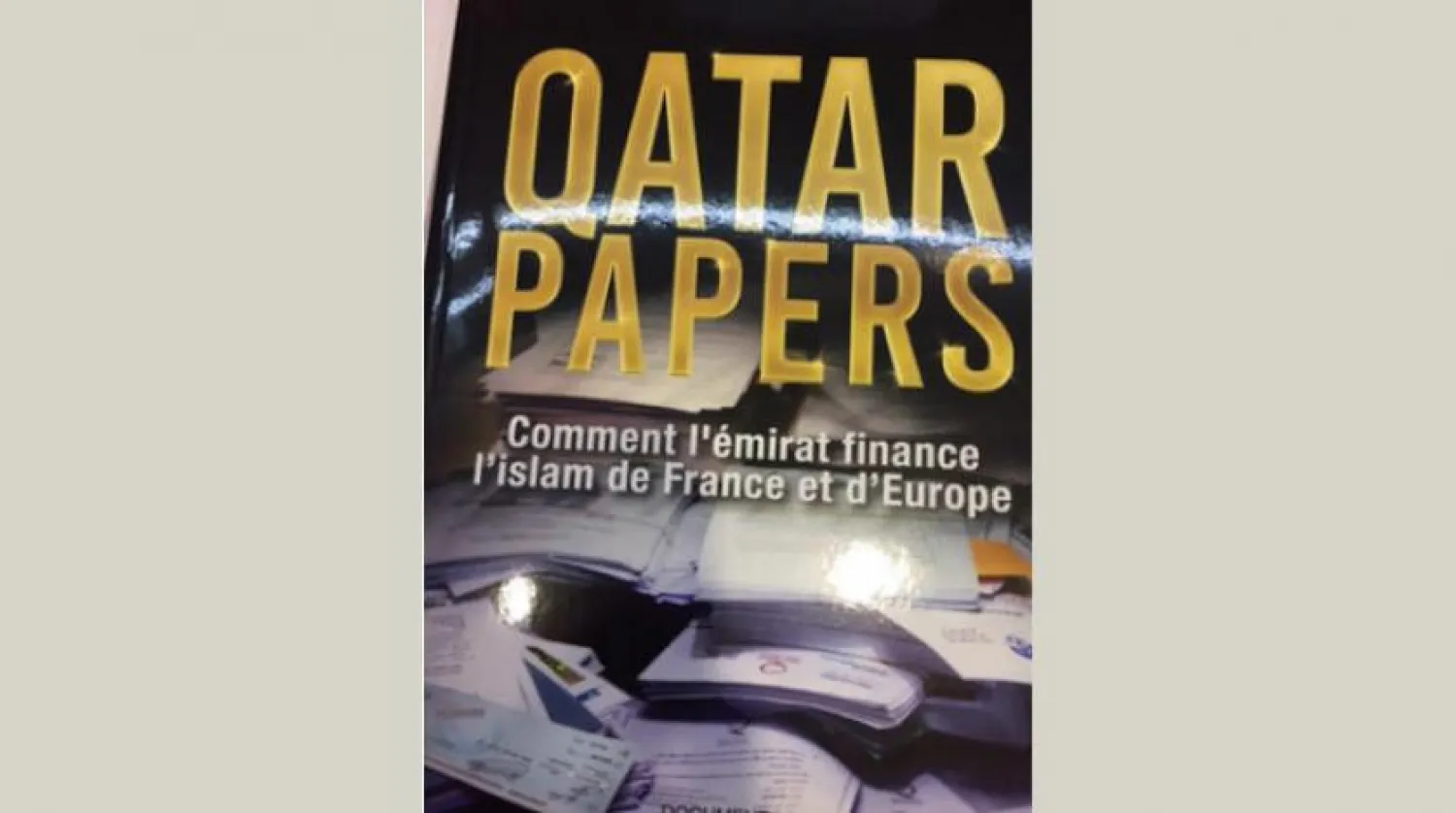

'Qatar Papers' Exposes Doha’s Funding of Muslim Brotherhood in Europe

Qatar Papers – How the Emirate finances Islam in France and Europe, (Arabic Website)
TT

'Qatar Papers' Exposes Doha’s Funding of Muslim Brotherhood in Europe

Qatar Papers – How the Emirate finances Islam in France and Europe, (Arabic Website)

A recent book titled Qatar Papers, authored by French journalists Georges Malbrunot and Christian Chesnot, revealed the extent of Qatar’s murky history of funding the Muslim Brotherhood, in Europe.

The two investigative reporters base their 295-page book on a plethora of official documents and testimonies that shed light on Doha’s extensive funding of Islamist groups in order to promote MB ideology. Even though its 14 chapters mainly focused on France’s experience, the read underlines the MB’s expansionist ambition seeking to fuel religious extremism all over Europe.

It also uncovers evidence that cheques and money transfers from Qatar have been used to underwrite more than 140 projects around Europe. It is worth noting that investigations included six different European countries next to French cities. T

The book also documents payments of €72 million to groups in seven European countries.

Tariq Ramadan, a contentious Islamist thinker and well-known MB figure in Europe who spent eight months in jail over rape allegations, is cited by the book for having strong ties with a Qatari charity foundation.

According to the book, Ramadan was paid €35,000 a month as a consultant to the Qatar Foundation, a body set up by Qatari royals. Just before his arrest early last year that saw Ramadan under criminal investigation, bank documents show that he withdrew €590,000 from Qatari bank accounts.

Even more alarmingly, documents found in the Swiss home of Youssef Nada, a formerly prominent MB leader, set out a strategy for co-opting mayors and other local bodies as tools of influence. They highlighted French intelligence warnings about Qatari support for the L'Union des organisations islamiques de France, an umbrella body in France.

Apart from the funds directed to leading MB figures in France and Switzerland, institutions such as Mucivi, or Le Musée des civilisations de l'Islam, a museum in Geneva that openly displays MB propaganda were financed by Qatar.


Australia Pledges Tougher Enforcement of Social Media Ban for Teens

FILE - Three boys use their phones while sitting outside a school in Sydney, Monday, Dec. 8, 2025. (AP Photo/Rick Rycroft, File)
TT

Australia Pledges Tougher Enforcement of Social Media Ban for Teens

FILE - Three boys use their phones while sitting outside a school in Sydney, Monday, Dec. 8, 2025. (AP Photo/Rick Rycroft, File)

Australia's prime minister vowed on Friday to bullet-proof laws supporting a social media ban for under-16s as the government prepares legal action against platforms amid a steady stream of evidence that the ban has had little impact on teen use.

The country's groundbreaking six-month-old experiment is being closely watched by many nations seeking to emulate it due to concerns about the impact of social media on youth mental and physical health. Britain this month said it planned restrictions that go further as gaming and live-streaming platforms will also be affected.

The Australian government plans to stress-test the law which bans platforms like Meta's Instagram and Google's YouTube from giving under-16s accounts.

Numerous studies have shown age-assurance mechanisms, such as taking a selfie, that have been put in place by tech companies are easily circumvented by children and that in many cases, ⁠the children have ⁠never been asked to prove their age.

"What we want to do is to make sure that the laws are as strong as possible and that they will withstand any legal challenges which are made," Prime Minister Anthony Albanese told the Australian Broadcasting Corp, according to Reuters.

One focus would be making sure that the eSafety commissioner, the country's internet regulator, was sufficiently empowered to do the job, he said.

He did not give further details about what steps the government would take and the regulator declined to comment.

The eSafety commissioner and Australia's Communications Minister Anika Wells have said they are ⁠preparing legal action against five of the biggest platforms, which face a fine of up to A$49.5 million ($34 million) if they are found to have systemically failed to uphold the ban.

Message board website Reddit is separately challenging the ban in Australia's highest court, seeking to overturn it on free speech grounds. The government has said it will defend the lawsuit. Reddit was not immediately available for comment on Friday.

When Australia's ban went live last December, there were early reports that platforms had shut down millions of accounts, but parents have said and studies have shown that teen social media use is little changed.

A paper published in the British Medical Journal this week said 85% of Australians aged 12 to 15 were still using social media three months after the ban took effect, according to a study of 408 adolescents.

Two-thirds of underage ⁠users stayed online by ⁠self-declaring an age over 16 or posting a selfie that the platform accepted as over 16, the paper said.

That broadly matched data shared by Australia's eSafety Commissioner in March which showed one-third of Australians under 16 were still on social media.

Experts on youth social media use say that a teething period in which platforms, parents and teenagers adjusted to the new rules was always to be expected.

Parents are now much more willing to police their kids' social media use, said Susan Sawyer, a professor of adolescent health at the University of Melbourne and an advisor to the eSafety commissioner. She is also co-author of a paper this month which found high social media use was linked to adverse mental health outcomes, especially in young teens.

"We do have evidence that those social norms are starting to change about what is the right age to get a phone," added Sawyer.

"As a pediatrician who is doing research in this space, I've got my antennae up. The conversations that people are having with me now are the sorts of conversations that no one was having with me six months ago," she said.


Humans and Great Apes Share Similar Giggles

A Lowland gorilla plays during an environmental enrichment activity, predicting the outcome of the Spain vs. Uruguay FIFA World Cup football match, with Uruguay winning, at the Guadalajara Zoo in Guadalajara, Jalisco, Mexico, on June 5, 2026. (Photo by ULISES RUIZ / AFP)
TT

Humans and Great Apes Share Similar Giggles

A Lowland gorilla plays during an environmental enrichment activity, predicting the outcome of the Spain vs. Uruguay FIFA World Cup football match, with Uruguay winning, at the Guadalajara Zoo in Guadalajara, Jalisco, Mexico, on June 5, 2026. (Photo by ULISES RUIZ / AFP)

Humans and great apes have been giggling in similar ways since branching off the evolutionary tree, a new study suggests.

How do we know this? Researchers tickled 13 captive apes — including gorillas, orangutans, chimpanzees and bonobos — and recorded the results. The new research reexamined those decades-old recordings and compared them with the newly captured giggles of four young children while they were being tickled and playing at home.

It turns out that the chuckles of humans and great apes follow similar rhythms, with regular timing between their laughs, a uniting thread that likely reflects their ties to a common ancestor, The Associated Press quoted researchers as saying.

“In a way, we are very similar to other great apes because we’ve been laughing in a similar way for 15 million years,” said study author Chiara De Gregorio, a primatologist at the University of Warwick in England.

Laughter communicates a playful, happy feeling without using words. Many animals can laugh too, but the giggles don’t follow human patterns as closely. When researchers tickle rats, for example, they respond with ultrasonic squeaks.

Scientists trying to uncover how laughter evolved have picked apart animals’ facial expressions, but less work has been done on how laughs sound. And compared with apes, human laughter has become faster and more complex. For one, our laughs sound different based on context — from a polite chuckle among colleagues to a full-bodied guffaw with close friends.

“We are like the masters of laughter, I would say,” said De Gregorio, whose findings were published Thursday in the journal Communications Biology.

These giggles evolved to best suit animals’ different social lives, said Brittany Florkiewicz, who studies animal communication at Lyon College and had no role in the new research. She said the study’s findings make sense, and point to a need for more investigation.

Florkiewicz said she’d like to hear comparable recordings of other animals with playful facial expressions, like dogs, horses and cats. That could tell us more about how laughter evolved, so we can “understand what makes us uniquely human, but also what is similar between humans and other animals.”

Studying the origins of laughter may seem corny, but it's one aspect of human communication that can help us understand others — including how we learned to speak.

Because sounds don't fossilize, scientists are using the evidence we do have to trace things back, one chuckle at a time.


Researchers: 'Master Key' Vaccine Technique May 'Prevent Next Pandemic'

FILE - A sign for flu & COVID-19 vaccines is displayed outside a CVS store in Buffalo Grove, Ill., Sept. 23, 2025. (AP Photo/Nam Y. Huh, file)
TT

Researchers: 'Master Key' Vaccine Technique May 'Prevent Next Pandemic'

FILE - A sign for flu & COVID-19 vaccines is displayed outside a CVS store in Buffalo Grove, Ill., Sept. 23, 2025. (AP Photo/Nam Y. Huh, file)

Known by acronyms that need no explanation, viruses like Covid, Sars and Ebola conjure up images of medics in protective suits and spark fear in populations worldwide.

Vaccines for individual viruses have provided some relief, but new strains pose a constant challenge.

Now, new AI-aided vaccine technology developed by scientists at Cambridge University offer potential immunity against whole families of viruses and could even prevent the next pandemic, according to researchers.

Professor Jonathan Heeney of Cambridge University likened the new technique to having the "master key" for an apartment block.

The main problem with vaccines, he said, was that they were "all historic" so the strain you are vaccinated with might not be the one you end up being exposed to in six months time.

Vaccines were "always chasing the virus", the project lead researcher told AFP in an interview.

"So we're getting rid of that variability by making something that's across the board recognizable by your immune system that should cover you from all these eventualities ... a real big paradigm change," he said.

Canadian Heeney, of the lab of viral zoonotics at Cambridge University's Department of Veterinary Medicine, began work on the project after the 2013-16 Ebola outbreak in west Africa where he was then based.

Ebola had previously been seen in the central African Democratic Republic of Congo, not in west Africa and it was initially misidentified as lassa fever, gastroenteritis or cholera.

The west African outbreak eventually claimed around 11,300 lives, according to the World Health Organization (WHO).

But Heeney said three or four months were spent trying to discover what it was before work could even begin on a vaccine.

"In that time, it spread from Guinea, to Sierra Leone to Liberia, three different countries quickly. The horse had bolted, the fire was raging," he said, adding many health workers were among the victims.

Returning to Cambridge after the west African outbreak, Heeney said there was a determination that "we've got to change the way this works, we can't go through it again".

Harnessing early AI, he said, his team used all the information they could get about various viruses and brought it together.

This allowed them to look for the "similarities and the differences in the important parts of the virus that the immune system responds to", recognizing not just one variant but all of them.

The new technology was all the more vital given the frequency with which viruses are now emerging due to population growth, greater movement across borders and human encroachment on animal habitats, he said.

Viruses that had previously existed harmlessly, residing in animals that had grown resistant, were coming into contact with a new species, humans, and "wow, there's no immunity, no natural defenses... and the virus goes crazy", he said.

A trial involving 39 volunteers -- sponsored by the University Hospital Southampton and published in the Journal of Infection -- found "no significant safety concerns" with the universal Sarbeco coronavirus vaccine made using the AI-aided technology.

The vaccine developed by the Cambridge scientists and biotechnoloy firm DIOSynVax will now move to larger tests.

Plagues have existed throughout history, said Heeney, from the Black Death of the Middle Ages to the 1918-20 influenza pandemic which killed an estimated 25-50 million globally.

Heeney's most pressing concern was a potential influenza outbreak, he said, describing it as one of the "trickier" viruses.

But he was hopeful the new technology could help prevent another deadly pandemic.

"Now, there's a whole different layer of AI, and we have a team using the latest AI technology ... to build a real powerful platform so we can work even faster with more data," he said.

"This, I hope is the start of a whole new era of vaccine manufacturing ... From my point of view it's about proving this technology to the world that it's safe, that it's more effective and actually jump on board.

"I think this opens the door to a whole new kind of technology. Hopefully that can change the future," he said.
