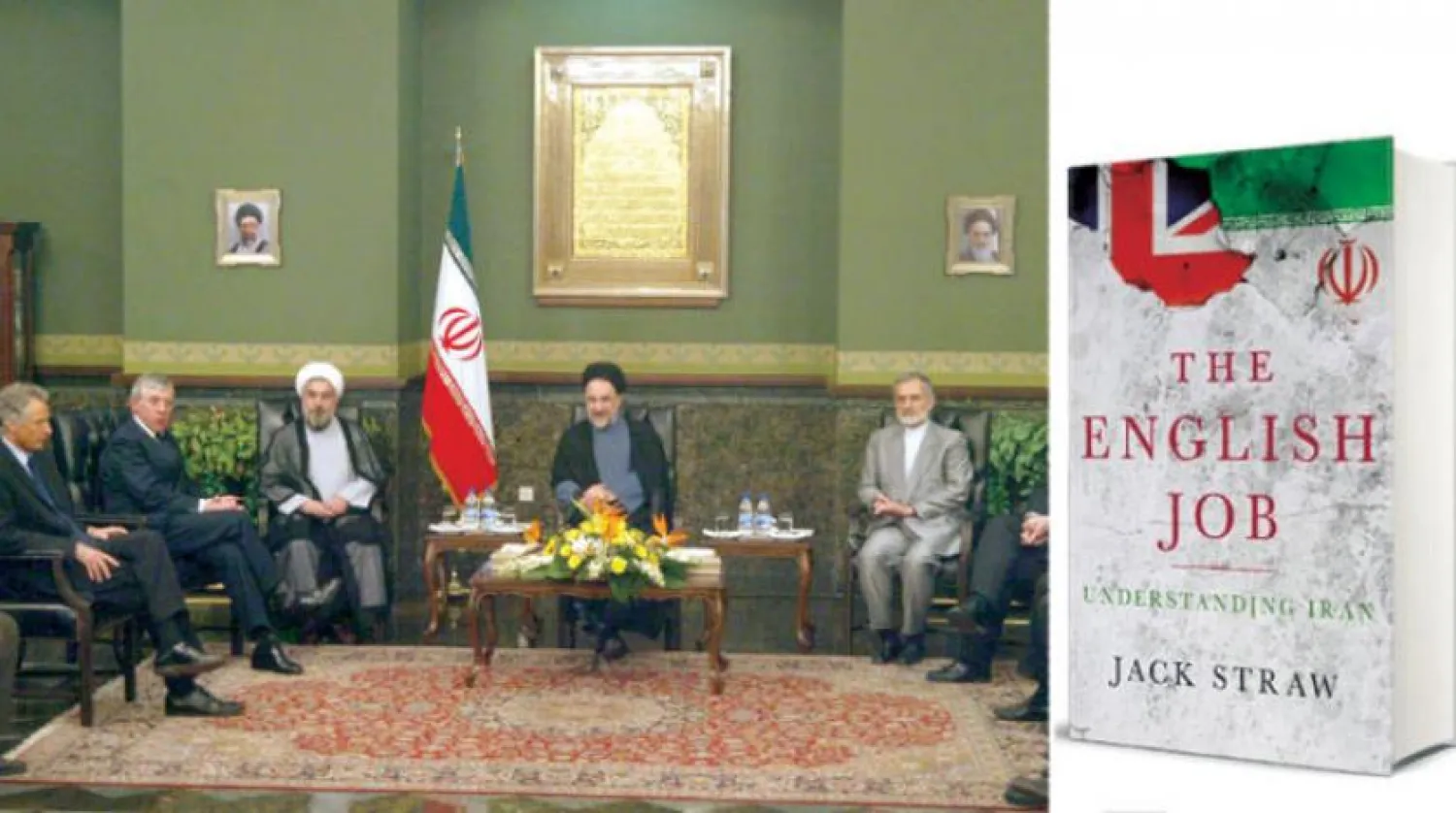

The English Job by Jack Straw
The subtitle of Jack Straw’s new book promises to help the reader in “understanding Iran”. However, what one gets in 390 pages might best describe as a misunderstanding of Iran today, a misunderstanding that has prevented Britain, along with other Western powers, to develop a realistic Iran policy and has helped prolong the crisis caused by the Islamic Republic unorthodox behavior in the international arena.
Straw’s misunderstanding, perhaps caused by his “absolute infatuation” with his imaginary Iran, has three aspects.
The first is that he thinks that because Iran, as he reminds the reader, is an ancient civilization, has produced great poets, weaves exquisite carpets and offers one of the world’s hautes cuisines, deserves indulgence for its weird activities in other domains such as hostage-taking, hate-mongering, human rights violations and the export of terror in the name of revolution. It is like offering indulgence to Stalin because one appreciates Pushkin and Tchaikovsky and enjoys a dish of borscht with a glass of “little water’ on the side. In another register, what would you say if we gave Hitler a pass because we like Schiller, Beethoven and potato salad? That Cyrus the Great was a great king and, arguably, even the founder of human rights, as Straw suggests, does not justify, citing just one example, the mass murder of Syrians by a mercenary army led by the Iranian mullahs.
The second “misunderstanding” concerns Straw’s strange belief that the Khomeinist ruling elite includes a “reformist” faction that craves close relations with Western democracies, and must, therefore, be supported to weaken and eventually get rid of the “ hardline” faction led by “Supreme Guide” Ali Khamenei. But, who are the “reformists” Straw claims to have discovered in Tehran? He cites a number of names among them former Presidents Hashem Rafsanjani and Muhammad Khatami, the current president Hassan Rouhani, former presidential candidates Hussein Moussavi and Mehdi Kariba, under both house arrest, and lower rank current or former officials such as Muhammad-Javad Zarif, Kamal Kharrazi whom Straw calls “ my old friend”, and Mostafa Tajzadeh.
The trouble is that Straw is unable to cite a single reform proposed, let alone carried out, by his “reformist” faction in Tehran. Worse still, he forgets that there have been more executions and political arrests under Khatami and Rouhani than during the supposedly “hardline” Mahmoud Ahmadinejad’s presidency.
The third misunderstanding is that in dealing with the Islamic Republic, all choice is limited to just two options: swallowing whatever Iran does or launching a full-scale war against it.
Straw was one of the most zealous advocates of the war to destroy Saddam Hussein’s regime in Iraq, asserting that the Ba’athist regime was beyond reform.
However, when it comes to the Islamic Republic, the former British Foreign Secretary becomes a dyed-in-wool peacenik. The only sane way is to use diplomacy to change Tehran’s behavior. In an elliptic manner, Straw claims some credit for what we now know as the Comprehensive Joint Plan of Action (JCPOA), or the “Iran nuclear deal” concocted by the Obama administration. Straw first sold the ideas to President George W Bush’s Secretary of State Condoleezza Rice in 2006 just before his boss, Prime Minister Tony Blair, moved him to another post.
In the past two decades, Straw has visited Iran seven times, five as Foreign Secretary. In one visit he was part of a British parliamentary delegation with Lord Lamont and, the current Labour Party leader, Jeremy Corbyn then working for the Islamic Revolutionary Guard’s Press TV channel. In one private visit, he and his wife, along with a couple of friends, were harassed and in the end hounded out of Iran by one of the nine security agencies operating in the Islamic Republic.
Straw is critical of President Donald J Trump for rejecting secret diplomacy when Tehran’s leaders see any public attempt at rapprochement as humiliating for their regime. He claims that the “nuclear deal” would have been completed with further secret talks about other issues of interest to Western powers, including the Islamic Republic’s intrusion in the internal affairs of several Arab countries. The first JCPOA could have been followed by other JCPOAs, even dealing with human rights issues, with the ultimate aim of marginalizing and eventually clipping the wings of the “Supreme Guide”.
Nevertheless, Straw offers no evidence than any deal made with the Islamic Republic in the past 40 years has had a long-lasting impact on the Khomeinist strategy and behavior. The Khomeinist rulers of Iran have perfected the art of diplomatic cheat-retreat-advance. Whenever their bones began to creak, they offered some concessions, which were subsequently withdrawn once the pressing of the bones ceased. More importantly, perhaps, Straw fails to realize that his “moderates” including Rouhani and Khatami, lack the popular support base needed to marginalize Khamenei let alone get rid of him.
Straw has adopted several erroneous assumptions, commonplace among so-called “Iran analysts”, including the division of authorities in the Khomeinist system between elected and un-elected officials. In that context, we are invited to believe that Khamenei, supposedly un-elected, enjoys less legitimacy than, say Rouhani, who is elected. However, the fact is that the Assembly of Experts, itself elected by popular vote, elects Khamenei. At the same time, Rouhani, like his predecessors, could not become president without an edict (hukm tanfizi) from the ”Supreme Guide”. In other words, it matters not one farthing who is or isn’t elected in a system in which all elections must either be regarded of equal value or rejected as fake from the start.
Straw is also wrong in believing that the Islamic Majlis, which he wrongly calls “The Iranian Consultative Assembly”, is subordinate to the Council of the Guardians which he calls, again wrongly, a solely “a creature of the Supreme Guide”.
To buttress his assumption that the mullahs have an almost natural claim to ruling Iran Straw exaggerates the role played by Shi’ite clerics in Iranian politics over the past five centuries. A fatwa issued by an obscure ayatollah to forbid smoking tobacco is blown out of proportion as an earth-shaking event. Clerics did play a role in the Constitutional Revolution of 1906 but only as second fiddle. The mullahs also supported the Shah in dismissing Prime Minister Muhammad Mossadeq in 1953, an event that Straw dubs a “coup d’etat” plotted by British Intelligence and the CIA. The fact
that the Shah had already appointed and dismissed Mossadeq as prime minister on two occasions without anyone talking of coup d’etat is conveniently ignored.
Straw hates the Pahlavi Shah and tries hard to present them in as bad a light as possible, possibly to justify the mullahs’ revolt in 1979.
Straw also exaggerates the role the British played in Iran. Iran’s own corrupt ruling elite, especially in the final decades of Qajar rule, used intervention by Britain and Russia, the two imperialist enemies of Iran at the time, as an excuse to explain away their own corruption and ineptitude.
No foreign power could impose its will on even the weakest nations without the assistance of at least some elements in that nation’s ruling elite. True the Persian expression” It’s all the work of the English!” reflects abiding resentment about the role played by Britain in Iranian affairs for over a century. However, the expression is more often used as a joke rather than a serious comment on history. There was never a major British human presence in Iran few Iranians ever saw even a single specimen of the vilified “Inglisi”. The Anglo-Iranian Oil Company was operating in less than one per dent of Iranian territory and , at its peak, employed under 200 non-Iranians, most of them Sikh guards and drivers from Punjab. Also, Britain never featured among Iran’s top five trading partners and couldn’t compete with France and Germany, and from 1960 onwards the United States, as poles of attraction for Iranians seeking higher education abroad.
The British did invade Iran, in conjunction with the Soviets, in 1941, not 1942 as Straw says, but did not “occupy the whole of Iran” as he seems to believe. In fact, the British Expeditionary Force, largely consisting of recruits from colonial India, was stationed in five localities in Iran and from 1943 onwards were put under US command until total withdrawal two years later. The myth of “The English Job”, like its French equivalent “perfide Albion” is designed to perpetuate enmity between two nations that, when all is said and done, experienced the attraction-revulsion that marks many human relatio0ns in history.
The popular novel “Dear Uncle Napoleon” by Iraj Pezeshkzad uses the “this is an English job” as a joke. Incidentally, it was written in 1970 not in the 1940s as Straw asserts.
Straw’s book, an enjoyable read, includes too many factual errors and dicey speculations to be cited here. I doubt if Ayatollah Khamenei’s second son Mujtaba has any chance of succeeding him as “ Supreme Guide”, even if the regime survives. Straw also exaggerates the status of Ayatollah Nasser Makarem Shirazi and Ayatollah Sadeq Larijani who now heads the Expediency Council. Straw may be admiring of Larijani because he speaks “fluent English” but the fact is that he lacks a genuine status within the Shi’ite clergy.
Khamenei’s mother tongue is not “Turkic”, a non-existent language, but Persian as his mother hailed from Isfahan and claimed descent from the poet Kamaleddin Ismail. Khamenei’s father was from Azerbaijan and spoke Azeri, an Altaic language.
The late Ayatollah Khomeini couldn’t have extensive knowledge of Greek philosophy as most works by the Greeks, including Plato and Aristotle cited by Straw, are still not translated into Persian or any other languages of the Muslim world.
Some of Straw’s assertions are too weird to merit comment. For example, he says: “Iran is the most secular of societies, people laugh at what the mullahs have to say.”
And, yet, he believes that mullahs are bound to rule Iran seemingly forever. But even then he is not sure of his analysis. He writes: “Just below the surface, Iran is far from calm, the regime {is} going one way, the majority of the population another.”
From an apologist for the Islamic Republic, this is something!