


UN Report Warns of Near-Collapse of Palestinian Economy

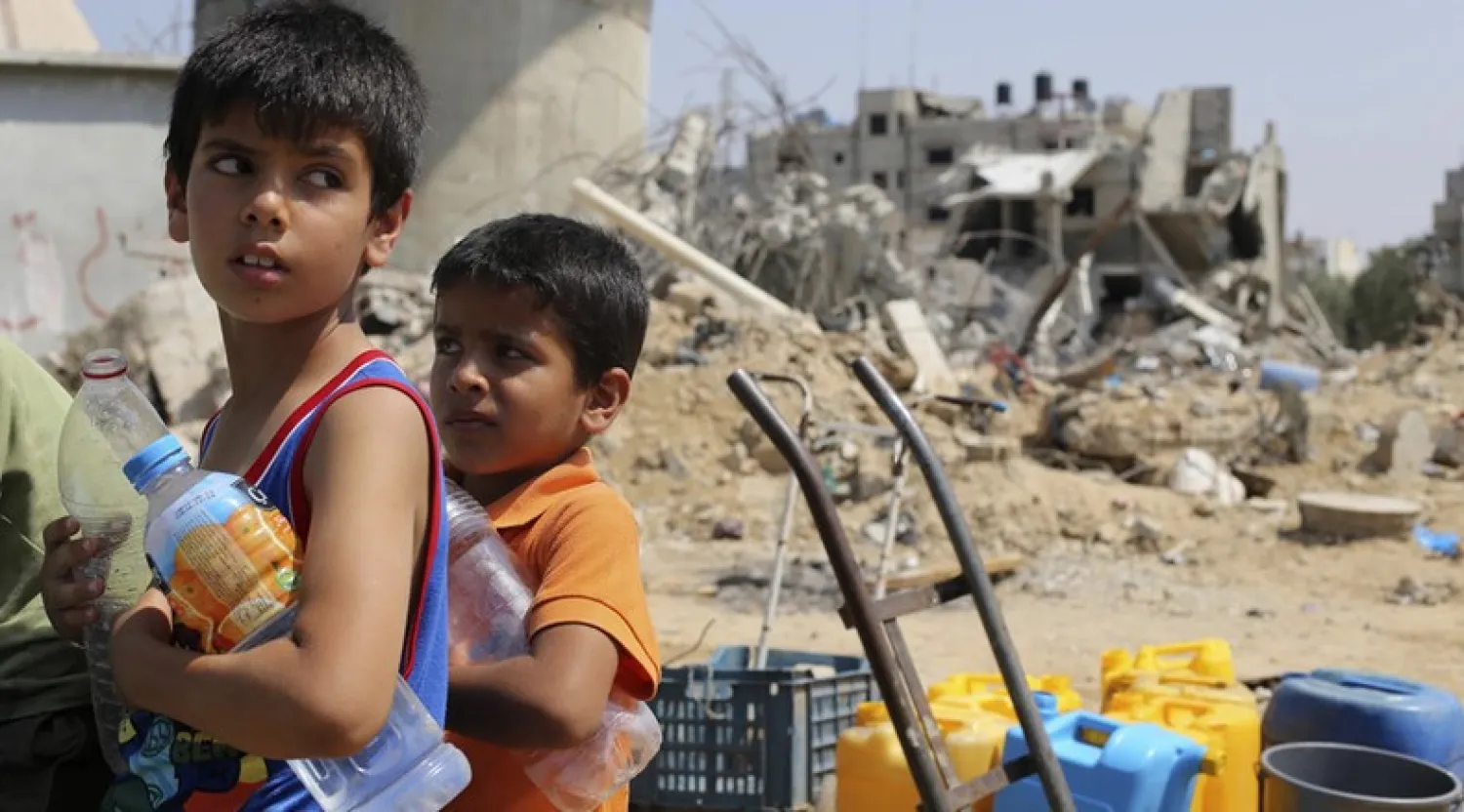
Palestinian children wait to collect water during a five-day truce in Khan Younis in the southern Gaza Strip. Ibraheem Abu Mustafa|Reuters
TT

UN Report Warns of Near-Collapse of Palestinian Economy

Palestinian children wait to collect water during a five-day truce in Khan Younis in the southern Gaza Strip. Ibraheem Abu Mustafa|Reuters

The reasons behind the near-collapse of the Palestinian economy are the tightening grip of occupation, the suffocation of Gaza’s local economy, a 6 percent drop in donor support between 2017 and 2018, deterioration of the security situation, and the lack of confidence as a result of bleak political horizons, the United Nations Conference on Trade and Development (UNCTAD) warned in its report.

In 2018 and early 2019, the Palestinian economy stagnated, per capita income further fell by 1.7 percent, unemployment increased, poverty deepened, and the environmental toll of occupation rose in the occupied Palestinian territory (Gaza and the West Bank including East Jerusalem).

About one in three Palestinians in the labor market is unemployed. In Gaza, the unemployment rate is above 50 percent while the poverty level has reached 53 percent, even though most of the people classified as poor receive aid from the government and international organizations.

Gaza is increasingly becoming unlivable under the severe and worsening socioeconomic conditions. In 2018, its local economy contracted by 7 percent, leading to a 10 percent decline in its per capita income.

Even though all sectors of the economy are constrained by occupation, agriculture and manufacturing are disproportionately impacted and the ensuing massive trade deficit adversely affects economic growth.

Between 1994 and 2018, the share of manufacturing in the economy shrunk from 20 percent to 11 percent of the gross domestic product (GDP), whereas the share of agriculture and fishing dropped from over 12 percent to less than a paltry 3 percent, the report said.

The viability and competitiveness of Palestinian producers are undermined by the multilayered system of physical and administrative restrictions deployed by the occupying power.

In the West Bank alone, 705 permanent physical obstacles restrict the movement of Palestinian workers and goods. They include checkpoints, gates, earth mounds, roadblocks, and trenches.

In addition, the economy is further weakened by the Israeli ban on the import of a long list of “dual-use” essential technological and intermediate goods as well as other critical production inputs (“dual-use” goods are civilian ones deemed, by Israel, to have potential military applications).

The report noted that occupation isolates the Palestinian people from international markets, compelling them into overwhelming trade and economic dependence on Israel, which accounts for 80 percent of Palestinian exports and supplies 58 percent of its imports.

The UNCTAD report suggested that occupation has prevented the Palestinian people from developing their oil and natural gas resources in Gaza and the West Bank.

Consequently, the estimated accumulated losses are worth billions of dollars and the associated opportunity cost of forgone development is staggering. The longer this situation persists, the higher this cost will be and the total economic cost of occupation borne by the Palestinian people will continue to rise.

Multiple fiscal shocks precipitate steeper economic decline, warned UNCTAD.

In addition to the unprecedented deterioration in socioeconomic conditions, in July 2018, Israel passed a law mandating deduction, from Palestinian fiscal revenues, of an amount equivalent to the payments made by the Palestinian government to families of Palestinian martyrs and prisoners in Israeli jails.

Subsequently, in 2019, Israel deducted $11.5 million per month (equivalent to $138 million annually) from Palestinian clearance revenues. The Palestinian government responded by refusing to accept anything less than the full amount due to it in fiscal revenue.

The fiscal faceoff deprives the Palestinian government of 65 percent of its revenue (15 percent of GDP). Deprived of two-thirds of its tax revenue, the Palestinian government coped by implementing painful cuts to social assistance to the neediest and paying public employees only 50 percent of their salaries.

This fiscal shock will further amplify the already large negative impact of declining donor support on output, employment and socioeconomic conditions. If this fiscal standoff persists, it may well push the economy into recession and instigate the collapse of Palestinian finances, the report warned.



ECB President Lagarde Reportedly Plans to Quit Before Macron's Term Ends

FILE PHOTO: European Central Bank (ECB) President Christine Lagarde addresses the press following the ECB's Governing Council meeting, at the ECB headquarters in Frankfurt, Germany, February 5, 2026. REUTERS/Jana Rodenbusch/File Photo
TT

ECB President Lagarde Reportedly Plans to Quit Before Macron's Term Ends

FILE PHOTO: European Central Bank (ECB) President Christine Lagarde addresses the press following the ECB's Governing Council meeting, at the ECB headquarters in Frankfurt, Germany, February 5, 2026. REUTERS/Jana Rodenbusch/File Photo

European Central Bank President Christine Lagarde plans to leave her job before next year's French presidential election to allow Emmanuel Macron to have an input into picking her successor, the Financial Times reported on Wednesday.

Lagarde's term is due to end in October 2027 but some fear that the far right may win the French presidential race ‌in the spring of ‌2027, complicating the selection for the ‌new ⁠leader of Europe's most ⁠important financial institution.

Citing a person familiar with the matter, the FT said Lagarde has not yet decided on the exact timing of her departure but was keen on Macron and German Chancellor Friedrich Merz to be the key deciders in who succeeds her. Macron cannot run again for a third term.

"President Lagarde is ⁠totally focused on her mission and has not ‌taken any decision regarding the end ‌of her term," Reuters quoted an ECB spokesperson as saying.

The FT report comes only ‌a week after Bank of France Governor Francois Villeroy de Galhau ‌said he would step down in June this year, more than a year before the end of his term, allowing Macron to name his replacement before the presidential election that the far-right could win.

While it ‌will be up to all leaders from the 21-nation euro zone to pick Lagarde's successor, ⁠past practice ⁠suggests that any successful candidate must have both German and French support to clinch the role.

There are no formal candidates for the job yet but several names have been floating among ECB circles as potential ECB presidents. The most prominent among these are former Dutch central bank chief Klaas Knot and Bank for International Settlements General Manager Pablo Hernandez de Cos.

Lagarde's non-renewable term at the ECB runs until October 31, 2027. Prior to heading the ECB, she was managing director of the International Monetary Fund from 2011 to 2019 and before that, the French finance minister.


UK Inflation Falls to 3.0% in January

Pedestrians cross Westminster Bridge in front of Parliament during the early morning hours in London, Tuesday, Feb. 10, 2026.(AP Photo/Kin Cheung)
TT

UK Inflation Falls to 3.0% in January

Pedestrians cross Westminster Bridge in front of Parliament during the early morning hours in London, Tuesday, Feb. 10, 2026.(AP Photo/Kin Cheung)

Britain's annual ‌rate of consumer price inflation fell to 3.0% in January from 3.4% in December, official figures showed on Wednesday.

A Reuters poll of economists had shown a median forecast of 3.0% in January and the Bank of England projected earlier this month that the headline measure of inflation would slow to ‌2.9%.

British inflation ‌has run higher than in ‌the ⁠United States and in ⁠the euro zone where it stood at 2.4% and 1.7% respectively in January.

But the BoE expects the pace of price rises to slow sharply to almost its 2% target in ⁠April as last year's rises ‌in utility costs and ‌other government-controlled tariffs fall out of ‌the annual comparison.

Investors expect the central bank ‌to cut its benchmark interest rate to 3.5% at its next meeting in March after a tight vote to keep borrowing costs ‌on hold in February although some policymakers remain worried about underlying ⁠inflation ⁠pressure.

Financial markets on Tuesday also priced a second quarter-point interest rate cut by the BoE by the end of in 2026.

ONS data last week painted a downbeat picture of Britain's economy at the end of 2025 with output barely growing. Figures released on Tuesday showed the labor market was still losing jobs although there were some signs of a stabilization.


Riyadh to Host Middle East’s Largest General Aviation Airshow in November 

The AERO Middle East x Sand & Fun 2026 will be held in Riyadh from November 24 to 28. (SPA)
TT

Riyadh to Host Middle East’s Largest General Aviation Airshow in November 

The AERO Middle East x Sand & Fun 2026 will be held in Riyadh from November 24 to 28. (SPA)

The Saudi Aviation Club announced that it will organize the AERO Middle East x Sand & Fun 2026 in Riyadh from November 24 to 28, reported the Saudi Press Agency on Tuesday.

The event is set to be the largest of its kind for general aviation in the Middle East, combining international business, investment, and innovation with live flying displays and interactive public experiences. It is being held in partnership with Messe Frankfurt Saudi Arabia.

Held at Thumamah Airport, the exhibition will bring together leading global companies operating in the general aviation industry, including aircraft and components manufacturers, avionics and navigation systems providers, as well as maintenance, repair, and overhaul (MRO) companies, offering an integrated platform that covers the full value chain of the sector.

The event will also spotlight startups in advanced air mobility (AAM) and innovators of electric vertical take-off and landing (eVTOL) aircraft, showcasing technologies and business models shaping the future of aviation.

General Supervisor of the Saudi Aviation Club Dr. Ahmed Alfahaid stated that AERO Middle East x Sand & Fun 2026 represents a qualitative leap for the Kingdom’s aviation sector and reinforces its positioning as a global hub for general aviation and advanced air mobility.

The partnership with Messe Frankfurt Saudi Arabia goes beyond presenting global innovations to providing a vital platform for international investment and strategic collaboration, he stressed.

Moreover, the event contributes to achieving Saudi Vision 2030 objectives, including the Kingdom’s ambition to rank among the world’s top 10 general aviation markets, he added.